Marius ComperRâmnicu Sărat, Buzău County
Română

Former Râmnicu Sărat Prison

Râmnicu Sărat: a cell, a report and the records of Ion Mihalache’s final months

In 1960 a guard accused Ion Mihalache of trying to speak to another prisoner, and an officer proposed four days in isolation. The report records Mihalache’s denial. The surviving records follow his imprisonment up to his death in February 1963.

Start the story ↓
IICCMER dates the prison’s documentary attestation to October 1901.
IICCMER dates the prison’s documentary attestation to October 1901. (Source · Original drawing based on the cited records and research)

1901–1989 · the building’s use
IICCMER dates the prison’s documentary attestation to October 1901.
IICCMER dates the prison’s documentary attestation to October 1901. (Source · Original drawing based on the cited records and research)

1901–1989 · the building’s use

One building, several regimes

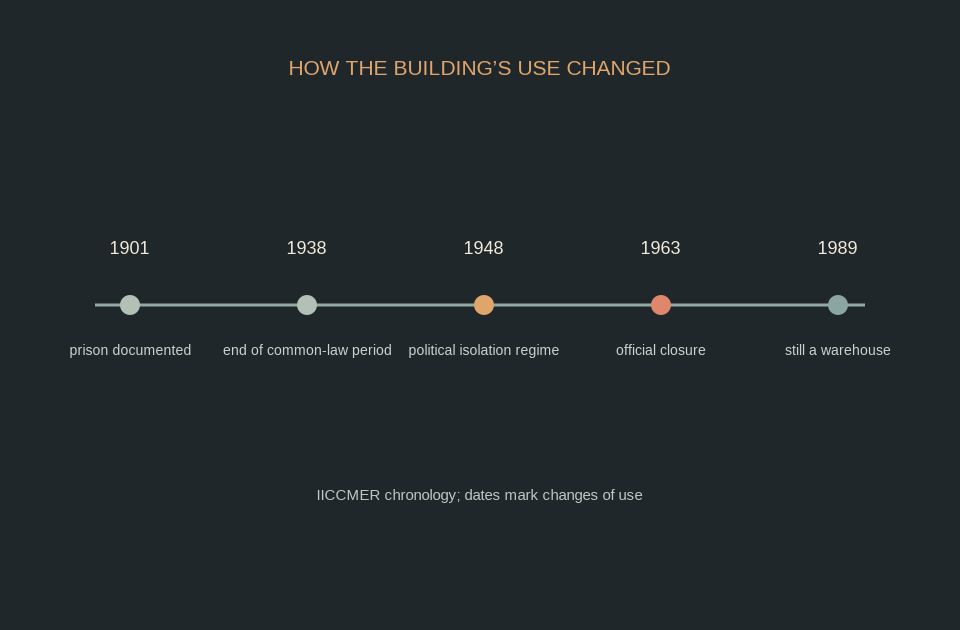
The Râmnicu Sărat prison appears in records from October 1901. Until 1938, Institute for the Investigation of Communist Crimes and the Memory of the Romanian Exile (IICCMER) says it held prisoners convicted of ordinary crimes with sentences of up to two years. The first political prisoners are recorded later, during King Carol II’s dictatorship. [1]

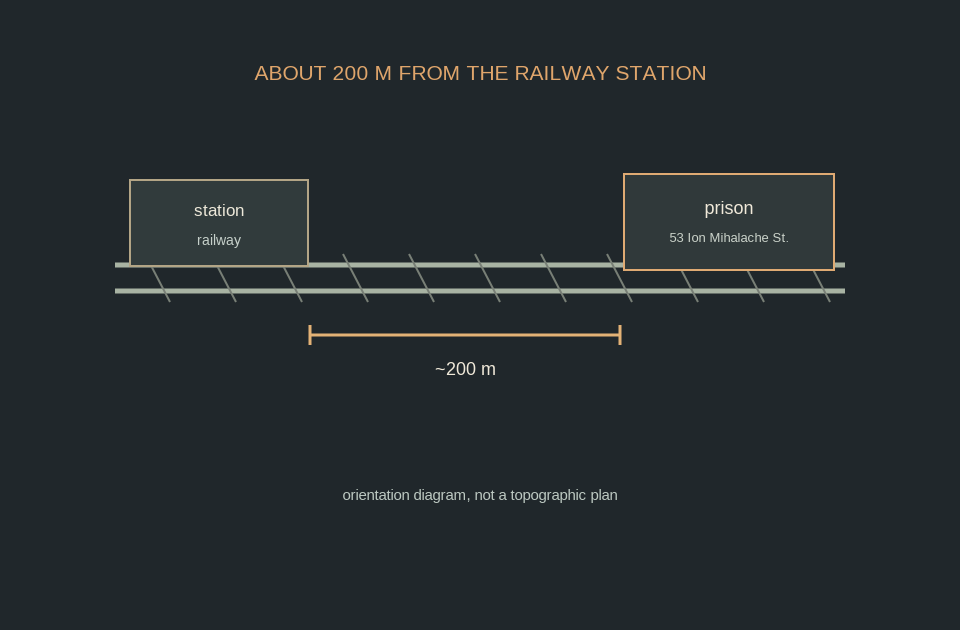
After 1948, the prison took on a distinct role in communist repression. It operated until April 1963 and was later used as a warehouse. The listed address is 53 Ion Mihalache Street, south of the town. [1] [8]
IICCMER dates the prison’s documentary attestation to October 1901.
IICCMER dates the prison’s documentary attestation to October 1901. (Source · Original drawing based on the cited records and research)
UNESCO places the prison about 200 metres from the town railway station.
UNESCO places the prison about 200 metres from the town railway station. (Source · Original drawing based on the cited records and research)

1948 · a secret regime

Isolation was written into rules and built into space

In September 1948, the authorities adopted a secret regulation for political prisoners. The Memorial’s archival section, documented with support from Romania’s National Council for the Study of the Securitate Archives, says it opened the way for isolation from family and society, hunger, inhumane living conditions and a lack of medical care. [2]

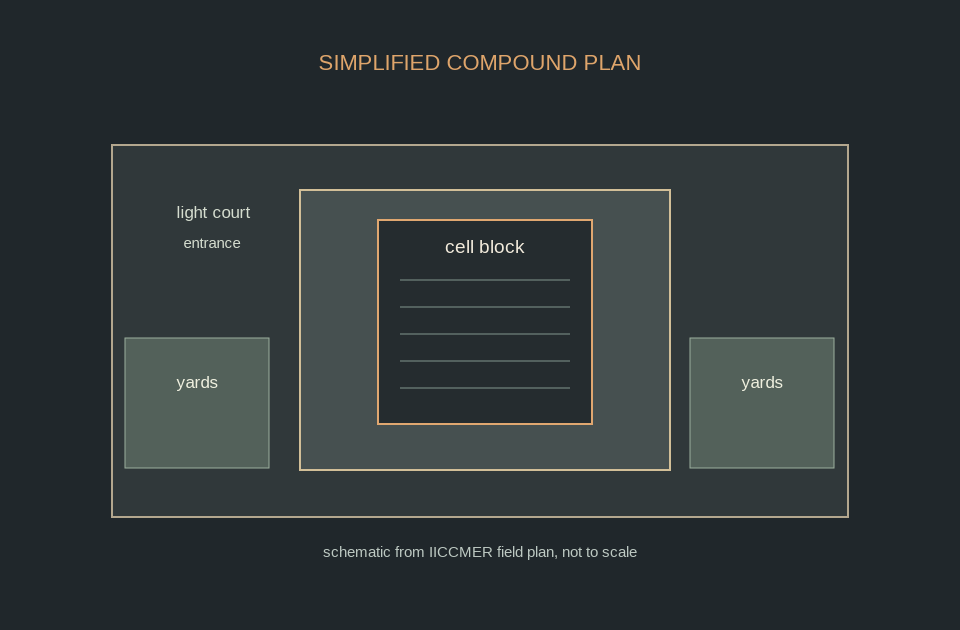
The regime operated in specific rooms: the cell block, entrance passage, light court and internal yards. In its 2021 research, IICCMER compared the layout of these spaces with survivors’ memories and archival documents. This plan simplifies the field drawing and is not to scale. [7]
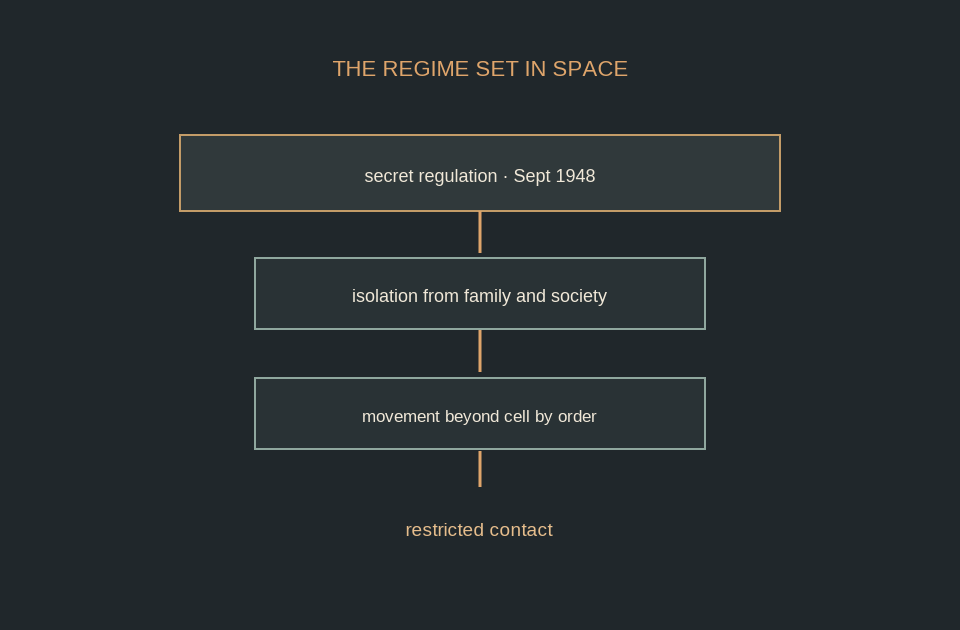
The Memorial describes the September 1948 regulation and isolation from family and society.
The Memorial describes the September 1948 regulation and isolation from family and society. (Source · Original drawing based on the cited records and research)
IICCMER’s plan distinguishes the cell block, light court, passage and internal yards.
IICCMER’s plan distinguishes the cell block, light court, passage and internal yards. (Source · Original drawing based on the cited records and research)

1955 · Ion Mihalache

A former teacher becomes prisoner no. 51

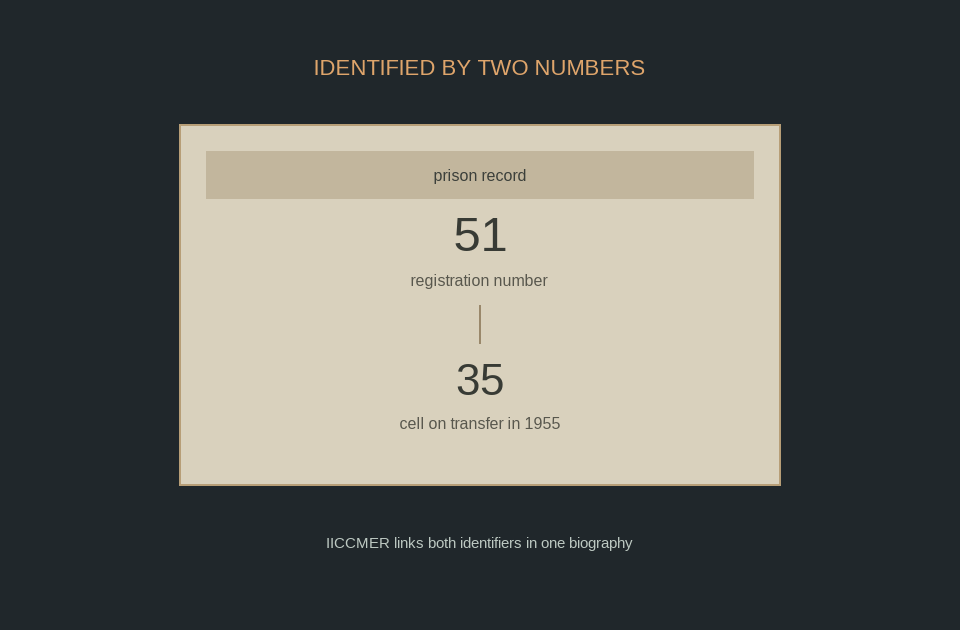
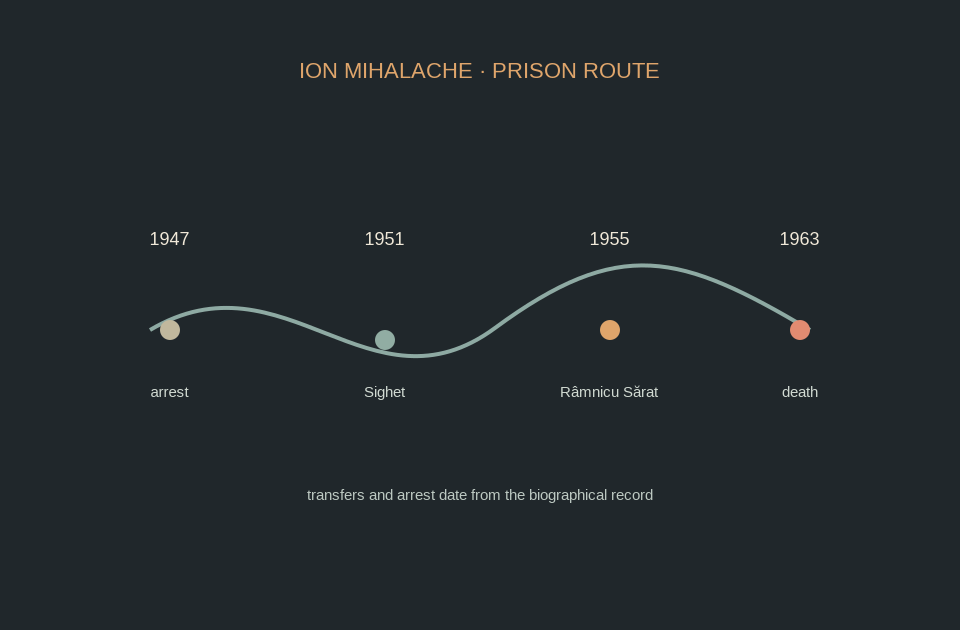
Ion Mihalache was a teacher and leader of the National Peasants’ Party. After his 1947 arrest and detention in Galați and Sighet, he was transferred to Râmnicu Sărat in 1955, aged 73. IICCMER identifies him in the prison register as no. 51 and places him in cell 35 on transfer. [6]

The number, cell and transfer dates are prison-administration markers. They let us trace his years in prison through notes and reports, even though the online selection of prisoner cards is incomplete. [3] [6]
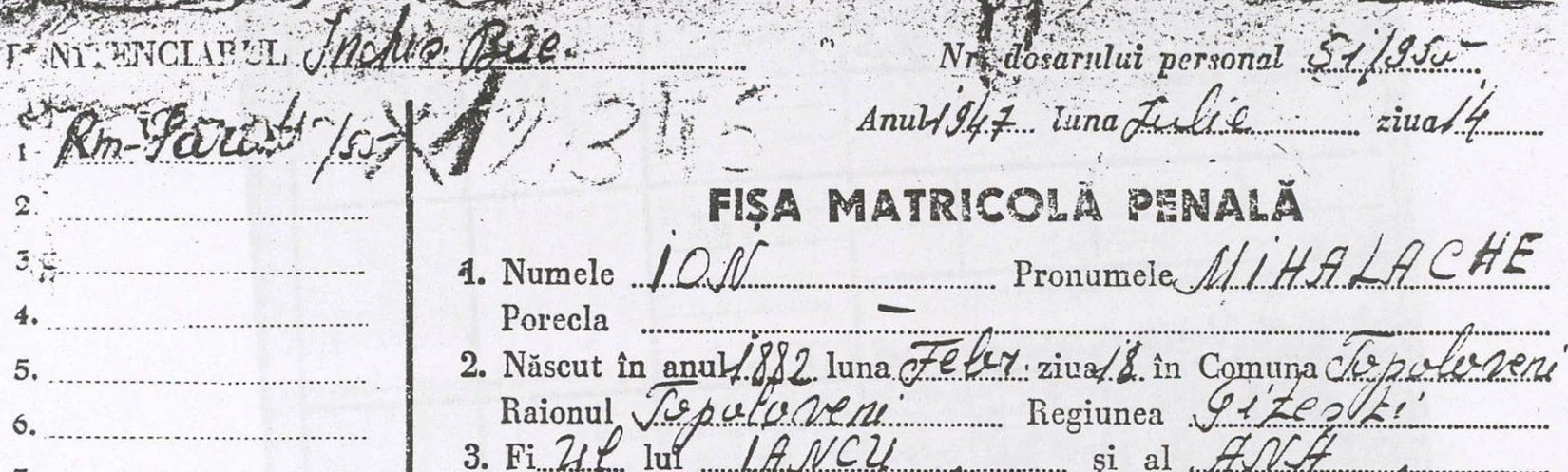
The copy published by the Sighet Memorial shows Ion Mihalache’s name, the form’s heading and annotations at top left.
The copy published by the Sighet Memorial shows Ion Mihalache’s name, the form’s heading and annotations at top left. (Source · Memorialul Victimelor Comunismului și al Rezistenței)
The Memorial biography dates his arrest to 1947 and his transfer to Râmnicu Sărat to 1955.
The Memorial biography dates his arrest to 1947 and his transfer to Râmnicu Sărat to 1955. (Source · Original drawing based on the cited records and research)
IICCMER identifies him by registration number 51 and cell 35 on his 1955 transfer.
IICCMER identifies him by registration number 51 and cell 35 on his 1955 transfer. (Source · Original drawing based on the cited records and research)

4 January 1960 · communication

The officer proposed four days in isolation

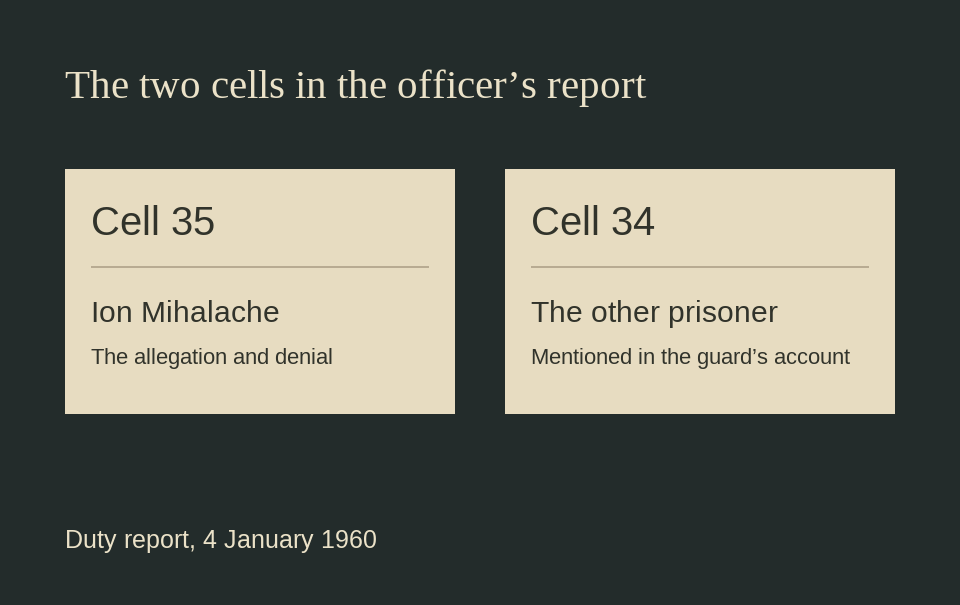
At 6:55 a.m., the duty officer recorded a guard’s account: Mihalache, prisoner no. 51 in cell 35, had allegedly tapped on a stool and tried to speak to the man in cell 34. The report says Mihalache denied tapping. It also attributes to him the remark that the authorities were mocking him because he had been convicted without an appeal. [5] [6]

The report proposed four days in isolation. It preserves one moment in a much longer routine and records a proposal, not its outcome. Here, an attempted exchange between cells appears as a routine matter that could bring a sanction. [5] [2]
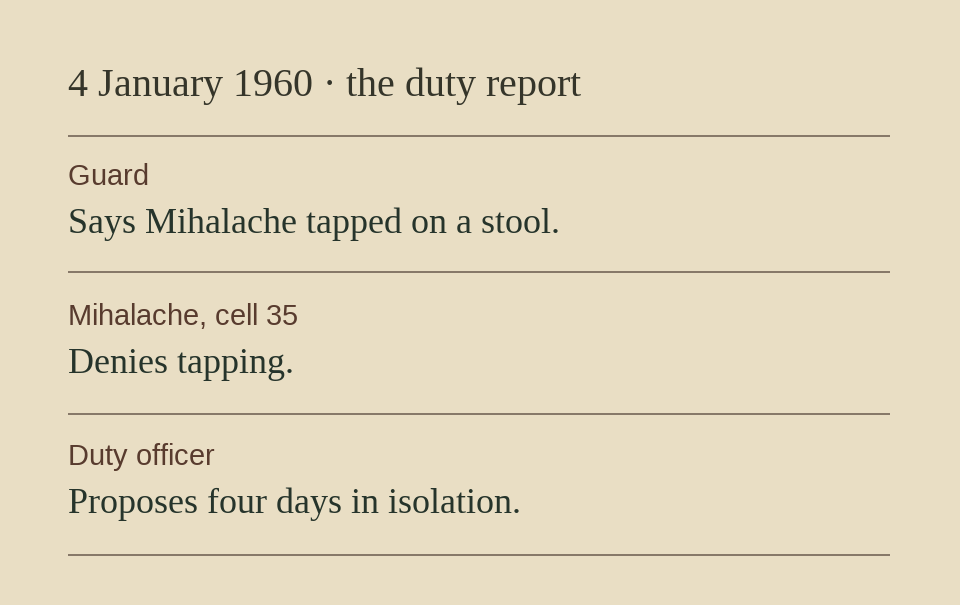
The note records the guard’s report, Mihalache’s denial and the proposal of four days in isolation.
The note records the guard’s report, Mihalache’s denial and the proposal of four days in isolation. (Source · Original drawing based on the cited records and research)
Mihalache was in cell 35. The officer noted the guard’s allegation and Mihalache’s denial. The other prisoner was in cell 34.
Mihalache was in cell 35. The officer noted the guard’s allegation and Mihalache’s denial. The other prisoner was in cell 34. (Source · Original drawing based on the cited records and research)

1962–1963 · illness and death

The records describe Mihalache’s last months

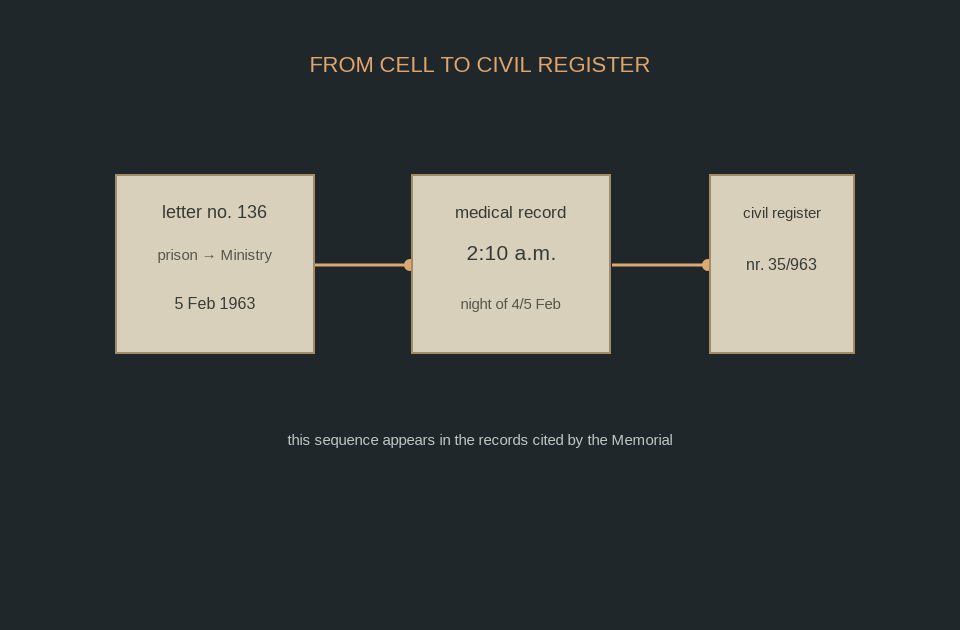
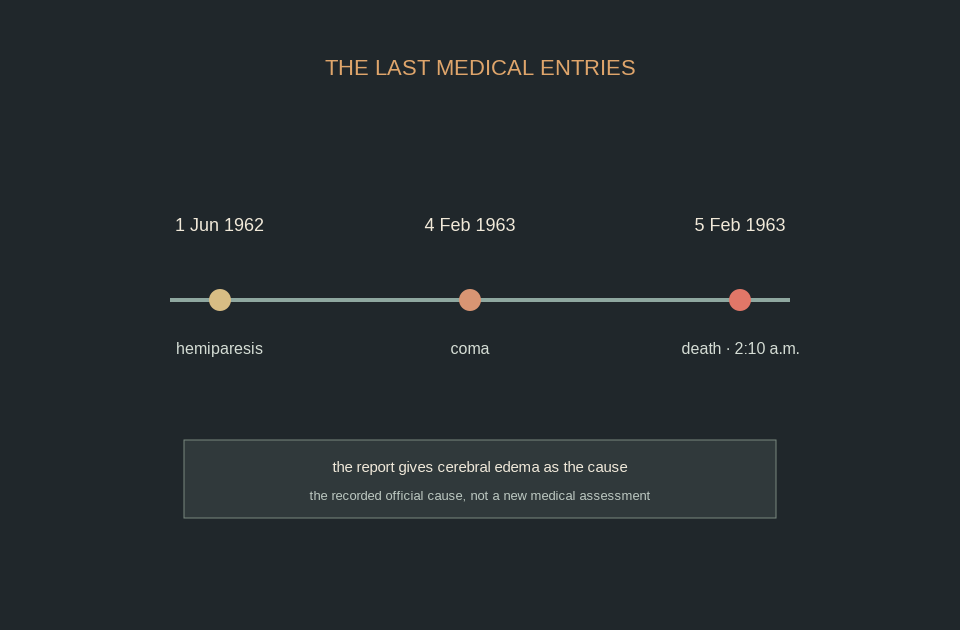
A medical report records that Mihalache had left-sided hemiparesis on 1 June 1962. On 4 February 1963 he went into a coma and died at 2:10 a.m., in the early hours of 5 February. The prison’s letter no. 136, sent that day, reported his death. [4]

The report lists cerebral circulatory failure and cerebral edema as the cause of death. The next day, the death was registered at Râmnicu Sărat’s Popular Council. These are the official records as quoted by the Memorial, not a new medical assessment. [4]
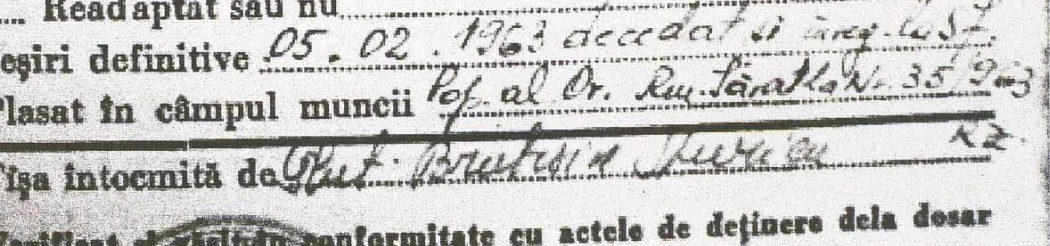
On the reverse of the prisoner card, a field records the death on 5 February 1963.
On the reverse of the prisoner card, a field records the death on 5 February 1963. (Source · Memorialul Victimelor Comunismului și al Rezistenței)
The medical report notes symptoms on 1 June 1962 and coma on 4 February 1963.
The medical report notes symptoms on 1 June 1962 and coma on 4 February 1963. (Source · Original drawing based on the cited records and research)
The prison’s letter and the entry at the Popular Council date the death to 5 February 1963.
The prison’s letter and the entry at the Popular Council date the death to 5 February 1963. (Source · Original drawing based on the cited records and research)

2021 · archaeological research

The building keeps traces the files do not describe

In 2021, IICCMER, the National History Museum of Romania and the Vasile Pârvan Institute of Archaeology documented the building as a material archive. They photographed and described alterations, changes and traces in the cell block, yards, passage and cellar. [7]

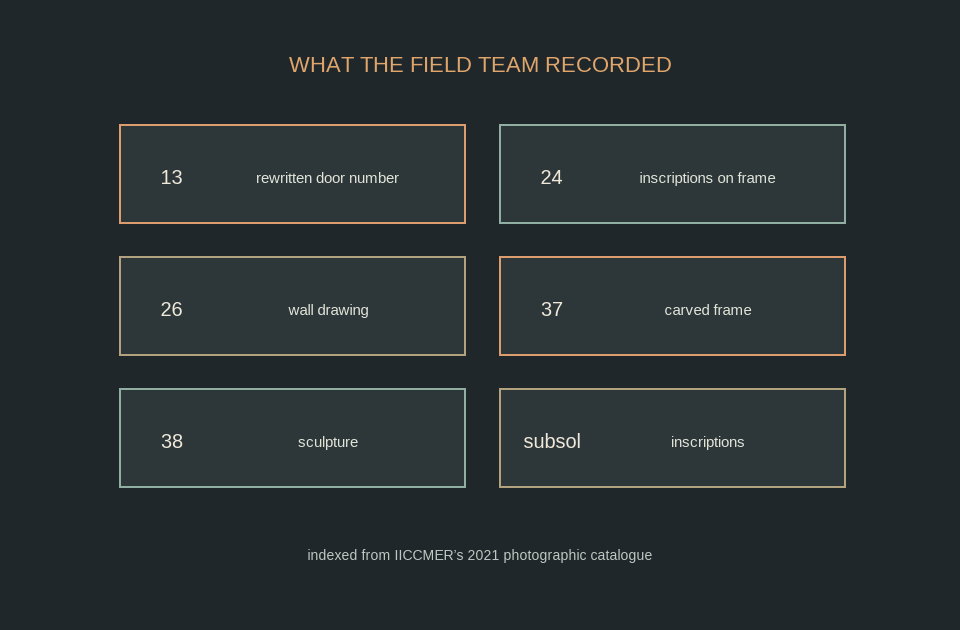
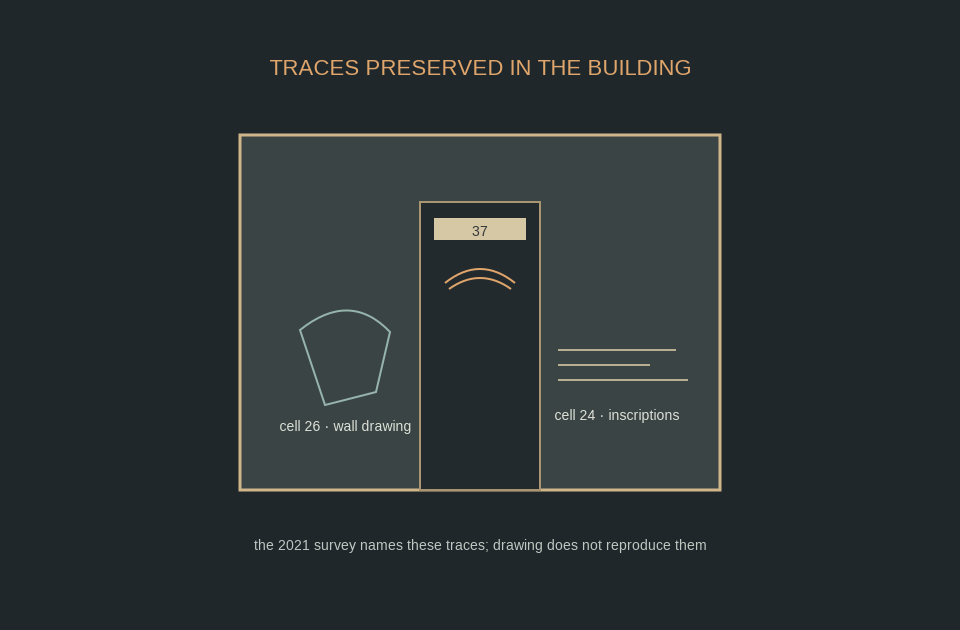
The catalogue names, among other things, the rewritten number on cell 13’s door, the carved frame of cell 37, a sculpture in cell 38, a drawing in cell 26 and inscriptions in cell 24 and the cellar. The traces do not identify their makers by themselves; the published prison cards are incomplete too, because some were destroyed or have not yet been found. [7] [3]
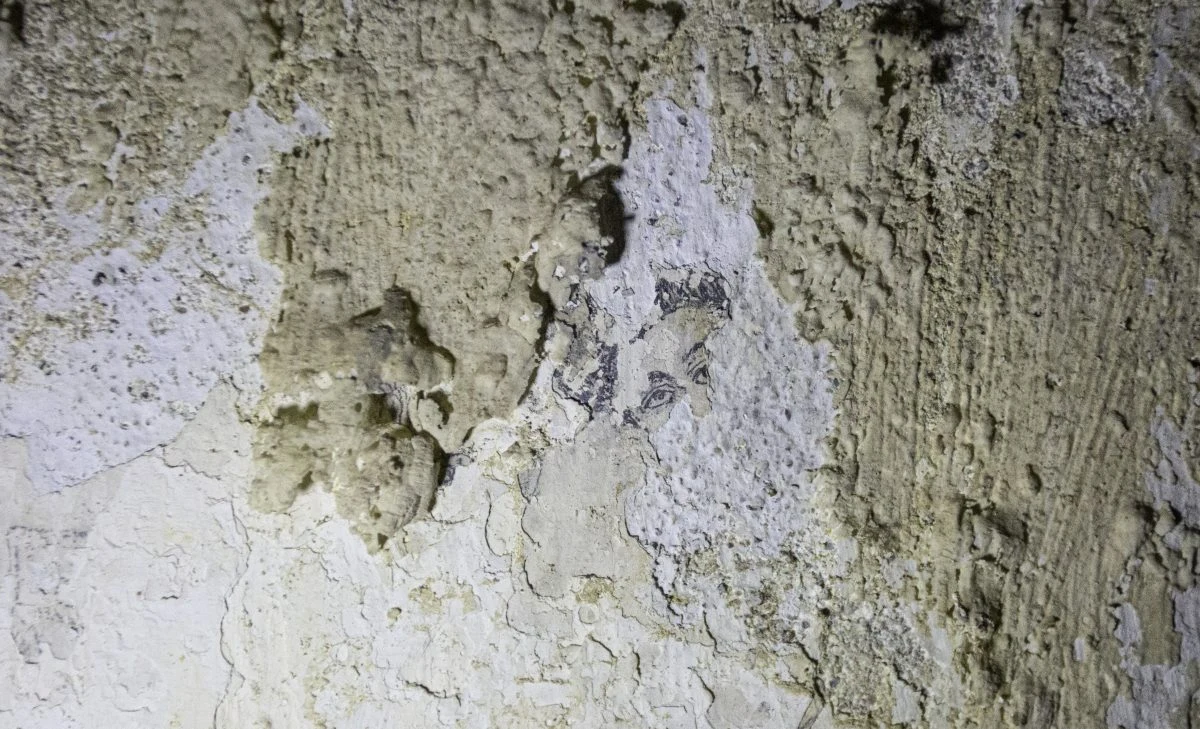
A drawing on the wall of cell 26, photographed during the 2021 survey. The report publishes the trace without identifying its maker.
A drawing on the wall of cell 26, photographed during the 2021 survey. The report publishes the trace without identifying its maker. (Source · Echipa cercetării / Survey team, IICCMER, 2021, fig. 19)
The 2021 catalogue locates inscriptions, drawings and carvings; the drawing marks documented places without copying the traces.
The 2021 catalogue locates inscriptions, drawings and carvings; the drawing marks documented places without copying the traces. (Source · Original drawing based on the cited records and research)
IICCMER’s photographic catalogue lists six traces preserved on doors, walls and in the cellar.
IICCMER’s photographic catalogue lists six traces preserved on doors, walls and in the cellar. (Source · Original drawing based on the cited records and research)

Sources

Râmnicu Sărat became a site of political isolation from 1948 to 1963. A report about an attempt to speak and the records from Ion Mihalache’s final months show how rules shaped an individual life. In 2021, research on the building added what its walls, doors and frames still preserve to the documentary record.

  1. Institute for the Investigation of Communist Crimes and the Memory of the Romanian Exile, “Report on the Rehabilitation of the Former Râmnicu Sărat Prison”, 2016Institutional chronology: recorded in October 1901, used for common-law prisoners until 1938, closed in April 1963, later used as a warehouse.
  2. Râmnicu Sărat Prison Memorial, archive documentsThe section, documented with support from Romania’s National Council for the Study of the Securitate Archives, explains the secret September 1948 regulation and reproduces reports, instructions and testimony about prisoners’ isolation.
  3. Râmnicu Sărat Prison Memorial, prisoner registration cardsA selection of official records from the National Prison Administration and National Archives; the list is incomplete because some cards were destroyed or have not been identified.
  4. Memorial of the Victims of Communism and of the Resistance, documents on Ion MihalacheThe article reproduces letter no. 136 of 5 February 1963 and the medical report recording Mihalache’s condition and death at 2:10 a.m.
  5. Memorial of the Victims of Communism and of the Resistance, report of 4 January 1960The article reproduces the duty officer’s report about prisoner no. 51 in cell 35, whom IICCMER identifies as Ion Mihalache. The guard reported tapping on a stool; the report says the prisoner denied it.
  6. Institute for the Investigation of Communist Crimes and the Memory of the Romanian Exile, “The death of Ion Mihalache (1882–1963)”, archival records and testimonyThe biographical account identifies Mihalache by prison number 51 and cell 35 in 1955, then cites sanctions, reports and testimony from later years.
  7. Institute for the Investigation of Communist Crimes and the Memory of the Romanian Exile, “Archaeological research at the former prison”, 2021The campaign documents the compound plan, changes to the buildings and surviving marks on doors, frames, walls and in the cellar, relating them to archives and former prisoners’ memories.
  8. UNESCO, “Former Communist Prisons in Romania”, Tentative ListIdentifies the Râmnicu Sărat compound south of the town and publishes the site coordinates.