
To scale, no perspective
Barcelona · Sagrada Família, 1882–2026
The Sagrada Família and Montjuïc: which stands higher above the sea
The Tower of Jesus Christ, finished in February 2026, is 172.5 metres tall. The basilica says Gaudí wanted it “a little below” Montjuïc, out of respect for the work of creation. Here the hill and the basilica stand side by side, at one scale, measured from sea level.
Scroll: the basilica settles onto its own ground.
The rule, in the basilica’s words#
By the proportions Gaudí worked with, the tower would have been expected to reach 180 metres, twice the greatest height inside. The foundation that builds the basilica, the Junta Constructora, explains why it stops at 172.5: Gaudí “looked at the height of the mountain of Montjuïc, which shapes Barcelona’s skyline, and out of humility and respect for the work of creation, for nature, wanted to stay a little below it, one module of 7.5 m less”.
The architect who directs the works today, Jordi Faulí, said it again on 10 June 2026, the day Pope Leo XIV blessed the tower: Gaudí did not want the basilica to be taller than Montjuïc, since he held that the work of man could not surpass the work of God. The basilica cites no text written by Gaudí for the rule. Catalan News traces it to notes written in 1914 by the secretary of the Junta Constructora.
Two heights measured from different places#
The tower’s 172.5 metres are measured from the temple floor. Press reports put Montjuïc at 173–177 metres, usually as an altitude above sea level. None of the articles says which point or which survey it uses. For now, the drawing places the basilica’s floor at sea level, as in the usual comparison.
On the terrain model of the Cartographic and Geological Institute of Catalonia (ICGC), Montjuïc’s highest ground, inside the castle grounds, is 185.5 metres above the sea. With the basilica’s floor set at sea level, the cross stays below it.
The basilica does not stand by the sea#
The Eixample climbs gently from the sea towards the mountains. ENAIRE, which runs air navigation in Spain, keeps a register of tall structures for pilots. It has listed the finished tower since June 2024, before it was built: its base, the temple floor, at 35 metres above the sea, the top of the cross at 207.6 metres. On the ICGC terrain model, the streets around the basilica lie between 30 and 35 metres.
On the same ruler, the top of the cross clears Montjuïc’s highest ground by 20–22 metres, depending on which ground elevations the calculation uses. Above the hill’s line rise the whole 17-metre cross and the last 3–5 metres of the tower.
Both statements are true#
Each measured from its own base, the tower stays below the hill: 172.5 metres above the temple floor against 185.5 above the sea, where Montjuïc begins. On one scale from sea level, the cross is higher. The basilica uses the first measure. The register for pilots records both, and a pilot needs the second.
The drawing shows the view from far out at sea along the line joining the hilltop and the tower, without perspective. Only the cross and the top of the tower rise above the hill.
Seen from the sea, the hill looks higher#
To scale and without perspective, as in an architect’s elevation, the cross clears the hill. The eye sees differently: what is near looks bigger. The hill and the tower are 4.5 km apart, so from out at sea, on the line that joins them, Montjuïc hides the basilica from any distance, even allowing for the curve of the Earth.
And on the hill something reaches higher than the cross: an antenna beside the castle, whose top ENAIRE’s register puts at 217 metres above the sea, about 10 metres above the top of the cross.
1925: the first tower#
The first stone was laid on 19 March 1882, and Gaudí took over the project in 1883. The bell tower of St Barnabas, finished in 1925, is the only tower he saw completed: Gaudí died in 1926. The other three towers of the Nativity façade were finished in 1930.
1976: the Passion façade#
In 1936, during the Civil War, the basilica was vandalised, and Gaudí’s plans, photographs and plaster models were destroyed. Work resumed in 1939 with what could be saved and rebuilt. Work on the foundations of the Passion façade began in 1954, and its four bell towers were finished in 1976.
The basilica had four towers for 46 years, then eight for another 45.
2010: the basilica is roofed#
From 1986 the foundations, columns and vaults of the nave, transept, crossing and apse were built. The work ended in 2010, and on 7 November Pope Benedict XVI dedicated the basilica. None of the central towers yet rose above the roof.
The central towers reach the hill’s line#
The six central towers were begun in 2016. Mary’s tower, 138 metres tall, received its star in November 2021, and the towers of the four Evangelists, 135 metres each, were finished in 2022 and 2023. On 4 December 2024 the Tower of Jesus Christ stood 142.5 metres tall: its top was still below Montjuïc’s highest ground.
Work on the 29-metre top section began in May 2025, and by 31 July 2025 the tower had reached 155.58 metres, about 190 metres above the sea, above the hill’s 185.5 m. It crossed Montjuïc’s line between May and 31 July 2025. No public record gives the day.
20 February 2026: the cross#
The lower arm of the cross was set in place on 27 October 2025 and the upper arm on 20 February 2026. Since then the tower has stood 172.5 metres tall, and the basilica has 14 of its 18 planned towers. On 10 June 2026, a hundred years after Gaudí’s death, the tower was blessed and the lighting of the cross was switched on.
The Sagrada Família in your family’s birth years#
Enter the birth years of up to four people in your family and see how much of the basilica stood when each of them was born. Each drawing shows it at the end of that year, at the same scale, with Montjuïc’s line.
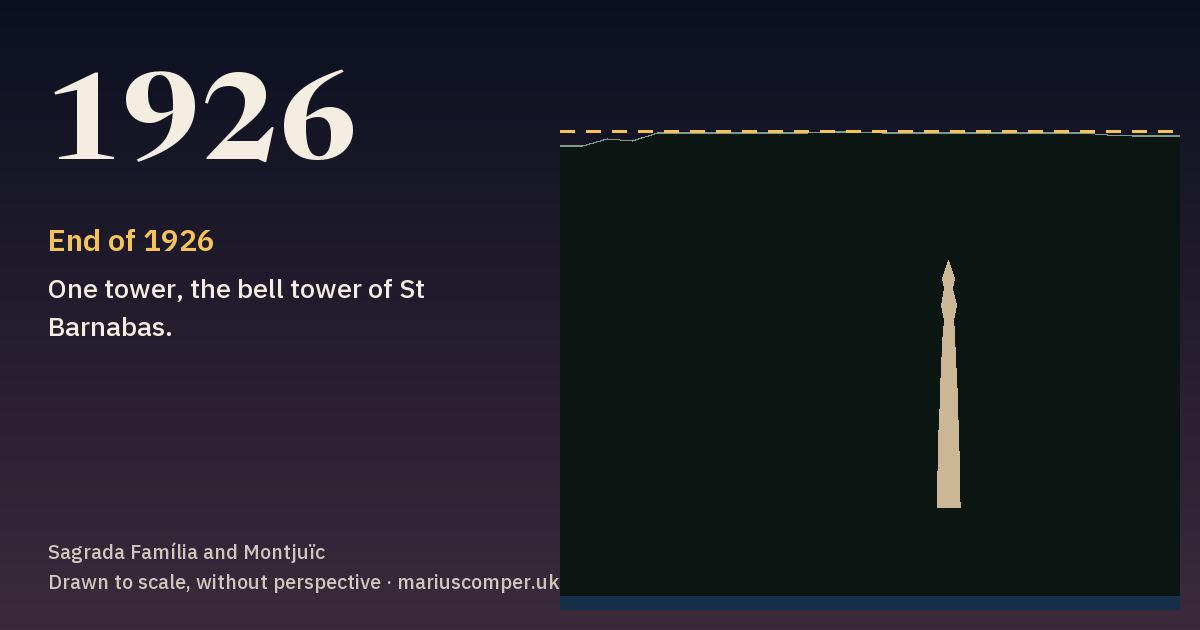
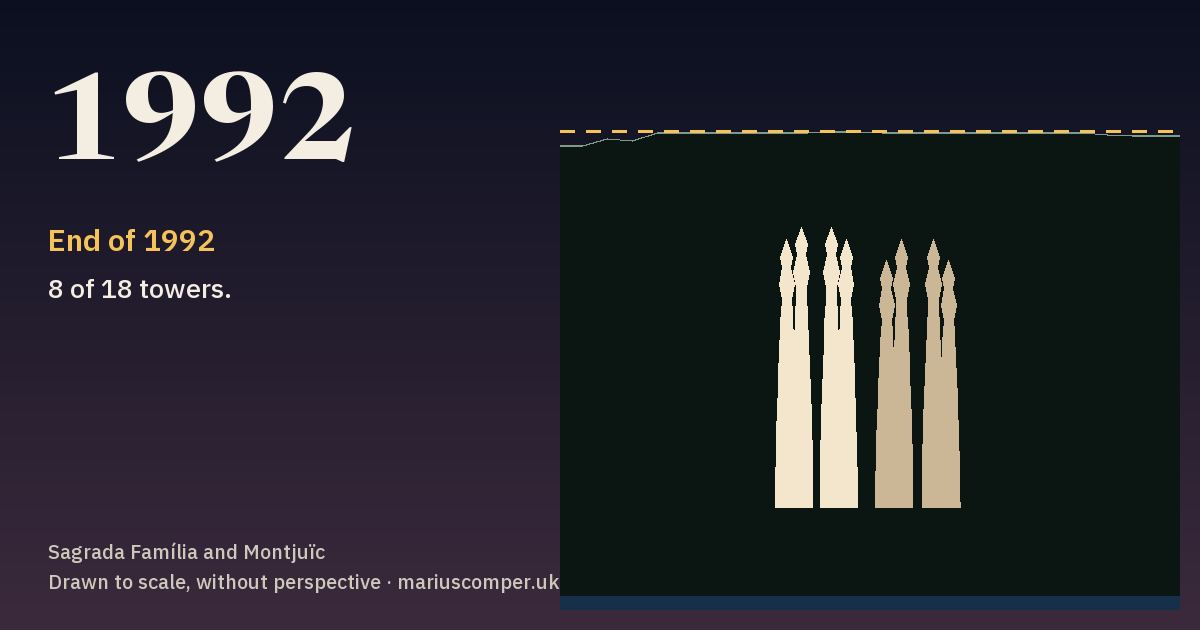
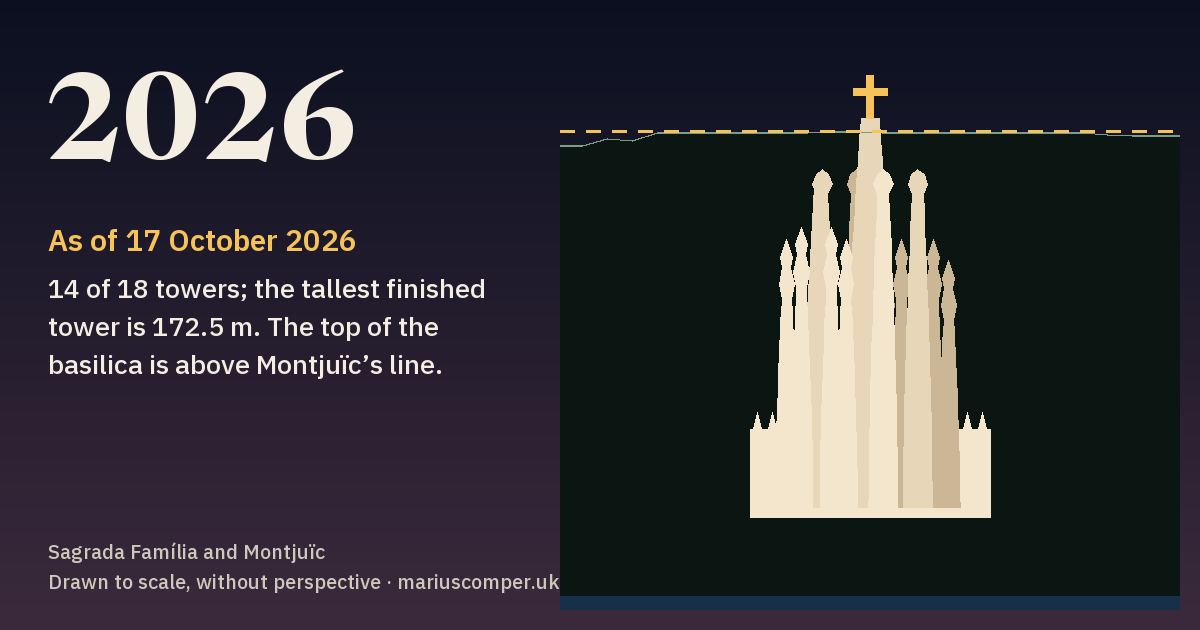
14 of 18 towers; the tallest finished tower is 172.5 m. The top of the basilica is above Montjuïc’s line.
What is left to build#
Still missing are the four bell towers of the Glory façade, the main entrance, dedicated to the apostles Andrew, Peter, Paul and James the Greater. ENAIRE’s register already lists them, at 107.5 and 120 metres; with their bases at temple-floor level, 35 metres above sea level, their tops would reach at most 155 metres above the sea, well below Montjuïc’s line.
The basilica announces work inside the Tower of Jesus Christ in 2027 and 2028 and gives no date for the Glory façade. Its plan, with a monumental staircase and a park, would mean demolishing two residential blocks; no dates have been announced.
Where the numbers come from#
The hill comes from the ICGC terrain model with 5-metre cells, downloaded on 17 October 2026. The model removes buildings, so 185.5 m is the highest ground inside the castle grounds, terraces included. ENAIRE’s register gives a “natural high point” of 190.8 m at the castle, but such points sit on average about 7 m above the terrain, so the drawing uses the ICGC model. The tower’s data come from ENAIRE’s obstacle register (record J01, listed since June 2024): 172.46 m tall, 207.6 m above the sea.
The two sources agree on sea level to within about a metre: for 319 trees around Barcelona, the median difference between the ground elevations given by ENAIRE and by the ICGC is −0.6 m. Hence the range of 20–22 m: 22 m with the top as ENAIRE registers it, 20 m if the tower’s base is taken from the ICGC terrain beneath it (32.7 m) in place of the temple floor at 35 m above sea level.
The drawing looks along the 4.5 km line from Montjuïc’s top to the tower, without perspective. The hill’s outline is the highest ground in each 10 m strip. The towers have simplified outlines at the heights the basilica publishes; for the eight bell towers already built, heights come from OpenStreetMap, brought within the basilica’s range of 98.5–120 m (two 98 m values are drawn at 98.5 m), and the Evangelists’ towers are placed schematically at the corners of the crossing. Each year shows the basilica on 31 December; a tower under construction appears at its latest documented height.
Sources#
- Junta Constructora: rules of the competition marking the completion of the Tower of Jesus Christ (the Montjuïc rule, p. 4) sagradafamilia.org
- Basílica de la Sagrada Família: “Una creu que arriba al cel de Barcelona”, 20 February 2026 (the tower’s heights and dates) sagradafamilia.org
- Basílica de la Sagrada Família: history of the temple, 1882–2026 (including the Tower of Jesus Christ at 125.85 m in 2022) sagradafamilia.org
- Junta Constructora: Quadern 10, “Campanars, cimboris i sagristies” (2026): tower heights, measured from the temple floor sagradafamilia.org
- ENAIRE, AIP Spain: obstacle datasets (LEBL aerodrome, amendment 07/2026; area 1, amendment 09/2026) aip.enaire.es
- ICGC: 5 m digital terrain model (WCS service) icgc.cat
- aldia.cat / Europa Press: Jordi Faulí on Gaudí and Montjuïc, 10 June 2026 aldia.cat
- Catalan News, 19 September 2024: Montjuïc at 173 m catalannews.com
- Catalan News, 31 July 2025: 155.58 m; Montjuïc at 177 m above sea level; the 1914 notes catalannews.com
- The Art Newspaper, 4 June 2026: the Glory façade and the blocks it would require demolishing theartnewspaper.com
- OpenStreetMap: tower positions (building:part) openstreetmap.org