LONDON · SANDWICH · CARDIGAN
Build the sandwich. Find the cardigan.
One half you can taste, one you can only debunk: the sandwich stands on record from a 1762 club diary to a printed 1777 recipe — though no source names its inventor — while the cardigan carries the Earl’s name though no contemporary source puts one on him.
Two staged scenes, a century apart. Build the sandwich from Mason’s recipe — every layer a dated primary — kit the Earl out for Balaclava from six sourced items, and search the record for the cardigan: the seventh slot stays empty.
The gaming table, 1762–1772
Supper at the Cocoa Tree, 24 November 1762: Edward Gibbon notes gentlemen supping “upon a bit of cold meat, or a Sandwich” — the word already generic, with no inventor present to explain it. A decade later Grosley prints the gaming-table story: a minister of state, four and twenty hours, a bit of beef between toasted bread. He never names Sandwich. The legend cannot be the whole story, because the diary predates his residence.
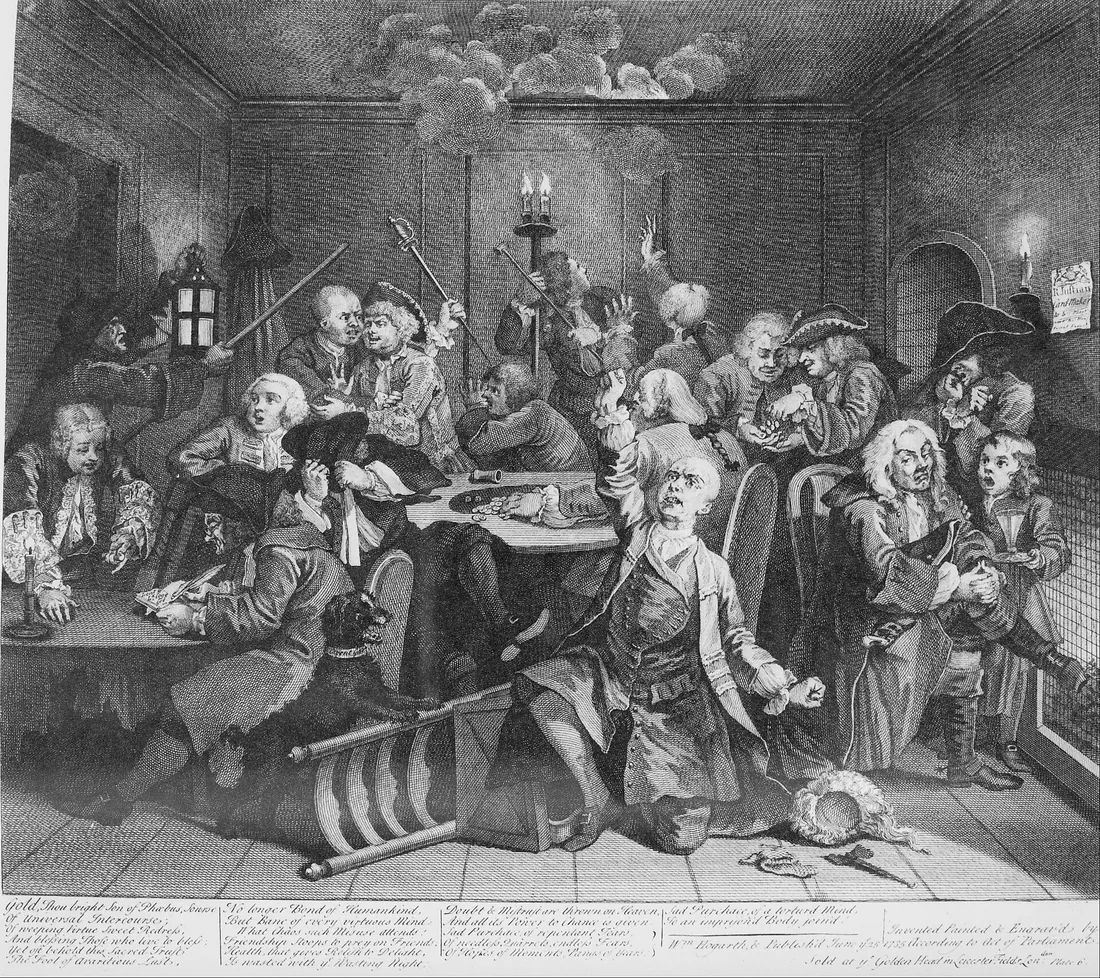
Figure receipt
1735 · William Hogarth · Public domain
The kitchen: build it by the book, 1777
By 1777 the dish is in print under the headword “Sandwichs”, with no e: Mason’s Lady’s Assistant sets beef between bread and butter and cuts the ends off neatly — veal and ham allowed in the same manner. Build it layer by layer; the book refuses whatever it does not name.
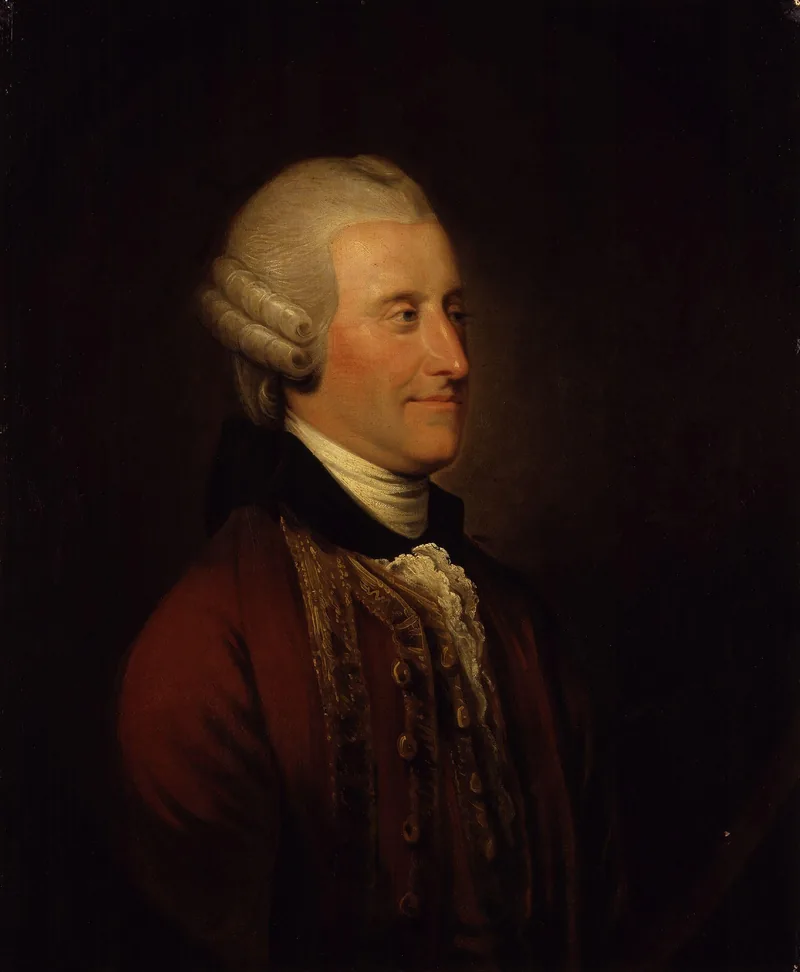
Figure receipt
c.1764 · Johan Zoffany · Public domain
Lay the four layers
Pick each layer. Mason’s 1777 wording decides; the book refuses the rest.
Kit the Earl for Balaclava, 1854
Balaclava, 25 October 1854. Kit the Earl out from the record: six items, each with its source line — cloak, jacket and sash, winter issue, undress rig, pelisse, full dress. Then check the seventh slot, the knitted waistcoat. The audit counts what the sources name; the last slot stays empty.
Check the seven slots
Inspect each kit item for its source line. The seventh slot is the cardigan: search it last.
The inspector calls for:
The proof rails, 1762–1987
Two rails. Four dated sources carry “sandwich” from club supper to canteen joke. Four dated claims carry “cardigan” from dictionary datings to a knitting historian’s verdict: nobody recorded it. The performed lines first, then the paper trails.
The performed set
The eleven lines the table gives you to perform: four layers, six kit items, one searched absence. The game buttons carry the same lines.
PUT the beef between thin slices of bread and butter
Mason · 1777
PUT some very thin slices of beef
Mason · 1777
cap it with thin slices of bread and butter
Mason · 1777
finish: cut the ends off neatly
Mason · 1777
Officer’s cloak — Cardigan banned cloaks on patrol as “effeminate” — Devna camp, June 1854. Woven wool, not knit.
Duberly · 1855
Hussar jacket and sash — Auctioned off the Charge dead on 31 October 1854: a new set went for thirty-six shillings. Braid, not knit.
Calthorpe · 1856
Winter issue: fur cap, pea-jacket, cloak — Ordered in mid-November 1854 — after the Charge. Fur, lined cloth, leather; the list names no knitwear.
ILN · 1854
Undress rig: frock-coat, forage-cap, boots — Calthorpe’s own June 1854 rig; a dead officer’s forage-cap fetched five guineas at Duberly’s November auction. Cloth and leather.
Calthorpe 1856 · Duberly 1855
Pelisse — The regiment’s warm over-jacket — left aboard the transports until November. Not at Balaclava on 25 October.
NAM · object 1967-06-32-1
Full hussar dress, Fenton 1855 — Wilkin of the 11th, photographed in spring 1855: busby, braided jacket, sash, sabretache, striped overalls. Tailored kit — and the sitter is not Cardigan. The garment names are later descriptions, not 1855 words.
Fenton photo 1855 · names later
The knitted waistcoat — Searched across Duberly, Calthorpe, Russell, Punch, the winter-clothing list, and Fenton’s captions. Found: nothing. Nobody recorded it.
Verified negative · 1855–1987
The sandwich rail
Four dated sources, 1762–1792: the word already generic, the unnamed minister, the printed recipe, the canteen joke.
supping at little tables… upon a bit of cold meat, or a Sandwich, and drinking a glass of punch
Edward Gibbon, Journal, 24 November 1762 — manuscript, first printed 1796 source
A minister of state passed four and twenty hours at a public gaming-table… he had no subsistence but a bit of beef, between two slices of toasted bread… it was called by the name of the minister, who invented it.
Pierre-Jean Grosley, A Tour to London, Englished by Thomas Nugent, 1772, vol. I, p. 149 — visit 1765, French Londres 1770 source
PUT some very thin slices of beef, between thin slices of bread and butter; cut the ends off neatly, lay them in a dish.
Charlotte Mason, The Lady’s Assistant, 1777, p. 427 — headword “Sandwichs”; the 1773 edition is claimed, unverified source
Two small slices of bread and butter… with a thin piece of stale ham, or beef, between them… Bellamy charges a shilling for them, and they do not stand him in above two pence.
Joseph Pearson, Pearson’s Political Dictionary, 1792, p. 81 source
The cardigan rail
Four dated claims, 1856–1987: two dictionary datings, one mid-century tradition, one historian’s verdict.
First Known Use: 1856, in the meaning defined above
Merriam-Webster, cardigan, 1856 — etymology: James Thomas Brudenell, 7th Earl of Cardigan; citation text not shown source
[1865–70; named after J. T. Brudnell (sic), 7th Earl of Cardigan (1797–1868), British cavalryman of Crimean War fame]
Collins/Random House, cardigan — in mild tension with 1856; the spread is reported open source
The garment appears to have been first worn by our men in the bitter cold of the Crimean winter.
Brewer’s Dictionary of Phrase and Fable — verified only in 1950s editions; the 1870 presence is unverified source
There is no evidence that he wore such a garment during the three short months he spent in the Crimea… if he had one in the Crimea, nobody recorded it.
Richard Rutt, A History of Hand Knitting, 1987, p. 135 — quoted secondhand source
Tomorrow at noon
Order or wear something named for someone, and ask what the record actually says about them. Then come back and read the rails again — the names sound different once you have built one and failed to find the other.
Four layers, seven kit — every line dated on the proof rails.
Both halves, in brief
The same table without the handling. Gibbon’s diary of 24 November 1762 already says “a Sandwich” at the Cocoa Tree; Grosley’s 1772 English account describes an unnamed minister of state at a public gaming-table, four and twenty hours, a bit of beef between two slices of toasted bread. Mason’s 1777 recipe reads: very thin slices of beef between thin slices of bread and butter, the ends cut off neatly, laid in a dish — veal and ham allowed in the same manner. Pearson’s 1792 dictionary prices Bellamy’s canteen sandwiches at a shilling, costing twopence. The six kit items are Cardigan’s banned cloak, the braided jacket and sash auctioned off the Charge dead, the winter issue ordered too late, Calthorpe’s undress rig, the pelisse left aboard, and Wilkin’s photographed full dress of 1855 — none of them knitwear. The seventh slot, the knitted waistcoat, is searched across Duberly, Calthorpe, Russell, Punch, the winter-clothing list, and Fenton’s captions, and found nowhere: nobody recorded it.
The earls
Two lords, two afterlives
Each beat dated, each portrait captioned for what it shows and when. The prints fix the men; the rails carry the words.
The naval lord
John Montagu, fourth Earl of Sandwich, 1718–1792: First Lord of the Admiralty in 1748–51, 1763, and 1771–82. His 1763 prosecution of Wilkes made him notorious. Cook, sailing under Admiralty orders signed “Sandwich”, named the islands he sighted in January 1778 for the Earl — published 1784. That is the certain eponym; the food word’s inventor stays unnamed in every source.
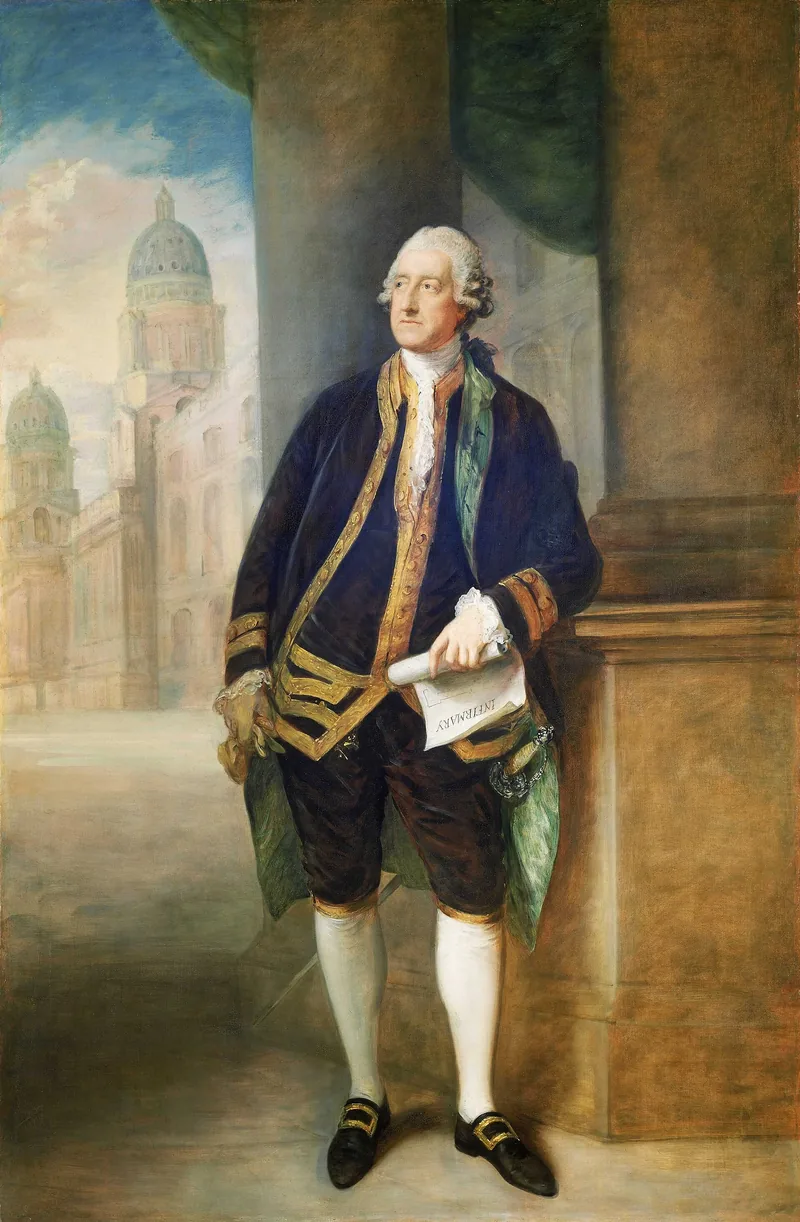
Sandwich in First Lord of the Admiralty robes, aged sixty-five, holding the infirmary plan: the naval lord Cook honoured with the Sandwich Islands. Gainsborough, 1783. Figure receipt
1783 · Thomas Gainsborough · Public domain
The cavalry lord
James Thomas Brudenell, seventh Earl of Cardigan, 1797–1868: major-general of the Light Brigade, leader of the Charge on 25 October 1854. A medical board sent him home in December; he landed at Folkestone on 13 January 1855 and died at Deene on 28 March 1868. No Crimean winter attaches to his person.
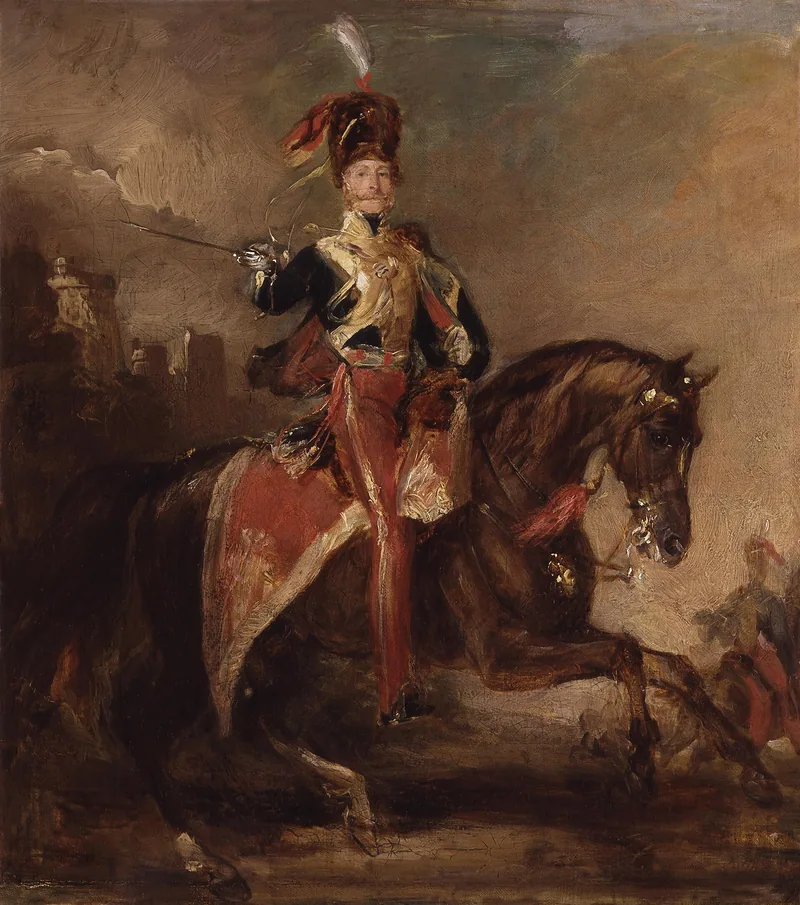
Cardigan about 1841, thirteen years before Balaclava: Grant’s sketch for the Deene Park painting. Figure receipt
c.1841 · Francis Grant · Public domain
The Charge
Britannica’s ninth edition, compiled within a decade of his death, gives the brigade as “numbering 600 men” and leaves half the men and horses dead on the field. Tennyson, in the Examiner of 9 December 1854, gave the contemporary verdict: “Someone had blundered.” The same entry never once names a garment.
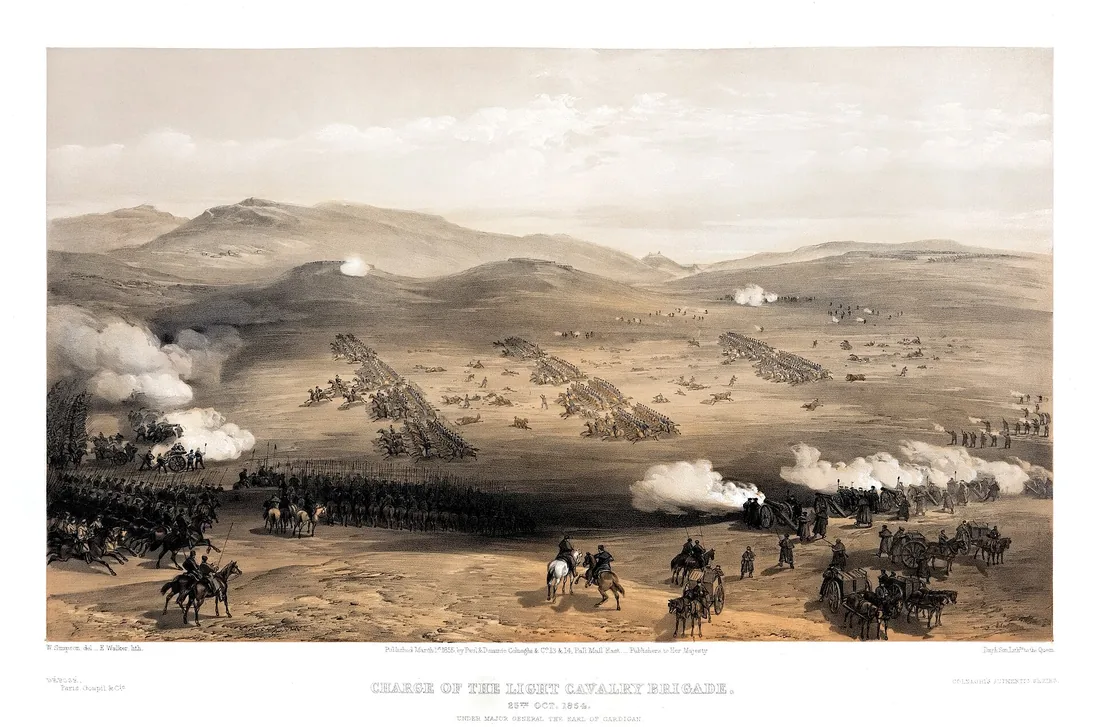
The Charge as published 1 March 1855: Cardigan leads, identified in the plate’s key. Simpson and Walker. Figure receipt
1855 · Simpson/Walker · Public domain
The kit that was there
What the sources name: a banned cloak, a braided jacket auctioned off the dead, a winter issue ordered too late, an undress rig, an absent pelisse, and Wilkin’s photographed full dress — spring 1855, not Charge dress, and the garment names are later. Six items, none of them knitwear.
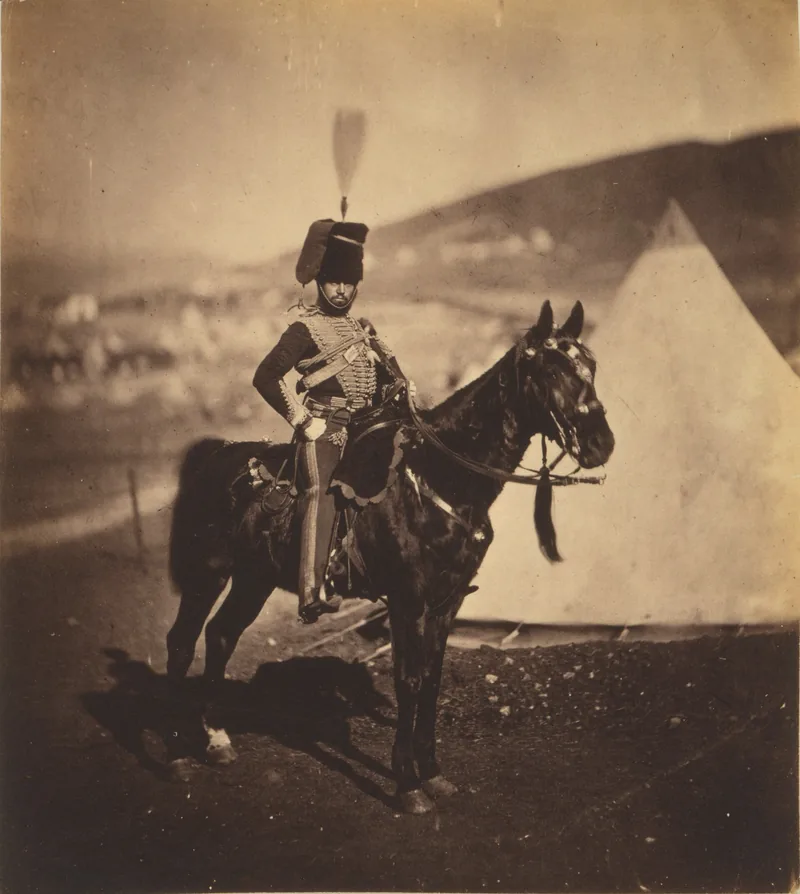
Not Cardigan: Cornet Wilkin of the 11th Hussars, Cardigan’s regiment, photographed by Fenton in the Crimea, 1855 — the hussar portrait most often confused with the Earl. Figure receipt
1855 · Roger Fenton · Public domain
The craft that was elsewhere
Knitting belonged to the home front and the comforts campaigns. The garment word is absent from Chambers’s dictionary of 1872, the women’s press, and the knitting manuals into the 1880s; the bare “cardigan” settles only in the late 1870s and 1880s. The thing followed the fame by a generation.
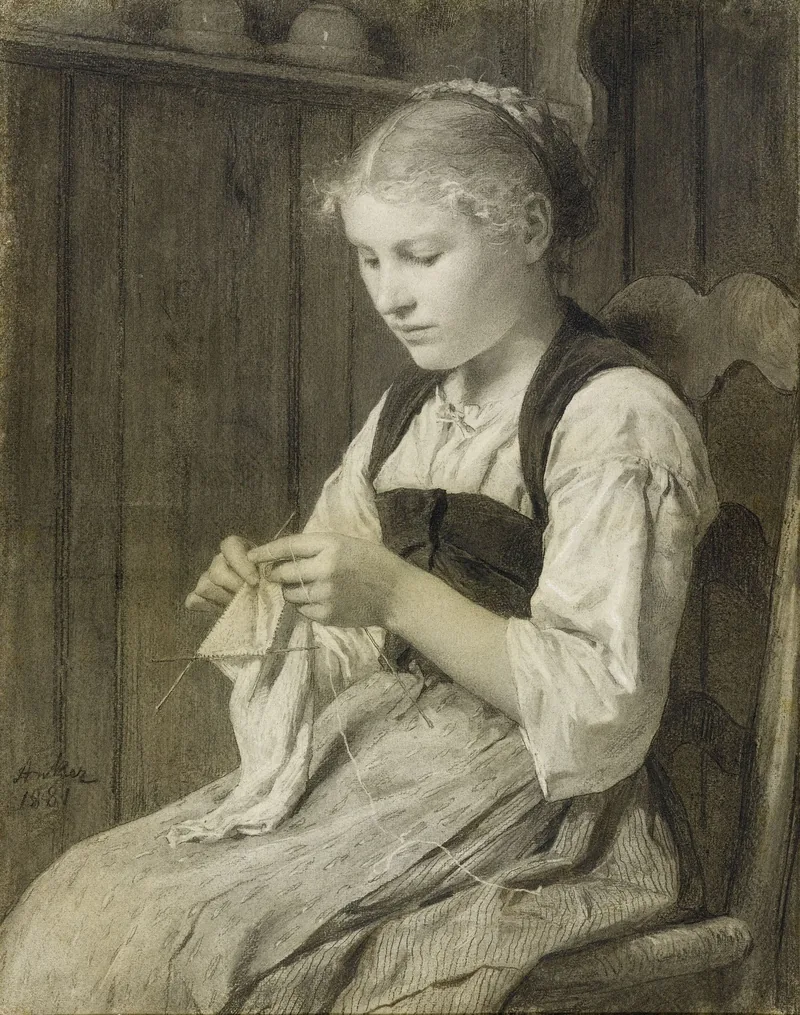
Period knitting, not an English Crimean scene: a Swiss girl knits in 1881, the decade the bare garment word finally settled. Anker. Figure receipt
1881 · Albert Anker · Public domain
The words
One chain of uses, one chain of claims
Three lines, more than two centuries apart: the generic word, the unnamed minister, the missing garment.
The sandwich rail quotes the dated chain — three uses and the legend that names no one; the cardigan rail quotes datings and a verdict. Uses prove a word lived. Datings only date the claim.
- “a Sandwich” — Edward Gibbon’s diary, 24 November 1762, first printed 1796
- “called by the name of the minister” — Grosley, Englished by Nugent, 1772
- “nobody recorded it” — Richard Rutt on Cardigan’s Crimea, 1987, as quoted secondhand
Gibbon’s diary is dated 24 November 1762 in manuscript, first printed 1796. The French Londres of 1770 was not freely verifiable; the Nugent English of 1772 is quoted. Rutt is quoted secondhand, verbatim across three independent copies. The full dated chains stand on the proof rails.
Who used them: a diarist, a French traveller, a cookery writer, a canteen satirist — then the dictionaries. Read the rails in order: one chain of uses, one chain of claims.
Sources
Receipts and method
Every performed line traces to one of these shelves. The sandwich: Grosley, Gibbon, Mason, Pearson — free full texts. The cardigan: Britannica, the Yacht Squadron history, the dictionaries’ datings, Rutt as quoted — and the absence itself, swept across memoirs, dispatches, Punch, and the winter-clothing list. The pictures: Commons, all public domain.
The sandwich
The cardigan
The kit
- Duberly, Journal Kept During the Russian War, 1855 (archive.org full text)
- Calthorpe, Letters from Head-Quarters, 1856, vol. I (archive.org full text)
- Illustrated London News, 18 November 1854 — the winter-clothing list (archive.org)
- Russell, The British Expedition to the Crimea (Gutenberg)
- National Army Museum, Cornet Wilkin portrait record
- National Army Museum, officer’s pelisse record
The pictures


Limits in the record
- Grosley never names Sandwich for the dish; the food word never prints in his Tour — the attribution is later inference.
- The 1773 Mason edition is claimed, not verified; the recipe text is verified in the 1777 edition.
- The 1856 cardigan citation text was never seen — dated, never quoted; the naming moment is unattested.
- Brewer’s “Crimean winter” sentence is verified only in 1950s editions; the 1870 presence is unverified.
- No Fenton portrait of Cardigan exists: he was home by January 1855 and Fenton arrived in March.
- Rutt is quoted secondhand; the naming-spread 1856/1865–70/1868 is reported open, never smoothed.
- “First known” rests on Gibbon 1762 plus a failed search for earlier: Glasse’s 1774/1784 cookbooks and Boswell’s Life carry no food use.
Type: Fraunces and Source Serif 4, under the SIL Open Font Licence.
Keep walking
Across town, a stall day pays in dated lines:
How did a fish market become an insult?
Short answers
Why build and audit instead of reading?
Mason’s recipe and the kit lists are short enough to perform. Building the sandwich shows a documented dish; auditing the kit shows a documented absence — six sourced items and an empty seventh slot. The rails then let you check every line against its date and source.
Did Sandwich invent the sandwich at cards?
The record does not say so. Grosley’s 1772 account names no one — only “a minister of state” — and Gibbon was already eating “a Sandwich” in 1762, three years before Grosley ever lived in London. Treat 1762 as the first known written use, not an invention.
Did Cardigan wear a cardigan at Balaclava?
No source says so. He left the Crimea in December 1854, before the worst winter; the dictionaries date the garment word to 1856 and after, but show no naming moment; Rutt’s verdict stands: nobody recorded it. The eponym is dated. The wearing is legend.
Why do the names survive?
This piece’s argument: use by other people. Clubmen ordered the dish and outfitters sold the garment long after the earls left the room. The sandwich kept its recipe; the cardigan kept only its fame.