LONDON · BILLINGSGATE · SPEECH
How did a fish market become an insult?
For over two centuries, writers used “Billingsgate” to mean foul speech — from a physician’s “Billingsgate-Rhetorick” in 1652 to Grose’s flat dictionary definition in 1811. The record shows the usage everywhere and the beginning nowhere.
Take a stall across two staged readings, a century and a half apart. Hurl verbatim retorts in the 1703 cellar, shout Mayhew’s priced London cries — every line a dated primary — and compare what you performed with two centuries of the word’s uses on the proof rail.
Land at Billingsgate, 1699
Every day but Sunday, the Act says, this foreshore is a free and open market for all sorts of fish — and any person may buy or sell without disturbance. Pick your vessel: the Act’s toll table names your price for one day ashore, to the penny. Take toll outside the table and the taker forfeits ten pounds.
Pay your toll
Pick your vessel. The Act names your toll for one day ashore.
The Dark-House cellar, 1703
Down a lane dark as a burying vault, which Ward says stank of stale sprats, Ned Ward listened to fish-women trading oaths over drink — tongues, he swore, sharper than talons. The rival opens; answer with any unperformed retort — hers included, if you dare. Four dated lines — Ward’s verbatim oaths, Swift’s fishwife, Grose’s threat formula — each footed with its year on the proof rail. Perform all four to clear the cellar.
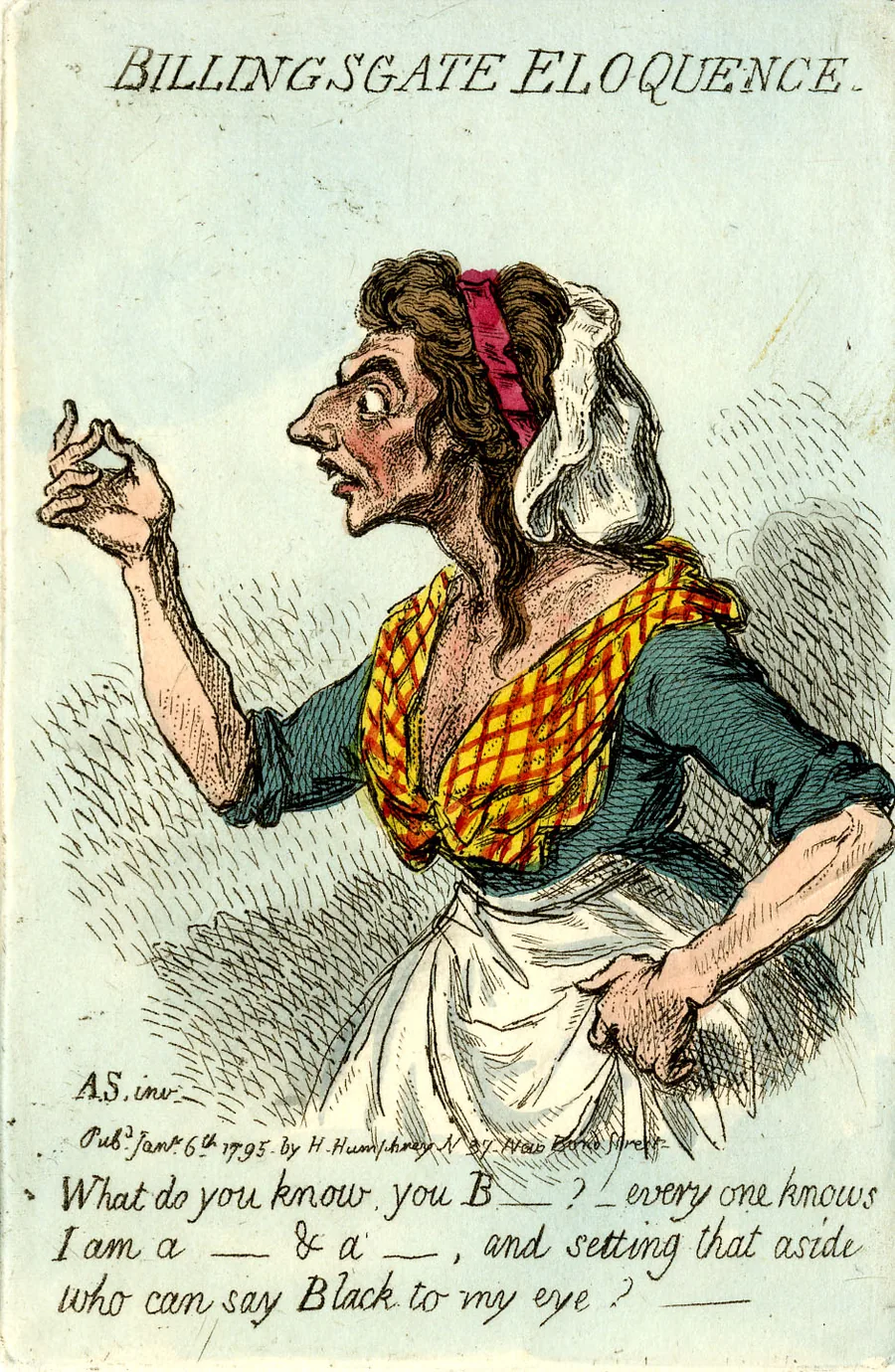
Figure receipt
1795 · James Gillray · Public domain
Clear the cellar
The rival says:
London street cries, 1851
Four in the morning, oil lamps flaring: Mayhew’s costers cry the day’s fish with its price inside the cadence. Shout each cry by tapping it, then complete its missing price-word from the documented set — three choices, one true. Four cries, four customers; the crowd walks past a wrong price. These are Mayhew’s recorded London cries, staged here beside the Billingsgate material — not a transcript of a Billingsgate trading day.
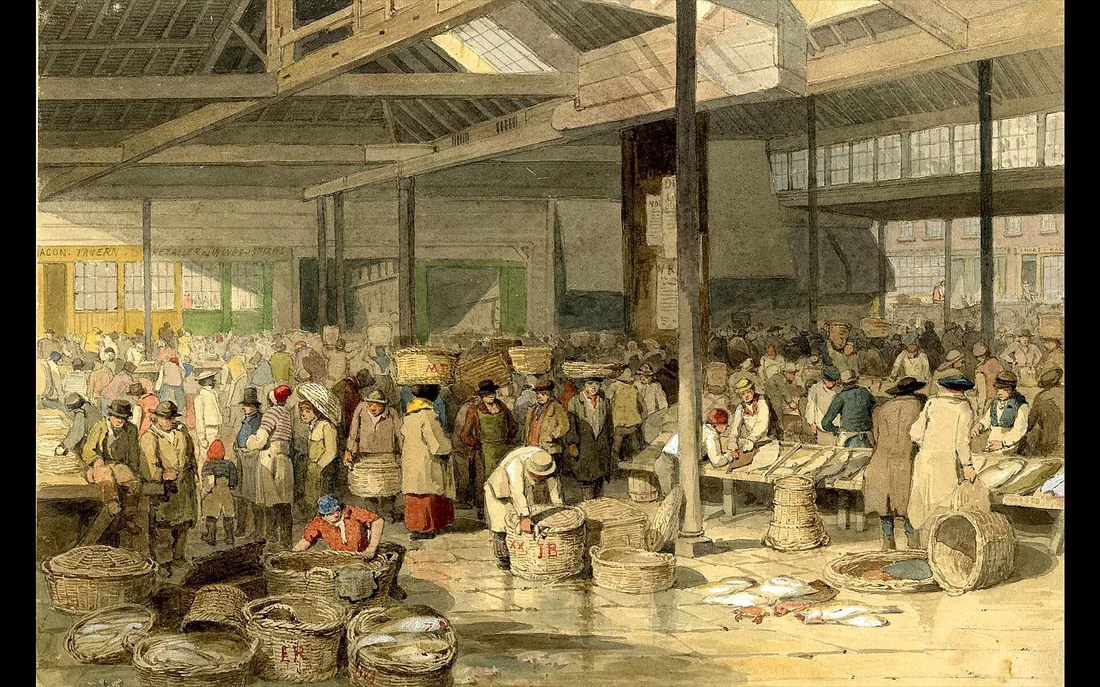
Figure receipt
1850 · John Wykeham Archer · Public domain
Sell the morning
The proof rail, 1652–1881
The lines you performed appear with sources and dates. Twelve related quotations trace uses of “Billingsgate” from 1652 to 1881. Grose’s 1811 definition is the clearest evidence here that it meant “foul language, or abuse.” The surviving quotations are written by men; none records a fishwife’s own words directly.
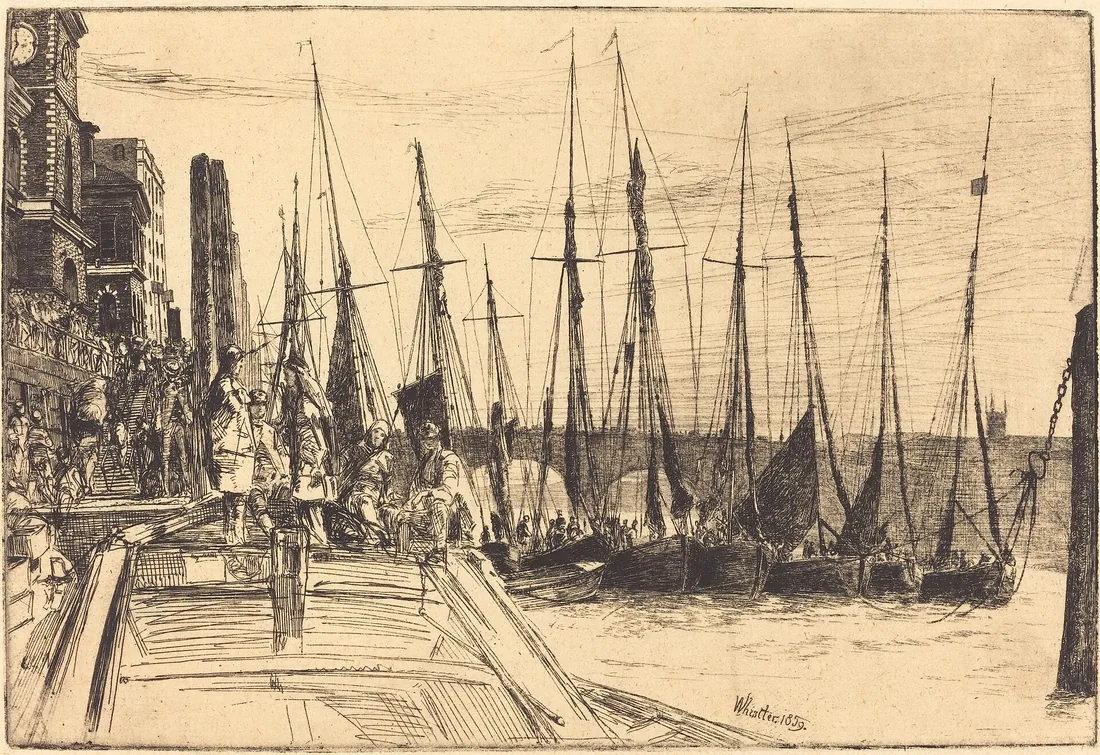
Figure receipt
1859 · Whistler · CC0 (National Gallery of Art)
The performed set
The eight lines the stall gives you to perform, with their years. The game buttons carry the same lines.
Here’s a Health to mine A—s, and a Fart for those that owe no Money.
Ward · 1703
You White-liver’d Son of a Fleet-street Bumsitter, begot upon a Chair at Noonday, between Ludgate and Temple-Bar.
Ward · 1703
You never had a bastard by Tom the waterman; you never stole a silver tankard…
Swift · 1730
I will knock out two of your eight eyes…
Grose · 1811
Ni-ew mackerel, 6 a shilling
Mayhew · 1851
New herrings alive, 16 a groat
Mayhew · 1851
Eels, 3lbs. a shilling…
Mayhew · 1851
Sprat! Sprat, oh! … Penny a pound!
Rowe · 1881
With down-right Billingsgate-Rhetorick
Nicholas Culpeper, The English Physitian, 1652 — via Murray’s dictionary source
heard such a number of Female Tongues, so Promiscuously engag’d in a Mess of Tittle-Tattle
Ned Ward, The London Spy, 1703 source
by no means comes up to the refinements of a fishwife at Billingsgate
Jonathan Swift (as Pulteney), Answer, 1730 source
And shameless Billingsgate her Robes adorn.
Alexander Pope, The Dunciad, canto four, 1742 (edition shown: 1743) source
…so much devilish malice and Billingsgate could lurk under so much sweetness…
Tobias Smollett, Roderick Random, 1748 source
Low, Billingsgate invectives
John Wesley, Works, 1750 — via Murray’s dictionary source
The style of Billingsgate would not make a very agreeable figure at St. James’s.
Samuel Johnson, Lives of the Poets, 1779 source
BILLINGSGATE LANGUAGE. Foul language, or abuse.
Francis Grose, Dictionary of the Vulgar Tongue, 1811 source
…as if the sea (See Billingsgate) made even the tongue more free.
Lord Byron, Don Juan, canto eleven, 1823 source
BILLINGSGATE, (when applied to speech,) foul and coarse language.
John Camden Hotten, The Slang Dictionary, 1864 source
irony is to the high-bred what Billingsgate is to the vulgar
Edward Bulwer-Lytton, Kenelm Chillingly, 1873 source
just the place to send any one to who would learn the richness of our tongue in rancorous and racily humorous abuse
Richard Rowe, Life in the London Streets, 1881 source
Tomorrow at noon
Stand where your street is loudest, shout one true thing about your own work, and listen to who shouts back. Then come back and read the rail again — the insult sounds different once you have performed it.
Four retorts, four cries — every line dated on the proof rail.
The whole market, in brief
The same market without the shouting. Under the 1699 Act a salt-fish vessel pays eightpence a day and twenty pence a voyage — two shillings and fourpence for one day ashore; a lobster boat or fresh-fish smack pays twopence and thirteen pence — one shilling and threepence; an oyster boat pays twopence and thirteen pence plus a halfpenny for every bushel. The four cries sell mackerel at six a shilling, herrings at sixteen a groat, eels at three pounds a shilling, sprats at a penny a pound. The cries are Mayhew’s recorded London street cries, staged beside the Billingsgate material. The four retorts are Ward’s two cellar oaths of 1703, Swift’s fishwife of 1730, and Grose’s eight-eyes threat of 1811 — all quoted verbatim on the proof rail. Two separately dated scenes, one staged stall day.
The market
One foreshore, from legend to the present day
From legend to statute to last orders — each beat dated, each number sourced. The ward map fixes the ground; the prints show the trade at work.
A gate, two stories
Geoffrey of Monmouth said King Belin built the gate four centuries before Christ; Stow, reading him four hundred years later, filed it under fable and guessed at an owner called Biling instead. A medieval chronicle puts tolls here under Æthelred — its date wobbles by years, so take it as smoke, not flame.
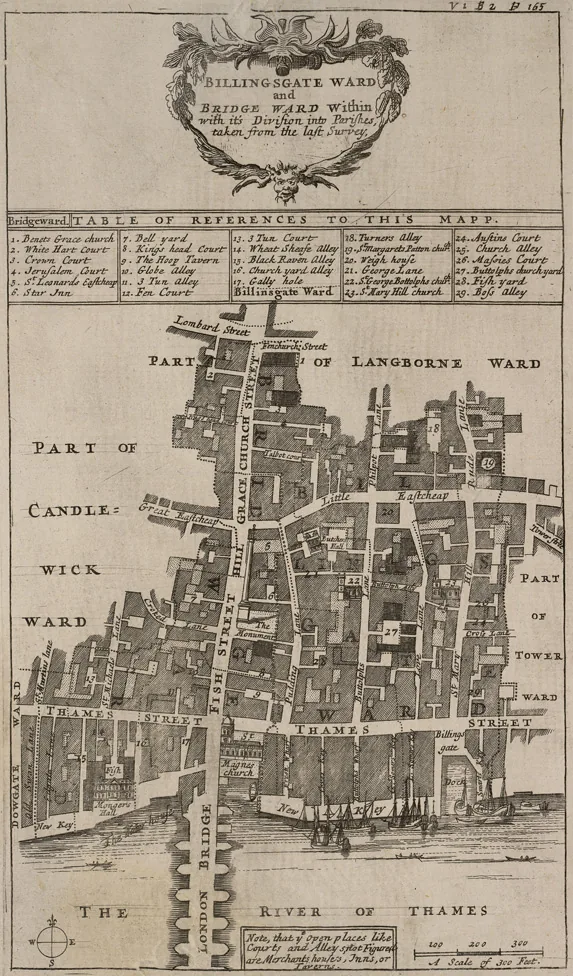
Billingsgate Ward — streets, stairs, wharves — in Strype’s 1720 edition of Stow. Figure receipt
1720 · after Stow/Blome · Public domain
The king’s foreshore
An Edward III charter of 1327 gave the City its market rights, and Henry IV’s of 1400 let it collect tolls at Billingsgate. Stow gives the Edward III scale: standage twopence for a great ship, a penny for a little one, a halfpenny for a lesser boat. By Stow’s day the gate had eclipsed Queenhithe as the landing that mattered.
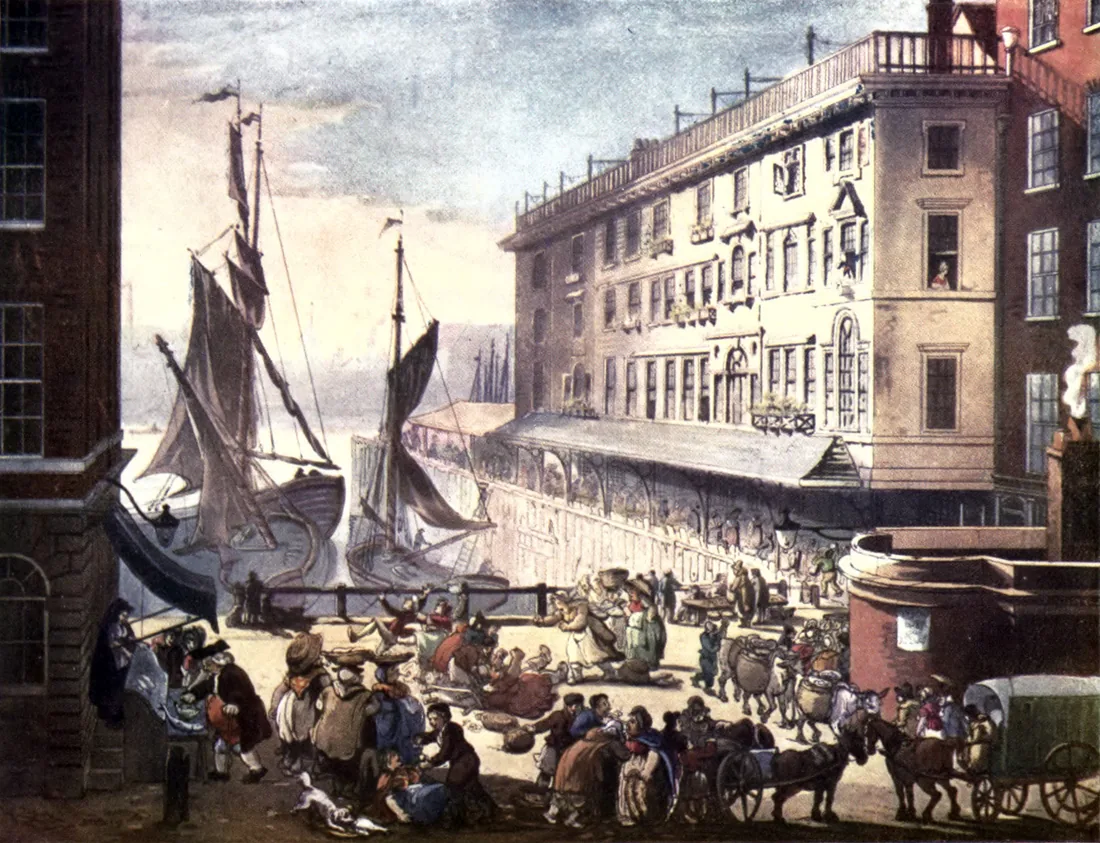
Billingsgate Quay from the north: stalls, fishwives, baskets, boats, donkeys. Rowlandson and Pugin, Microcosm of London, plate nine, 1808. Figure receipt
1808 · Rowlandson/Pugin · Public domain
The free market
Assented on the fourth of May 1699, in force six days later, the Act broke the fishmongers’ monopoly: every day but Sunday a free and open market for all sorts of fish, tolls capped to the penny, ten pounds forfeit for taking outside the table. Anyone could sell fish at Billingsgate. Anyone did.
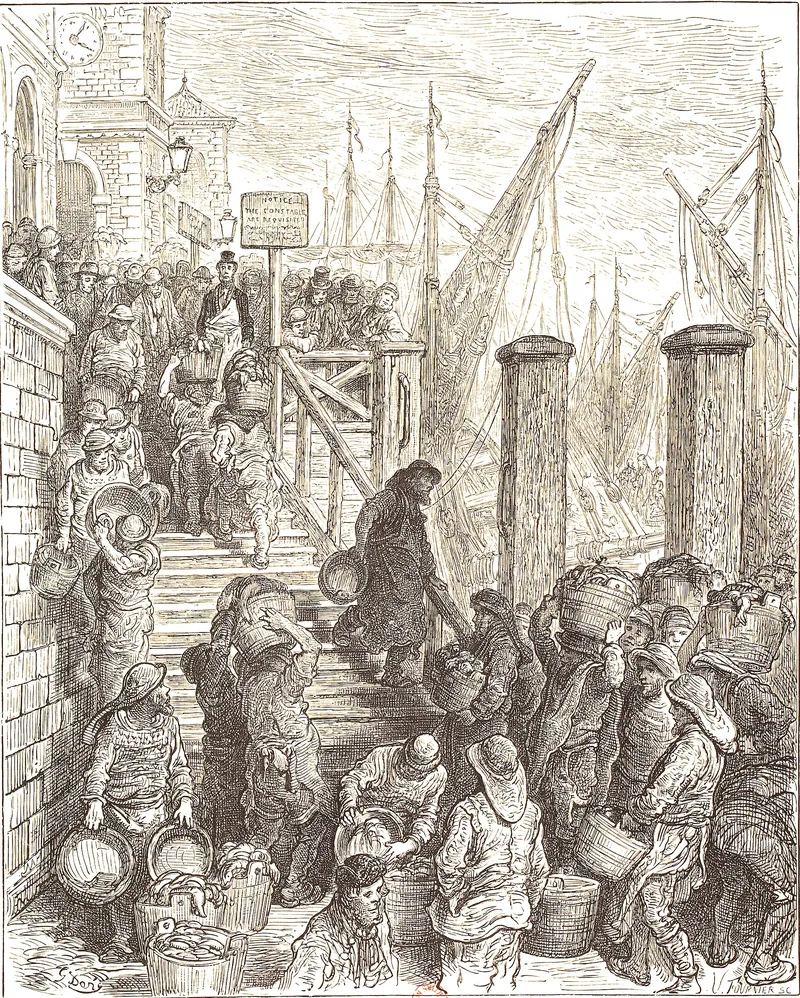
Landing the fish at Billingsgate. Doré, London: A Pilgrimage, 1872. Figure receipt
1872 · Gustave Doré · Public domain
Two halls
The first purpose-built hall went up in 1850, proved inadequate, and came down in 1873. Its replacement — City Architect Horace Jones’s arcaded hall, built by Mowlem, opened in 1876 — still stands, listed, a short walk from the old foreshore.
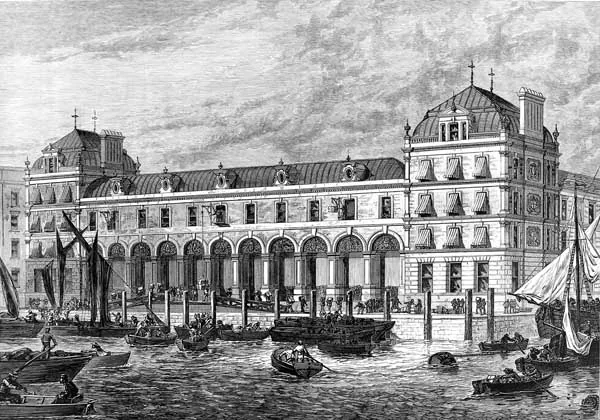
The replacement hall: City Architect Horace Jones, built by Mowlem, opened 1876 — the listed building that still stands. Illustrated London News. Figure receipt
1876 · Illustrated London News · Public domain
The market moves on
In 1982 the porters carried the trade to Docklands, off Trafalgar Way. A planned move to Dagenham, approved in 2021, was cancelled in 2024. In December 2025, Albert Island was named the preferred site for both markets. Traders will remain at the current sites until at least 2028; a move depends on the City of London (Markets) Bill passing and Newham granting planning permission.
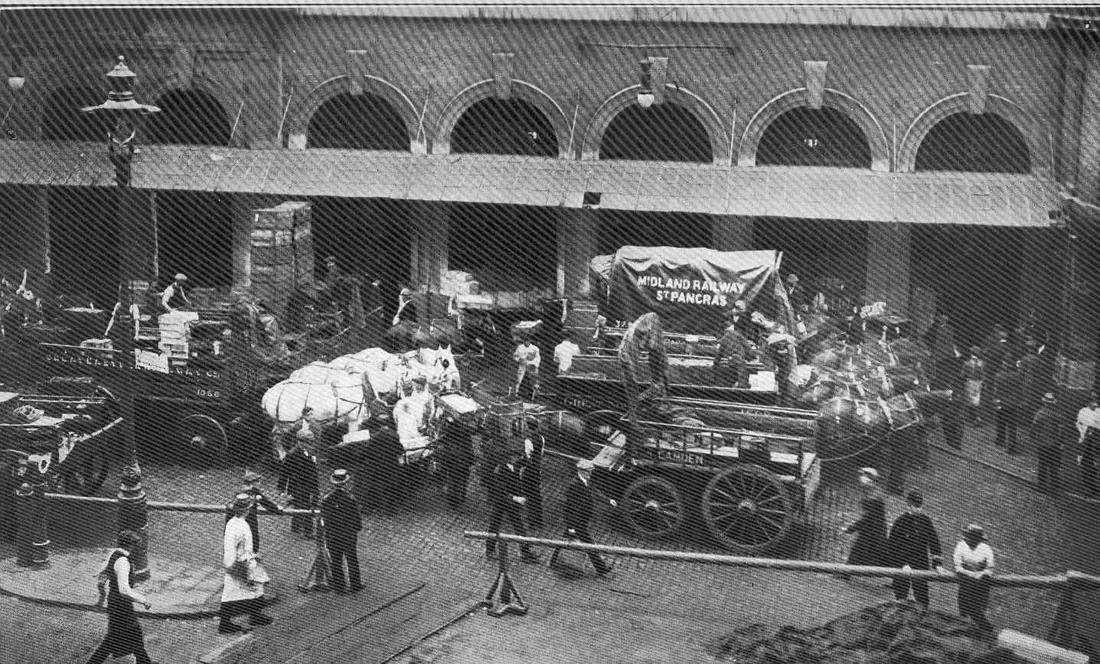
The market exterior in 1919, still on the old foreshore. Figure receipt
1919 · Richardson’s Practical Fishmonger and Fruiterer, facing p. 30 · Public domain
The word
Loud enough to enter the dictionary
Three exhibits from the proof rail, almost two centuries apart: the rhetoric, the personification, the definition.
Three uses, almost two centuries apart — all written by men; none records a fishwife’s own words directly.
- “down-right Billingsgate-Rhetorick” — Nicholas Culpeper, 1652, via Murray’s dictionary
- “shameless Billingsgate” — Alexander Pope, The Dunciad, 1742
- “BILLINGSGATE LANGUAGE. Foul language, or abuse.” — Francis Grose’s dictionary, 1811
Quoted verbatim; dashes and capitals as printed. The full dated chain stands on the proof rail.
Who used it: a physician, satirists, a divine, poets and novelists — then the dictionaries. Read the rail in order: twelve dated uses, from rhetoric to dictionary entry.
Sources
Receipts and method
Every line performed traces to one of these shelves. The market: the enrolled 1699 Act, the City’s own history, Thornbury (1878), Stow. The word: Grose, Ward, Mayhew, Murray’s dictionary entry, Pope — all free full texts. The pictures: Commons and the National Gallery of Art, all public domain or CC0.
The market
- Billingsgate etc. Act 1698 (10 Will. III c. 13), assented 1699 — enrolled text (tolls, free market)
- City of London, History of Billingsgate Market
- Thornbury, Old and New London vol. 2 (1878), Lower Thames Street
- Stow, Survey of London, Billingsgate Ward (MoEML text)
- City of London, Future of Smithfield and Billingsgate (Albert Island preferred site)
The word
- Grose, Dictionary of the Vulgar Tongue, 1811 (Gutenberg)
- Ward, The London Spy, Dark-House scene, 1703 (Grub Street)
- Mayhew, London Labour vol. 1, 1851 (Gutenberg)
- Murray’s dictionary, Billingsgate entry and citations (WEHD)
- Pope, The Dunciad, 1743 page image (Wikisource)
- Rowe, Life in the London Streets, ch. 18, 1881 (Victorian London)
The pictures
.jpg)
.jpg)


Limits in the record
- The 1850 hall keeps no architect’s name; the Dagenham move never happened; the Romans built baths, not a market; the eels were custom, not statute.
- Mayhew never records foul language — verified negative; his only quarrelling passage is set at the donkey market, not Billingsgate.
Type: Fraunces and Source Serif 4, under the SIL Open Font Licence.
Keep walking
One street over, a garret day pays documented wages by the hour:
What were your hands worth in 1888?
Short answers
Why perform insults instead of reading them?
Ward’s 1703 retorts and Mayhew’s 1851 cries come from separate scenes. Performing and comparing them lets you read those lines beside the word’s dated uses. Whether any likeness explains why the name attached, the record never says.
Where do the lines come from?
Five dated primaries: Ned Ward’s London Spy of 1703 for the cellar oaths, Swift’s pamphlet of 1730 for the fishwife, Grose’s 1811 dictionary for the threat formula, Mayhew’s 1851 London Labour and Rowe’s 1881 streets for the cries. Every line is footed with its date and source on the proof rail.
Is the market still there?
The trade left the old foreshore for Docklands in 1982; the Jones hall of 1876 still stands, listed. The City cancelled the Dagenham move in 2024. In December 2025, Albert Island was named the preferred site for both markets. Traders will remain at the current sites until at least 2028; a move depends on the City of London (Markets) Bill passing and Newham granting planning permission.
Why is the word tied to fishwives?
Nobody knows for certain — the record shows the association, never its beginning. What the record does show: they were audible, and quotable men were listening. Every quotable line comes from writers describing them; the closest to their own voices is Ward’s 1703 eavesdropping. The insult is a portrait painted entirely by outsiders.