LONDON · SPITALFIELDS · WORK
What were your hands worth in 1888?
A reconstructed working day in a Spitalfields garret: one unnamed woman's 1885 pay, her trade's sewing machine, a tailor's house.
Take her seat for a few minutes. Your own taps keep the treadle going, the sun crosses the window, and the day pays you from her documented weekly pay, hour by hour — 12 shillings and sixpence a week, from the letter's February 1885 example, divided across an assumed 72-hour week.
No. 10, c. 1750 — the unpaid prologue
This house was built in 1726 for living in, not weaving in. But by 1743 a silk-weaver named Lardant worked here, and looms filled the garret. No wage rate survives from these years, so this part pays nothing. The light is the point — keep scrolling and watch the windows.
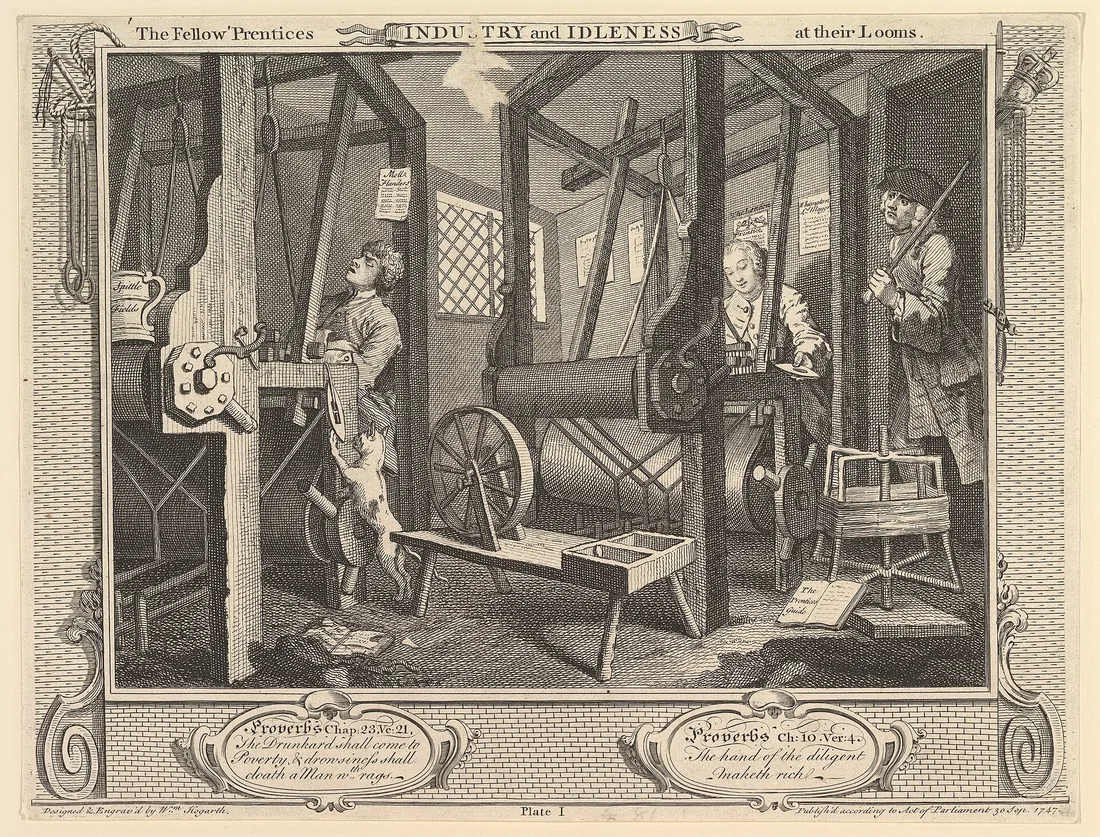
Figure receipt
1747 · William Hogarth · CC0 (Metropolitan Museum of Art)
The windows widen
As the street's fortunes sank through the 1700s, garret after garret was glazed for weaving: wide weavers' windows where plain attics had been. 'Lights absolutely necessary,' wrote Knight, 'to throw a strong light on every part of the looms, which are usually placed directly under them.' Light became the house's trade. That same kind of light may have made these garrets useful for garment work a century later.
No. 8, 1888 — the paid day
Next door. The looms are gone — French silks came in duty-free in 1860 — and the scene sets a sewing machine — the trade's documented tool, not this household's documented possession — under a weaver's window like its neighbour's. The room is a reconstruction: no source lists a machine in this house, and none gives its window widths. In 1891 a tailor named Rosenthall lived at this address with six others. The day runs six in the morning to six at night, and it pays 12 shillings and sixpence a week: one unnamed woman's pay in the letter's February 1885 example. Tap the treadle to work — stop, and the day waits.
The day 6:00 Earned so far 0d
12s 6d a week · about 2d an hour
A composite day: her documented pay, the trade's documented machine.
Assuming a 72-hour week: six days of 12 hours.
While the garrets worked
The chapel at the end of the street passed through five successive religious uses: a French church in 1743, a mission chapel to the Jews in 1809, Methodist in 1819, a synagogue in 1898, a mosque in 1976. The second line — the mission decade — is the one popular summaries skip.
Tomorrow at noon
Stand at the widest upstairs window you can find, hold your hands in the light, and price one hour of your own work — a day's pay divided by a day's hours. Keep the two numbers together.
Earned so far 0d
Your hour against hers
Type your own hourly pay in pounds — it never leaves your device — and see how many of her hours fit inside one of yours. Pounds against pence, face value: no inflation adjustment.
A working day, in brief
The full day is worked at the treadle; here is the same arithmetic worked. One unnamed woman in the letter's example earned 12 shillings and sixpence a week in February 1885. Assuming a 72-hour week — six days of 12 hours — that is about two pence an hour. A full 12-hour day comes to two shillings and a penny; six such days make the letter's 12 shillings and sixpence. The sweater himself kept £2 4s 4d that week for doing no work. The room is a reconstruction of No. 8 Fournier Street (then Church Street): the machine, a sewing machine of the trade that the hands had to buy themselves; the window above, a weaver's window glazed a century earlier for silk.
The waves
Four peoples, one street
After the working day, the potted history — each wave dated, each number sourced. Rocque drew this street in 1746; Cross redrew it in 1853 with the railway cut through; the parish map fixed its boundaries around 1885.
The silk-weavers
After the Revocation of the Edict of Nantes in October 1685, some 50,000 French Protestants came to England; 13,050 were counted in London in December 1687. Some settled here, and Spitalfields wove silk — lustrings, velvets, brocades — for a century.
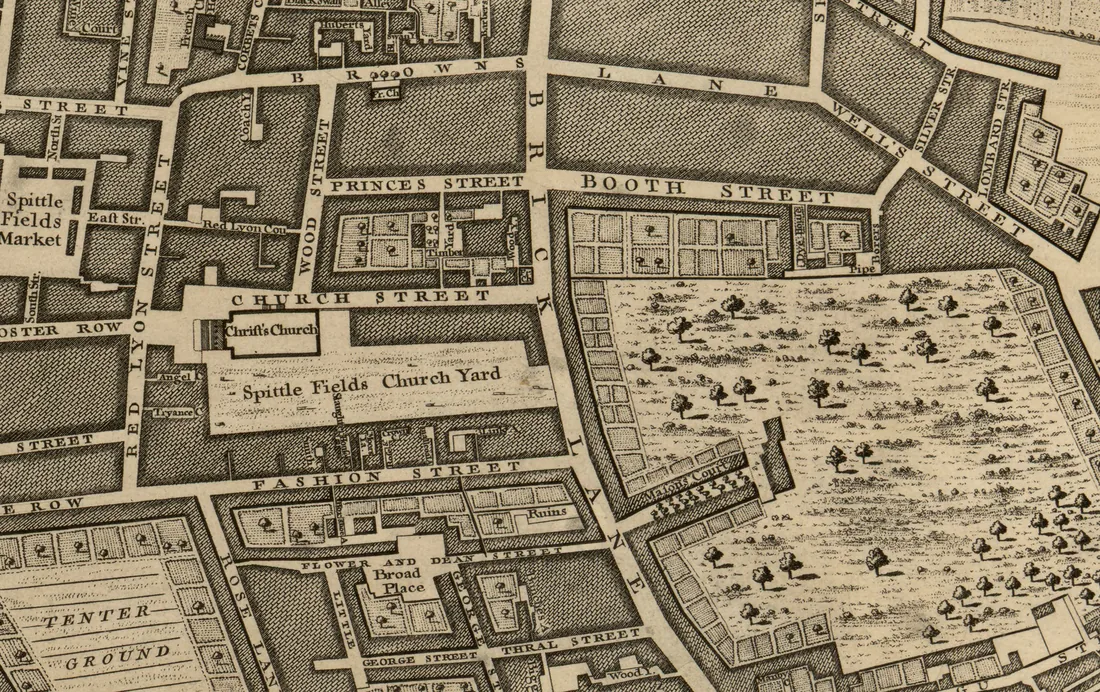
Church Street — now Fournier Street — with Christ Church and its churchyard. Rocque, Plan of London, 1746. Figure receipt
1746 · John Rocque · Public domain
The Irish
A famine-driven influx was noted by the Spitalfields Vestry in 1847, and St Anne's church rose in 1855 largely for Irish immigrants. Earlier Irish silk-weavers, from the 1730s, are plausible but thinly sourced — treat any date before 1847 as uncertain.
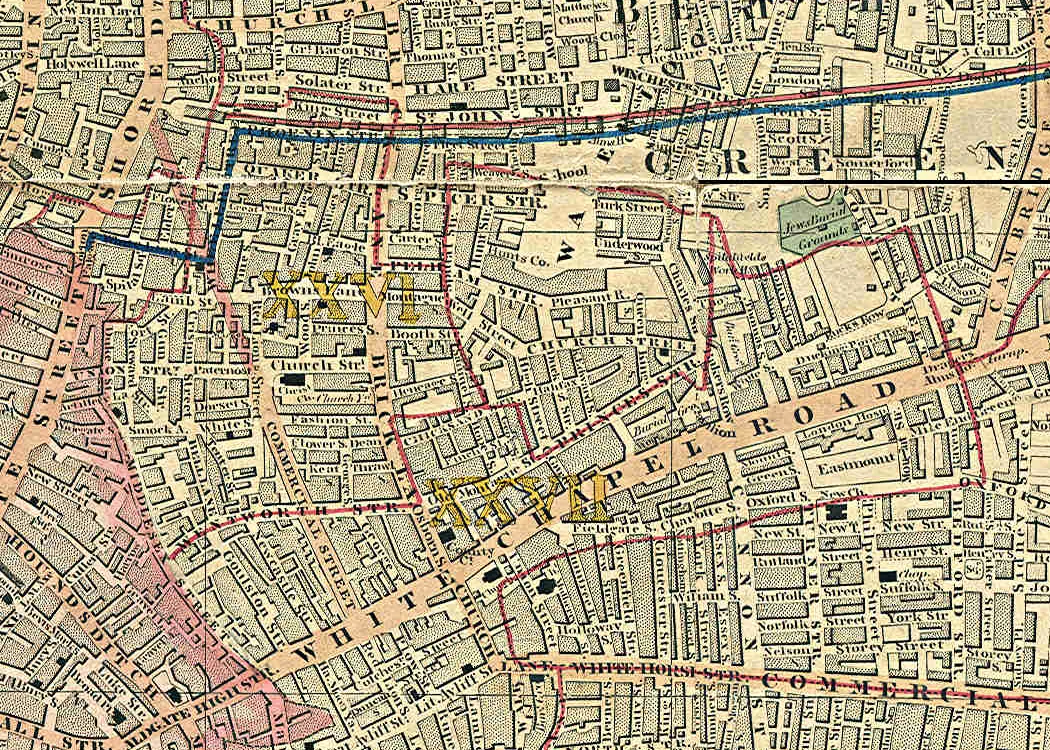
Church Street and its neighbours in 1853, with the railway newly cut through. Cross's New Plan of London. Figure receipt
1853 · J. Cross · Public domain
The tailors
Dutch and German Jews from the 1840s, then the mass Eastern European wave of 1881–1905: over 100,000 Jewish people in the East End by 1900, and tailoring dominant — men's and women's garments in sweating workshops, plus boots, cabinets, and fur.
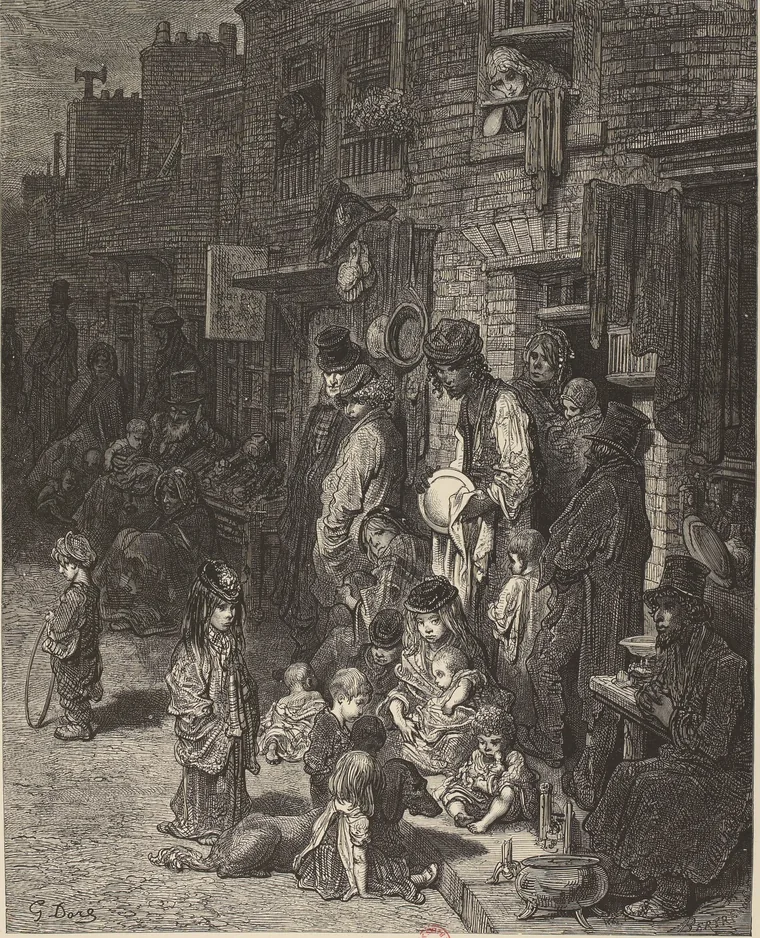
Wentworth Street, just south of the Fournier block, in 1872. Doré, London: A Pilgrimage. Figure receipt
1872 · Gustave Doré · Public domain
The garment workers
Sylheti men in the 1950s and 60s, family reunification from the late 1970s: Tower Hamlets counted some 15,000 Bangladeshi-born residents in 1981 and 65,000 residents of Bangladeshi ethnicity in 2001. Garment trades first, then the restaurants — early curry houses appeared on Brick Lane in the 1970s; by the late 1990s “going for a curry on Brick Lane” had become a London ritual. Banglatown was designated in 1997.
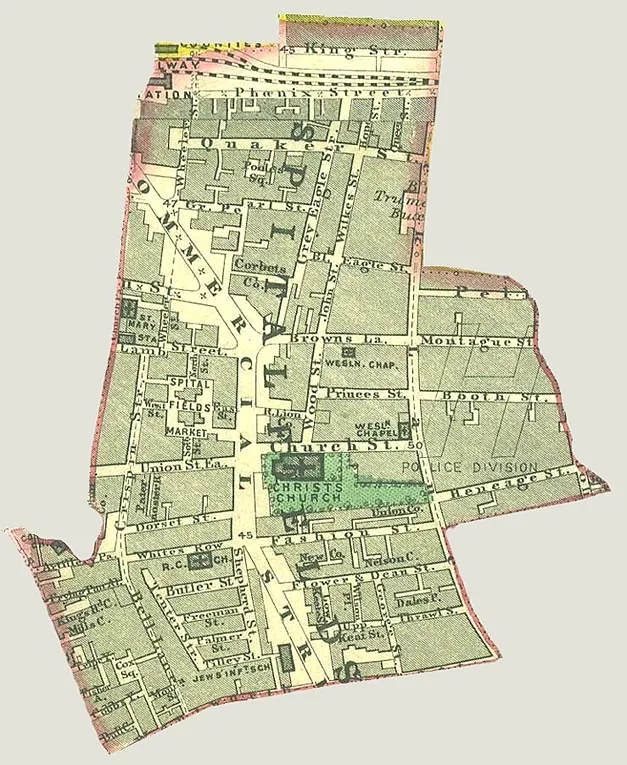
The parish of Spitalfields around 1885: the same few streets all four waves shared. Figure receipt
c.1885 · Public domain
The house
Two doors, honestly
The working day splits across two real houses, because no single house holds both ends. No. 10 (then No. 4 Church Street) carries the 1750 loom prologue: 1726 Worrall build, Lardant silk-weavers 1743–73, intact plan. No. 8 carries the paid 1888 day: a tailor's household, verified in 1891.
This house rested — the work was next door. In April 1891 No. 10 held one household with no garment trade in it:
- John L. Holloway, 47, dock porter
- Martha S. Hibbert, 29, fruiterer's assistant, born Ireland
- Jane S. Dell, 31, general servant
TNA RG12/273, Schedule 213 (short attributed quotation; transcript). Next door at No. 8 that same night: a tailor, a cigar-maker, and 12 others under one roof.
And the beigel shops? The famous 'since 1855' claim is unattested, and mass Jewish settlement postdates it by 25 years. Beigel Bake, at No. 159, was founded in 1974. Brick Lane's beigels are a 1970s continuity of Jewish food culture into the Bangladeshi era, not a Victorian survival.
Sources
Receipts and method
Every figure in the story traces to one of these shelves. Wages and hours: the February 1885 Commonweal letter (piece rates, the £2 4s 4d profit in the letter's example — recomputed from its figures), VCH (weaver hours and pay), Thornbury (1878). Houses: Survey of London vol. 27. Waves: VCH, UCL, census via official series. Pictures: Commons and the Met, all public domain or CC0.
The room
The wages
The waves
The pictures


Cuts and corrections
- Surname-through-census: every free source forbids republication; only 1891-partial exists — cut.
- House floor-by-floor 1851–1911: one year verified, floors never recorded — cut to one census.
- 'Built for light' on Fournier Street: houses were domestic first, adapted later — corrected.
- Beigel Shop 'since 1855': unattested — killed; 'Methodist chapel from 1809': actually the mission decade — killed.
- 13,050 Huguenots 'to Spitalfields': the report says London — corrected.
Type: Fraunces and Source Serif 4, under the SIL Open Font Licence.
Keep walking
Zero itself moved 102.5 metres east of where the world voted it. The vote, the gap, and your own noon:
Why does zero run through here?
Short answers
Why two doors?
Because honesty needed two. No. 10 has the documented 18th-century weaving history; No. 8 has the documented 1891 tailor's household. No. 10's own 1891 residents — a dock porter, a fruiterer's assistant, a servant — worked no garment trade at all.
Where do the two pence an hour come from?
From a February 1885 letter: one unnamed woman in the letter's example earned 12 shillings and sixpence a week. Divided across an assumed 72-hour week — six days of 12 hours — that is about two pence an hour. The week length is a stated assumption, printed beside the wage; the weekly pay is the letter's figure.
Is the garret real?
It is a labelled reconstruction from documented comparanda: Knight's and Thornbury's window descriptions, the Survey's No. 27 casements and Princelet Street's fully windowed garret. No free source gives one Fournier house's window widths, so none is drawn to measure.
What killed the silk?
Not one blow but three acts: the wage-fixing Spitalfields Acts repealed in 1824, a long stagnation employing tens of thousands, then the 1860 Cobden-Chevalier treaty admitting French silks duty-free. By the 1901 census, 548 silk workers remained in all London.