Marius ComperThe Golești school
Română

Golești · Argeș

At Golești, who could enter the “free” school?

In 1826, Dinicu Golescu reopened a school on his family estate. His notice promised tuition without charge to children of different ranks, including those held in slavery. Follow the offer through its subjects and rooms to the building restored later.

Open the notice ↓
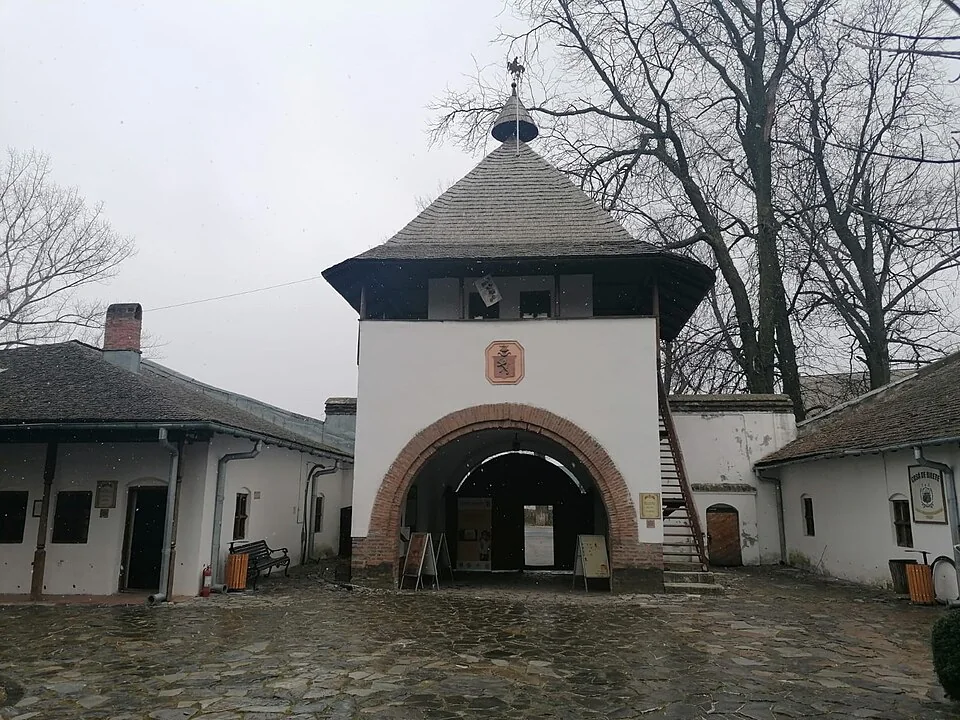
The guard tower with a large entrance arch and courtyard buildings on either side.
Ioana nirvana77 photographed the guard tower in 2022. The museum locates the school rooms to its right. (Source · Ioana nirvana77, Wikimedia Commons · CC BY-SA 4.0)

The 1826 notice

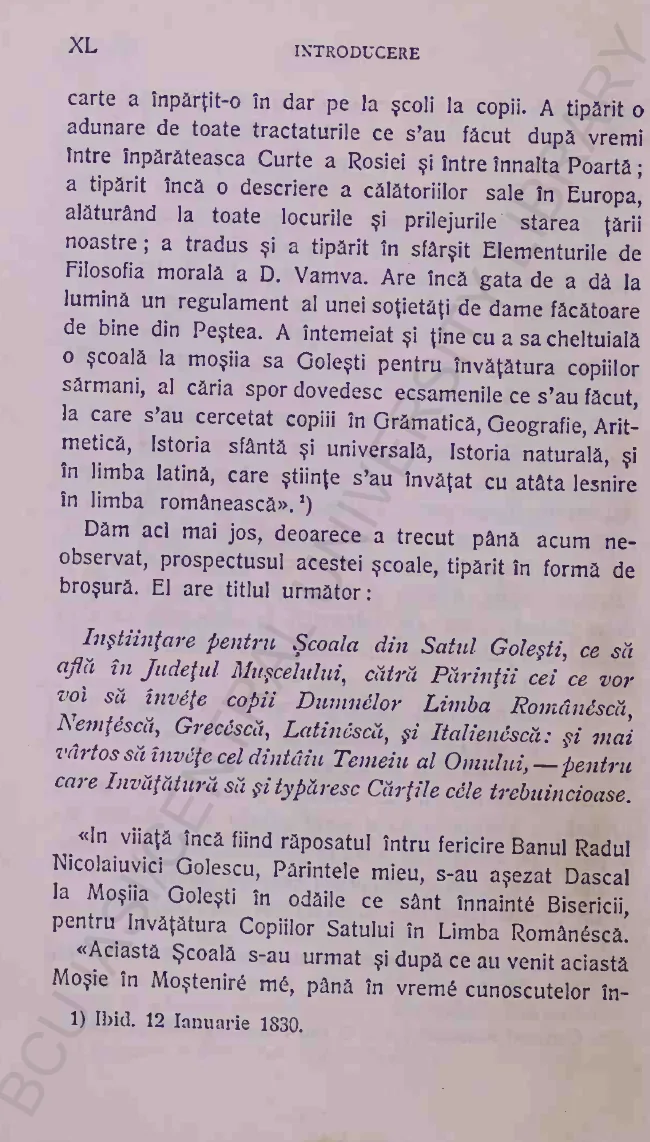
A yellowed page of Romanian in Latin type, with the long title of the Golești school notice.
Page XL of the 1910 edition. Hodoș reproduces the 1826 pamphlet; this is not the original 1826 copy. (Source · “Mihai Eminescu” Central University Library Iași, 1910 edition · Domeniu public · text tipărit în 1910)

The 1826 notice

Dinicu reopened a school begun by his father

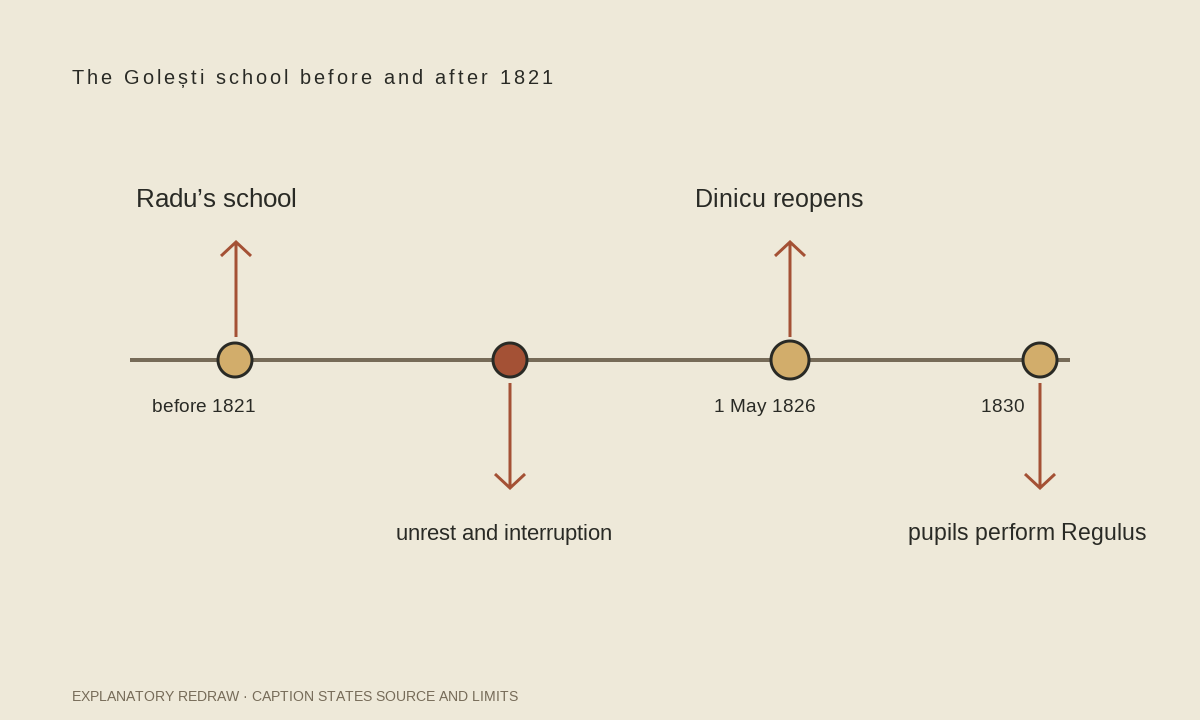
The 1826 prospectus begins with Radu Golescu: while he was alive, he placed a teacher in the rooms in front of the church for village children learning Romanian. Dinicu says the school continued on the estate until the unrest around 1821. Its 1826 opening resumed the work with a broader programme; it was not the first time children in Golești had been taught. [1] [2]

After travelling through Austria, Germany and Switzerland, Dinicu told parents that the school would open on 1 May 1826. The date appears in the pamphlet reproduced by Nerva Hodoș in the 1910 edition; the image here is a page from that reprint, held by the Central University Library in Iași. [1]
A yellowed page of Romanian in Latin type, with the long title of the Golești school notice.
Page XL of the 1910 edition. Hodoș reproduces the 1826 pamphlet; this is not the original 1826 copy. (Source · “Mihai Eminescu” Central University Library Iași, 1910 edition · Domeniu public · text tipărit în 1910)
Timeline showing a school on Radu Golescu’s estate before 1821, Dinicu’s reopening in 1826 and the school’s pupils in 1830.
The notice recalls Radu’s school and says Dinicu reopened it in 1826. The years between these points are not documented continuously here. (Source · Explanatory redraw from the 1826 notice and Revista de Pedagogie, 2000)

Who is it for?

The invitation names nobles, commoners and children held in slavery

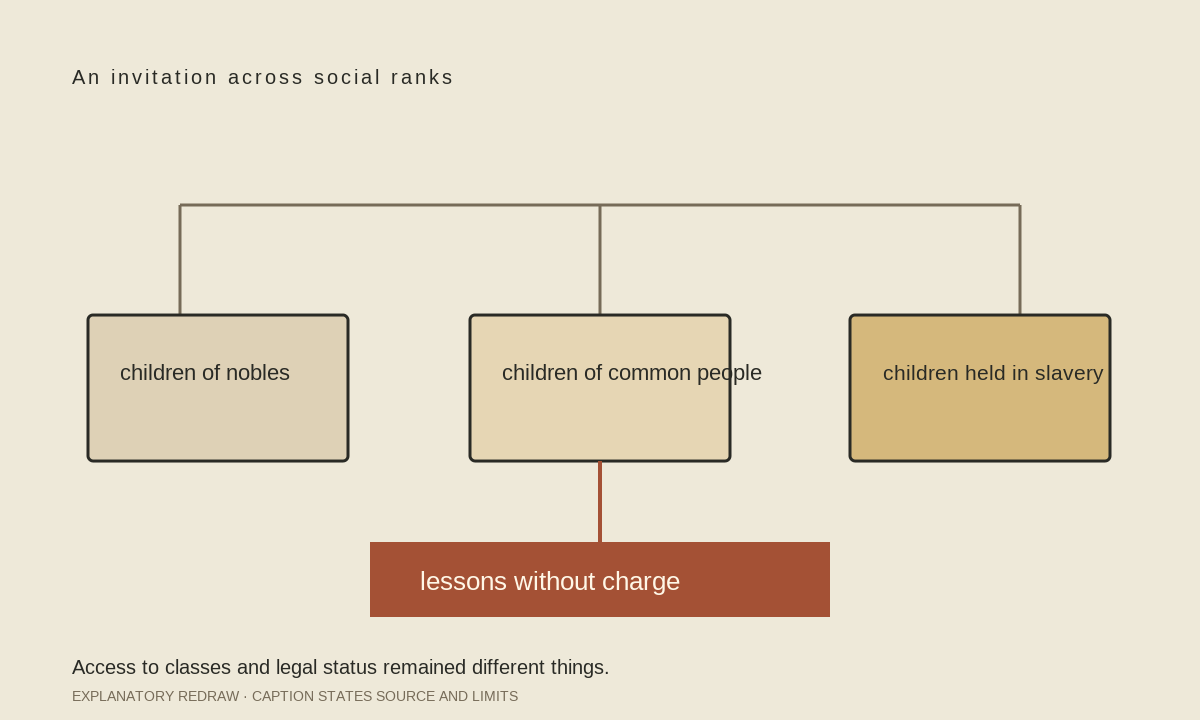
Dinicu writes that the school can receive the children of nobles, common people and “even slaves”. Roma slavery in Wallachia continued through the nineteenth century and ended in stages, with emancipation completed in 1856. The notice promises access to education across social categories; its wording did not change anyone’s legal status. [1] [6]

That is why “free” has to be read in its full sentence: parents of different ranks could send their children without payment. It is an admission rule within a society that still held people in slavery. [1]
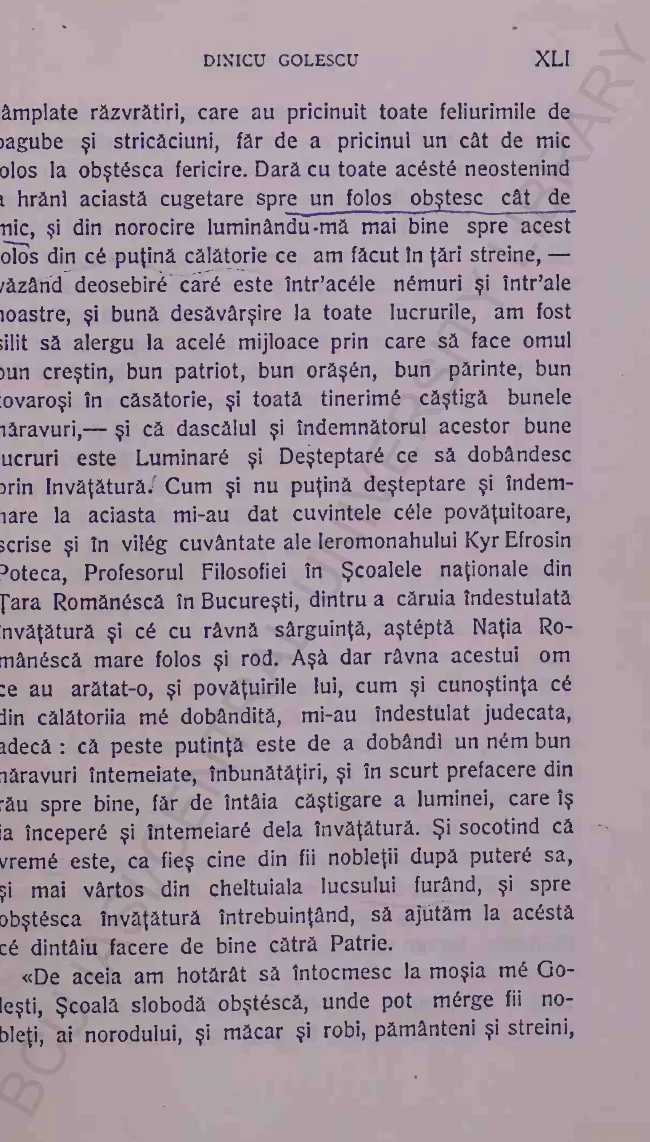
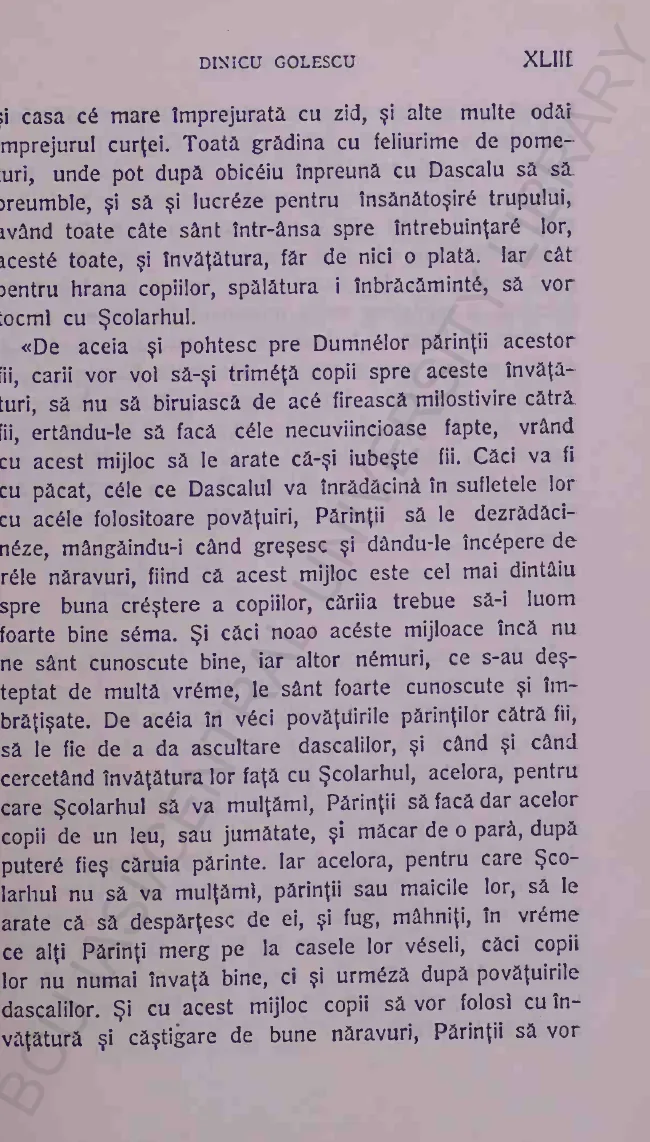
A page from the 1910 edition with paragraphs about the school’s purpose and which children could attend.
The page continues the list of children accepted and the language programme. The visible type belongs to the 1910 edition. (Source · “Mihai Eminescu” Central University Library Iași · Domeniu public · text tipărit în 1910)
Three groups of children—nobles, common people and enslaved children—enter through one gate, above a note that lessons are without charge.
The diagram groups the terms used in the notice; the shapes do not represent proportions of enrolled pupils. (Source · Editorial redraw from the 1826 notice)

What was free

Tuition cost nothing; living expenses were arranged separately

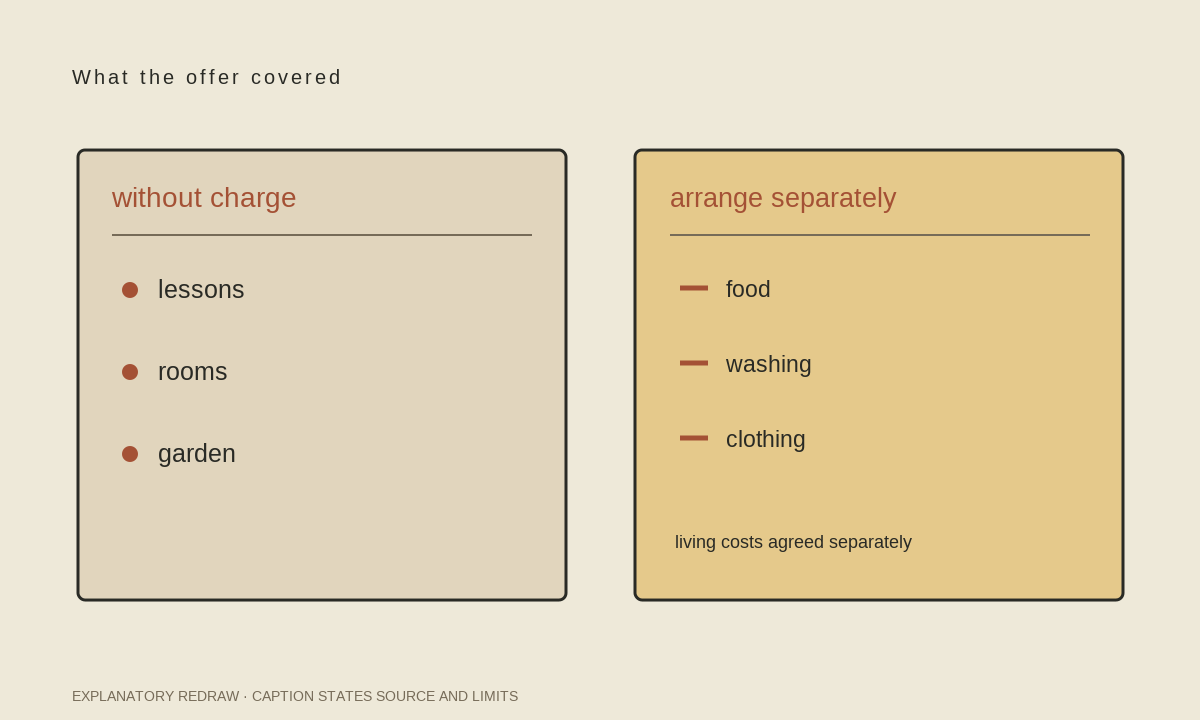
The notice promises lessons without charge. Dinicu also offers pupils rooms and the estate garden, where they could walk and work with their teacher. [1]

Then it sets out a practical limit: parents were to arrange food, washing and clothing with the schoolmaster. “Without payment” therefore describes the teaching and the rooms offered; it does not promise that every cost of a child’s stay was covered. [1]
Page XLIII of the 1910 edition, with the passage about rooms, the garden and arrangements for living costs.
At the end of the passage, the text separates free lessons and rooms from the costs of food, washing and clothing. (Source · “Mihai Eminescu” Central University Library Iași · Domeniu public · text tipărit în 1910)
Two columns: lessons, rooms and the garden were offered without charge; food, washing and clothes were to be arranged with the schoolmaster.
This division follows the pamphlet’s wording. No accounts survive here to show the sums charged in practice. (Source · Explanatory redraw from the 1826 prospectus)

The girls’ place

Girls could attend, with separate rooms and specified skills

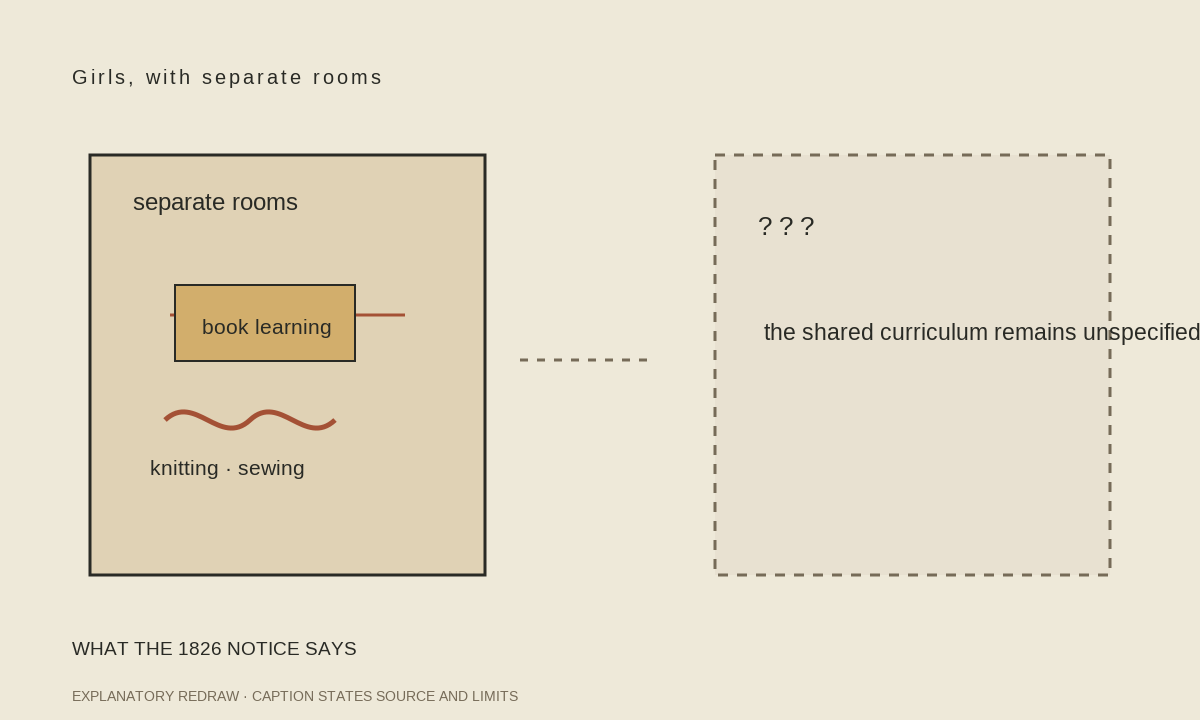
The notice includes girls and assigns them “separate rooms”. It promises book learning and names knitting, sewing and other household skills. [1]

The text does not say whether girls took every language, mathematics and philosophy course promised in the same notice. Today the museum describes the school as open to boys and girls; the 1826 testimony gives more detail about separate spaces and the domestic part of girls’ instruction. [1] [3]
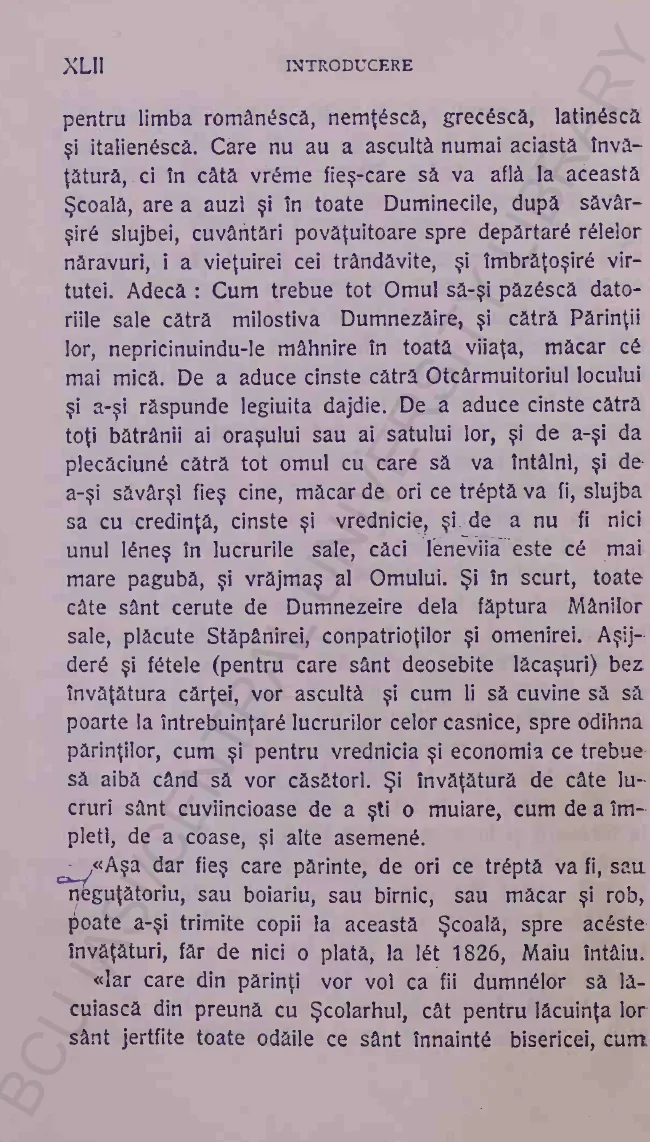
Page XLII of the 1910 edition, with text about girls’ access to school and household skills.
The passage about girls follows the course list and Sunday moral instruction. The pamphlet specifies separate rooms and household skills. (Source · “Mihai Eminescu” Central University Library Iași · Domeniu public · text tipărit în 1910)
Diagram of separate rooms for girls, with a sand tray, needle and thread; a dotted band marks shared subjects left unspecified.
The diagram sets explicit provisions beside the question the pamphlet leaves open: how much of the full programme girls followed. (Source · Explanatory redraw from the 1826 notice)

What pupils studied

From foreign languages to history, arithmetic and philosophy

The notice to parents foregrounds Romanian, German, Greek, Latin and Italian, alongside “the first principles of being human”, a moral statement of education’s purpose. Each Sunday after church, pupils were to hear guidance on duty, work and conduct. [1]

The museum’s history page also lists reading, writing, grammar, arithmetic, history, geography, logic, philosophy, algebra, geometry, music and drama. This retrospective list shows the school’s ambition; the 1826 pamphlet remains the direct evidence for the languages, moral promise and terms of the offer. [2] [1]
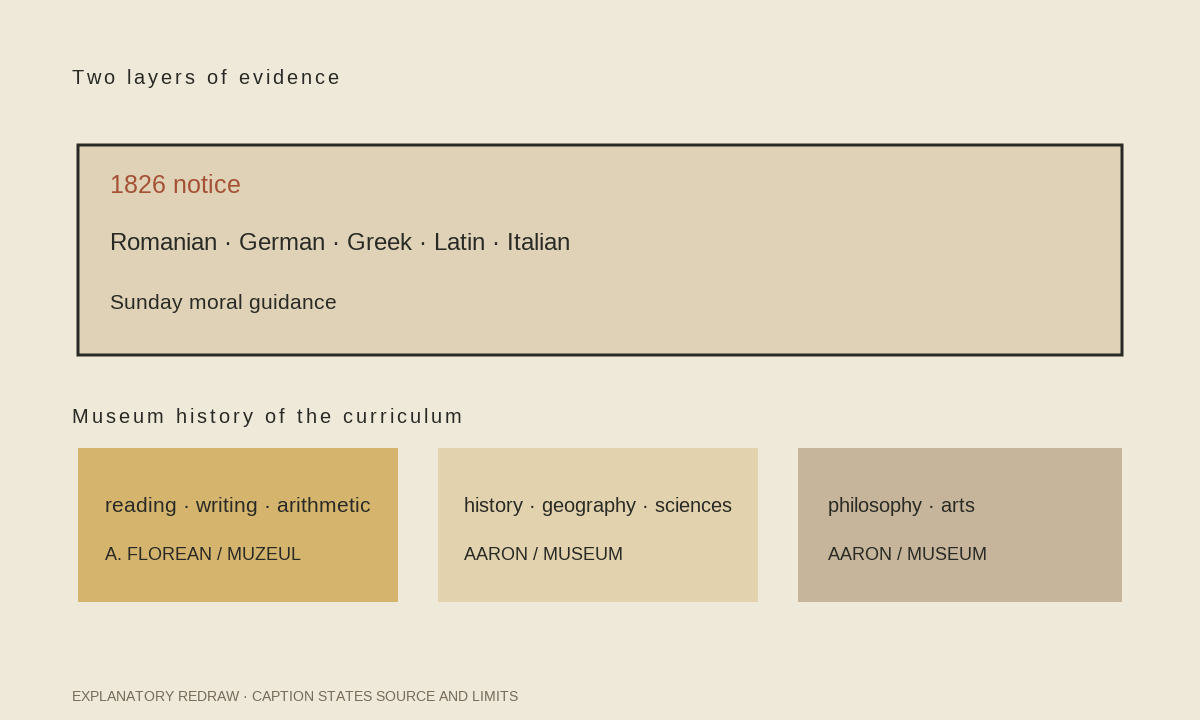
Diagram of Romanian, German, Greek, Latin and Italian, followed by subjects listed retrospectively by the museum, grouped as literacy and numeracy, history and sciences, philosophy and arts.
The first strip reflects the languages and moral guidance in the notice; the second groups subjects listed on the museum’s history page. (Source · Explanatory redraw from the 1826 notice and the museum page)

Rooms and courtyard

The school stood beside the gate; the garden was part of the day

The museum places classrooms and dormitories in the rooms to the right of the guard tower; its interactive map marks the school as building 2. The building east of the tower matches that marker. [3] [8]

The 1826 notice reserves rooms and a garden for pupils to walk and work with their teacher. The 2022 photograph shows the gate and courtyard, not a classroom from Dinicu’s time. [1] [7]

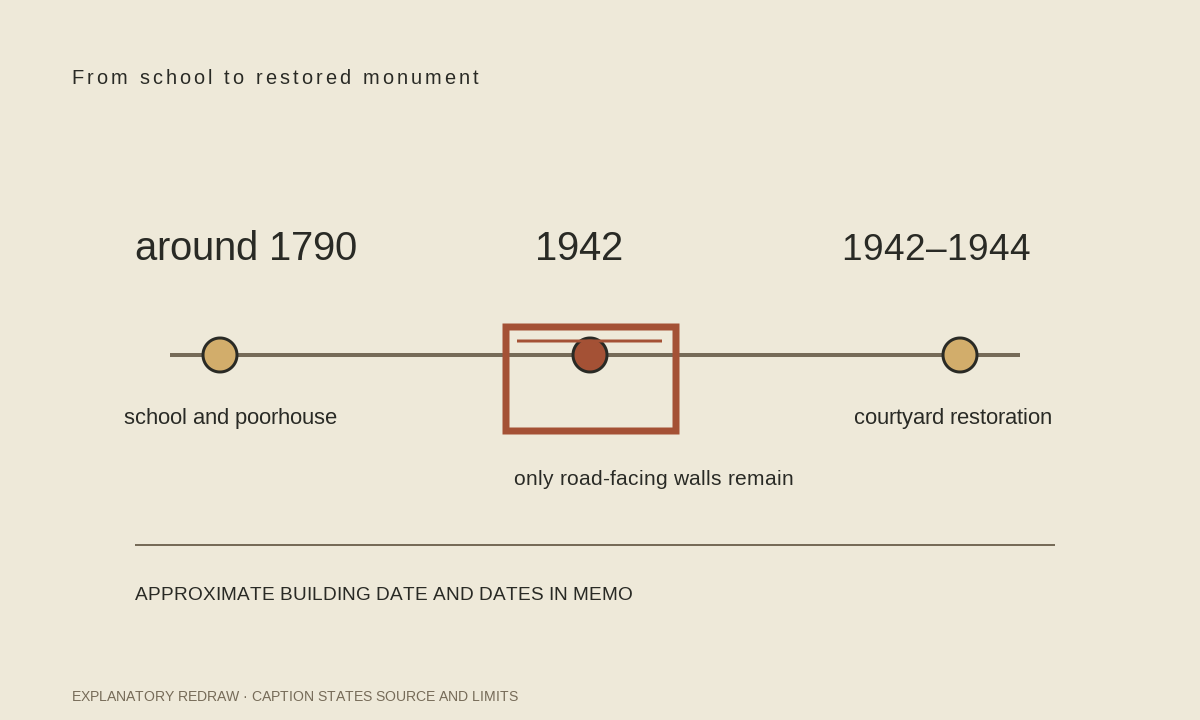
Engineer Corneliu Săndulescu’s published memorandum dates the school and poorhouse to “around 1790”. By 1942 only the road-facing walls remained; the courtyard was restored in 1942–1944. The original memorandum is held by the museum. [5]
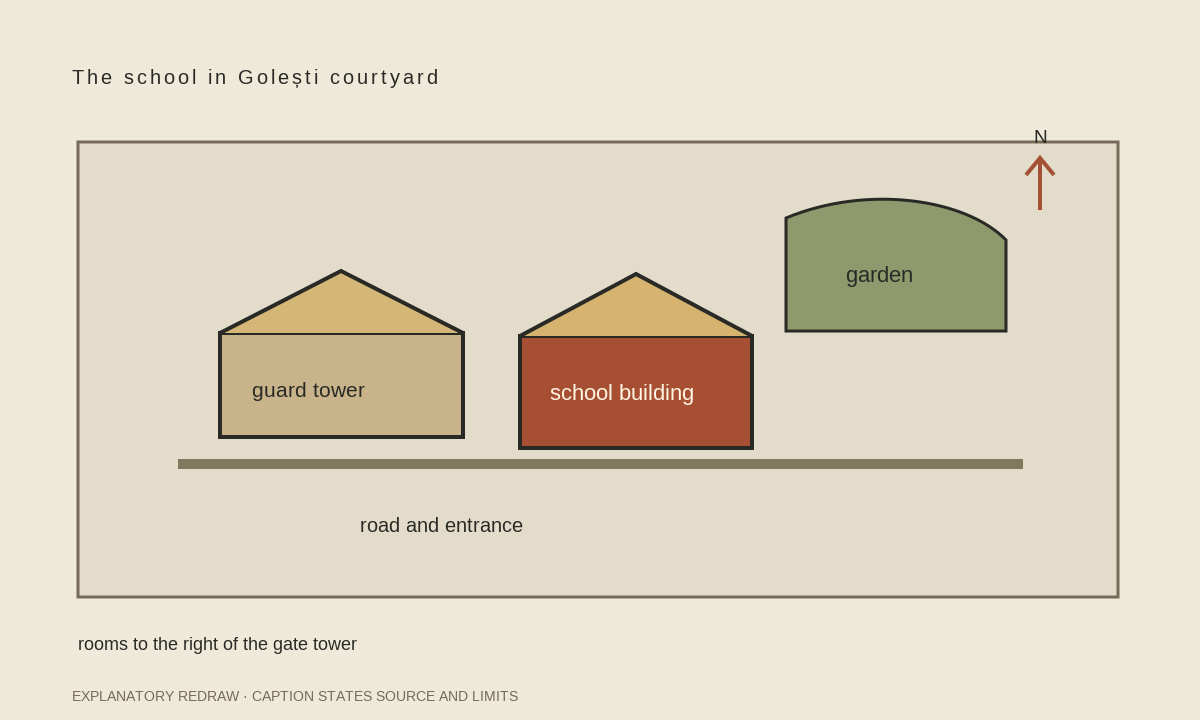
North-oriented diagram of the courtyard: guard tower at the entrance, school immediately to its right and the garden behind the buildings.
Diagram of the relationship described by the museum: the school rooms stood to the right of the gate tower. Shape and distance are illustrative, not a cadastral plan. (Source · Redrawn from Golești Museum’s interactive map)
The guard tower with a large entrance arch and courtyard buildings on either side.
Ioana nirvana77 photographed the guard tower in 2022. The museum locates the school rooms to its right. (Source · Ioana nirvana77, Wikimedia Commons · CC BY-SA 4.0)
Building phases: the school dates to around 1790; in 1942 the road-facing walls remained; the courtyard was restored from 1942 to 1944.
The timeline uses an approximate building date and the work dates in the published memorandum; “around 1790” is not an exact construction year. (Source · Redrawn from Corneliu Săndulescu’s memorandum)

After 1830

In 1830 pupils take the stage; in 1850 Zinca reopens the school

In 1830, pupils performed the tragedy *Regulus*, translated by Iancu Văcărescu. It is a concrete trace of the school’s activity in the last year of Dinicu’s life. The sources consulted do not establish how long it continued afterwards or when it closed. [4] [2]

A letter from January 1851, cited by I. Gh. Stanciu, says Zinca Golescu had reopened the school toward the end of the previous year and that nearly 25 children attended. The story returns to Golești: a school begun by a father, expanded by his son and resumed by his widow. [4]
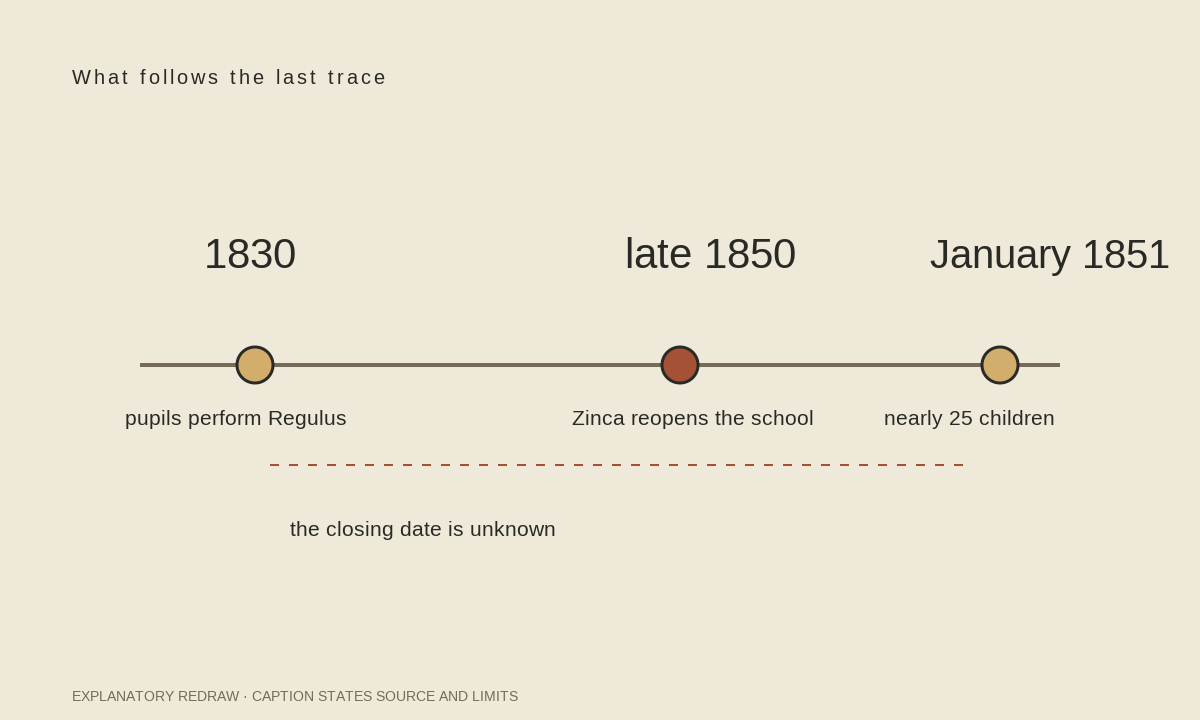
Timeline showing a pupils’ performance in 1830, Zinca Golescu’s reopening at the end of 1850 and the January 1851 letter about nearly 25 children.
The timeline shows dates supported by the sources; no exact closing date is established between 1830 and the reopening in 1850. (Source · Redrawn from Revista de Pedagogie, 2000)

Sources

The 1826 notice sets out an ambitious programme and a clear rule about fees: lessons and school rooms were free. It also records the limits of the offer: food, washing and clothing had to be arranged separately, while girls were assigned separate rooms and household skills. The building the museum identifies as the school later went through ruin and restoration.

  1. Dinicu Golescu, Account of My Travels, 1910 edition with a preface by Nerva HodoșThe 1910 volume reproduces the 1826 school prospectus on pages XL–XLIII. Embedded images are crops from this archival edition, not scans of the original 1826 pamphlet. Hodoș lived from 1869 to 1913; Golescu’s text dates to 1826.
  2. Golești Museum, Dinicu Golescu’s schoolThe museum describes the school’s interrupted operation, its 1826 reopening, the rooms and garden, its teachers and the curriculum preserved in its history. It says the year when the school stopped operating cannot be specified.
  3. Golești Museum, interactive map of the courtyardMarker 2 identifies the Free Public School. The museum places classrooms and dormitories to the right of the guard tower and describes the objects in its teaching exhibition.
  4. I. Gh. Stanciu, “Golescu, Dinicu”, Revista de Pedagogie, 1–12/2000The article cites the 1826 notice, information about Aaron Florian, pupils’ activity in 1830 and a January 1851 letter about Zinca Golescu reopening the school and the nearly 25 children attending.
  5. Corneliu Săndulescu’s 1969 restoration memorandum, published in Curtea de la ArgeșThe article quotes the manuscript held by Golești Museum: the school and poorhouse near the entrance, built around 1790, their condition in 1942 and restoration in 1942–1944.
  6. Council of Europe, The Beginnings of Roma Emancipation in Wallachia and MoldaviaThe history resource explains that Roma emancipation in Wallachia took place in stages and concluded in 1856. Used here to set the legal context for the word “enslaved” in the 1826 notice.
  7. Ioana nirvana77, Entrance to the Golești manor courtyardPhotograph made on 8 March 2022, used under CC BY-SA 4.0. It shows the entrance tower and courtyard; the photograph alone does not identify the school rooms.
  8. OpenStreetMap, building way 793388702The pin is the centroid of the building footprint east of the guard tower, matched to marker 2 on the museum’s official map. OSM data are available under the ODbL.