Marius ComperSeaca, Olt
Română

Seaca-Mușetești Monastery

How old is Seaca’s church, really?

An inscription says 1427. The records and the building tell a more complicated story: a monastery documented in 1519, likely founded a few years earlier, and later repairs that changed the church.

Read the inscription ↓
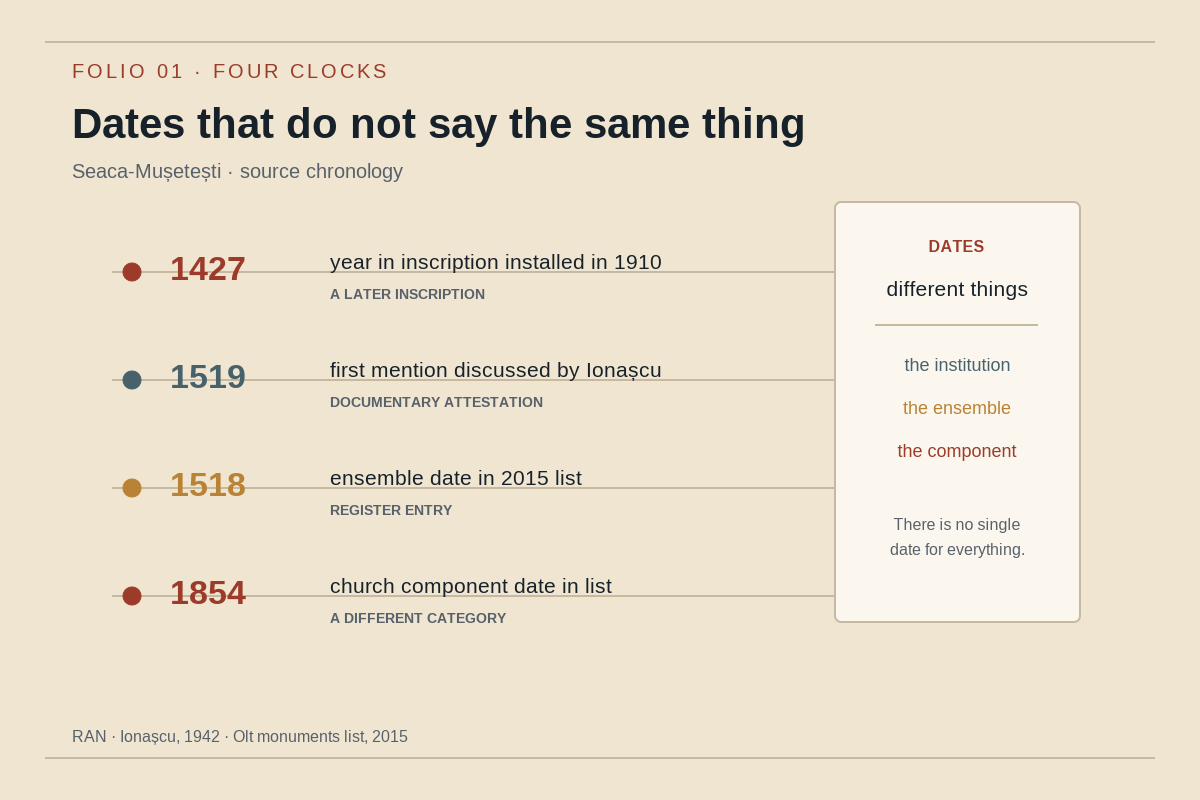
Four timeline bands show 1427 as a date copied into the 1910 inscription, 1519 as the first mention discussed by Ionașcu, 1518 for the ensemble in the monuments list and 1854 for the church component.
Original diagram: the inscribed year, the historian’s first documentary attestation, the ensemble’s register date and the church component’s date. The sources do not date the same thing. (Source · Original diagram by this project, based on [ran], [ion] and [lmi]; not a facsimile. · Original SVG; source works linked in the source list.)

The question

What does each date tell us?

At Seaca, ‘How old is the church?’ has more than one answer because the sources date different things. The National Archaeological Repertory says the monastery was founded around 1512. Ion Ionașcu’s 1942 study, drawing on documents and measurements, more cautiously places its beginnings in 1515–1518. Both dates concern the start of an institution and its complex [1] [2].

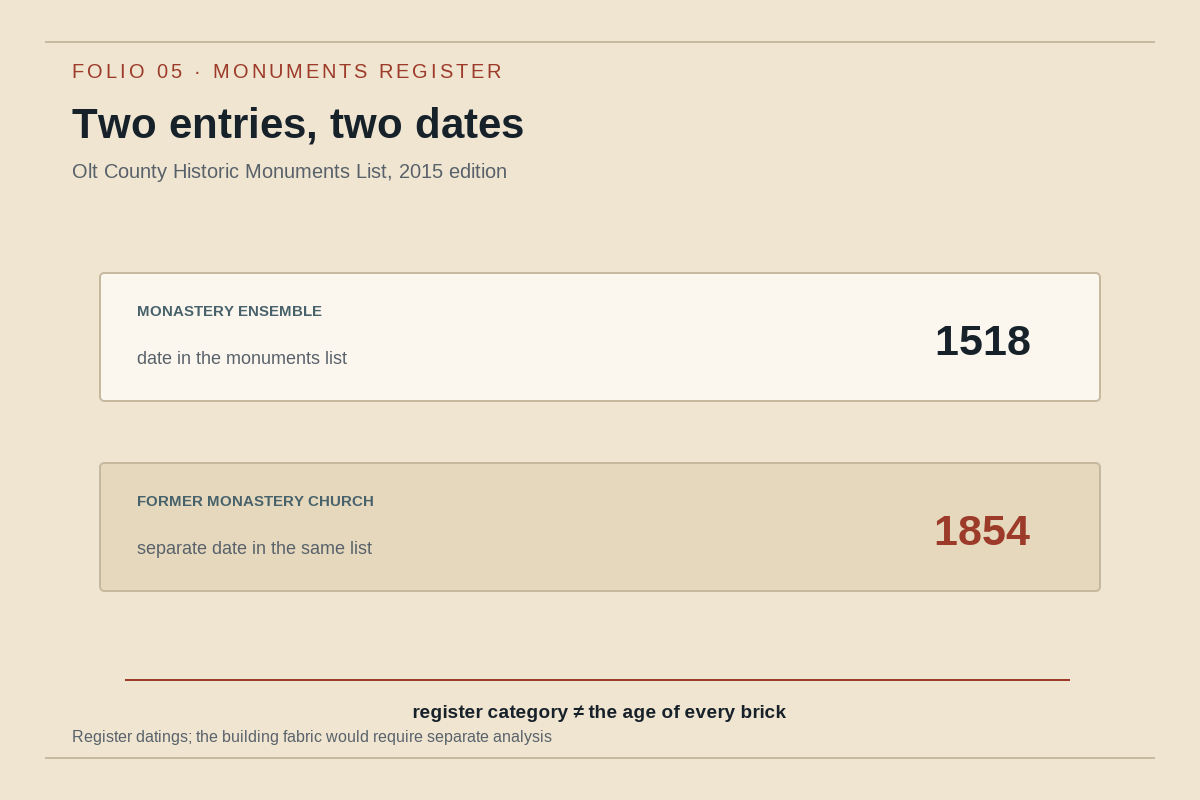
The 2015 Historic Monuments List has three entries for this site. It dates the monastery complex to 1518, the church to 1854 and the enclosure wall to the sixteenth century. The inscription above the entrance gives 1427. Each date needs to be read in the context of its source [3] [2].

We will follow four kinds of evidence: an inscription made in 1910, Vlădaia’s tombstone, a 1519 charter and architectural measurements published in 1942. Together they show a monastery documented by 1519 and a likely beginning around 1515–1518. The age of each part of the church that survives today remains a separate question [1] [2].

Four timeline bands show 1427 as a date copied into the 1910 inscription, 1519 as the first mention discussed by Ionașcu, 1518 for the ensemble in the monuments list and 1854 for the church component.
Original diagram: the inscribed year, the historian’s first documentary attestation, the ensemble’s register date and the church component’s date. The sources do not date the same thing. (Source · Original diagram by this project, based on [ran], [ion] and [lmi]; not a facsimile. · Original SVG; source works linked in the source list.)

The inscription

Why does 1427 appear?

The inscription above the entrance says that Manea Vornicul and his wife, Vlădoaia, built the church in 1427. Ionașcu dates the inscription to 1910, when the church was refurbished. The text also records that work [2].

Ionașcu transcribed the names of villagers Ilie Radu and Iordache Beliță, priest Marin Gorjanu, teacher Ghica Alexandrescu and church trustee Constantin Turbatu. The inscription also credits the whole village of Seaca with supporting the repairs [2].

Ionașcu rejects 1427 on the basis of documents and Vlădaia’s tombstone. He suggests the year may come from a misreading of the date on her stone. That is the historian’s explanation, not proof of exactly how the error happened. We can say that 1427 appears in an inscription made in 1910; this evidence does not attest the church in 1427 [2] [1].
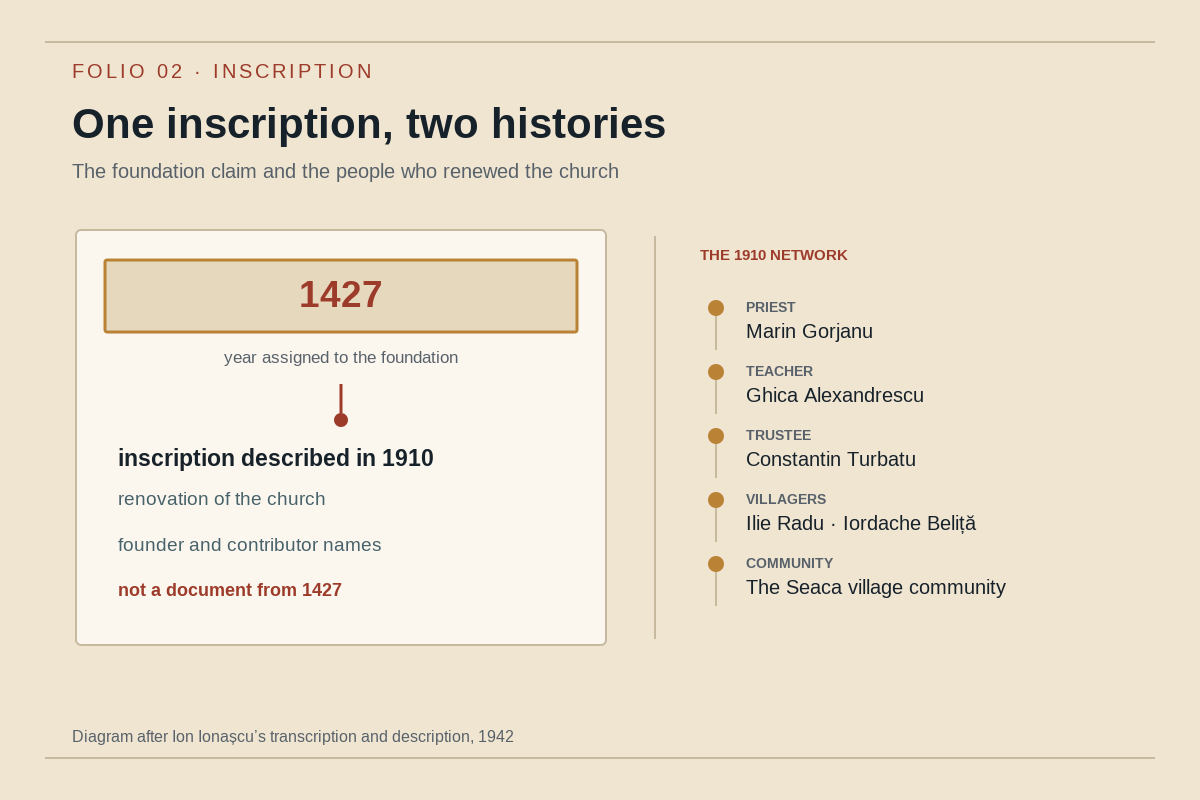
A vertical register separates 1427, recorded by the 1910 inscription, from local people named in connection with the 1910 repair.
Interpretive diagram after Ionașcu’s description: 1427 belongs to the foundation claim; the community names belong to the 1910 renewal. This is not a façade reconstruction or full transcription. (Source · Original interpretive diagram after Ion Ionașcu, 1942; not a copy of the inscription. · Original SVG; no archival photograph reused.)

Vlădaia’s stone

What does Vlădaia’s stone say?

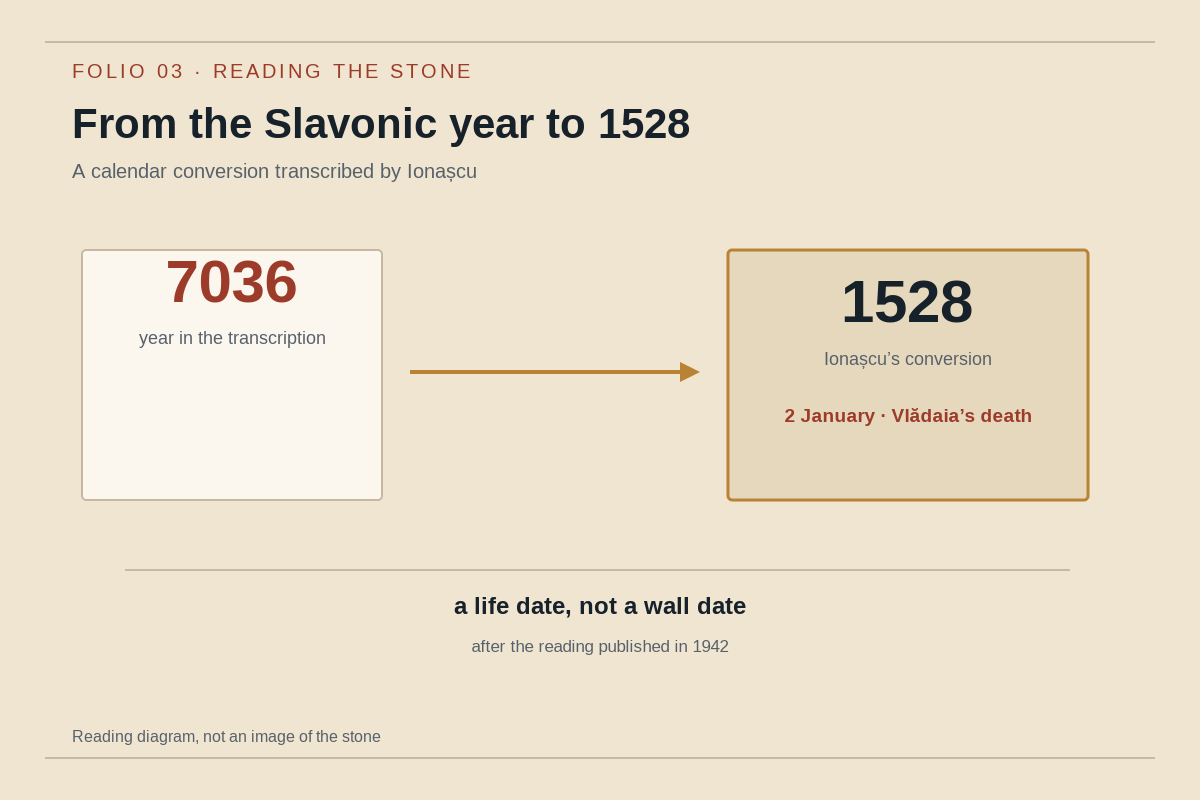
Ionașcu describes the funerary stone of Vlădaia, wife of Manea Perșanul, by the north wall of the church’s entrance chamber, or pronaos. He read the date of her death on the stone as 2 January 7036, equivalent to 1528 [2] [1].

Just over a century separates the date 1427 above the entrance from Vlădaia’s death in 1528. Ionașcu regarded the foundation date as wrong and suggested that the people who installed the inscription in 1910 might have misread the year on the stone [2].

A seal ring bearing Vlădaia’s name was found at St Parascheva’s Church in Târgoviște. Its discovery led archaeologist Minodora Cârciumaru to consider whether Vlădaia might have been buried there. The ring does not establish the place of burial. The stone at Seaca records her death, and the date of the walls is a separate question [6] [2].
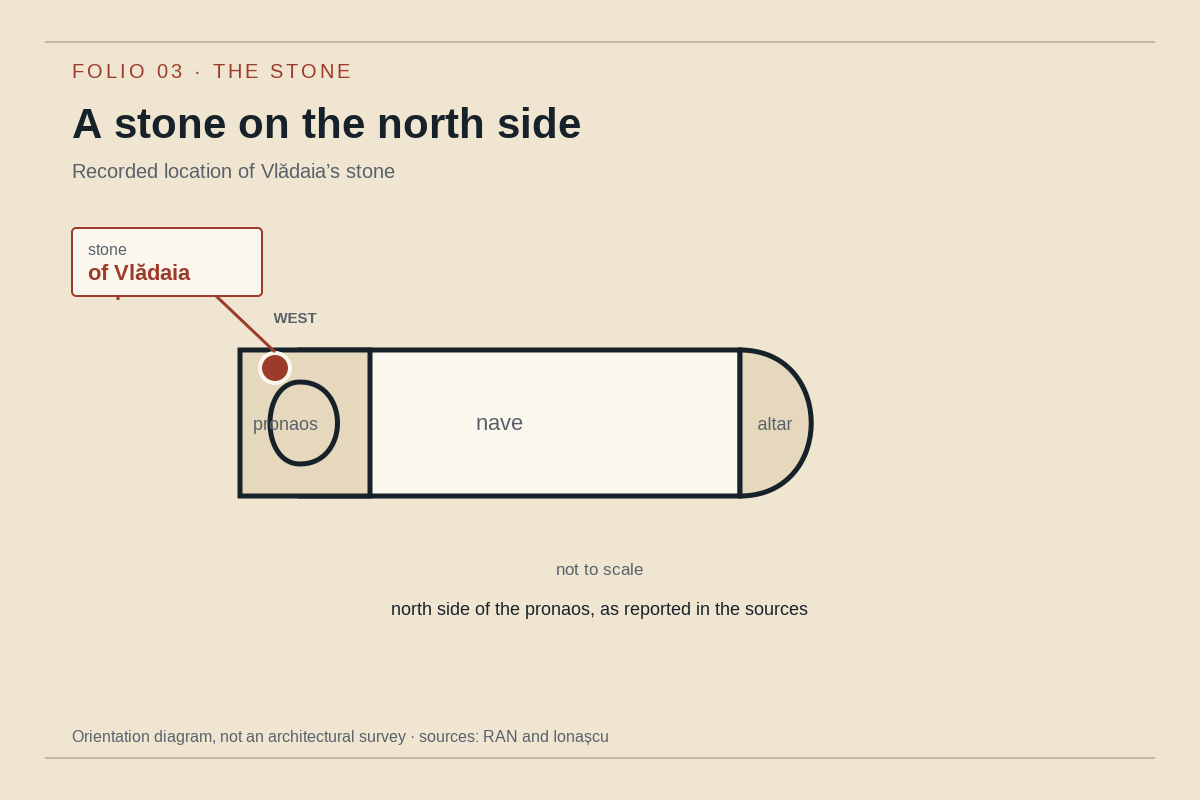
Schematic plan marking the place by the north wall of the entrance chamber where Ionașcu describes Vlădaia’s funerary stone.
Schematic plan with the altar to the east: the marker follows RAN and Ionașcu’s description; the shape and proportions are not an architectural survey. (Source · Original location diagram from written descriptions in [ran] and [ion]. · Original SVG; not a reproduction of the 1942 plan.)
Year 7036 connects to 1528 and Vlădaia’s death date, 2 January; a note says this does not date the walls.
Ionașcu reads 2 January 7036, equivalent to 1528. Figure 10 on page 74 of Cârciumaru’s study shows the stone. (Source · Reading diagram based on Ion Ionașcu, 1942. · Original SVG.)

The charter

What did the 1519 endowment include?

On 16 September 1519, Neagoe Basarab issued a charter concerning the monastery. Ionașcu treats it as the first secure documentary mention he found for the institution. The charter confirms donations and exemptions, showing a monastery tied to an estate, villages and income. Behind the religious foundation stands an institution that needed land and labour [2].

Ionașcu lists Mușetești, part of Vaideei, Criva and a mill at Leotești. The donations also include about seven households of enslaved Roma, described by Ionașcu as “sălașe de țigani”. The charter places them under the monastery’s ownership. Ionașcu does not name them in this passage [2].

Roma were enslaved in Wallachia for centuries, and monasteries were among the owners of enslaved people. The Council of Europe’s context helps us read the charter’s wording as a coercive legal relationship, not an occupation or a family label. The archive guide published in 1972 describes other records on property, privileges, obligations and exemptions [5] [4].
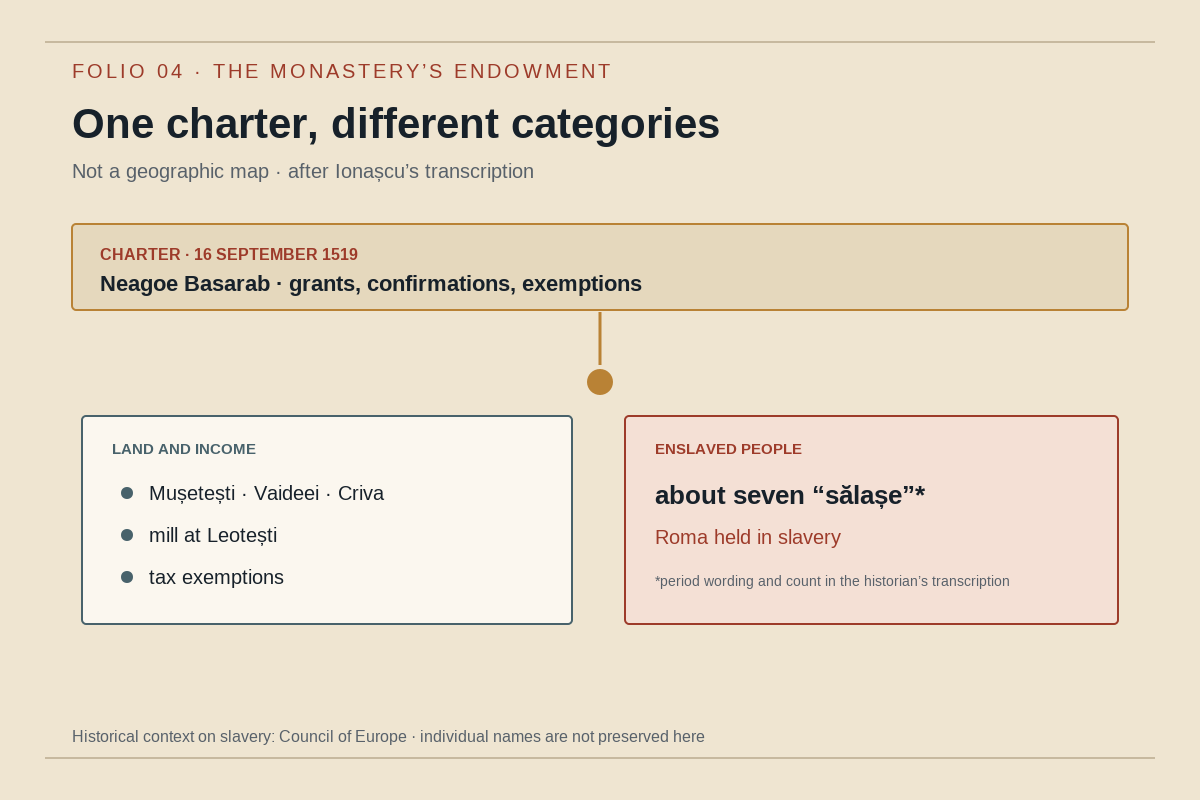
A not-to-scale charter diagram: three villages, a mill, exemptions and a separate line for about seven enslaved Roma households, described in the article with period wording.
The diagram groups items reported by Ionașcu; it is not a map and does not imply every village had the same legal relationship. Enslaved people are shown separately from land and income. (Source · Original, non-geographic diagram based on Ionașcu’s transcription; historical term quoted in context. · Original SVG.)

The building

What can the walls tell us?

Ionașcu and architect I. L. Atanasescu described a church of exposed brick with a trilobed plan. The 1942 article gives a length of 14.30 metres, a width of about 4.50 metres and walls roughly 85 centimetres thick. These measurements make the building easier to picture than a register date alone [2].

The published plan shows side apses and asymmetrically placed windows; the diagram here is newly drawn, not a copy of the original plate. Ionașcu describes interior paintings from the nineteenth century and notes retouching in 1902. Masonry, plaster, paint and repairs have different histories even when they occupy one room [2].

Two official datings are hard to compress into one: the historic-monuments list dates the ensemble to 1518 and the church component to 1854. The register helps us distinguish categories, but it does not show which bricks, arches or painted surfaces belong to each phase. That would require technical analysis of the building, which the sources consulted do not provide [3].
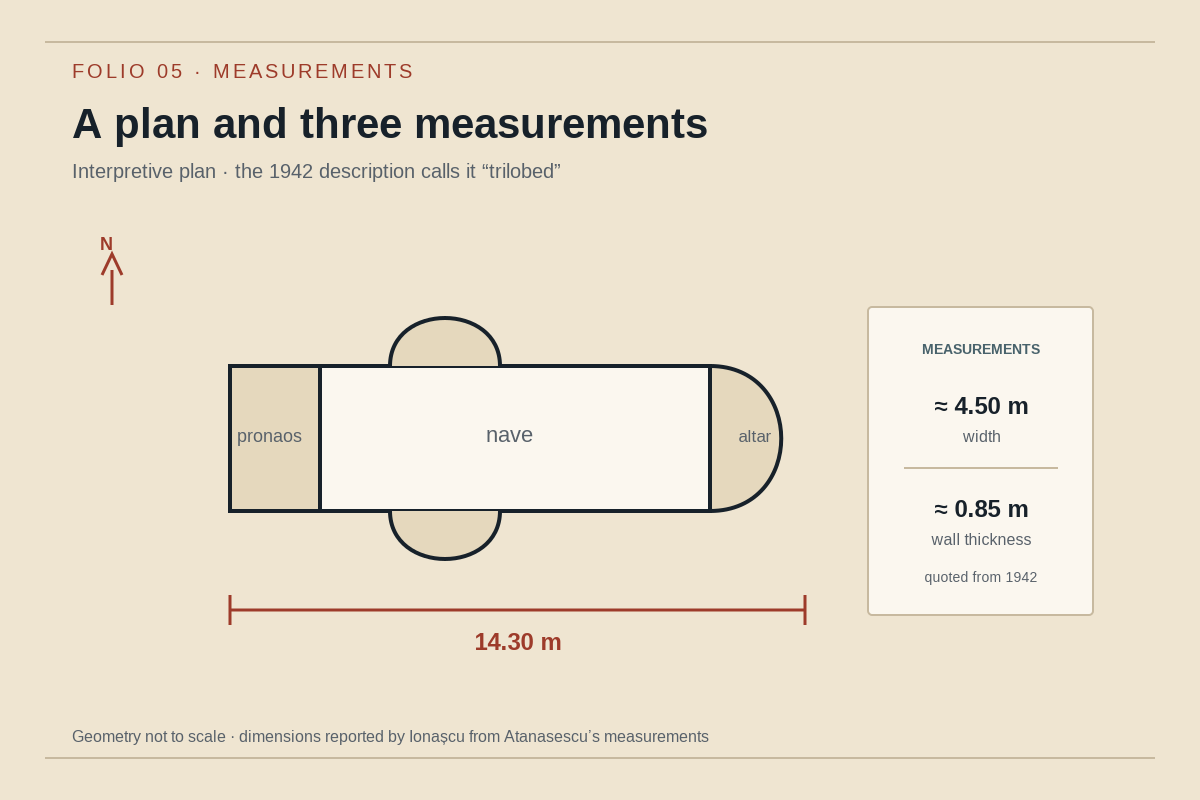
A schematic trilobed plan with north and south side apses, the altar apse to the east, a quoted length of 14.30 metres and walls about 85 centimetres thick.
Interpretive diagram after the 1942 description and measurements. Dimensions are quoted from the source; the drawn geometry is not to scale and does not reproduce Atanasescu’s plate. (Source · Original schematic after Ion Ionașcu and I. L. Atanasescu’s 1942 survey; not a facsimile. · Original SVG.)
Two register rows: monastery ensemble—1518; former monastery church—1854, with a note that these years do not date every surviving brick.
The two entries in the 2015 Historic Monuments List date the complex and the church as a whole. (Source · Original diagram based on the 2015 Historic Monuments List, Olt County. · Original SVG.)

Later layers

From monastery to village church

In 1664, the monastery became a dependency of Cozia, according to Ionașcu and the archive guide. Administration passed under another monastery. Over time, the monastic complex contracted to the church and traces of its enclosure wall; later sources record several rounds of renewal [2] [4].

The Historic Monuments List dates the church to 1854. The State Archives guide records a renovation that year. Ionașcu describes repairs and retouching of the paintings in 1902, and the inscription names those who supported the work in 1910 [3] [4] [2].

The answer is layered: the monastery is documented in 1519; its beginnings are probably around 1515–1518; 1427 comes from a later inscription and is judged wrong by Ionașcu and RAN. For the church visible today, 1854 is the official component date, but the sources cannot assign every stretch of masonry to one building campaign [1] [2] [3].
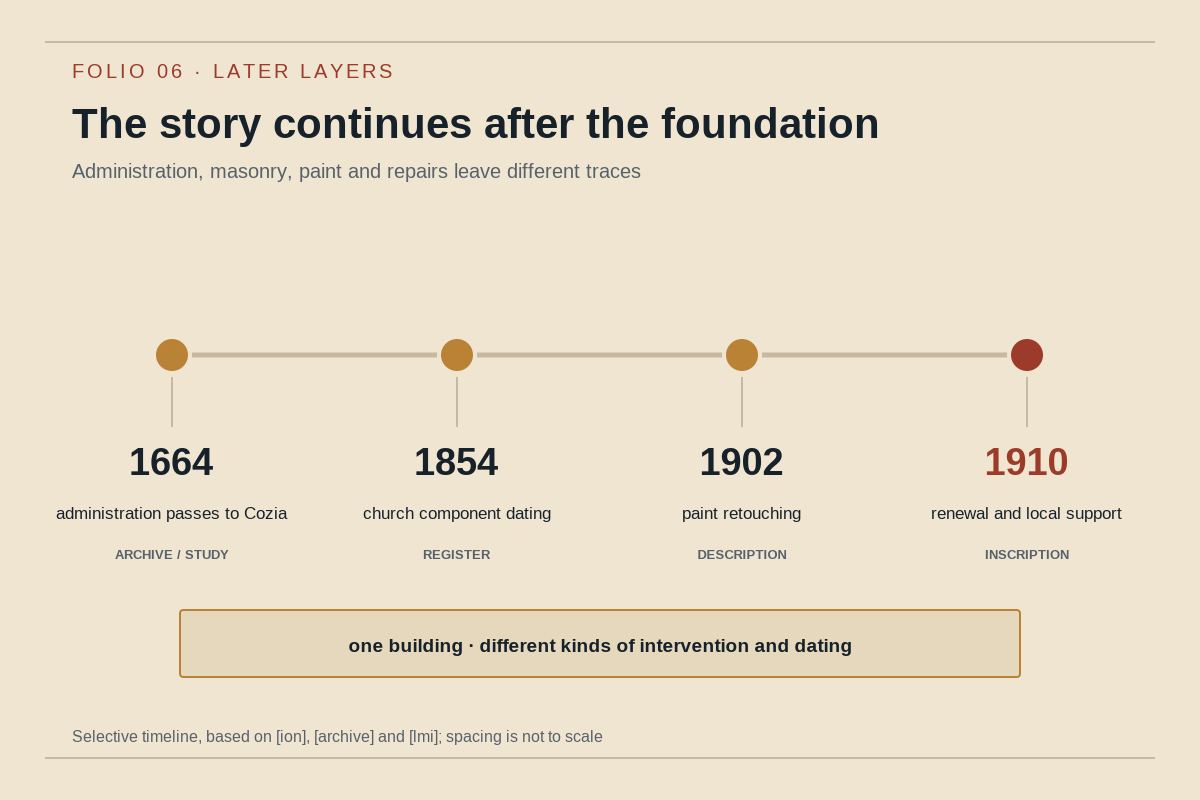
Timeline showing 1664, dependency on Cozia; 1854, church-component dating; 1902, paint retouching; and 1910, renewal with local contributions.
Timeline of changes and interventions mentioned in the sources; visual spacing is not a time scale, and dates do not show how much masonry survives from each phase. (Source · Original evidence timeline based on [ion], [archive] and [lmi]. · Original SVG.)

Sources

When you stand by Seaca’s church, you can read 1427 above the entrance. You now know what kind of evidence it is: a date inscribed in 1910 and challenged by the records and Vlădaia’s tombstone. The monastery appears securely in documents in 1519, with historians placing its beginnings around 1515–1518. The surviving walls still need direct building analysis to tell their full story.

  1. National Archaeological Repertory, record 128356.01Identifies the monastery and its founders, dating its beginnings to around 1512. It records Vlădaia’s stone on the north side of the church entrance chamber and rejects the date 1427.
  2. Ion Ionașcu, “Mănăstirea Seaca-Mușetești (Olt),” 1942A study based on the author’s 1930 and 1933 visits, architect I. L. Atanasescu’s measurements, and records consulted at the State Archives. It argues that 1427 conflicts with the documentary evidence and places the monastery’s likely beginnings in 1515–1518; it describes the entrance inscription, tombstone, measurements and repairs. The author’s explanation for the 1427 error remains a hypothesis.
  3. 2015 Historic Monuments List, Olt CountyLists the monastery ensemble as 1518, the former monastery church as 1854, and the enclosure wall as sixteenth-century. These are separate register entries and datings; the list alone does not date every surviving stretch of masonry.
  4. State Archives, Guide to the Central Archives, vol. I, 1972Describes the Seaca-Mușetești archive, dates the monastery’s transition to a dependency of Cozia, and records church renovations in 1854 and 1910.
  5. Council of Europe, factsheet on the legal status of Roma under slaveryProvides context on Roma enslavement in Wallachia and Moldavia, including monastic ownership of enslaved people. It explains the historical institution; it does not identify individuals in Seaca’s charter.
  6. Minodora Cârciumaru, study of Vlădaia’s ring (2021)Pages 68–69 discuss the place of burial. Figure 10 on page 74 shows the stone at Seaca.