Bucharest, Filaret Hill · November 1902
Hepites's seismograph: how it would have written today's earthquakes on smoked paper
In November 1902, at the observatory Ștefan Hepites ran on Filaret Hill in Bucharest, Romania's capital, two Bosch pendulums began tracing the ground's motion in soot on paper wrapped round a drum. Today a modern station about 400 metres from its listed position records the earthquakes of Vrancea, a seismically active region near the bend of the Eastern Carpathians. The acceleration it measures is run here through the 1902 pendulum, to show the trace it would have left.
The sources consulted give no period for the Bucharest pendulums. Comparable Bosch pendulums: 20 s in Strasbourg, about 25 s in Washington, 30 s in Tiflis (now Tbilisi, Georgia).
Hepites's earthquake observation network
From 1892 Ștefan Hepites, a pioneer of Romanian seismology, systematically collected reports of felt earthquakes through the meteorological network; later histories speak of about 400 observation posts. The seismic station on Filaret Hill dates from 1895, and among its first instruments were a Guzzanti microseismoscope and a Tacchini pendulum. In 1901 Hepites founded the Romanian Seismological Service.
In early November 1902 two Bosch horizontal pendulums were installed under him, each in its own room in the basement of the former magnetic observatory on Filaret Hill, on grounds now on Cuțitul de Argint Street. His assistant Ion St. Murat mounted and adjusted them. One recorded east–west motion, the other north–south.
How the 1902 seismograph worked
Each pendulum had a mass of 10 kg. Levers magnified its displacement 10 times on the east–west pendulum and 15 times on the north–south one. The stylus left a trace in the soot on paper wrapped round a drum with a circumference of 90 cm.
The drum turned once an hour, 24 times a day, so the paper passed under the stylus at a quarter of a millimetre a second, 15 mm a minute. At each turn the drum moved 3 mm sideways, so the hourly lines lie 3 mm apart. An electric signal marked each minute. The pendulums had no damping. Their natural period does not appear in the sources consulted; for similar Bosch pendulums it was 20–30 seconds.
Seismograms of the 6 October 1908 earthquake
The seismogram archive of Romania's National Institute for Earth Physics (INFP) keeps the Bosch sheets recorded on 6–7 October 1908, with the Vrancea earthquake of 6 October (M6.8 according to Paulescu and colleagues, M7.1 in the Euroseismos catalogue). On the east–west sheet, after a run of small oscillations, the stylus makes an excursion of about 18 mm peak to peak, across several neighbouring lines. The length was measured on the scan, to about 1 mm.
In the measured area of the north–south sheet, the hourly lines are about 9 pixels apart and the minute marks about 45–46 pixels: the ratio is 0.198. If the paper moved at 15 mm a minute and the drum stepped 3 mm a turn, the ratio had to be 0.200. Hepites's printed text says "15 cm a second", a misprint: at that speed, consecutive minute marks would be 9 m apart.
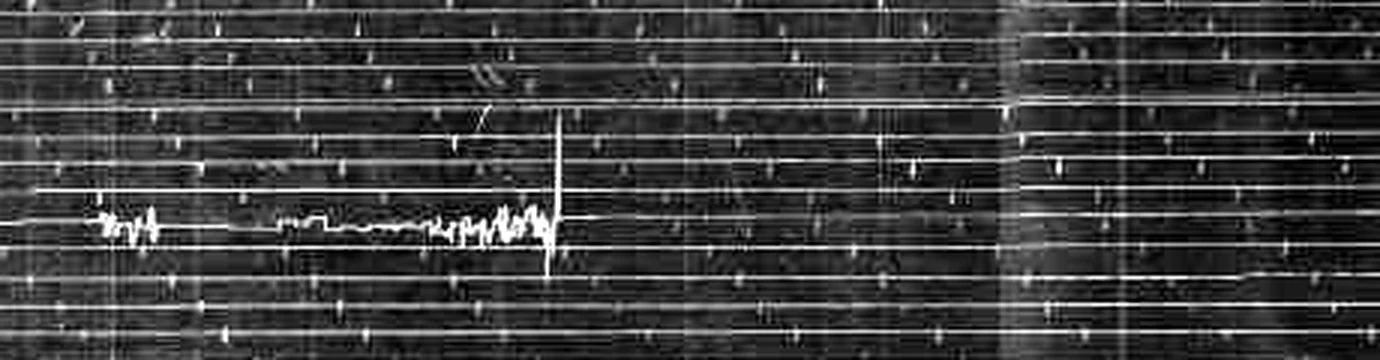


What the seismograph could record
For ground oscillations with periods much shorter than the pendulum's natural period, the trace approximates ground displacement. Very weak shaking could be hard to tell on the paper; even so, Hepites reported recordings of earthquakes nobody felt.
In large earthquakes the problem was the opposite: the trace crossed the lines of adjacent hours, as in 1908. On 10 November 1940 the station, which then had Mainka-type mechanical seismographs, logged the arrival of the first P wave; the styluses jammed in the first oscillations, and no S wave was recorded.
The same hill, another station
Station BUC of Romania's national seismic network stands today about 400 m from the observatory's position in the historical station lists. On this page its recordings from 2014, 2022 and 2024 are run through the Bosch pendulum: one crustal earthquake, about 41 km deep, and two of intermediate depth, about 149 and 128 km. How the deep Vrancea earthquakes are felt far away is on another page.
Sources and calculation
The ground acceleration comes from station BUC of Romania's national seismic network, run by the National Institute for Earth Physics (INFP): east–west and north–south components recorded at 100 samples a second, corrected for the instrument response, with frequencies below 0.02 Hz attenuated, then resampled to 20 a second. The pendulum is computed as an undamped oscillator, x″ + ω²x = −a, with the chosen period; its displacement is multiplied by 10 (east–west) or 15 (north–south) and drawn on paper moving at 0.25 mm/s. Stylus friction is unknown and not modelled. The drum turns here 20 times faster than in reality.
- Șt. C. Hepites, „Cutremurele de pământ din România în anul 1902”, Analele Academiei Române, Memoriile Secțiunii Științifice, s. II, t. XXV (1903), și „… în anul 1903”, t. XXVI (1904). dspace.bcu-iasi.ro · restitutio.bcub.ro The Bosch pendulums, mass, magnification, drum, the November 1902 installation (pp. 543–544; pp. 213–214).
- Arhiva seismogramelor INFP. archive.infp.ro Sheets 43 and 44 (6–7 October 1908, BS_1 and BS_2); the measurements on the scans are made here.
- National Institute for Earth Physics (1994), Romanian Seismic Network, doi:10.7914/SN/RO; stația BUC, serviciul FDSN. doi.org · eida-sc3.infp.ro Acceleration records (HNE, HNN) for 22 November 2014, 3 November 2022 and 16 September 2024; the event catalogue.
- R. Rădulescu (2008), istoria seismologiei românești. geodin.ro · E. Anghelache (2025), CRIFST. studii.crifst.ro The 1892 network, the 1895 station, the installation on Filaret Hill.
- Paulescu et al., baza de date a seismogramelor vechi din România. scispace.com; Euroseismos, catalogul României. storing.ingv.it The magnitude of the 1908 earthquake (6.8 / 7.1).
- Rudolph și Tams (1907), stațiile seismice; Bosch, catalogul nr. 20 (1907). iaspei.org · isc.ac.uk Periods of the Bosch pendulums at Strasbourg and Tiflis; the 15 mm/min paper speed.
- Buletinul seismic al stației București, 1940. isc.ac.uk The earthquake of 10 November 1940: the styluses caught in the first oscillations (pp. 34, 39).