One stone, one name
One stone, one name
Rese, daughter of Zvi
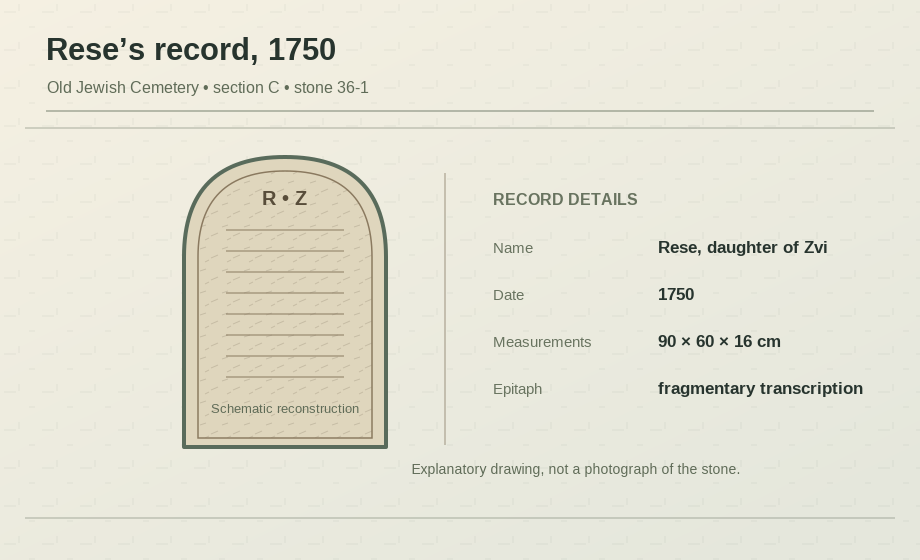
In the catalogue of Siret’s Old Jewish Cemetery, Rese, daughter of Zvi, appears on a stone dated 1750. The record locates it in section C, number 36-1, and gives its measurements: 90 centimetres high, 60 wide and 16 thick. The epitaph transcription is incomplete; the name and family relationship are what the catalogue can read. [1]
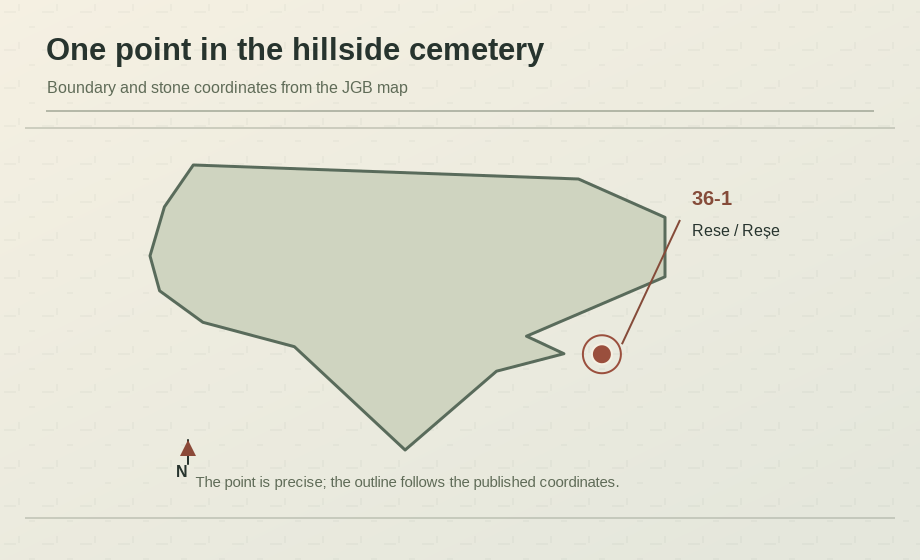
The Jewish Galicia & Bukovina record includes a photograph of Rese’s stone and its location on the cemetery map. Zusia Efron’s 1968 archival photograph shows another gravestone at Siret. [1] [5]
Two layers of the place
Two cemeteries, two histories
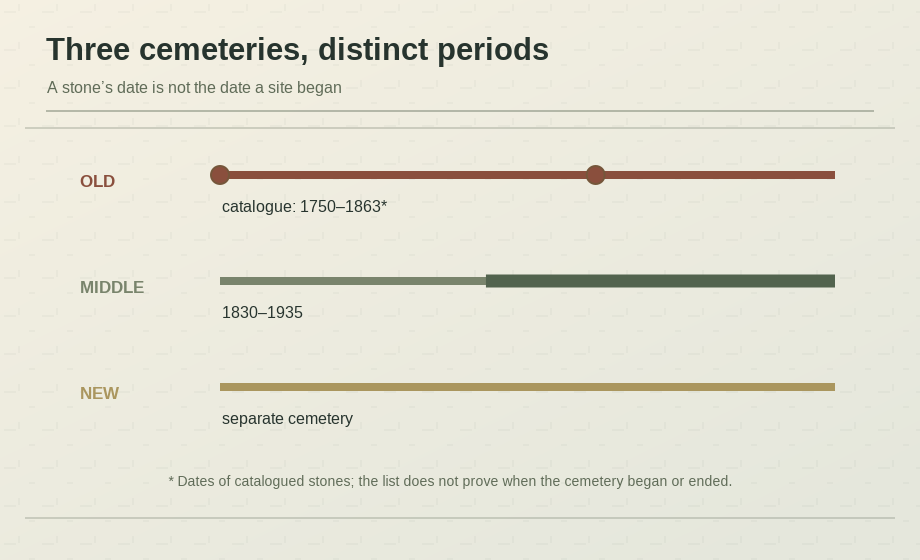
The Jewish Galicia & Bukovina team documented more than 300 surviving stones in the Old Cemetery in 2021 and 2022. The researchers say the site probably dates to the sixteenth century, but the catalogue’s earliest stones begin in 1750. Rese’s grave sits at the start of the documented sequence, not at a proven beginning of the cemetery. [2] [3]
Siret also has a Middle Jewish Cemetery, used from 1830 to 1935, where the same team documented about 1,300 stones. It is a separate burial ground, even though some sources also call it the historic part of the New Cemetery. Keeping the two timelines apart matters: an inscription in one site does not automatically date the other. [3]
Families in the records
Growth and coercion
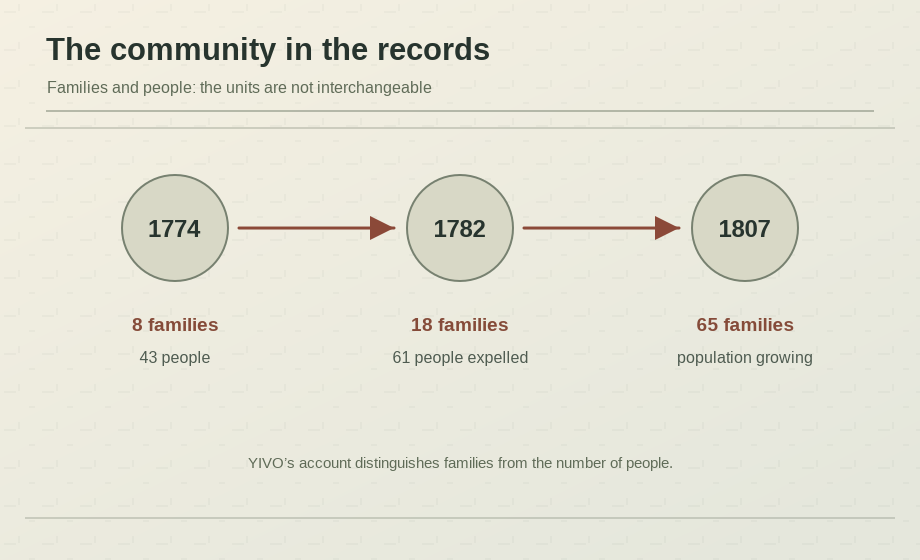
In 1774, when Austrian troops occupied Bukovina, a register listed eight Jewish families and 43 people in Siret, according to YIVO’s account. In 1782, the Austrian administration ordered the expulsion of 18 families, 61 people. Those who remained were compelled to give up traditional professions and take up farming, the author writes. [4]
By 1807, the account counted 65 Jewish families. In 1880 it records 3,122 Jewish residents out of a total of 7,240. The first record counts households. The second shows how many people lived in the town and how many were Jewish. [4]
The town of the community
Shops, schools and public office
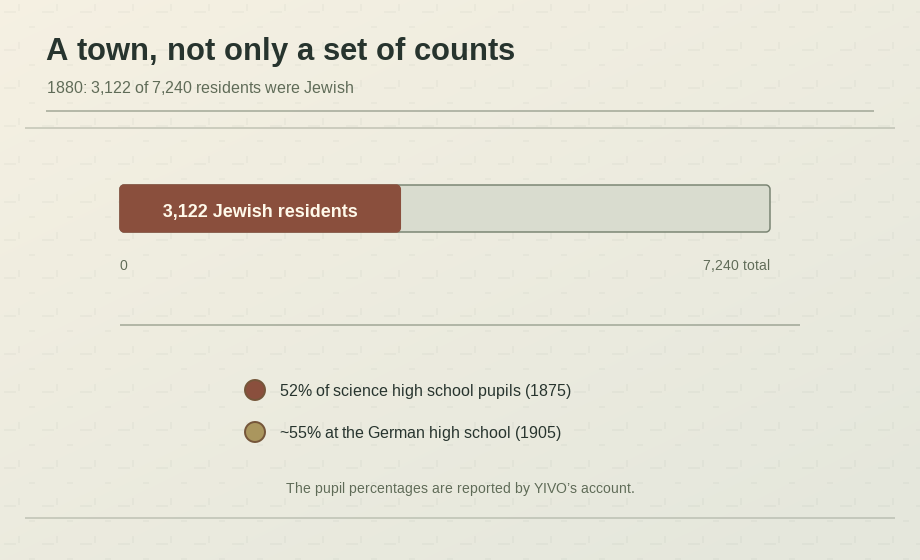
In 1880, Jews numbered 3,122 of Siret’s 7,240 residents—about 43% of the total, calculated from figures published by YIVO. The account describes shops, workshops and inns in the urban centre, as well as one synagogue and eight prayer houses after the community gained autonomy shortly after 1850. [4]
Schools form part of the same history. YIVO records that Jewish pupils made up 52% of the science high school founded in 1875 and about 55% of the German high school in 1905. In 1912, a Jewish resident was elected mayor. The percentages and public office show the community’s role in town life; they do not mean every Jewish resident had the same experience or position. [4]

1941
From evacuation to deportation
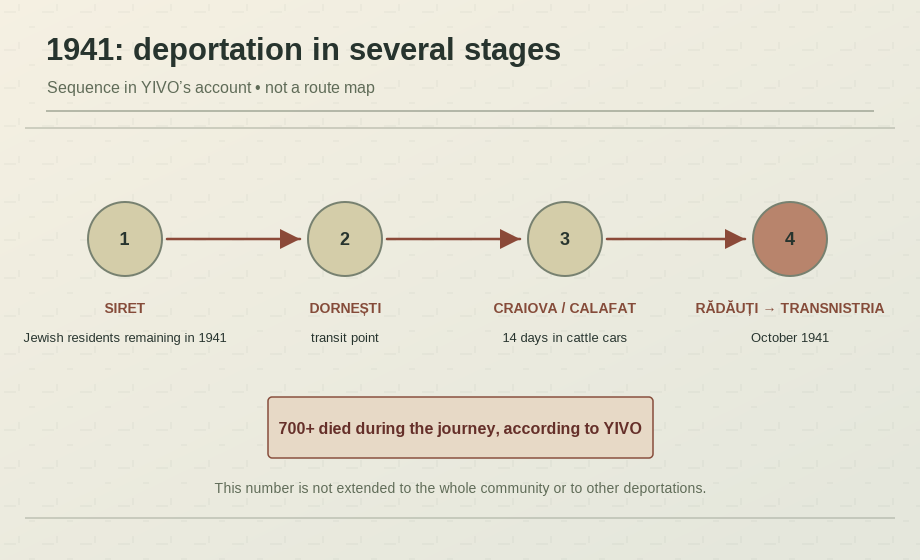
In 1930, Siret had 2,121 Jewish residents out of 9,905. By 1941, 1,614 remained, according to YIVO’s account. Romanian authorities forced them to march to Dornești in Bukovina. After 14 days in cattle cars, they reached Craiova and Calafat. In October 1941, they were sent via Rădăuți to camps and ghettos in Transnistria. [4] [7]
YIVO records that more than 700 people from the town’s Jewish community died along this route through massacres, starvation and disease. Survivors were repatriated in 1944. Many never returned to Siret. [4]
Memory today
A regional memorial, one particular town
After repatriation, some survivors did not return. YIVO estimates Siret’s Jewish population at about 1,700 in 1947 and records continued emigration; the same account says the town’s last Jewish resident died in 2002. These dates describe the disappearance of a local community, not the end of Jewish life in the region or in Romania. [4]
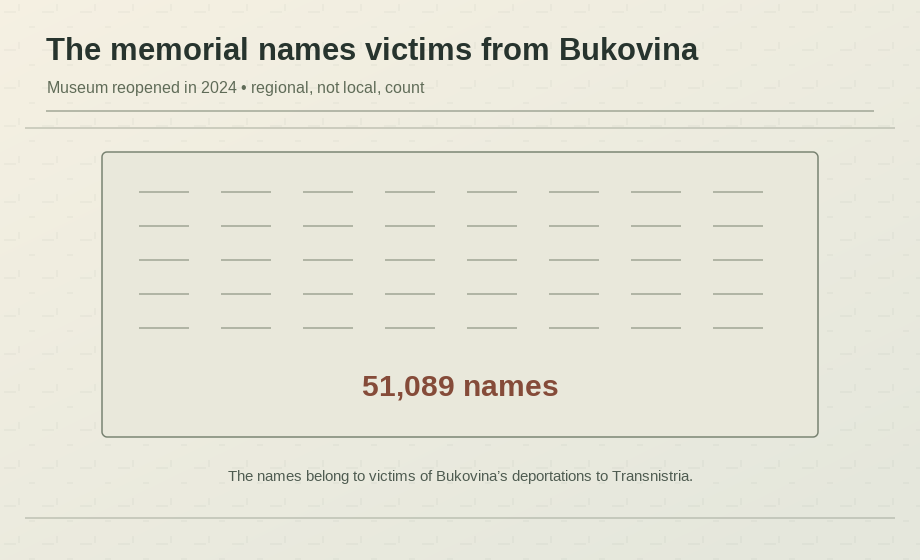
Siret History Museum reopened in 2024 with an exhibition on the town’s history, the Holocaust in Bukovina and Jewish emigration. Its exterior memorial bears 51,089 names of victims of deportations to Transnistria, a regional figure. It is not a count of deportees from Siret; keeping those numbers separate places local memory in the wider context of Bukovina. [6]