Bacău County · The Slănic Valley
Slănic-Moldova: the valley of numbered springs, and what the laboratory measured in each glass
The town counts more than 20 mineral springs in the Slănic valley. The profile here shows 11 mapped stops; seven of them were analysed in a laboratory, on January 2021 samples, ion by ion. Take a 200 ml glass and follow the valley along the profile: at those seven, the glass fills with what the laboratory found.
11 stops on the profile · seven laboratory analyses (2021) · one 200 ml glass
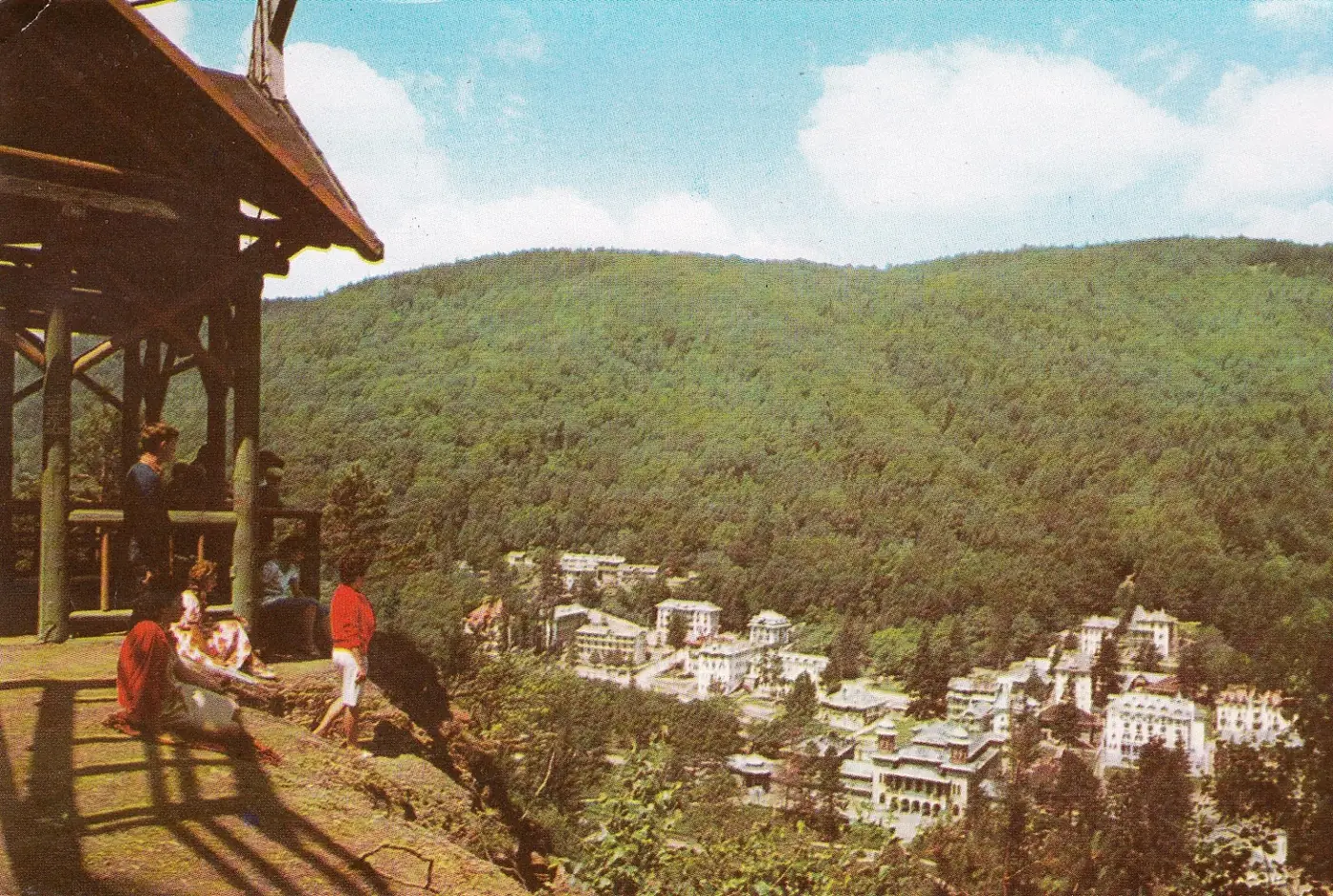
The valley, step by step
The profile follows the valley along the water: 693.5 metres measured in straight segments between stops, from Sfântul Spiridon to Sonda 2. Distances come from coordinates, the valley surface from the terrain model — estimates, drawn with heights doubled against lengths; the underground is a schematic. Walk on: at seven of the stops, the glass fills with the 2021 analysis.
Sfântul Spiridon: the humble spring
The first on the way is the only unnumbered stop on this profile: it shares its name with the Iași hospital whose trust, the Epitropia, administered the baths. In January 2021 the laboratory found 10.71 mg of sodium per litre in it — the least of the seven analysed springs. Each glass gets its verdict at the glass.
By the lower pavilion: 6, 1, 8
About a hundred metres further on stand springs 6, 1 and 8. The town puts springs 1, 8 and 8 bis in one pavilion; the position of 8 bis is unverified, so it is missing from this profile. Spring 1 — “Mihail”, for the steward who found it in 1801 — is, on the town's list, sulphurous, sodic, hypotonic water; spring 6 carries the town's warning: “very high concentration”.
The upper pavilion: 10, 1 bis, 3
Across the alley, the second pavilion: 10, recorded between 1805 and 1820; 1 bis, found in 1874, rising from the rock at Piciorul Boroișului; and 3 — the “King of the Mineral Springs”, hypertonic on the town's list. Walk on: next come the neighbours that do not match.
5 and 14: the neighbours that do not match
Spring 5, in use since 1807, is listed by the town for external use: oligomineral and ferruginous; its 2021 measurements still enter the glass comparison. 20 metres away, on the other bank, 14 — in use since 1958 — was the most mineralised of the seven sampled springs: 4,438 mg of sodium per litre, 414.4 times as much as Sfântul Spiridon, the lowest-sodium spring in the sample.
15: through the Kliwa sandstone
The borehole of 15 first cuts the Kliwa sandstone horizon, then the Lower Oligocene horizons. The water rises carbonated, bicarbonated, sodium-chloride and ferruginous, in the 2023 study's characterisation. Further on, the valley narrows toward the last spring.
Sonda 2: 70.90 metres down
The end of the profile: a 70.90-metre shaft, officially approved (homologated) in 1980, beside the trout farm. From below, the water rises pure alkaline and hypotonic, at pH 8.1 — and, among the six springs in the storage study, with the smallest variations. Follow the shaft down with your eyes: that is the water's road to the surface.
The valley's breath
Rain and snowmelt from Pufu and Piciorul Dobrului sink through sandstones and shales and dissolve salts — and through cracks in the crust they meet carbon dioxide: “a distant breath of the mofettes”. Here ends the 693.5-metre profile; the audit of the glasses comes next.
What the profile shows
The profile follows the valley along the water: 693.5 metres measured in straight segments between stops, from Sfântul Spiridon to Sonda 2. Distances come from coordinates, the valley surface from the terrain model — estimates, drawn with heights doubled against lengths; the underground is a schematic. Walk on: at seven of the stops, the glass fills with the 2021 analysis.
Three glasses and the laboratory's verdict
Pick three of the seven analysed springs. Each glass fills with the values measured on the January 2021 samples, and the lines mark comparison values chosen from the study: sodium 200 mg/l, manganese 0.5, iron 0.3, fluoride 5.0 (each one's source, in the method). The verdict — “drinking water” or not — is the laboratory's, for the 2021 samples, not the page's; present-day potability is not verified here. The 1981 and 2006 values are historical records compiled by the study; sampling and techniques may differ.
The 1981 and 2006 values are historical records compiled by the 2022 study; sampling and techniques may differ. The verdict stays the 2021 one.
The study's verdicts (January 2021 samples)
From a deer to the Pearl of Moldavia
The story is told from the town's own pages and from the studies that date the springs. What could not be verified — names, years, inaugurations — stayed out; the list is in the method.
The valley is first named in Prince Constantin Cehan Racoviță's charter of 1 January 1757, “hill where salt is dug” included; the estate later passes to the Epitropia of the Sf. Spiridon hospital in Iași — the church trust that ran the hospital.
In 1801, Serdar Mihalache Spiridon — steward of the salt works at Târgu Ocna — chases a deer through the empty valley, rests on a rock and sees a spring gushing from the stone, leaving a yellowish trail to the river. He tastes it, marks the spot with branches and sends the water to friends in Ocna for analysis. So the town tells it, after the writer Wilhelm de Kotzebue, who spent the summer of 1885 at Slănic.
Clearing the ground, the serdar finds a second spring beside the first, “different from it in taste”. Between 1804 and 1807 he finds springs 3, 4 and 5 and cuts a bridle path to them. Spring 1 long carries his name: “Mihail”.
Around 1808, the serdar asks leave to move 12 rufetași families — salt-work peasants — into the valley, free of taxes for ten years, to tend the springs and the guests. A small church, rooms and baths (feredeie) rise in 1810; in 1812 the first patients arrive, “two or three”; in 1816, Metropolitan Veniamin Costache; around 1820, about 40 rooms.
In 1824 comes the princely privilege for the baths. Prince Ioniță Sandu Sturza raises the colonists to 27 in 1826, Prince Mihail Sturza to 50 in 1836 — with rooms free of rent for up to 30 poor patients, six rooms the baths' contractor had to build for them. Meanwhile peasants from the Oituz valley found Cerdac and Satu Nou. In 1840 the resort first appears on the country's map: “Feredeiele Slănicului”, the Slănic baths.
In 1846 the Moldavian Assembly passes the baths, forests and springs to the Epitropia of St. Spiridon; Prince Grigore Ghica confirms the gift in November 1851. In 1852 the pharmacists Zotta and Abrahamfi run partial analyses; in 1856 the protomedicus Ludwig Steege — with the chemists Schnnel and Stenner — completes the full study and sets the waters beside famous European spas, from Vichy and Karlsbad to Spa.
The medals follow: silver at Frankfurt am Main in 1881 — for springs 1, 3 (“the king of Slănic”) and 4 — gold at Bucharest in 1894 and at the Paris Universal Exposition in 1900. The town ties the nickname to the exhibition years: “From then it was nicknamed the “Pearl of Moldavia””.
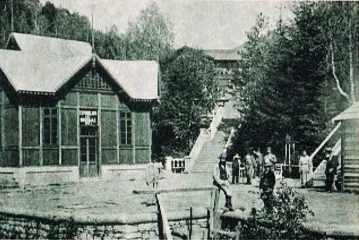
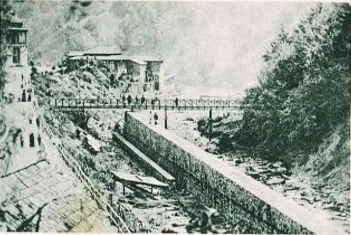
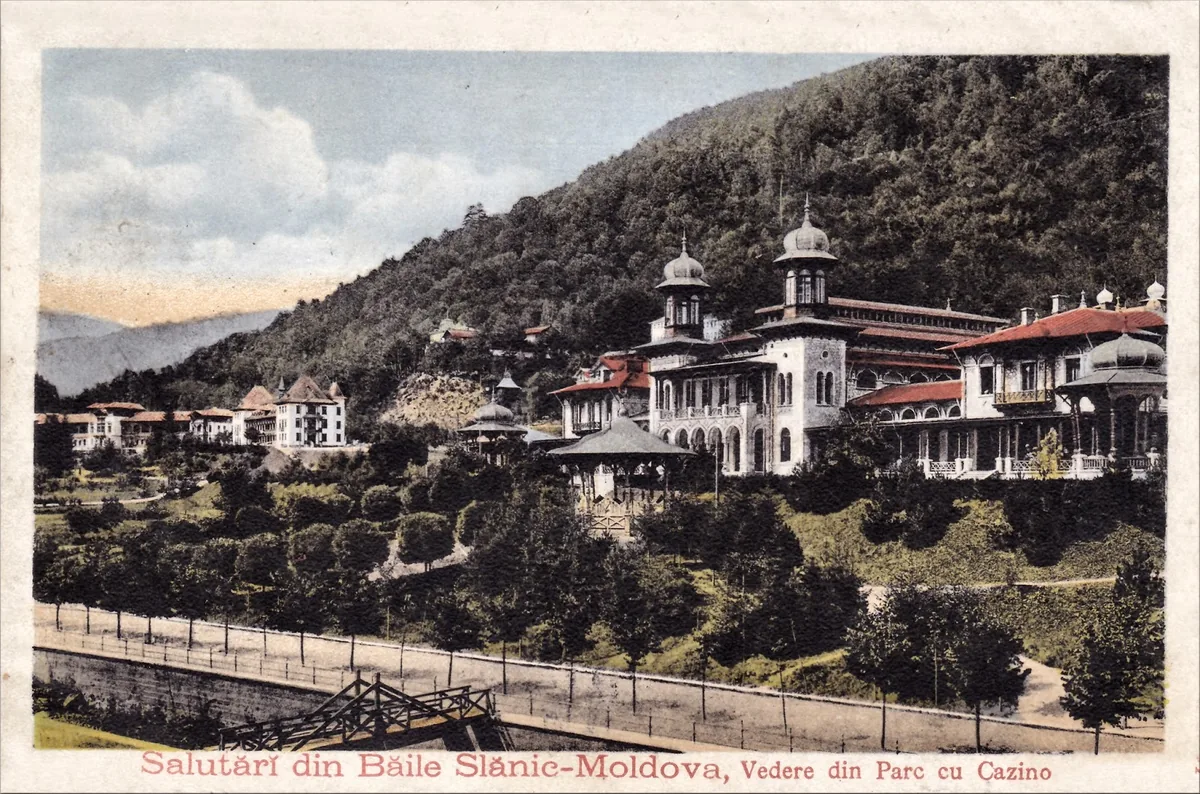
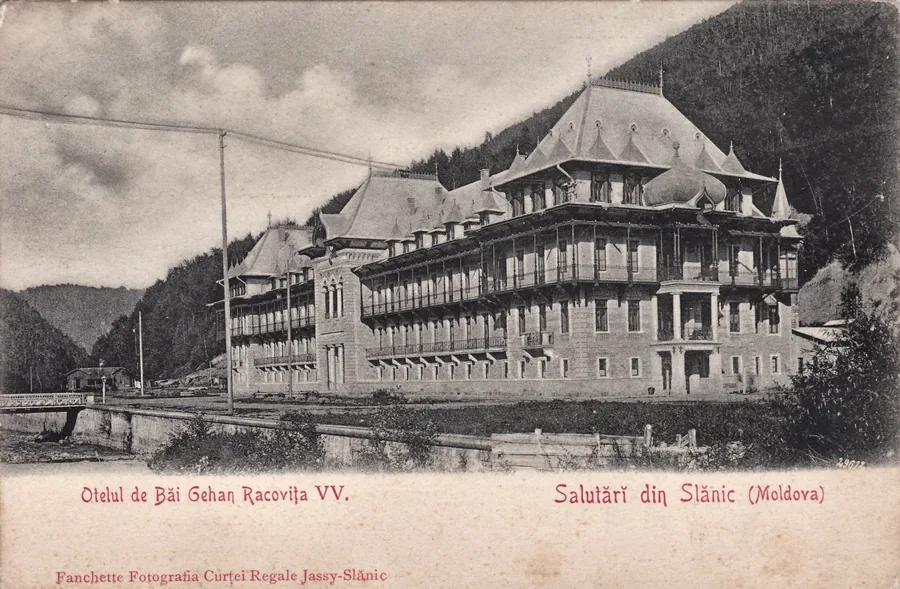
From 1887 the resort is laid out on a plan: the new building of 1887–1912 brings the Racoviță hotel and six more hotels, a park, the training of the Slănic river, capped springs, a power plant — with Italian masons and valley stone. The Adjud–Târgu Ocna railway opens in 1888, the road with four iron bridges in 1890, and the Casino — Art Nouveau, architect George Sterian, 1,847 sqm — rises in 1892–1894.
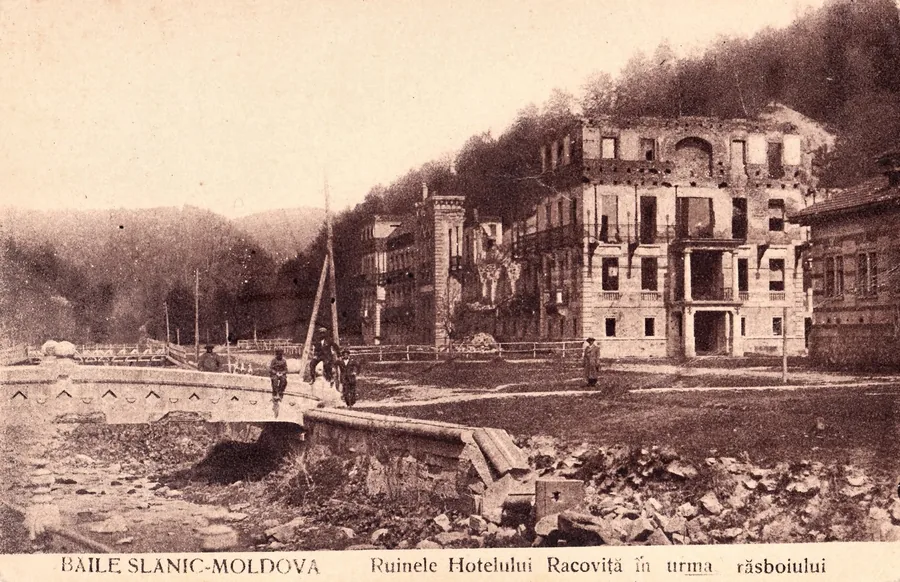
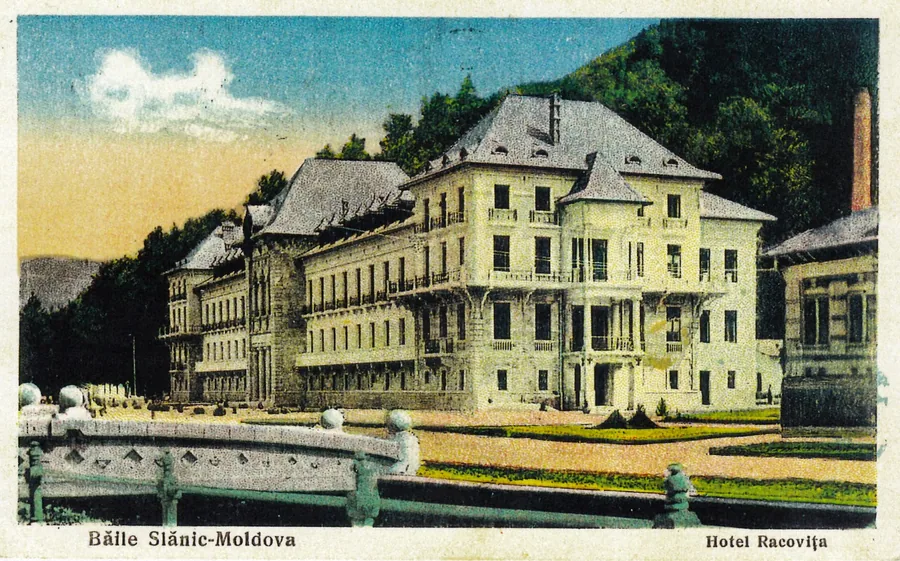
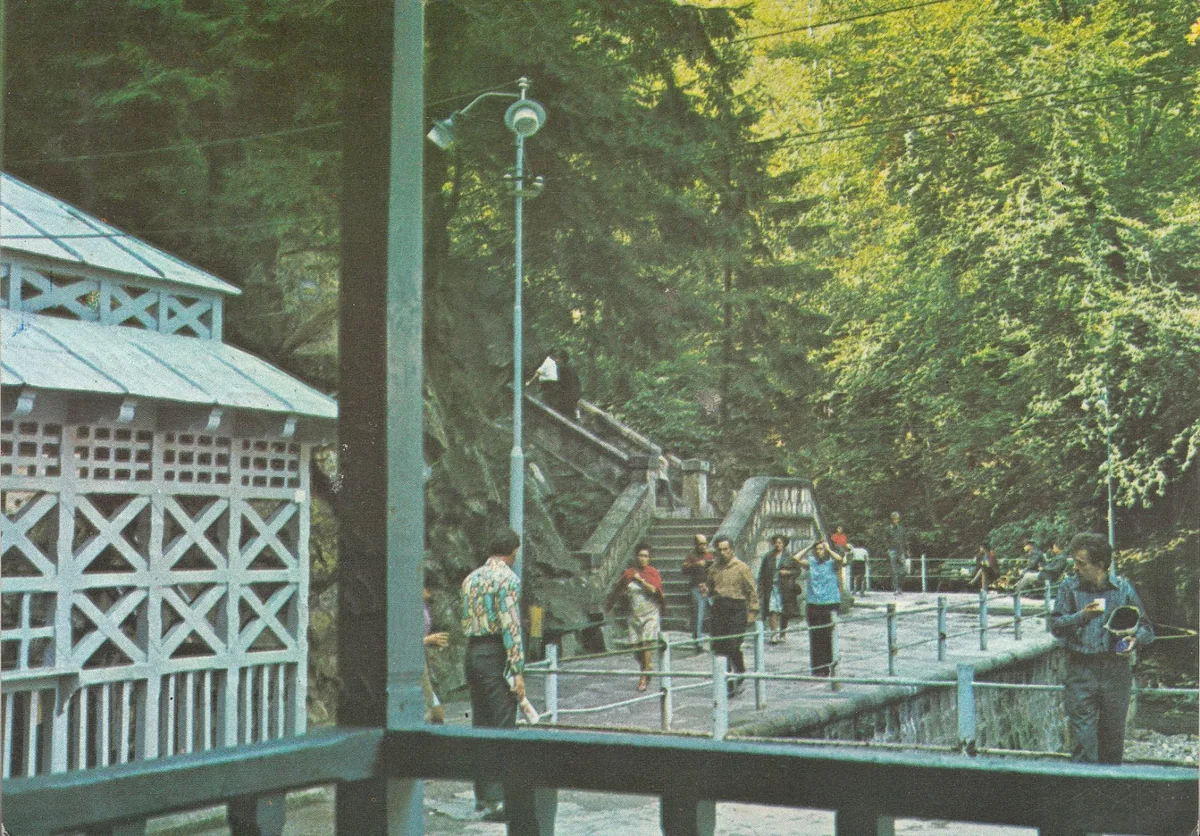
The years 1916–1918 turn Slănic into a ruin: fighting over Cerbu and Pufu, artillery, a German headquarters at the Racoviță. In 1932 the hotel was still a ruin; rebuilding starts late and the resort is only partly remade, and after the 1948 nationalisation the resort expands — sanatorium, clinic, modernised spring captures, a mofette — and in 1974 it is declared a resort of international interest.
Why they taste different
The names on the plaques are adjectives with thresholds in Munteanu's balneology reference (2013): each means a concentration. The town and the studies keep their own classifications, though, so a plaque label does not always check out against the book's threshold. And the waters fall into three families — on the 2022 study's diagram, four springs resemble each other (1 bis, 10, 14, 15), 5 and Sonda 2 make the bicarbonate pair, and Sfântul Spiridon stands alone.
- carbonated at least 1,000 mg of CO2 per litre
- sulphurous at least 1 mg of sulphur compounds per litre
- ferruginous at least 10 mg of iron per litre
- iodinated at least 1 mg of iodine per litre
- oligomineral under 1 g of dissolved solids per litre
- sodium-chloride over 1 g of salt per litre; over 14 g — hypertonic
→ Romania's mineral springs: why water tastes of iron or eggs
Spring 1 is, on the town's list, sulphurous, sodic, chloride-bearing, carbonated, bicarbonated, iodinated, hypotonic water; spring 3 carries the “King” title. Springs 6 and 10 share one town characterisation — iodinated, sodic, chloride-bearing, bicarbonated, hypertonic. Of spring 8 the town writes that it “increases gastric secretion but does not alter hydrochloric acid”. All from the town's list; no cure advice here.
The Ciuget spring is “water unique in the country”, the town says: alkaline, slightly chloride-bearing, carbonated, hypotonic. No published position is known for it, so it is not on the valley profile — only here, in the town's words.
Missing from the walk: springs 2, 4, 7, 9, 11, 12 and 13 and the Cascada have no dated analysis or no published position — some neither. OpenStreetMap also marks a spring called “300 de scări”, outside this profile and with no analysis in the 2022 study. The profile holds 11 mapped springs, the glass the seven analysed ones; the rest await a dated analysis.
Method and limits
Where the figures come from, what they cannot say, and what was refused.
The analyses are the 2022 study's, from the “Vasile Alecsandri” University of Bacău: 38 parameters on seven springs — 29 elements by ICP-MS — by conductometry, pH-metry and UV-Vis spectrometry. The plotted positions come from OpenStreetMap; the same team's 2023 study describes six of the springs — banks, commissioning dates, Sonda 2's depth. The profile surface comes from the Terrarium terrain model.
The comparison across 1981, 2006 and 2021 is the study's own — the old columns come from a 1981 tourist guide and a 2006 hydrogeochemical study — and its caution is printed here and beside the year controls: climate, exploitation, sampling and analysis techniques differ; comparability is not established.
The glass computes the 200 ml load — milligrams per litre times 0.2 — and how many times each value crosses the comparison values chosen from the study: sodium 200 mg/l (a European labelling criterion and a WHO value, per the study's notes), manganese 0.5 (the allowed level in the study's methods table and the European maximum for natural mineral waters; the study's other table notes also print 0.05, the drinking-water value — the study itself calls 1.15–1.72 only “slightly higher”, which fits 0.5), iron 0.3 (the methods table), fluoride 5.0 (the mineral-water maximum; the European drinking-water parameter is 1.5). The “sum of measured substances” adds the laboratory-reported analytes for each spring (12, dissolved CO2 included; at Sonda 2, 11 — manganese is missing from the study's table); it is a floor under everything dissolved, not a total.
The verdicts are the study's, for the January 2021 samples: only Sfântul Spiridon “has all the physicochemical qualities of a drinking water”; the rest “do not meet the evaluation criteria for drinking water”. The tension inside the study stays visible: Sfântul Spiridon crosses the fluoride line, 17.00 against the 5.0 benchmark — 3.4 times — and the verdict stays as printed. Present-day potability is not verified for any spring.
One misprint was corrected in the open: spring 10's manganese appears in the study's text as “1.55 g/L” — it is mg/l, as in the table and the series. The gold medal “from Vienna, in 1833”, in the town's history, could not be verified as a year, so Vienna's year is missing.
The elevations in the 2023 study's table were not used to place the profile: at the old springs they sit about 30 metres under the terrain model and do not rise monotonically along the valley. The disagreement stays unresolved; the profile's heights are terrain-model estimates, and its underground is a schematic, not a survey.
No cure advice is given here and no diseases to treat are named: the town's indications are quoted as the town's indications, nothing more. Names, years and inaugurations without cover — 1839 christenings, the inscription at 6, the 1895 inauguration, the plaque at 1 — stayed out.
The storage study (six springs, 360 days) shows how much glass and cold matter: in glass at 4 °C the pH moved by 0.1–0.2 units; in PET at room temperature, spring 5 rose from 4.6 to 7.4. The whole profile is 693.5 metres in straight segments — on the ground, look for the numbered plaques and read the taste from the figures.
Sources
The analyses, the positions and the story — each with its papers in view.
- Misaila, L. et al., “Perspectives for Quality Evaluation of Some Mineral Waters from Slanic Moldova”, Water 14 (2022) 2942, DOI 10.3390/w14192942 (CC BY 4.0) — the 2021 analyses, the 1981 and 2006 comparisons, the benchmarks and the verdicts.
- Misaila, L. et al., “Eco-friendly and efficient monitoring… — a case study”, Ovidius University Annals of Chemistry 34 (2023) 72–82, DOI 10.2478/auoc-2023-0010 — positions, banks, aquifers, datings, the storage study.
- Slănic-Moldova Town Hall: Izvoarele minerale, Istoric, Date geologice, Date geografice, Monumente istorice (in Romanian) — the spring list, characterisations, the resort's history, the geological mechanism.
- Constantin Munteanu, Ape minerale terapeutice, Editura Balneară, Bucharest 2013 (in Romanian) — the adjectives' thresholds: carbonated, sulphurous, ferruginous, iodinated, oligomineral, sodium-chloride, hypertonic.
- OpenStreetMap (ODbL) — spring positions, the Slănic stream, the alleys; the Terrarium terrain model (AWS Terrain Tiles) — the profile surface.
- Pictures: Wikimedia Commons (public domain) — each file page carries its author and licence: the 1965 panorama, spring 1 in 1980 (I. Gogioiu), above spring 1, the Casino before 1916, the Racoviță hotel before the war, the bombed hotel, the repaired hotel, the springs in 1872, the road in 1872; captions carry the credit.
Every figure printed here was recomputed from the study's tables.