Marius ComperSmulți, Galați County
Română

Smulți

Smulți. The missing bag of coins

A teacher gathered coins with his pupils, then said that a bag containing coins and an old document disappeared in Galați. The story leaves a more important question: which of the coins actually came from Smulți?

Start the story ↓
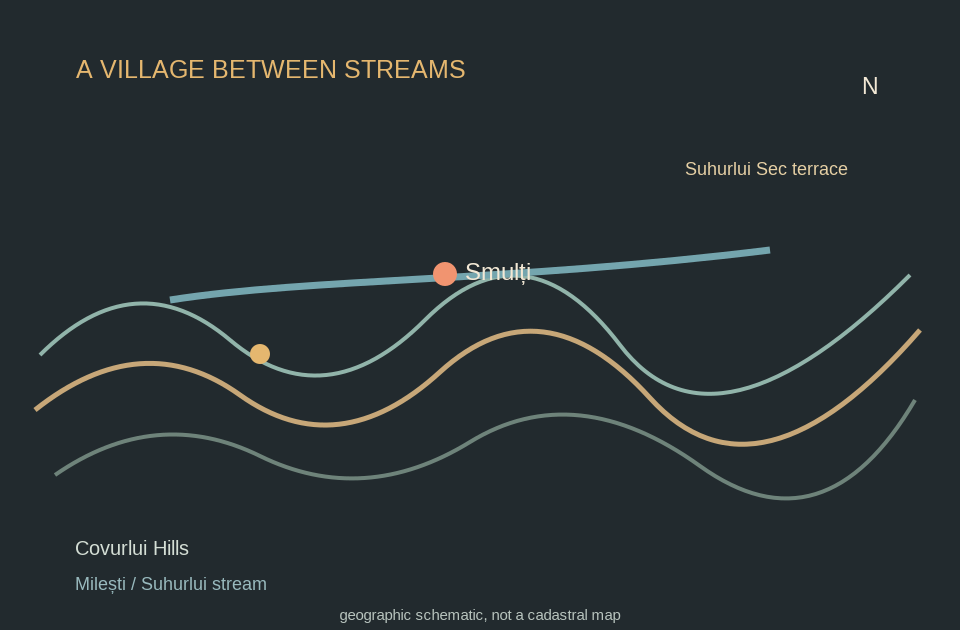
Croitoru places the village at the headwaters of the Milești / Suhurlui stream, in the Covurlui Hills.
Croitoru places the village at the headwaters of the Milești / Suhurlui stream, in the Covurlui Hills. (Source · Original editorial drawing based on the cited source; not a facsimile)

The place

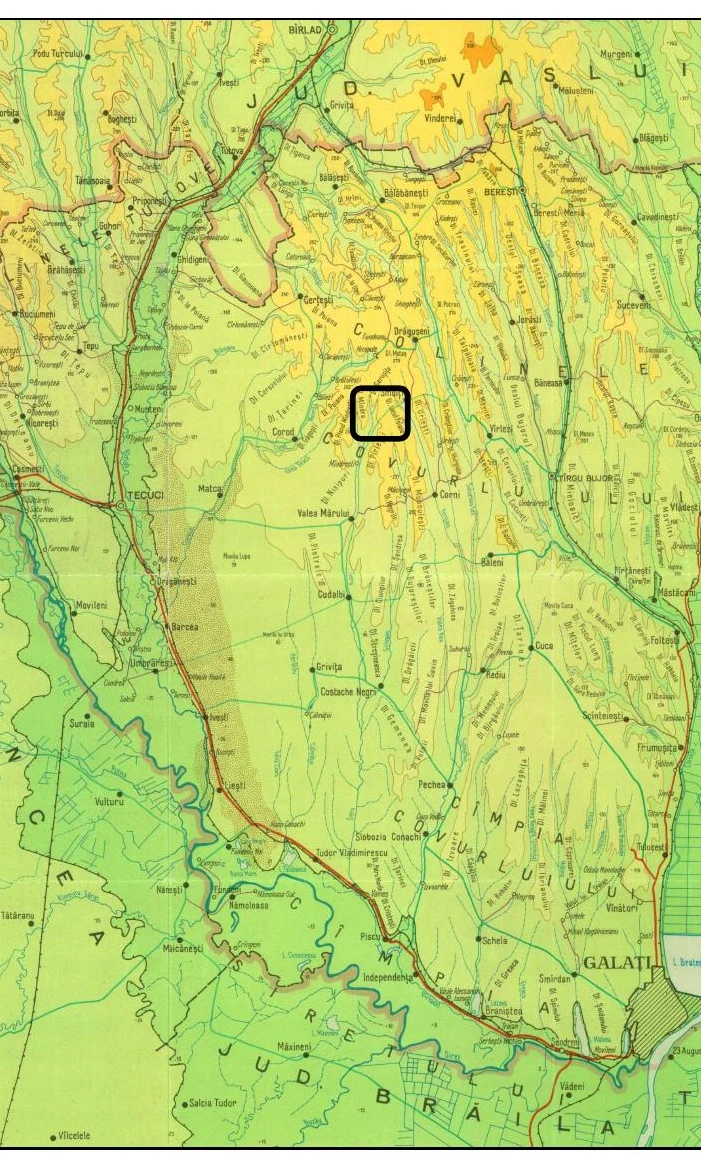
In Costin Croitoru’s article a square marks the village on a county map. It locates the village, rather than the coin findspots.
In Costin Croitoru’s article a square marks the village on a county map. It locates the village, rather than the coin findspots. (Source · Acta Musei Tutovensis XII, 2016, p. 118)

The place

Smulți, among hills and headwaters

Smulți lies among the narrow ridges and valleys of the Covurlui Hills. Historian Costin Croitoru places the village at the headwaters of the Milești stream, also called Suhurlui. The forests that once covered the area formed part of the Bârlad woods. [1]

This story follows several records of finds across the commune and a coin collection assembled at the local school. The archaeological locations are scattered; the map coordinate marks the village, not an excavated site. [3] [1]
In Costin Croitoru’s article a square marks the village on a county map. It locates the village, rather than the coin findspots.
In Costin Croitoru’s article a square marks the village on a county map. It locates the village, rather than the coin findspots. (Source · Acta Musei Tutovensis XII, 2016, p. 118)
Croitoru places the village at the headwaters of the Milești / Suhurlui stream, in the Covurlui Hills.
Croitoru places the village at the headwaters of the Milești / Suhurlui stream, in the Covurlui Hills. (Source · Original editorial drawing based on the cited source; not a facsimile)
The coordinate locates the village for orientation. The research discussed in the article concerns several locations across the commune.
The coordinate locates the village for orientation. The research discussed in the article concerns several locations across the commune. (Source · Original editorial drawing based on the cited source; not a facsimile)

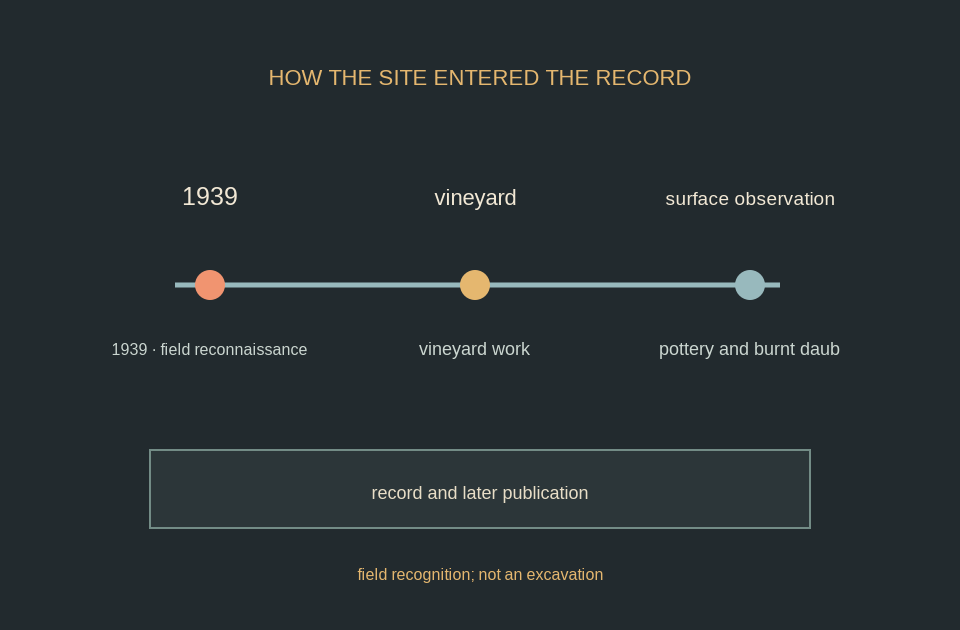
1939 · the first record

Vineyard work brought sherds to the surface

In 1939, archaeologist Mircea Petrescu-Dîmbovița travelled through the former Covurlui district. For Smulți, the 2016 article quotes a record saying that teacher Huzum noticed remains during vineyard work, on a terrace above the Suhurlui Sec stream. [1]

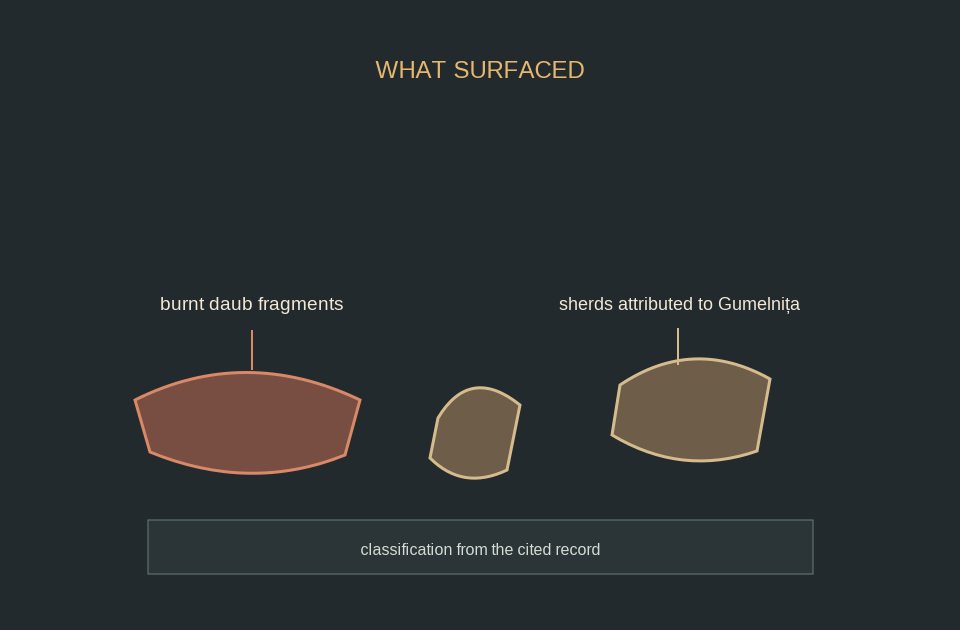
The record mentions burnt daub and pottery attributed to the Gumelnița culture. This was a surface observation, not an excavation that exposed a house or preserved the objects’ order in the ground. [1]
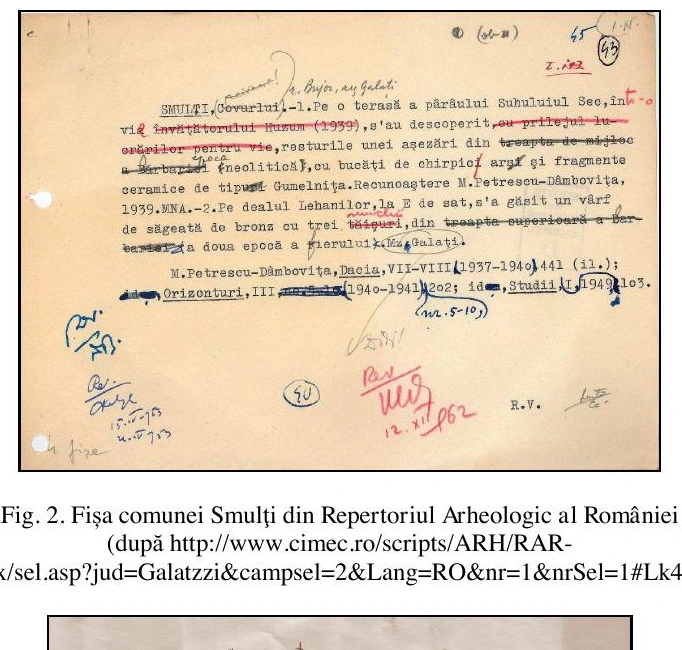
The index card for Smulți, reproduced by Croitoru. Its annotations show that the record was added to over time.
The index card for Smulți, reproduced by Croitoru. Its annotations show that the record was added to over time. (Source · Acta Musei Tutovensis XII, 2016, p. 119)
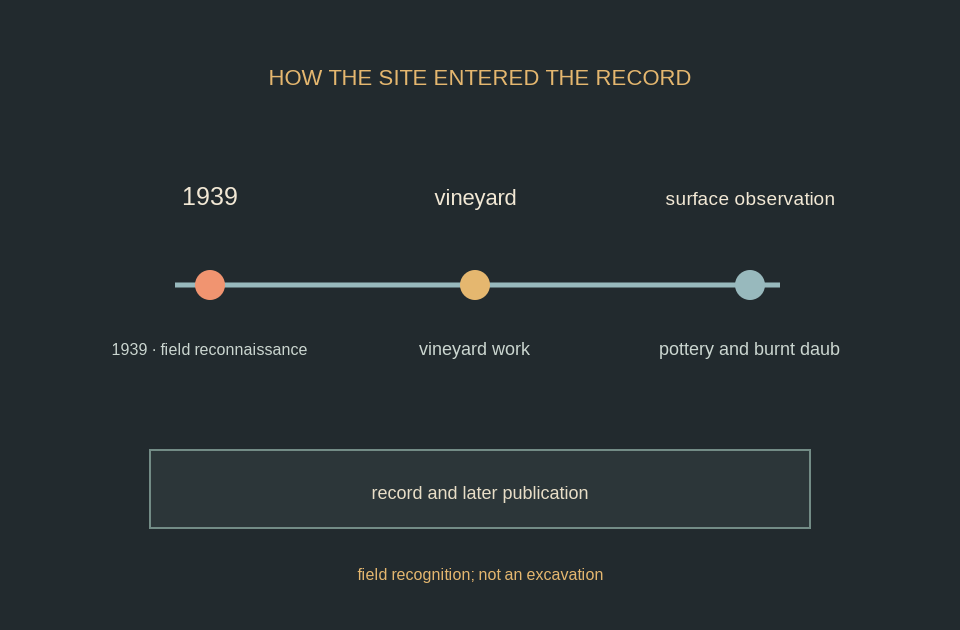
The record reproduced in the article links the discovery to vineyard work in 1939.
The record reproduced in the article links the discovery to vineyard work in 1939. (Source · Original editorial drawing based on the cited source; not a facsimile)
The older account mentions burnt daub and pottery; it provides no excavation plan or stratigraphy.
The older account mentions burnt daub and pottery; it provides no excavation plan or stratigraphy. (Source · Original editorial drawing based on the cited source; not a facsimile)

Pottery · classification

A cultural label cannot replace excavation

The archaeological record quoted in the article calls the site “middle Neolithic” and associates its pottery with Gumelnița. Croitoru, following later archaeological literature, describes an Eneolithic settlement of the Stoicani-Aldeni aspect. The terms come from different authors’ classification systems. [1]

Neither label tells us what a house looked like or how many families lived there. The article says the settlement has not since been checked or investigated, so the drawing leaves the sherds as fragments instead of turning them into a complete vessel. [1]
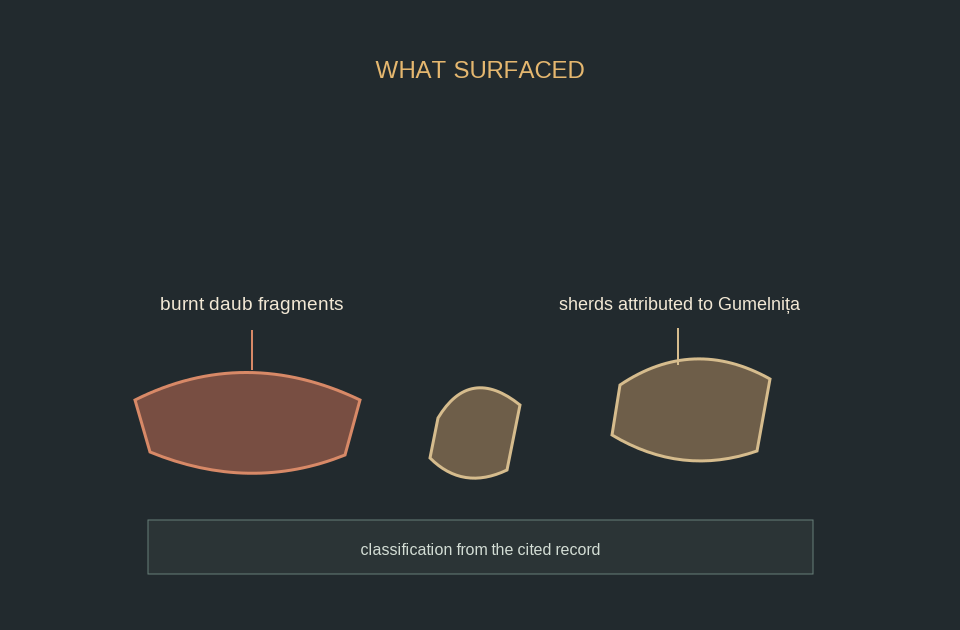
Explanatory drawing of the categories named in the record; it does not reproduce surviving artefacts.
Explanatory drawing of the categories named in the record; it does not reproduce surviving artefacts. (Source · Original editorial drawing based on the cited source; not a facsimile)
The older record says “middle Neolithic” and Gumelnița; the 2016 study describes the site as Eneolithic and Stoicani-Aldeni.
The older record says “middle Neolithic” and Gumelnița; the 2016 study describes the site as Eneolithic and Stoicani-Aldeni. (Source · Original editorial drawing based on the cited source; not a facsimile)

1970s · fieldwalking

Five places, five different histories

A typed 1989 thesis excerpt, quoted in Croitoru’s study, records fieldwalking in the south of the commune by Constantin Doca-Trîncu and Nicolae Ifrosie. It names five locations: Râpa Galbenă, Valea Stânii, Mărăcinișul, Podul de la Saivane and Gornești. [2]

The list brings together pottery from different periods and a skeleton found in 1978. Croitoru says these observations change the commune’s archaeological picture, but he cannot tell whether they connect to the coins attributed to Smulți. The drawing shows only distances and directions stated in the text. [1] [2]
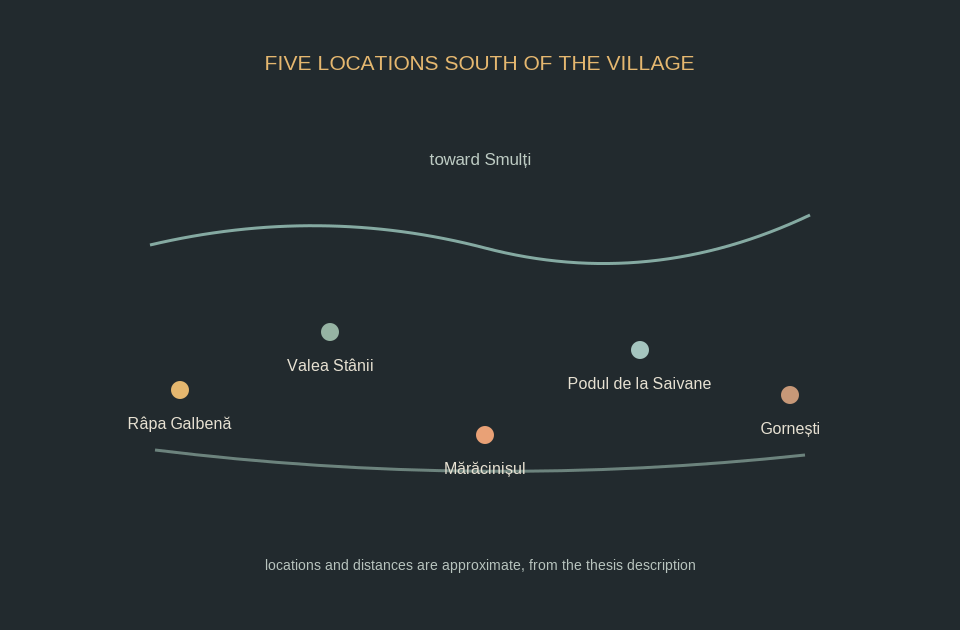
Locations are schematic, based on distances in the 1989 thesis excerpt.
Locations are schematic, based on distances in the 1989 thesis excerpt. (Source · Original editorial drawing based on the cited source; not a facsimile)
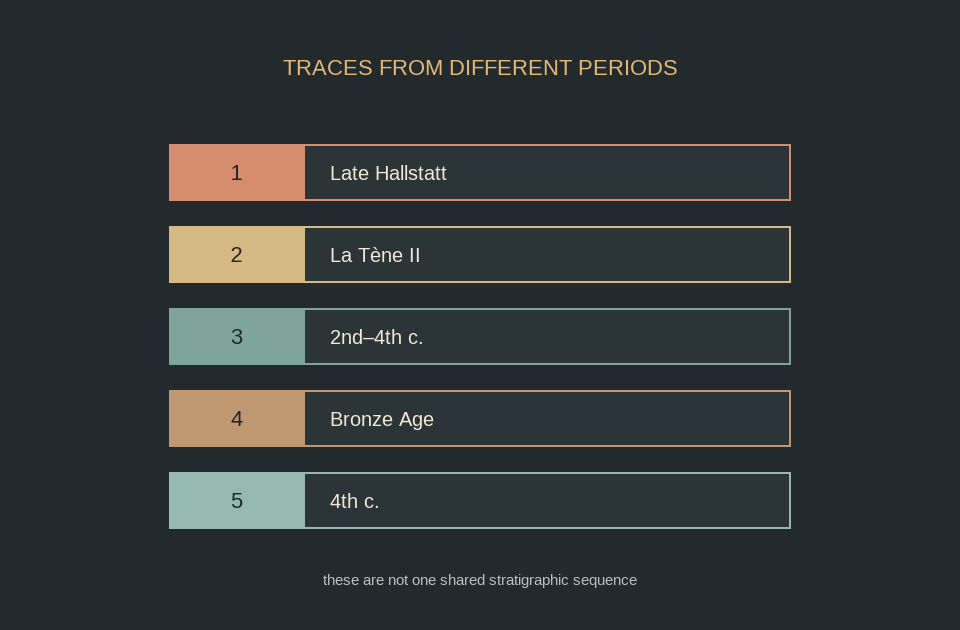
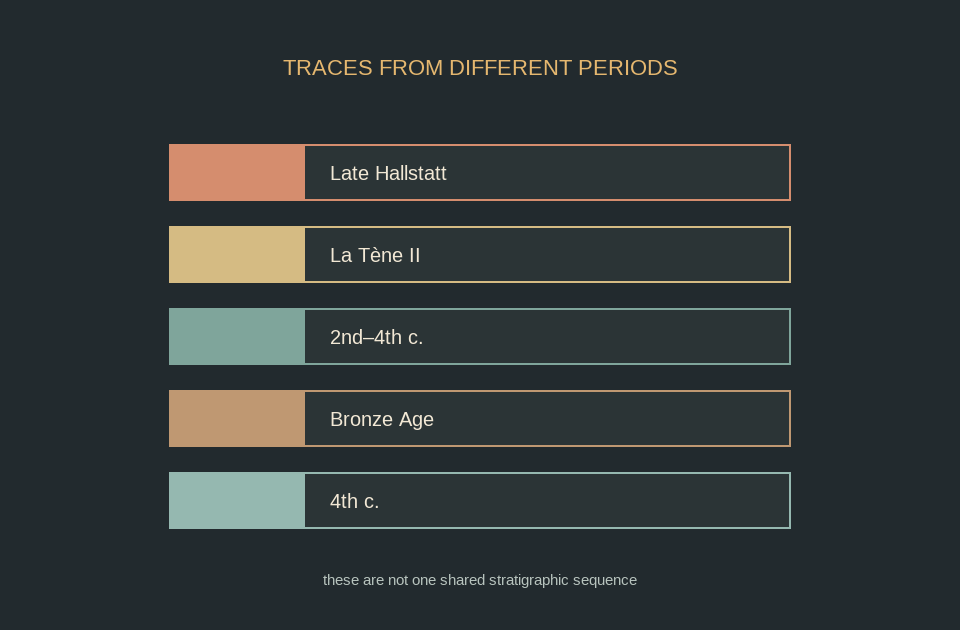
Some of the periods recorded for sites south of the village. One site can have more than one period.
Some of the periods recorded for sites south of the village. One site can have more than one period. (Source · Original editorial drawing based on the cited source; not a facsimile)

The school at Smulți

The coins entered the catalogue through a collection

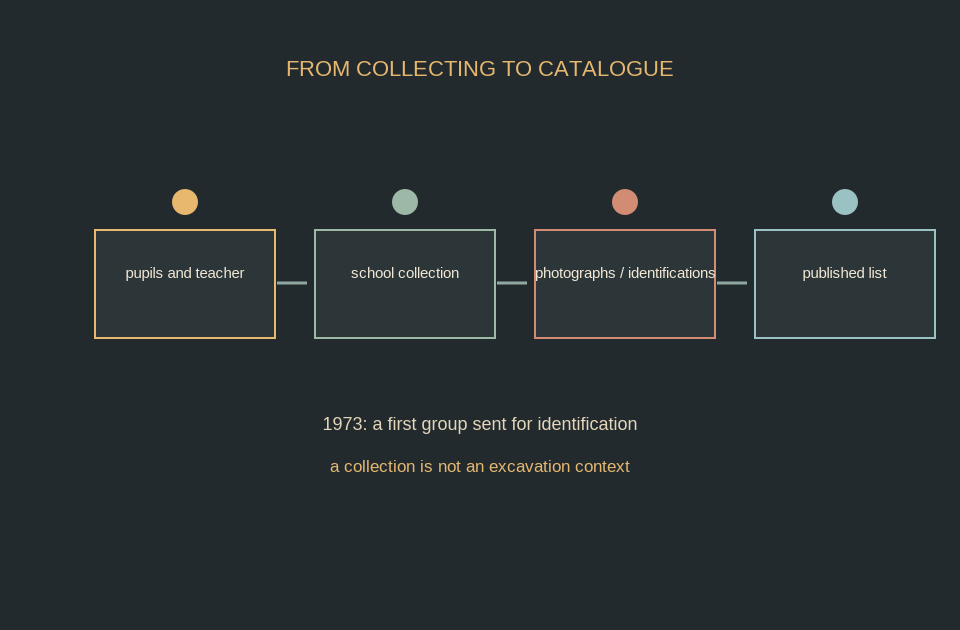
In the 1970s, teacher Paul Cuza collected coins with help from his pupils. In 1973 he sent a first group to numismatist Bucur Mitrea for identification; some pieces were published from photographs. The 2016 study says we do not know the collection’s full history and that it was probably incomplete. [1]

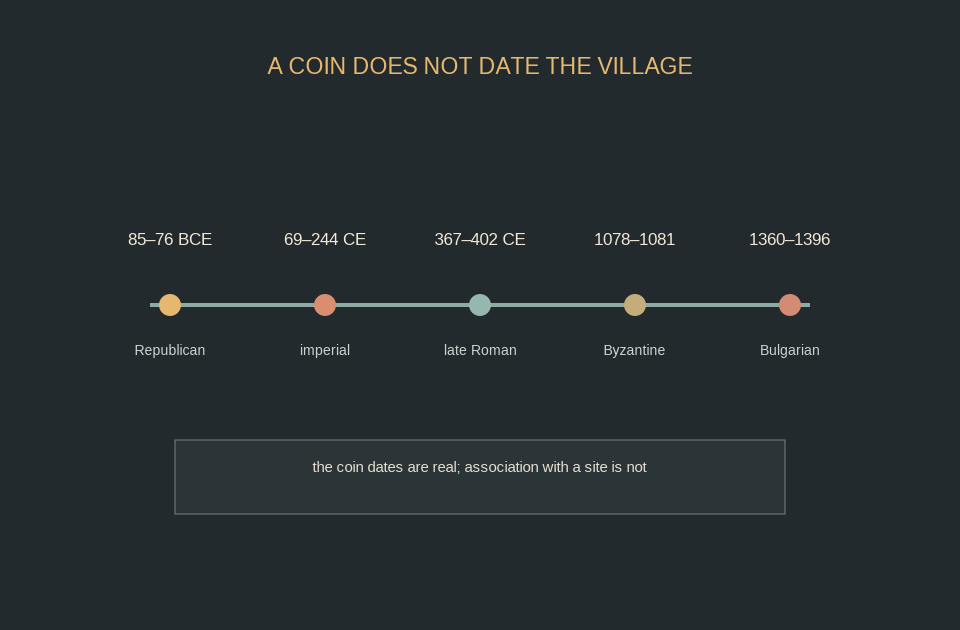
The catalogue spans very different periods, from the Roman Republic to medieval Bulgarian coins. But a school collection does not automatically preserve where each object was found. Croitoru explicitly says some pieces probably did not come from Smulți. [1]
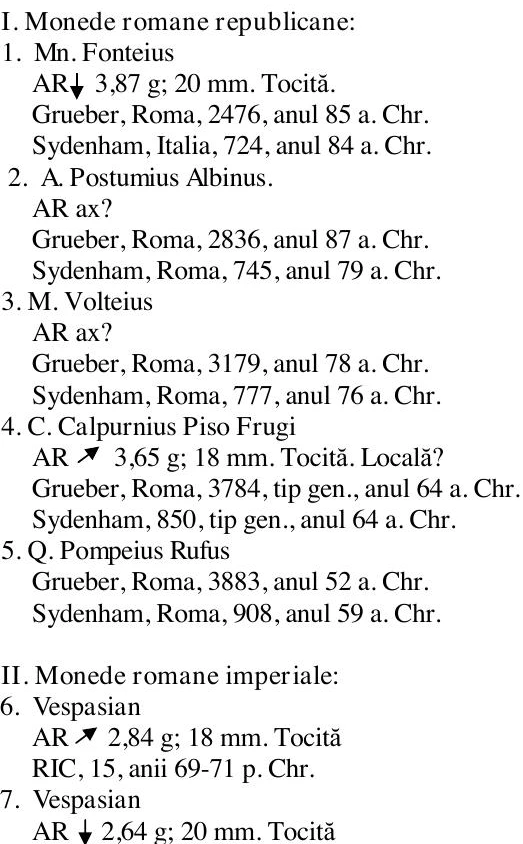
Under the first entries, the author lists Roman Republican coins and identifies the sources for his readings.
Under the first entries, the author lists Roman Republican coins and identifies the sources for his readings. (Source · Acta Musei Tutovensis XII, 2016, p. 112)
According to the study, Paul Cuza collected coins over several years with pupils’ help; in 1973 he sent a first group for identification.
According to the study, Paul Cuza collected coins over several years with pupils’ help; in 1973 he sent a first group for identification. (Source · Original editorial drawing based on the cited source; not a facsimile)
The catalogue dates the coins’ minting periods, not a settlement at Smulți.
The catalogue dates the coins’ minting periods, not a settlement at Smulți. (Source · Original editorial drawing based on the cited source; not a facsimile)

1975–1976 · a statement

The lost bag and the document from 1807

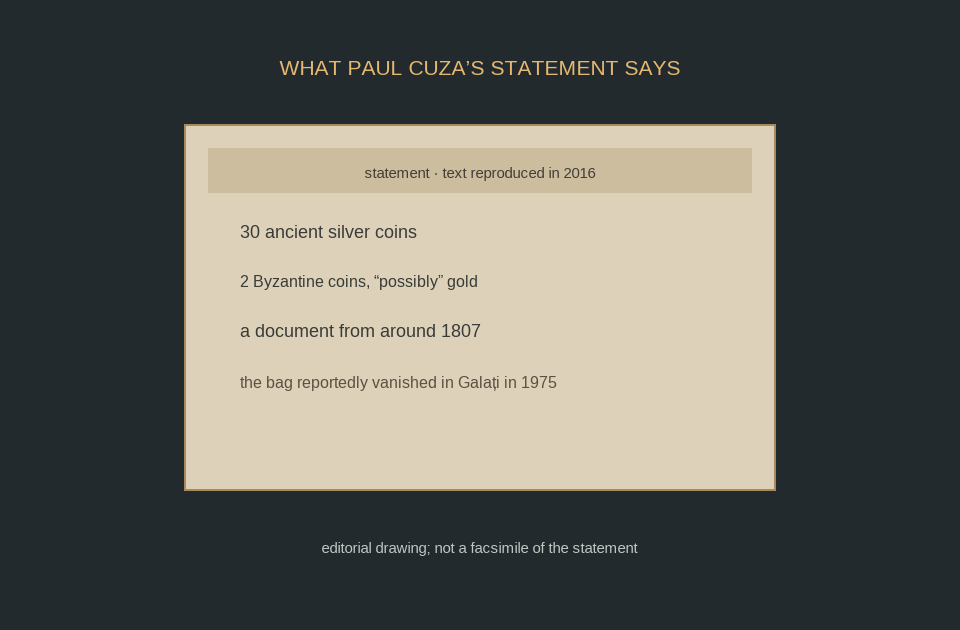
A statement attributed to Cuza says he left a bag in a Galați shop in August 1975 and it disappeared. He said it contained 30 ancient silver coins, two Byzantine coins he thought might be gold, and a document from around 1807 connected to an old lay school in Smulți. [1]

The article prints a facsimile of the handwritten statement alongside a transcription dated 6 April 1976. Together they document the loss reported by Cuza. What the bag contained remains known through his account. [1]
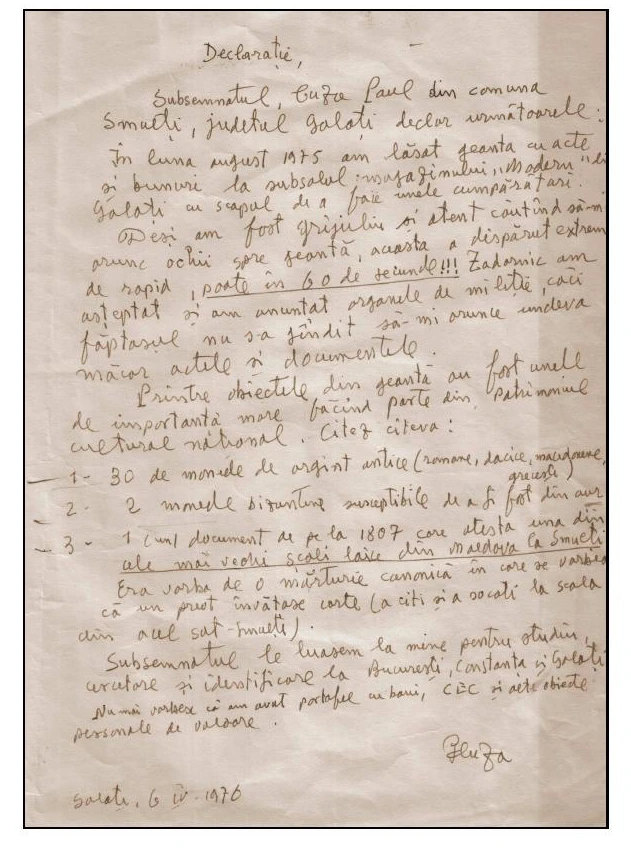
Croitoru reproduces Paul Cuza’s statement. It records what the signatory said the bag held.
Croitoru reproduces Paul Cuza’s statement. It records what the signatory said the bag held. (Source · Acta Musei Tutovensis XII, 2016, p. 119)
The reproduced statement attributes to Cuza the account of a bag that disappeared in August 1975.
The reproduced statement attributes to Cuza the account of a bag that disappeared in August 1975. (Source · Original editorial drawing based on the cited source; not a facsimile)

Sources

At Smulți, a find noticed during vineyard planting, a coin list and five fieldwalking locations leave an incomplete map. The coins tell us when they were minted; the sources do not show that all were found here. Until new archaeological checks are made, the distinction between collection and discovery remains essential.

  1. Costin Croitoru, “Coins Found, Coins Lost: Numismatic Finds from Smulți”, Acta Musei Tutovensis XII, 2016, pp. 111–119The study brings together an older archaeological record, later fieldwalking in the south of the commune, a coin list and a 1976 statement; the author cautions that many coins have uncertain provenance.
  2. Constantin Doca-Trîncu, typed teaching-degree thesis, Iași, 1989, excerpt quoted by CroitoruNotes on five archaeological locations in the south of the commune, from fieldwalking in the 1970s. The 2016 study quotes the passage and identifies its author.
  3. GeoNames, Smulți communeThe coordinate locates Smulți village for orientation; it is not the coordinate of an archaeological site.