The south-pointing chariot · Song History, 1027 and 1107
The chariot that pointed south with gears, and the turns it could not survive
No magnet: the wooden figure on top is set to south by hand, and gears connected to the wheels turn it back against every turn of the chariot. In 1027 the engineer Yan Su described his to the emperor down to the teeth: road wheels 6 chi high, wheels of 24, 12 and 48 teeth. Those numbers work only for one way of turning. Pick a route, or draw your own, and see where the figure ends up pointing.
What the Song History records
The official history of the Song dynasty, compiled in 1345, copies two specifications. The first is Yan Su’s, presented in 1027: a carriage with a single pole and a two-storey canopy, a wooden immortal on top “stretching out its arm to point south”, and nine wheels with 120 teeth in all. The two road wheels are 6 chi high and 18 chi round. Fixed to each is a vertical wheel 2.4 chi across with 24 teeth. Under the pole sit two small horizontal wheels of 12 teeth, one on each side, and in the middle a great horizontal wheel 4.8 chi across with 48 teeth, its axle carrying the figure.
若折而東,推轅右旋,附右足子輪順轉十二齒,擊右小平輪一匝,觸中心大平輪左旋四分之一,轉十二齒,車東行,木人交而南指。
“If it turns east, [the back of] the pole is pushed to the right; the wheel on the right road wheel turns forward twelve teeth, takes the small right horizontal wheel once round, and moves the great central wheel a quarter turn to the left. When the great wheel has turned twelve teeth the carriage is going east, and the wooden figure, now crosswise, points south.” Turning west works the same way on the left. The text names the wheel engaged on each turn; how the pole lowers it is not described for this chariot.
| Wheel | Size | Teeth | What it does |
|---|---|---|---|
| Road wheels (2) | 6 chi high, 18 chi round | — | carry the carriage |
| Vertical wheels on the road wheels (2) | 2.4 chi, 7.2 chi round | 24 | turn with the road wheel |
| Small vertical wheels under the crossbar of the pole (2) | 3 inches (0.3 chi) | — | on an iron axle; role not stated |
| Small horizontal wheels (2) | 1.2 chi | 12 | the one on the outer side engages on a turn |
| Great horizontal wheel (1) | 4.8 chi, 14.4 chi round | 48 | carries the figure’s axle, 8 chi high |
Check: 12 of 24 teeth = ½ turn of the road wheel; 12 teeth = 1 turn of the 12-tooth wheel = 12 of 48 = ¼ turn of the figure (the text: 四分之一). Figure turn per chi of rim = 1/D; carriage turn per chi when pivoting = 1/track; equal when track = D = 6 chi. Differential, 1 in 1,000 on a 3 m track: 19.1° per km (Wikipedia: nearly 20°).
The one turn the numbers fit
Count the teeth. Twelve teeth of the 24 are half a turn of the road wheel: 9 chi of rim, by the text’s own 18 chi. Twelve teeth also take the 12-tooth wheel exactly once round, and that moves 12 of the great wheel’s 48 teeth: a quarter turn, 90°. So the figure turns back 90° for every 9 chi the outer wheel rolls.
Suppose the carriage turns by pivoting: the inner wheel stands still while the outer wheel swings round it. Then the outer wheel draws a quarter circle whose radius is the track, the distance between the wheels. With the text’s own ratio of 3 between circumference and height, a quarter circle of radius 6 chi is 9 chi. The track has to be 6 chi: the same as the wheels are high.
With the true π the result does not change. The figure turns by the distance the outer wheel rolls divided by the wheel’s height; the carriage turns by that distance divided by the track. They match when track equals height, whatever π is.
So if the driver pivots on one wheel, the chariot is exact only when its track equals its wheel height. On a rolling turn, where the inner wheel keeps moving, only the outer wheel drives the figure, and the error depends on the curve and the track: on the courtyard above, the rounded corners turn the figure 75° too far each.
Wu Deren’s chariot of 1107
Eighty years later the palace official Wu Deren presented designs for two vehicles: a more elaborate south-pointing carriage and a “carriage with a drum that records the li”, an odometer (compare Vitruvius’s cart that dropped a pebble every Roman mile). Both were first used at the great ancestral sacrifice that year. His road wheels are 5.7 chi across and the body 9.5 chi wide, with 13 wheels in each storey:
| Wheel | Diameter (chi) | Teeth |
|---|---|---|
| Vertical wheels on the road wheels (2) | 2.2 | 32 |
| Attached wheels (2) | 1.55 | 24 |
| Double wheels, lower tier (2) | 2.1 | 32 |
| Double wheels, upper tier (2) | 1.2 | 32 |
| Small horizontal wheels that rise and fall, with iron weights (2) | 1.1 | 17 |
| Great horizontal wheel (1) | 3.8 | 100 |
| Horizontal wheels in the upper storey (13) | 1.85 | 32 |
| Pulleys at the back of the pole, with bamboo cords (2) | — | no teeth |
The text lists the wheels but not, in so many words, which drives which. If every wheel between the 32-tooth wheels on the road wheels and the 100-tooth great wheel only passes the motion on (the two tiers of the double wheels have 32 teeth each), the ratio is 32 to 100 and the same pivot rule asks for a track of 8.9 chi, inside the 9.5-chi body. That is an inference from the counts, not something the text says.
The differential: a modern answer
In the twentieth century the English engineer George Lanchester proposed that some south-pointing chariots might have used a differential gear, the device that lets a car’s outer wheel turn faster than the inner one. An ideal differential, with equal wheels rolling without slipping on level ground, turns the figure by the difference between the two wheels’ turns, so it follows any curve, not only pivots. Many modern models, including one in the Science Museum in London, are built this way.
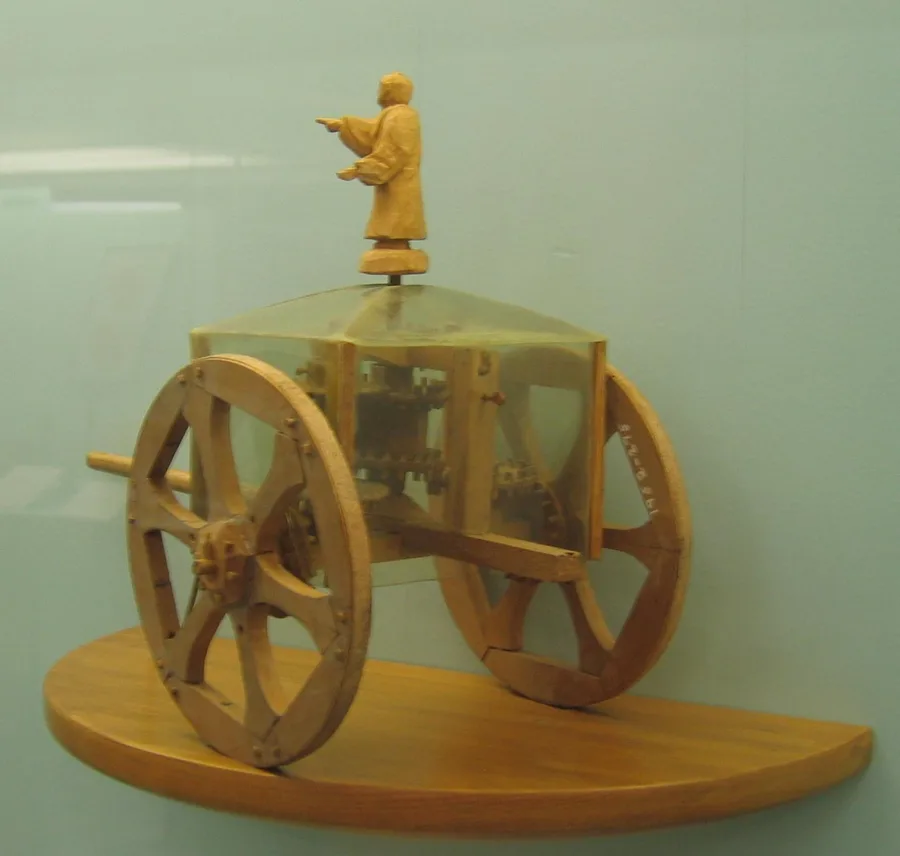
No surviving text describes a differential, and the Song designs read as fixed gear trains engaged by the pole. A differential has its own weakness: wheels that differ by one part in a thousand, on a track of 3 metres, turn the figure nearly 20° in a kilometre of straight road, and almost round to north in nine. To stay within a couple of degrees over 100 km the wheels would have to match to one part in a million.
Why even a perfect chariot fails on a sphere
An ideal chariot turns its figure back by exactly as much as the carriage turns. On a flat courtyard that keeps it pointing south. On a sphere it does not: after a closed loop the figure comes back turned by an angle, in radians, equal to the area inside the loop divided by the square of the Earth’s radius.
The effect is far too small to see on any ordinary journey. A loop around 100 km² of land turns the figure by about 0.00014°, while a one-in-a-thousand wheel mismatch on a 3-metre track adds about 19° for every kilometre driven. Santander (1992) used the chariot to teach parallel transport, the way a direction is carried across a curved surface, and Bernard Linet (2009) showed that a suitably defined pointer on an ideal chariot follows this rule exactly on a sphere.
Who built them
The earliest securely documented south-pointing carriage was built by Ma Jun for the Wei court between 233 and 237, after scholars at court had dismissed the old stories of one. Later copies, says the Song Shu in Needham’s translation, “very often did not point true, and had to negotiate curves step by step, with the help of someone inside to adjust the machinery”, until Zu Chongzhi made one at the end of the 470s that kept its figure on south in the tests reported. No original is known to survive; tooth counts come from the Song History and, for the 1107 design, from Yue Ke’s Kuitan lu.
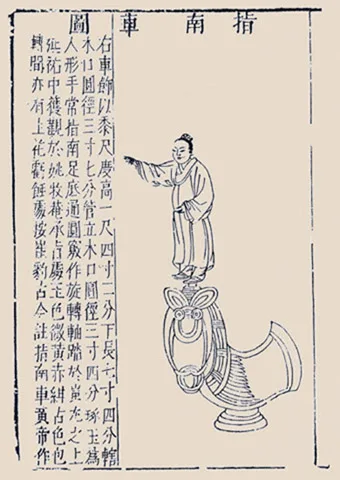
The woodcut below, from the encyclopaedia Sancai Tuhui of 1609, shows a pointing figure on its stand, with its arm out.
Sources
The tooth counts and sizes are read from the Chinese text of the Song History; the translations from it are by Marius Comper, checked against Needham’s, and the Song Shu passage is quoted in Needham’s translation. Chi are Song feet: about 0.308 m each in the Northern Song (estimates differ), so a 6-chi wheel stood a little under two metres.
- Song Shi (History of the Song), ch. 149, 輿服一, “指南車”: Wikisource.
- Joseph Needham, Science and Civilisation in China, vol. IV part 2 (Cambridge 1965), pp. 286–303 (translations of the Song Shu and Song Shi; Lanchester’s hypothesis), as quoted in Wikipedia, “South-pointing chariot”.
- The differential arithmetic (3 m, 1 in 1,000, nearly 20° per km; one in a million for 100 km): Wikipedia.
- M. Santander, “The Chinese South-Seeking chariot: A simple mechanical device for visualizing curvature and parallel transport”, American Journal of Physics 60 (1992) 782–787, doi:10.1119/1.17059.
- Bernard Linet, “The south-pointing chariot on a surface”, arXiv:0906.0288 (2009), arxiv.org.
- Northern Song chi: Wikipedia, “Chinese units of measurement”.
- Land outlines: Natural Earth 1:50m (public domain).