Two forts, not one
Two forts, not one
A plateau divided into two enclosures
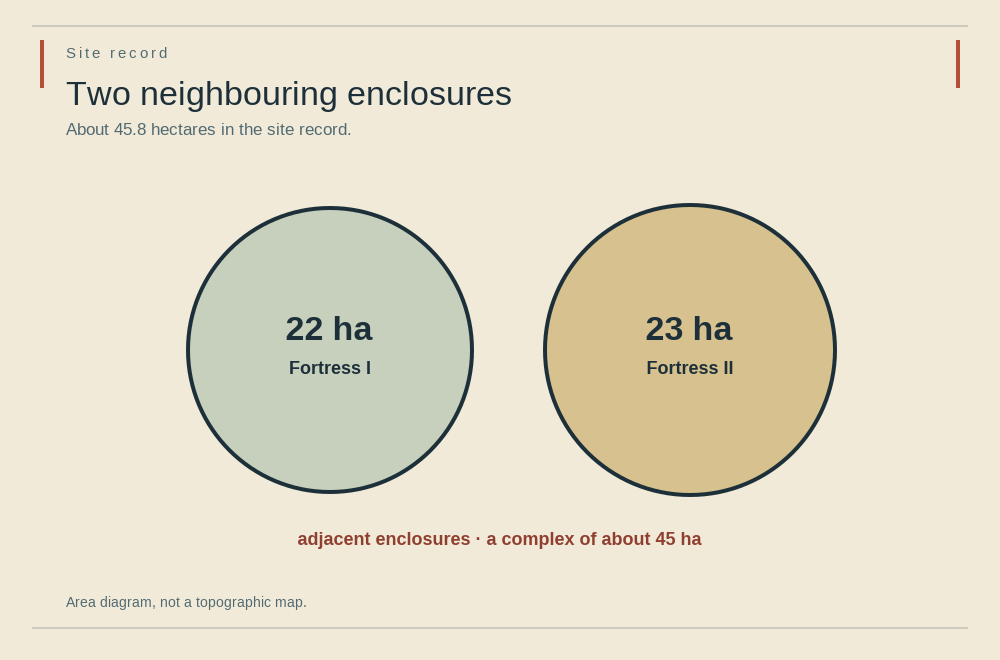
South of Stâncești village, a plateau holds two neighbouring Getic fortifications. Romania’s National Archaeological Repertory estimates 22 hectares for Fortress I and 23 for Fortress II; together, the site covers about 45.8 hectares. The circles compare area only; they do not trace the ramparts. [1]
Published chronology runs from the sixth to the third centuries BC. Some finds belong to only one enclosure, so the story keeps the labels Fortress I and Fortress II attached to each object and plan. [1] [2]
A ditch and its excavated earth
How large were the defences?
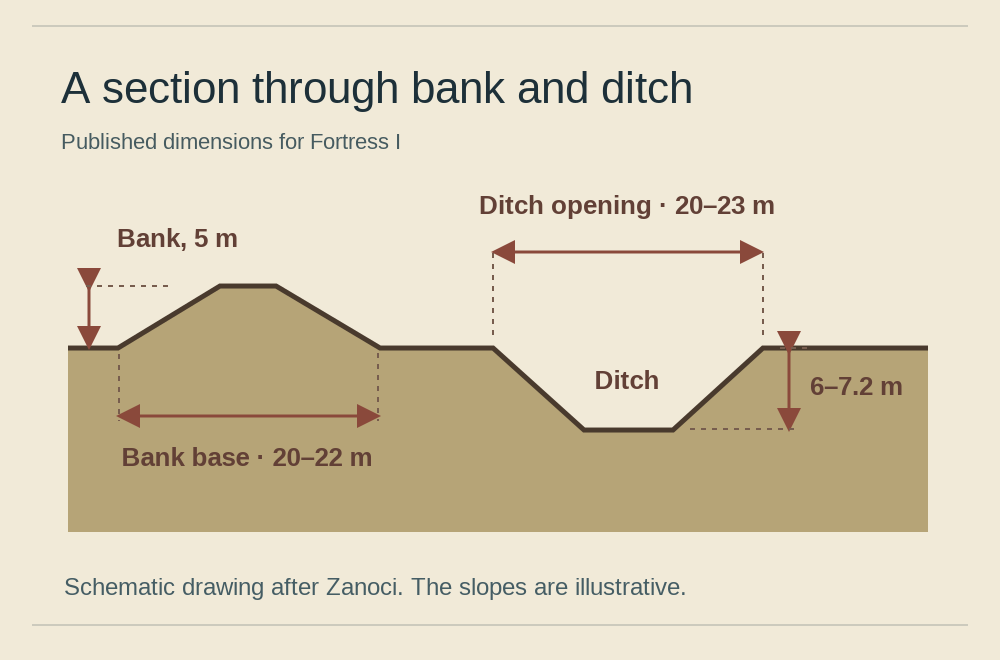
Zanoci publishes a 20–22 metre base and a five-metre height for Fortress I’s rampart; the adjoining ditch was 20–23 metres wide and 6–7.2 metres deep. The published values for Fortress II are smaller. [2]
In a 2025 interview Alexandru Berzovan describes the ground as it survives today. From the crest to the present ditch bottom is roughly six metres. That is the height difference between two points on the site. The five metres in Zanoci’s account refers to the height of the bank. The arrows on the drawing show the endpoints of each measurement reported by Zanoci. [6] [2]
The vessel beneath a house
A deposit beneath the floor
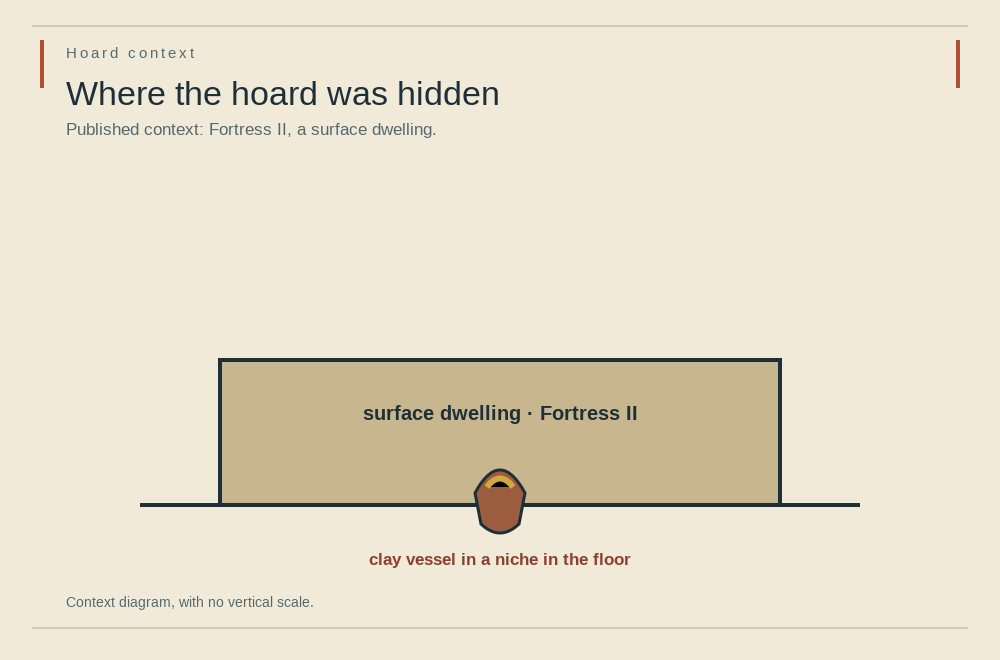
The National History Museum catalogue dates the hoard’s discovery to 1965. Archaeologists found it below one of the surface dwellings in Fortress II, in a clay vessel placed in a niche in the floor. The catalogue does not give an exact depth here. [3]
The context changes the question: a gold object does not float alone in a past of kings and wars; it was hidden in a house used by a community. The vessel, floor and fortress location are documented. The reason for hiding it is not. [3] [4]
How the creature was made
The gold sheet measures 47.8 centimetres
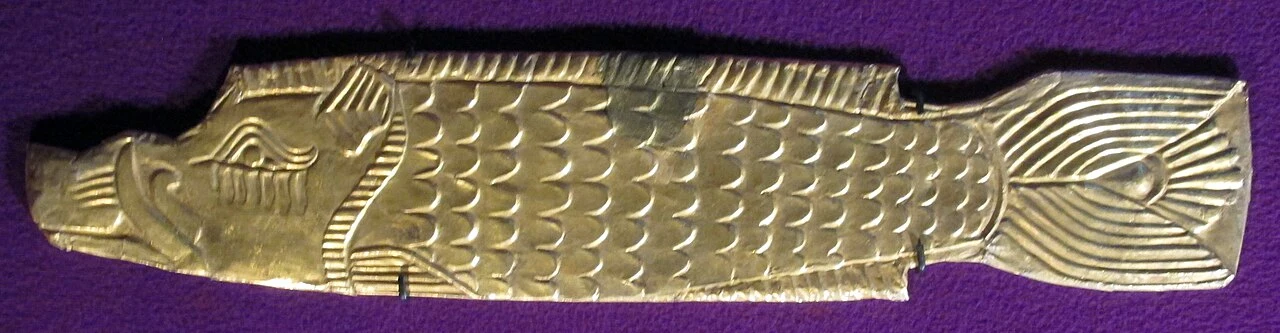
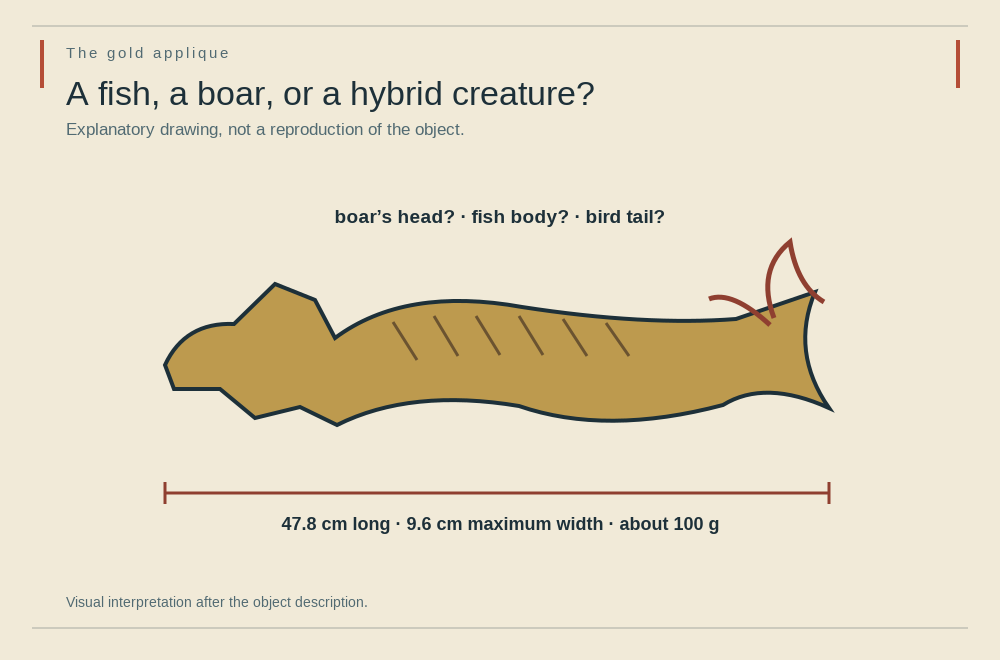
The main piece is a thin gold sheet worked in relief. The catalogue describes a fantastic animal: a boar’s head, a fish body, a tail and bird wings. Another author notes that some researchers have read it simply as a fish. [3] [4]
The published measurements are 47.8 centimetres long and 9.6 centimetres at its widest point; it weighs about 100 grams. The drawing uses those measurements for comparison, but the creature’s identity remains a reading of the relief, not a name written on the object. [4]
Harness or shield?
Choose an interpretation and examine its basis
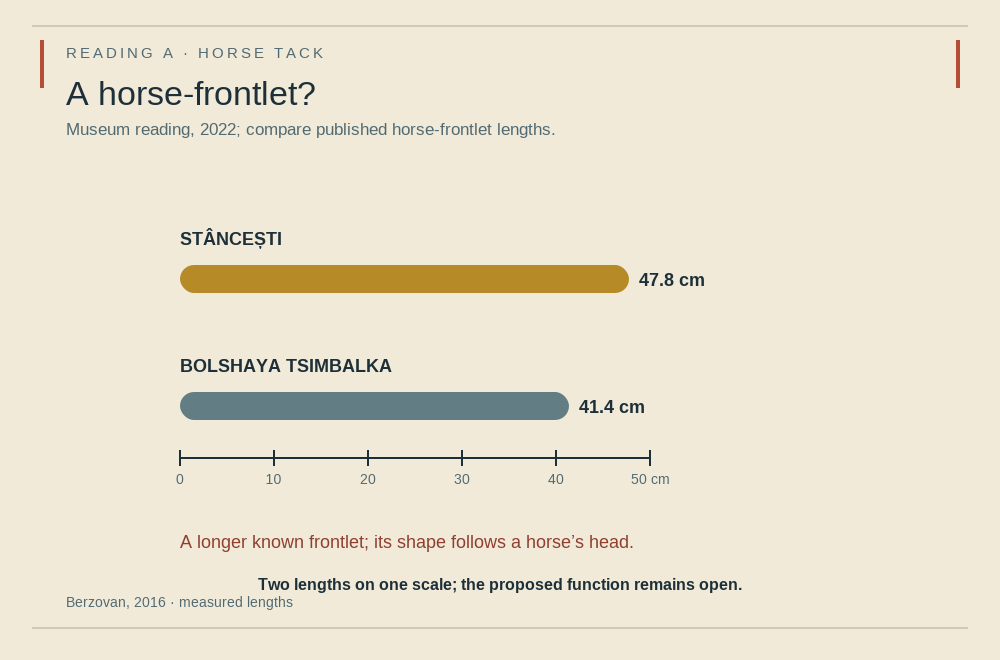
In 2022 the National History Museum presented the hoard as horse equipment, with the large applique as a forehead ornament. Alexandru Berzovan’s 2016 study tests that reading against known harness pieces. [5] [4]
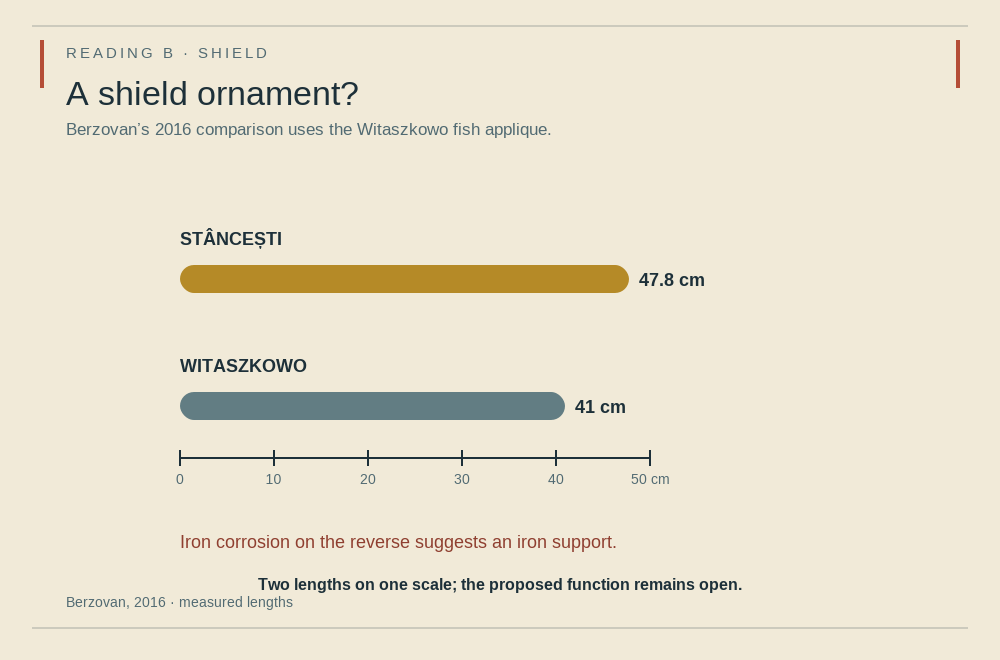
Berzovan cites a 41.4 cm forehead applique from Bolshaya Tsimbalka as the largest comparison for horse tack; its shape follows a horse’s head. The Stâncești piece is 47.8 cm long. Berzovan argues that this extra length makes it an unlikely fit on a horse’s forehead. The two smaller bronze fittings may still have been harness pieces. [4]
Switch between the Bolshaya Tsimbalka and Witaszkowo comparisons. The gold fish applique from Witaszkowo is about 41 cm long; iron corrosion on its reverse suggests it was mounted on an iron support. Berzovan therefore prefers a shield ornament for the large Stâncești piece, although its function remains debated. [4]
Silver in gold
What the metal analysis measures
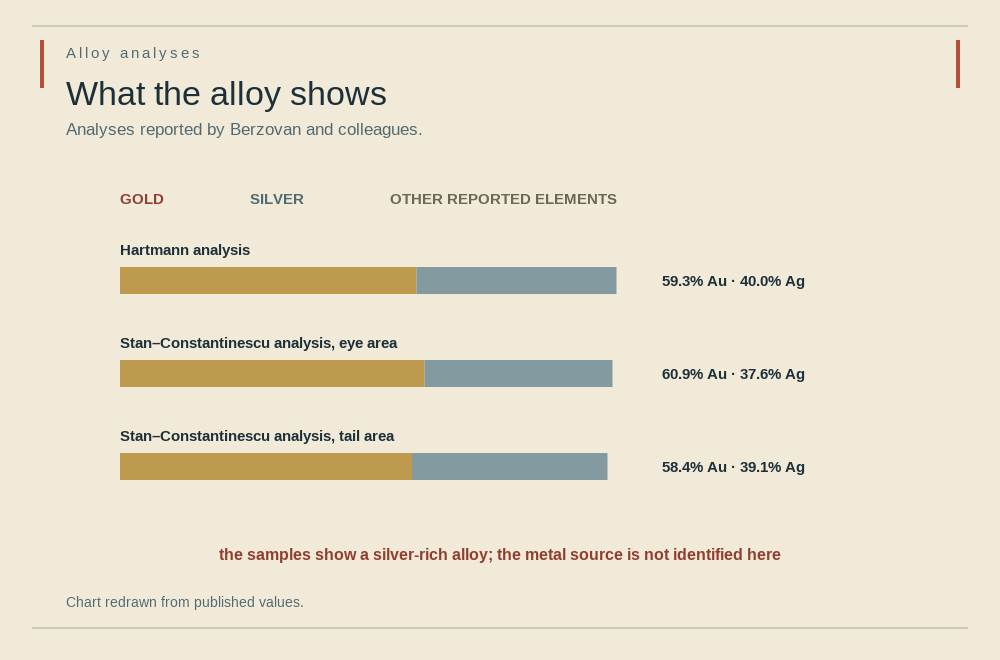
Published analyses find about 58–61% gold and 38–40% silver in the applique, with small amounts of copper, iron and other elements. Composition describes the object’s alloy; it does not directly show who made it or which mine supplied the metal. [4]
The study discusses similarities with Scythian techniques and objects, while the museum catalogue uses the phrase “Scythian influences”. These cultural comparisons do not by themselves identify the object’s route to Stâncești. [4] [3]
Excavation resumes
Two anomalies are not yet two houses
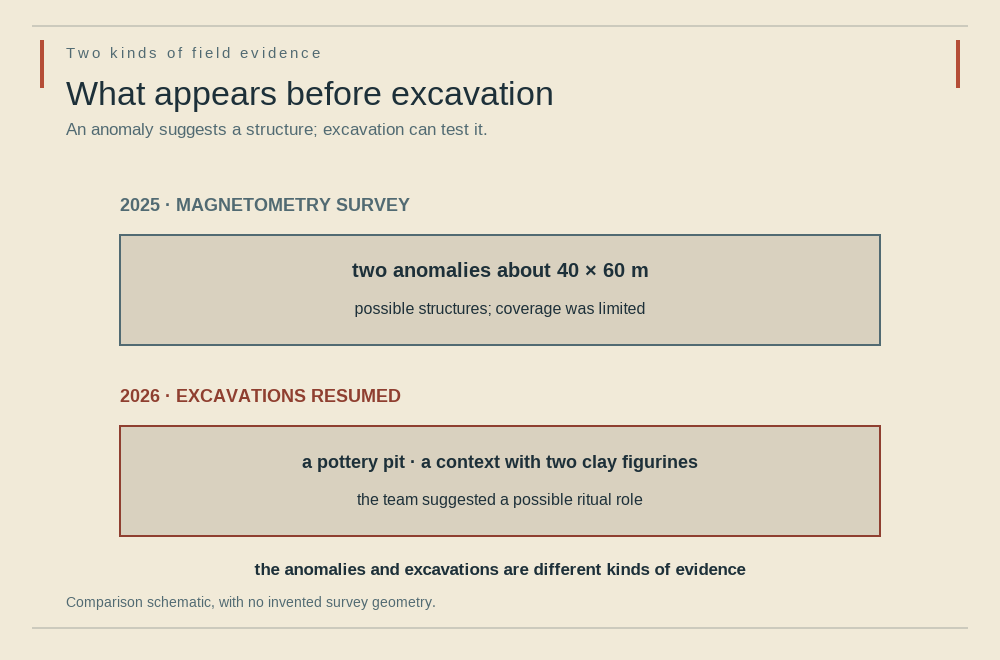
In 2025, archaeologist Alexandru Berzovan reported that magnetometry had indicated two anomalies about 40 × 60 metres in size, possible timber-and-earth buildings. Coverage was limited, and excavation had not yet tested them. They remain targets for future research. [6]
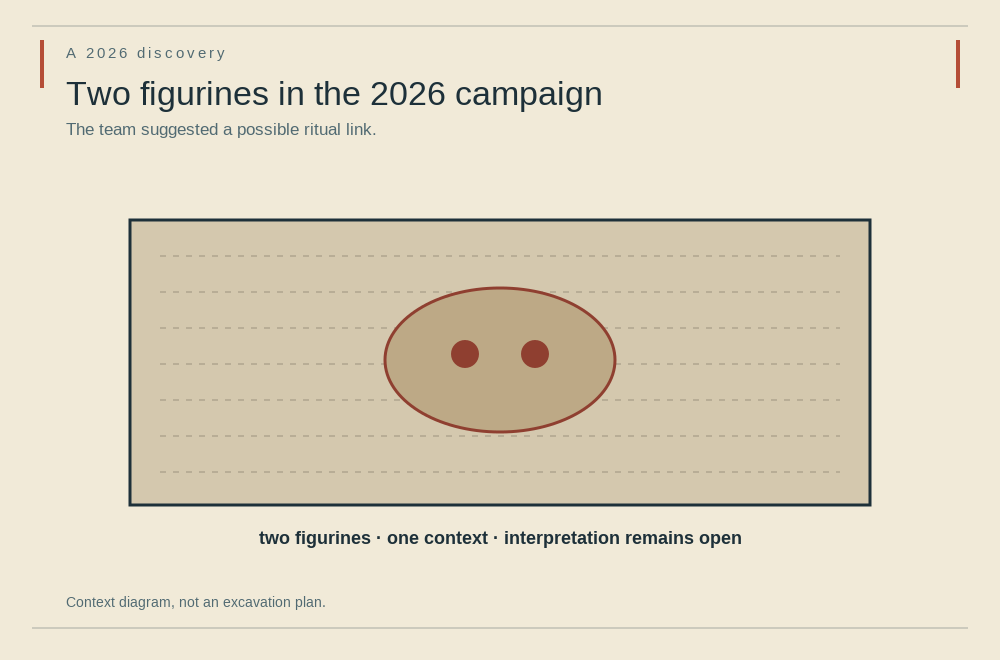
From 29 June to 13 July 2026, the team resumed systematic excavation. The campaign report mentions a pit with pottery and a feature that yielded two anthropomorphic clay figurines. The team suggested a possible ritual link; the context alone does not establish a sanctuary. [7]