Tărtăria, Alba county · 1961
Europe's first writing, dug out of a pit in Transylvania?
Out of the soil of a village on the Mureș came three clay tablets covered in signs. Some see in them the world's oldest writing, two millennia before Sumer. Others say the dating does not hold, the signs add up to no script, and the discovery story has holes. Three small objects, three questions with no shared answer.
Three small objects, a pit, a skeleton
In 1961, a team led by Nicolae Vlassa, an archaeologist at the Transylvanian History Museum in Cluj-Napoca, was digging at Tărtăria–Gura Luncii, in Săliștea commune, about thirty kilometres from Alba Iulia. Out of a ritual pit came three unfired clay tablets, 26 clay and stone figurines, a shell bracelet, and the burnt, broken and disarticulated bones of an adult.
The bones gained the popular name of “Milady Tărtăria”. The archaeologist Alasdair Whittle reads the pit as the grave of a respected local, perhaps a wise elder or a shaman.
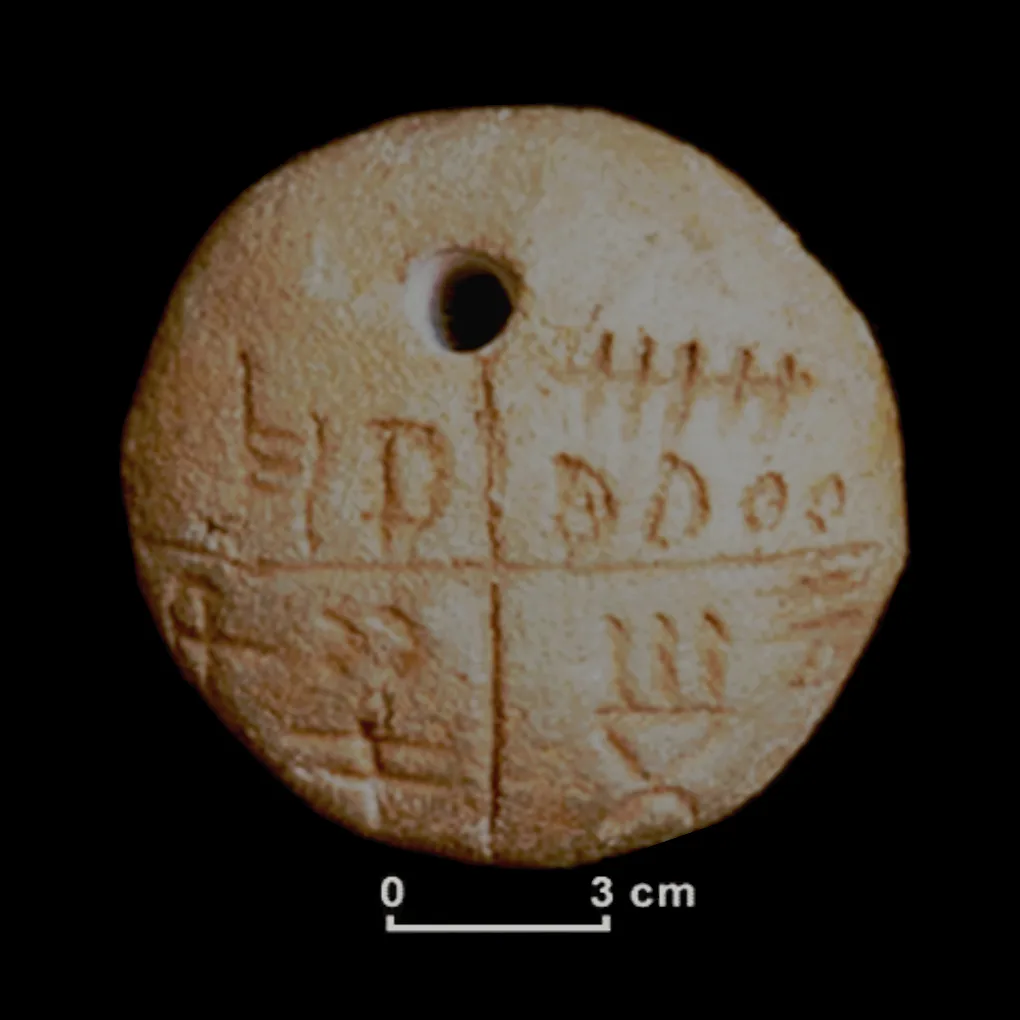
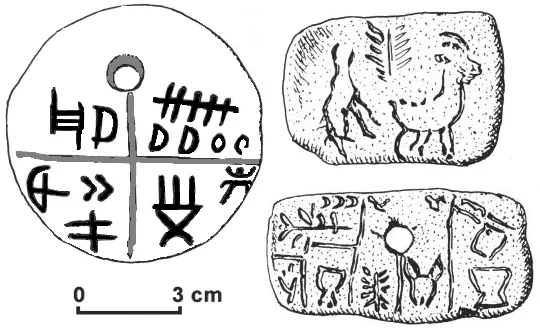
Two tablets are rectangular, one is round, six centimetres across. Two are pierced — the round one and one of the rectangular ones — and all three carry signs on one face only. Pick a tablet to see what each one shows.
-
The round tablet
Six centimetres across, two perforations, four groups of signs divided by lines. This is the piece held closest to true writing: abstract signs, set in rows, partly matched on other artefacts with Vinča signs.
-
The pierced rectangle
A rectangular plaque pierced by a hole, covered in abstract signs on one face only. The holes in the two pierced pieces suggest they were worn as pendants — a hypothesis, not a certainty.
-
The animal rectangle
The only unpierced one. It shows a horned animal, an unclear figure and a vegetal motif, like a branch or a tree. It is the only one read pictographically: here you see a horned animal, a branch, a silhouette — the rest is silence.

- Where
- Tărtăria–Gura Luncii, Săliștea commune, Alba county, about thirty kilometres from Alba Iulia
- When
- 1961, in the dig led by Nicolae Vlassa
- What
- Three unfired clay tablets, 26 clay and stone figurines, a shell bracelet, burnt and scattered human bones
- Size
- The round tablet: six centimetres across; all three are small pieces, held in the palm
- Kept at
- The National Museum of Transylvanian History, Cluj-Napoca
What Vlassa claimed
Vlassa read the signs as pictograms. He found resemblances with the Sumerian tablets of Uruk and Jemdet Nasr, from the late fourth and early third millennium, and weighed the hypothesis of an ancient script tied to Sumerian writing. One tablet he read as a hunting scene, the other two as a primitive script, kin to the early pictograms of the Sumerians.
At the time, the Vinča–Turdaș culture was thought late: Serbian and Romanian archaeologists placed it around 2700 BC. Vlassa dated his tablets by comparison with Mesopotamia, around 2600 BC. Only later, when radiocarbon dating overturned the chronology of the European Neolithic, did the pieces move three millennia earlier.
The signs were nothing wholly unseen: Vinča signs had been known since Zsófia Torma's digs at Turdaș, in the late nineteenth century. What Tărtăria added was the context — a pit with a skeleton and ornaments — and the boldness of the Sumerian comparison.
How old are they, really
First, the bad news for dating. The tablets were unfired clay, and the conservation lab of the Cluj museum baked them in a kiln to save them. The heat treatment closed the road to direct radiocarbon dating for good: the age of the clay can no longer be measured.
The bones in the pit were dated instead, and the result pushed the site — and with it the whole Vinča culture — back to around 5500 BC, in the time of early Sumer. The German scholar Harald Haarmann puts the tablets around 5300 BC. If the age is right and the signs are writing, the Tărtăria pieces beat cuneiform and Egyptian hieroglyphs by two millennia.
Here the dispute starts. Dating by association lends the tablets the age of the bones beside them, and the stratigraphy of the discovery is contested: Vlassa never published a clear stratigraphic account of the context, and some scholars read the tablets as an intrusion from the upper layers of the site, far later than the pit. Others contest the radiocarbon chronology for south-eastern Europe itself and tie the Tărtăria signs to Mesopotamian proto-writing, which they take to be contemporary.
- Late nineteenth centuryZsófia Torma digs at Turdaș and gathers the first Vinča signs.
- 1961Nicolae Vlassa's team finds the three tablets at Tărtăria–Gura Luncii.
- 1962Vlassa publishes the find and ties the signs to Sumerian pictograms; proposed date: around 2600 BC.
- 1965The first critical replies: Vladimir Milojčić on chronology, Adam Falkenstein on the tablets, both in Germania.
- 1973Colin Renfrew doubts the Sumerian comparison and the idea that the signs are writing.
- 1981–1990Shan Winn describes the Vinča sign system as pre-writing; Harald Haarmann writes on the script of Old Europe.
- 2002–2011Gheorghe Lazarovici and Marco Merlini re-examine the pieces and the bones at Cluj and defend the early date.
- 2013Erika Qasim proposes a severe re-evaluation, with the modern-forgery hypothesis.
- 2016Attila László rejects the Lazarovici–Merlini “reconsideration”; Sabin Adrian Luca publishes the Tărtăria Rediviva monograph.
The trial: three questions
Answer each question. At the end you will see which camp your answers approach: those who read the tablets as writing, or the sceptics.
-
1. Are the tablets over seven millennia old?
The writing campThe bones in the pit were radiocarbon-dated to around 5500 BC. Lazarovici and Merlini place the complex in the early Vinča culture and say the new research settled most of the open questions.
The scepticsThe age of the bones is not the age of the tablets. Vlassa never discussed the stratigraphy of the discovery, the published dig record is thin, and the pieces may be a late intrusion from the upper layers.
-
2. Do the signs add up to writing?
The writing campThe signs are standardised, set in rows, and belong to a corpus found on a large number of artefacts. Marija Gimbutas called it “Old European Script”; Haarmann gives it a religious function, not an administrative one.
The scepticsColin Renfrew: plain pictograms, and a goat sign naturally looks like a goat sign anywhere. Sarunas Milisauskas: writing arrives with states and administration, and Neolithic Europe had no states. Perhaps ownership marks or ritual signs.
-
3. Can the discovery story be trusted?
The writing campBetween 2002 and 2011, Lazarovici and Merlini re-examined the tablets, the bones and the accompanying artefacts at Cluj and say they settled most of the disputed points of the discovery.
The scepticsErika Qasim shows that some signs resemble reproductions of Sumerian signs from the Romanian popular literature of the time and raises the forgery hypothesis. Attila László dismisses the “reconsideration” as unconvincing.
Your verdict: answer all three questions to see where you stand.
“To me, the comparison made between the signs on the Tărtăria tablets and those of proto-literate Sumeria carry very little weight. They are all simple pictographs, and a sign for a goat in one culture is bound to look much like the sign for a goat in another. To call these Balkan signs ‘writing’ is perhaps to imply that they had an independent significance of their own communicable to another person without oral contact. This I doubt.”
Where things stand
The tablets stay undeciphered: the language is unknown, and three short pieces are too few for a decipherment. Nobody has read them, and nobody knows what kind of system the signs would form — pictographic, ideographic, or something else.
What goes uncontested: the signs belong to the Vinča corpus, found on a large number of artefacts across south-eastern Europe. Signed pieces came out of other sites too: the Karanovo seal, the Gradeșnița dishes in Bulgaria, the Dispilio tablet in Greece.
Most specialists accept the pieces as genuine Neolithic artefacts; the forgery hypothesis stays a minority view. On whether the signs are writing, the dominant answer is reserved: signs, yes — writing, unproven. The live dispute is the dating: the seven-millennia age stands on the bones in the pit, not on the tablets, and the discovery context can never be fully rebuilt.
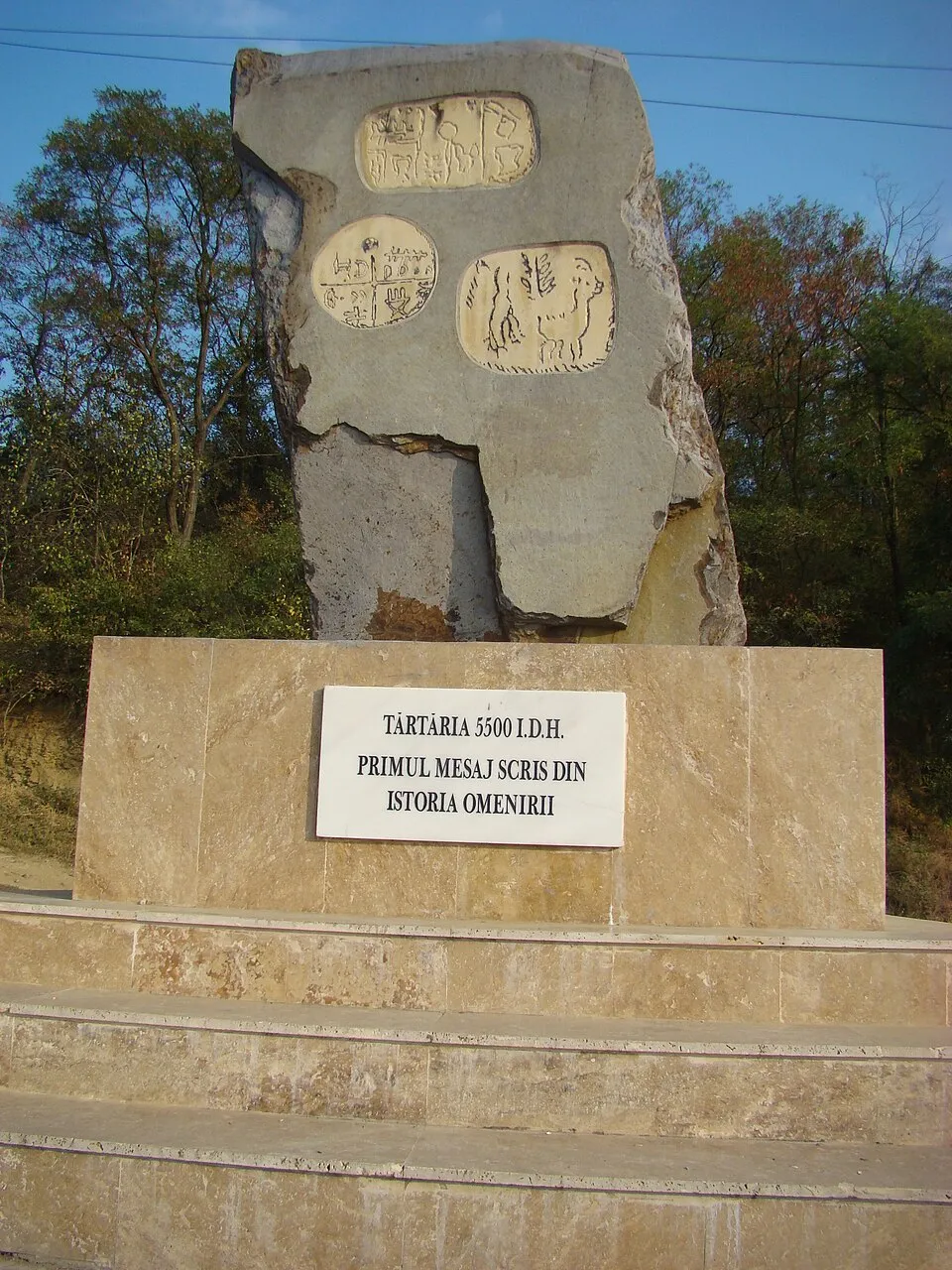
At Tărtăria, a monument recalls the day in 1961 when three lumps of clay set archaeology a question that, six decades on, still waits for an answer.

Sources
The facts and the controversy below are gathered from these sources.
- Marco Merlini, Gheorghe Lazarovici: “Settling discovery circumstances, dating and utilization of the Tărtăria tablets”, Acta Terrae Septemcastrensis VII, Sibiu, 2008.
- Marco Merlini: “Challenging Some Myths About the Tărtăria Tablets”, Journal of Archaeomythology 4, 2008, pp. 47–64. archaeomythology.org (PDF)
- Gheorghe Lazarovici, Cornelia-Magda Lazarovici, Marco Merlini: Tărtăria and the Sacred Tablets, Mega, Cluj-Napoca, 2011.
- Colin Renfrew: Before Civilization: The Radiocarbon Revolution and Prehistoric Europe, Jonathan Cape, 1973, p. 186.
- Erika Qasim: “Die Tărtăria-Täfelchen — eine Neubewertung”, Das Altertum 58 (4), 2013, pp. 307–318.
- Attila László: “Cui Bono? Thoughts About a «Reconsideration» of the Tărtăria Tablets”, Dacia LX, 2016, pp. 281–292. daciajournal.ro (PDF)
- Vladimir Milojčić: “Die Tontafeln von Tărtăria und die absolute Chronologie des mitteleuropäischen Neolithikums”, Germania 43, 1965, pp. 261–268.
- Adam Falkenstein: “Zu den Tontafeln aus Tărtăria”, Germania 43, 1965, pp. 269–273.
- Harald Haarmann: Geschichte der Schrift, C.H. Beck, 2002, p. 20.
- Harald Haarmann, Joan Marler: “An introduction to the study of the Danube Script”, Journal of Archaeomythology 4, 2008.
- Shan M. M. Winn: Pre-writing in Southeast Europe: The Sign System of the Vinča Culture, Western Publishers, Calgary, 1981.
- Emilia Masson: “L'écriture dans les civilisations danubiennes néolithiques”, Kadmos 23 (2), 1984, pp. 89–123.
- Sorin Paliga: “The tablets of Tărtăria. An enigma? A reconsideration and further perspectives”, Dialogues d'histoire ancienne 19 (1), 1993. doi.org/10.3406/dha.1993.2073
- Sarunas Milisauskas: European Prehistory: A Survey, Kluwer / Plenum, 2002, pp. 236–237.
- Alasdair Whittle: Europe in the Neolithic: The Creation of New Worlds, Cambridge University Press, 1996, p. 101.
- Wikipedia: “Tărtăria tablets” (en) and “Tăblițele de la Tărtăria” (ro). en.wikipedia.org/wiki/Tărtăria_tablets