London, the winter of 1684
The cold that froze the Thames came back once, in 1963. The river kept flowing
For two centuries, whenever the Thames stopped under the ice, Londoners built streets of booths, printing presses and taverns on it. Go down the river through the winter of 1684 and the last fair, in 1814, then see why they never came back.
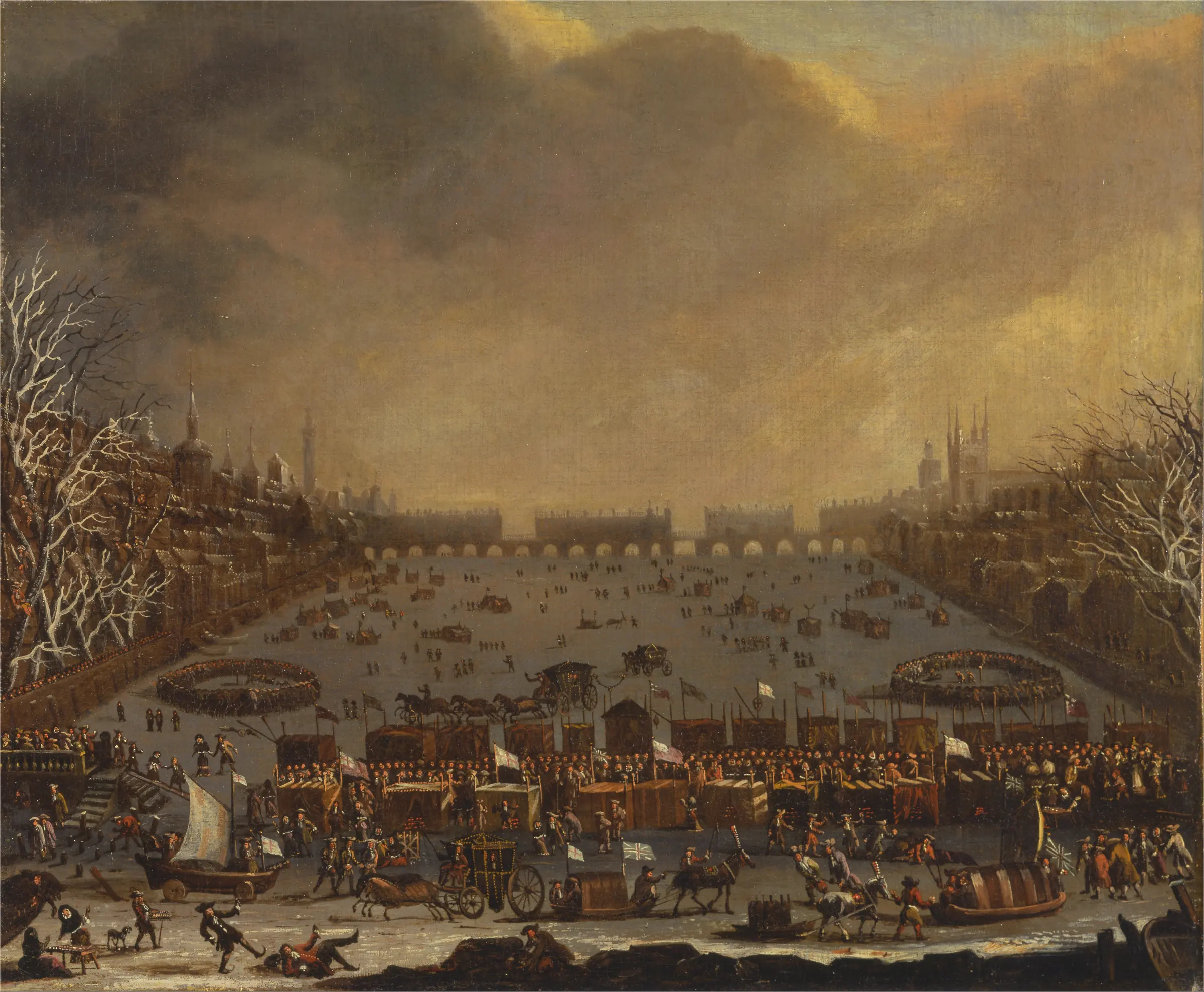
Go down the riverUnknown artist, c. 1685, Yale Center for British Art · public domain

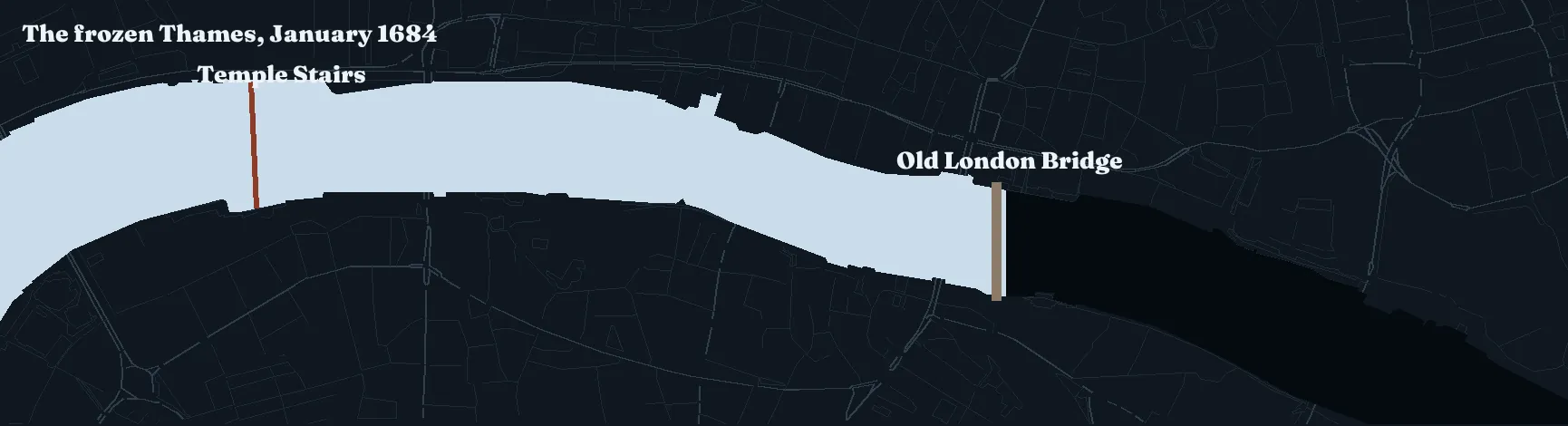
The banks and streets are today's; before the Victorian embankments the river was wider. The ice, the floes and the booths are an illustration drawn from the accounts of the time, not a map of them.
23 December 1683
The floes come down to the city
The winter of 1683 came early and did not let go. On 23 December John Evelyn, writer, gardener and one of London's most attentive diarists, wrote down two things: smallpox was killing many, and “the Thames frozen.”
Ice does not form across the whole river at once. The margins go first, where the water is shallow and slow. Floes from upstream come down on the ebb, the flood pushes them back, and every tide leaves more of them piled against the city's only bridge.
Old London Bridge
A bridge that held the river still
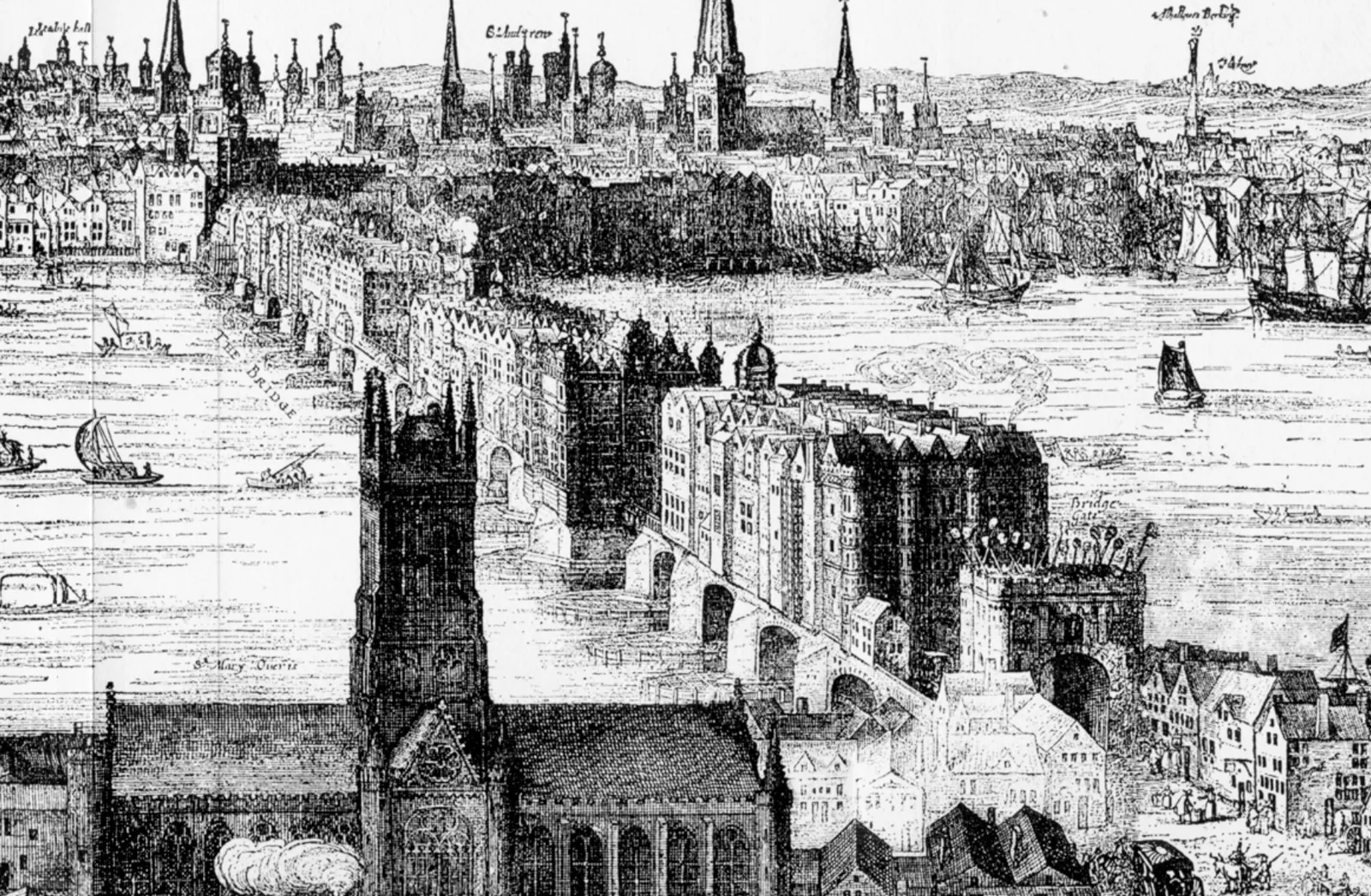
The stone bridge, with houses on it, stood on 19 arches. Each pier sat on a boat-shaped platform of piles and rubble called a starling. A pamphlet of 1736 measured the result: at low water a river nearly 900 feet wide was “forced through a channel of 194 feet, which is not a quarter of the whole.”
Water banked up above the bridge and dropped through the arches as over a weir: in 1746 the engineer Charles Labelye reported “a fall of nearly five feet,” about a metre and a half. Floes lodged against the piers and made a dam, and behind the dam the water stood still.
6 January 1684
“The river quite frozen”
“The river quite frozen,” Evelyn writes on 6 January 1684. From Westminster down to the bridge the Thames becomes a plain of ice, ridged and cracked where the floes froze together.
The winter of 1683–84 is still the coldest in the longest instrumental temperature record in the world, the Central England series, which begins in 1659. January averaged −3 °C. The number is approximate: the early values were reconstructed in whole degrees.
9–16 January 1684
A town on the river
On 9 January Evelyn walks across. The ice bears “not only streets of booths, in which they roasted meat, and had divers shops of wares, quite across as in a town, but coaches, carts, and horses passed over.” He goes from Westminster stairs to Lambeth to dine with the Archbishop.
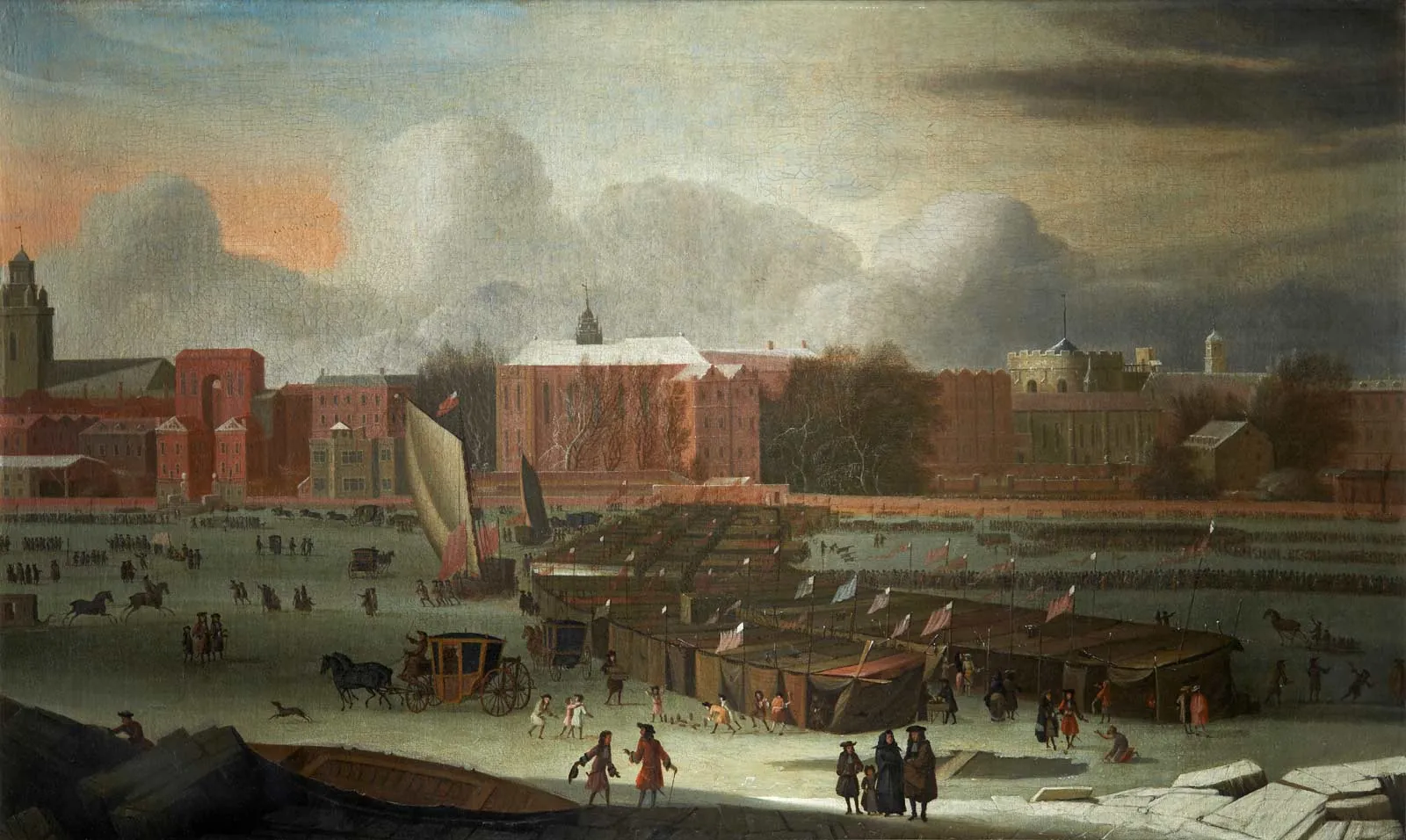
Bargemen and sailmen with no work guided sightseers on the ice, the London Museum says. Abraham Hondius painted the fair from Temple Stairs, by the lawyers' quarter. By 16 January, Evelyn writes, “the Thames was filled with people and tents selling all sorts of wares as in the city.”
24 January 1684
Your name, printed on the Thames
Among the booths stands a printing press, “where the people and ladies took a fancy to have their names printed, and the day and year set down when printed on the Thames.” The fashion “took so universally” that the printer was said to make £5 a day, “at sixpence a name.”
On 31 January the printer G. Croom ran off a sheet for the royal family: Charles II, his brother James, the Queen, the Duchess of York, Princess Anne and Prince George, then a seventh name, “Hans in Kelder”, Jack-in-the-cellar. It has been suggested that this was Princess Anne's unborn child and a joke of the King's. The sheet survives; the joke is a guess.
24 January, continued
A carnival on the water, a judgement on the land
In the same entry Evelyn lists everything on the ice: coaches plying from Westminster to the Temple, sleds, skates, “a bull-baiting, horse and coach-races, puppet-plays and interludes, cooks, tippling, and other lewd places.” It seemed, he writes, “a bacchanalian triumph, or carnival on the water.”
On land it was “a severe judgment”: trees splitting “as if the lightning struck”, men and cattle perishing, birds and fish dying, fuel so dear that collections were taken “to preserve the poor alive.” The cold air held the coal smoke down over the city, “hardly could one see across the street.”
5–10 February 1684
The thaw
On 5 February “it began to thaw, but froze again.” The booths were almost all taken down, but a map of the whole fair had already been “cut in copper,” “in memory of so signal a frost.” On 8 February came “an absolute thaw and rain; but the Thames still frozen.”
When the ice gives way it breaks into plates that go off downstream. On 10 February, “after eight weeks missing the foreign posts,” news from abroad reached London again.
1–4 February 1814
The last fair and its street, City Road
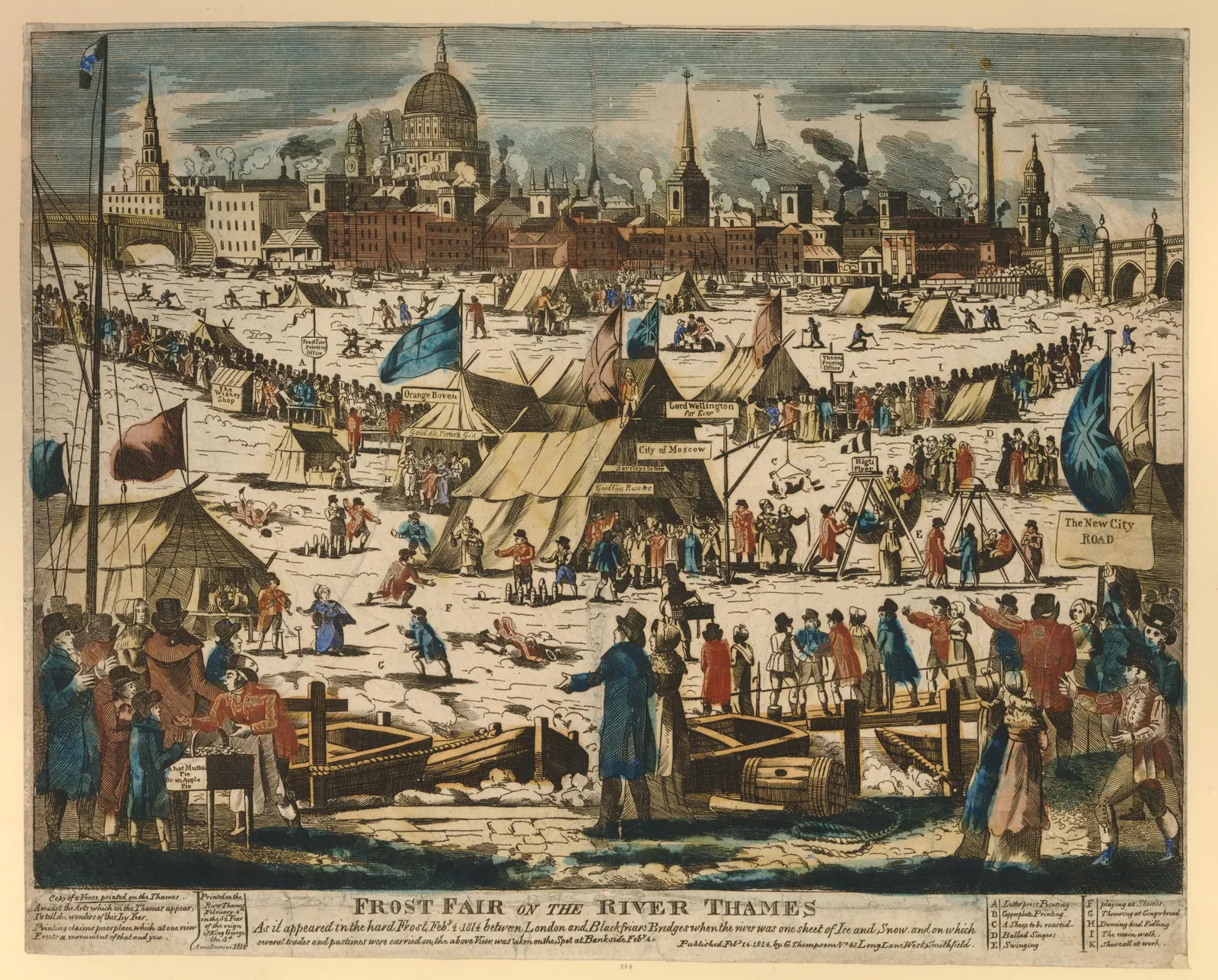
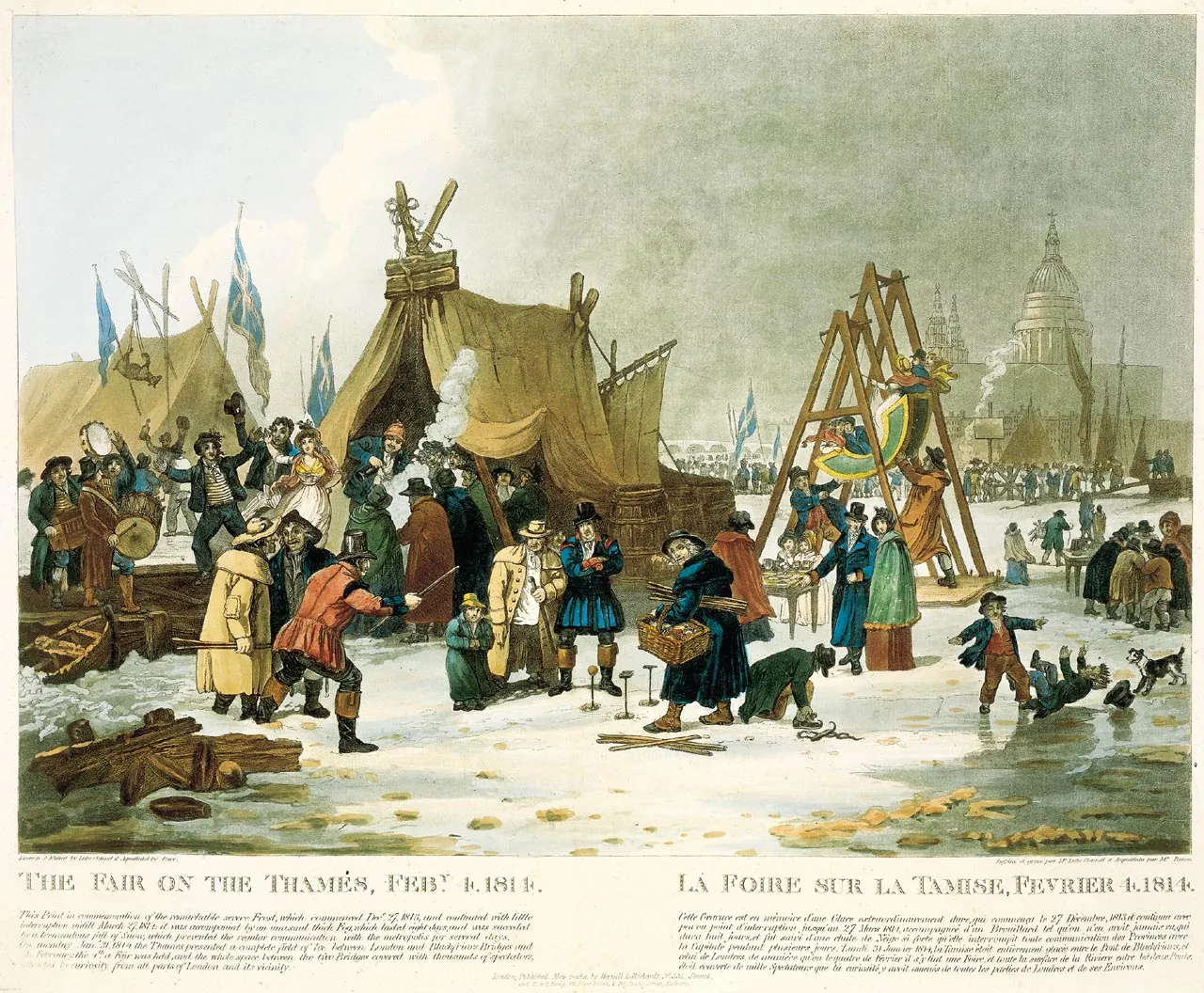
There were fairs again in 1716, 1740 and 1789. In January 1814, after weeks of frost and snow, floes from upstream jammed the river between Blackfriars and London bridges. On 1 February, in an account gathered at the time, the floating masses of ice, “having been stopped by London Bridge,” set into a solid surface.
By 2 February the grand walk ran from Blackfriars Bridge; “this was named the City-road.” Eight or ten printing presses worked on the ice. A sheep was roasted and sold at a shilling a slice as “Lapland mutton.” And “in consequence of the impediments to the current of the river at London Bridge, the tide did not ebb for some days more than one half the usual mark.”
5–6 February 1814
The last night
On 5 February the wind went round to the south. By evening there was rain, “Maister Ice gave some loud cracks,” and floated off “with the printing presses, booths, &c.” Two young men who had ventured onto the ice above Westminster Bridge were carried off on a floe and drowned; on 1 February a plumber named Davis had sunk “between two masses of ice” near Blackfriars.
At two in the morning on 6 February the flood tide ran fast under the bridge. A booth with nine men in it was swept towards Blackfriars and caught fire from its own candles. The men got off. It was the last frost fair on the Thames.
1831
The new bridge lets the ice through
In 1831 John Rennie's new London Bridge opened, with five wide arches, a little upstream of the old one. The medieval bridge was demolished the following year. Without its weir the water runs freely with every tide, and the floes pass under the bridge instead of piling up.
Between 1865 and 1870 the Victoria Embankment narrowed the river through the middle of the city. The London Museum puts the end of the fairs down to three things: milder winters as the Little Ice Age ended, the new bridge, and the embankments and dredging, which left the Thames “too deep and too fast-flowing to fully freeze over again.”
The cold
The cold did not go away. The bridge did
Each bar below is a winter from 1660 to today, coloured by its coldest month in central England. The circles mark the winters of the frost fairs.
Five times before 1832 a winter month averaged −2 °C or less. Four of those winters had a fair on the ice. For the fifth, 1795, there is only a one-line note that the Thames froze, and no fair is recorded. After the old bridge came down, cold like that came just once, in January 1963. The Thames froze at Oxford, where a car was driven across it, but not in London.
The 1789 fair needed no more than a December of −0.3 °C, after a frost that set in late in November. Since the last fair, in 1814, 12 winters have had a month colder than that December.
The cold did not go away. The bridge did
coldermilder
1963: coldest winter month, January, −2.1 °C on average. Upper Thames frozen, at Oxford; in London the water kept flowing.
| Winter | Coldest month | What happened on the Thames |
|---|---|---|
| 1795 | −3.1 °C | A note that the Thames froze, no fair recorded |
| 1684 | −3.0 °C | Fair on the ice |
| 1814 | −2.9 °C | The last fair |
| 1740 | −2.8 °C | Fair on the ice |
| 1963 | −2.1 °C | Upper Thames frozen, at Oxford; in London the water kept flowing |
| 1716 | −2.0 °C | Fair on the ice |
The Central England Temperature series (Met Office HadCET) covers a triangle between Lancashire, London and Bristol, not London alone. Values before 1722 were reconstructed by Gordon Manley from diaries and are precise to half a degree or a degree. A monthly mean does not show how many days the frost lasted. In 1963, warm water discharged by the Battersea and Bankside power stations also helped keep the river open.
Your name
Printed on the ice
For sixpence the printer on the ice would set your name and the date. Type yours. The sheet beside it follows the one G. Croom printed for the royal family on 31 January 1684.
The wording is the original's, in the English of the time.
CHARLES, KING.
London: Printed by G. Croom,
on the ICE, on the River Thames, January 31, 1684.
Pictures
What it looked like

.jpg)

_by_Claes_Van_Visscher.jpg)
Myths
What is said, and what can be shown
- tradition“In 1814 an elephant was led across the ice below Blackfriars Bridge.”The story circulates in modern articles and books. The day-by-day account of the 1814 fair, gathered at the time and reprinted by William Andrews in 1887, has no elephant, and we found no contemporary source. It may be true, but it is not established.
- unconfirmed“Charles II visited the fair.”Evelyn, whose diary mentions the ice in eight entries, never says the King went onto it. The visit rests on the sheet of royal names printed by Croom, now in the London Museum, and on later writers, such as Andrews (1887) and the museum itself, who read it as proof.
- partly“Frostiana was printed entirely on the ice.”The title page says “printed and published on the ice” on 5 February 1814. But the book has 124 pages and the fair lasted only a few days. A Regency historian, reasoning from how books were printed then, suggests only the first twelve pages were printed on the river.
- tradition“Queen Elizabeth walked on the ice in 1564.”Holinshed describes people playing football and shooting at targets on the frozen Thames on New Year's Eve. The Queen's walk is only a tradition; Holinshed does not mention it.
- simplified“The fairs ended because the climate warmed.”Winters did grow milder, but the cold that froze the river came back once, in 1963. The new bridge and the embankments changed the river itself.
What is not known
The limits of the map and the story
- The map shows today's banks. Before the embankments of 1865–1870 the Thames through the city was wider and shallower.
- The ice, the floes, the street of booths and the people on the map are an illustration. We know where the fairs were from accounts and paintings (Temple Stairs in 1684, between Blackfriars and Three Crane Stairs in 1814), not from measured plans.
- The movement of the floes and the tide is a sketch, not a hydrological model. The share of open water between the old bridge's piers follows the 1736 measurement: 194 feet of nearly 900.
- The list of fair winters follows the accounts collected by William Andrews (1887). The London Museum says the river froze over 24 times between the early 1600s and the early 1800s; not every freeze had a fair.
- The London Museum dates the last fair to January 1814; the accounts of that year put it between 1 and 5 February.
Sources and method
John Evelyn is quoted from the Bray edition on Project Gutenberg. The accounts of the fairs from 1564 to 1814 come from William Andrews, Famous Frosts and Frost Fairs in Great Britain (1887), which reprints the chronicles, newspapers and pamphlets of the time. Temperatures are the Met Office's monthly HadCET series. The banks and streets on the map come from OpenStreetMap (© OpenStreetMap contributors, ODbL).
- John Evelyn, Diary, ed. William Bray, vol. 2: 23 Dec 1683 – 10 Feb 1684. www.gutenberg.org/ebooks/42081
- William Andrews, Famous Frosts and Frost Fairs in Great Britain (1887): Holinshed on 1564–65, Howes on 1608, Dawks's News-Letter on 1716, the 1684 royal card, the 1814 day-by-day account. www.gutenberg.org/ebooks/55375
- Richard Thomson, Chronicles of London Bridge (1827): the 1736 pamphlet on the waterway, Labelye's 1746 report on the fall. www.gutenberg.org/ebooks/47475
- London Museum, “Frost fairs: Festivities on a frozen River Thames” (why the river froze, why the fairs ended, the Croom keepsake). www.londonmuseum.org.uk/collections/london-stories/frost-fairs-festivi
- Met Office Hadley Centre, HadCET monthly mean Central England Temperature, 1659–2026 (Manley 1974; Parker et al. 1992). www.metoffice.gov.uk/hadobs/hadcet/
- Kathryn Kane, “Frostiana by George Davis”, The Regency Redingote, 2014 (the title page; how much was printed on the ice). regencyredingote.wordpress.com/2014/03/07/frostiana-by-george-davis/
- London Picture Archive, frozen Thames gallery (ice floes in 1895). www.londonpicturearchive.org.uk/gallery?i=233612
- Wikipedia, “Winter of 1962–63 in the United Kingdom” (the Thames at Oxford; the power stations), citing The Times. en.wikipedia.org/wiki/Winter_of_1962%E2%80%9363_in_the_United_Kingdom
- Wikipedia, “Victoria Embankment” (dates of construction). en.wikipedia.org/wiki/Victoria_Embankment
- Wikipedia, “London Bridge” (Rennie's bridge, 1831; the old bridge demolished 1832). en.wikipedia.org/wiki/London_Bridge
- OpenStreetMap, streets and river (ODbL). www.openstreetmap.org/copyright
Pictures
- Frost Fair on the Thames, with Old London Bridge in the distance: Unknown artist, c. 1685, Yale Center for British Art · public domain
- A Frost Fair on the Thames at Temple Stairs: Abraham Hondius, 1684, London Museum · public domain
- Frost Fair on the River Thames: George Thompson, 1814, British Museum · public domain
- The Fair on the Thames, Feb'y 4th 1814: Luke Clennell, 1814 · public domain
- London Bridge, detail of the panorama of London: Claes Jansz. Visscher, 1616 · public domain