The church sits on the ridge between Peșteanca and Murgut
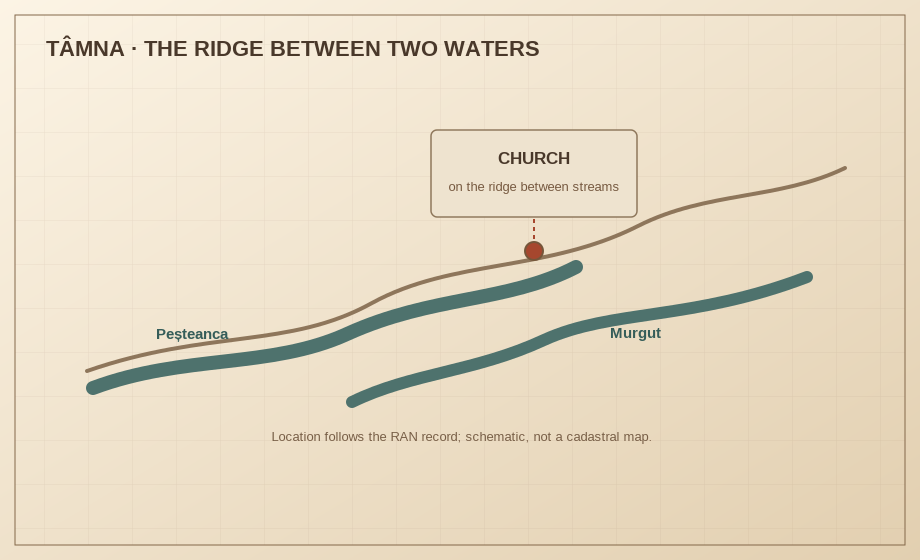
The church sits on the ridge between Peșteanca and Murgut
The church stands by the former town hall
St Nicholas Church stands in the western part of Tâmna, between the Peșteanca River and Murgut stream, east of county road DJ561A and by the former town hall, according to the National Archaeological Repertory. The present map point fixes the place we will compare with older records. [4] [5]
RAN also describes the terrain as a hill and says the stone church was built on the site of an earlier wooden church. That does not tell us when each part of the building appeared, or whether records from the nineteenth and twentieth centuries refer to the same phase. The question begins with a place, but its answer depends on how the records were made. [4]
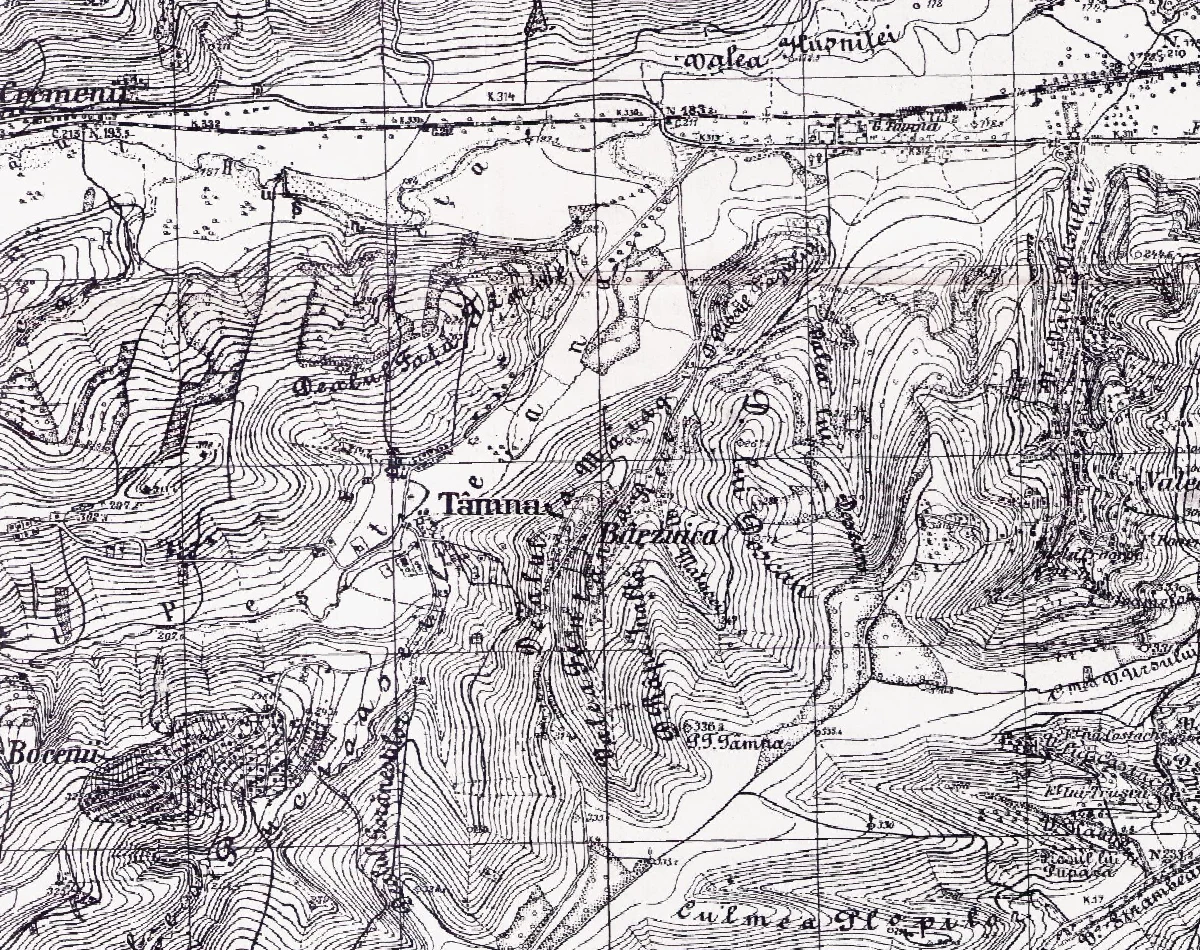
In 1832, the church was masonry and stood on common land
The inventory counts buildings and records ownership
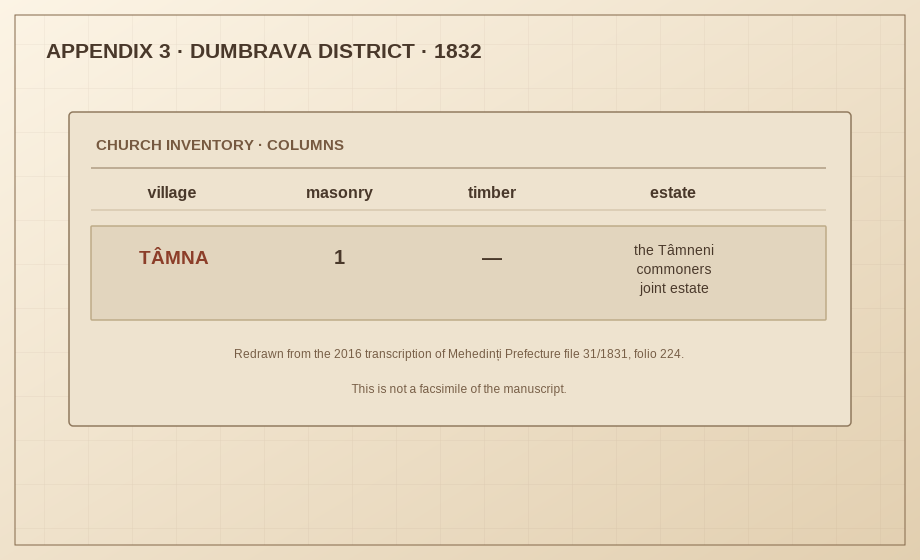
Appendix 3, transcribed by Nicolae Chipurici, reproduces a 1832 table of churches in Dumbrava District. Tâmna’s row lists one masonry church, none of timber, on the estate of the “Tâmneni commoners”. It gives no construction year. [1]
That is an important limit of the first piece of evidence: the building existed by 1832, and the record hints at who held the land, but it does not give a starting date. The 2016 study publishes a transcription and cites Mehedinți Prefecture file 31/1831, folio 224; the journal page is not an image of the manuscript. [1]
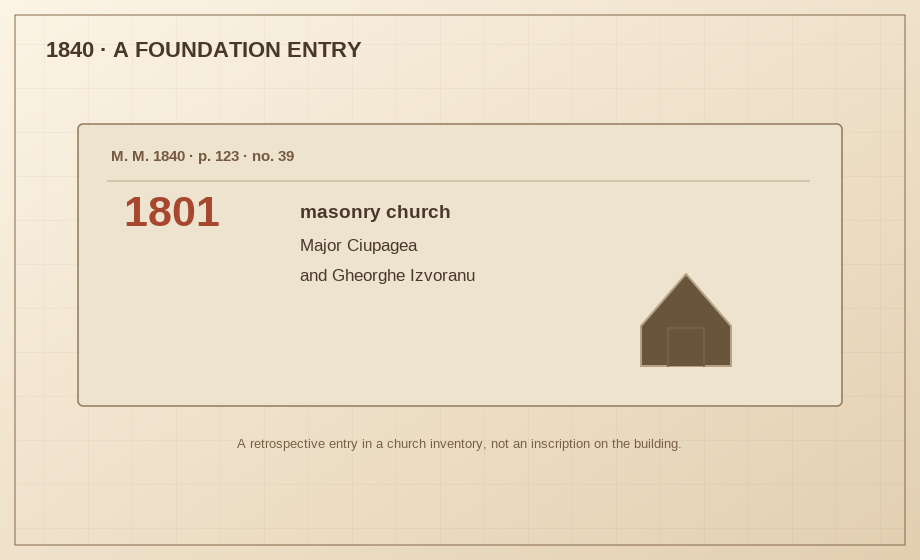
In 1840, the inventory dates the church to 1801
Major Ciupagea and Gheorghe Izvoranu appear as founders
The March 1840 inventory says the masonry church was built in 1801 by Major Ciupagea and Gheorghe Izvoranu. Nicolae Chipurici gives the precise reference: page 123, entry 39. It is a retrospective account entered nearly four decades after the year it names. [1]
The Diocese of Severin repeats the same information and dates the inventory to 30 March 1840. The founders’ names connect the building to a military family and a boyar family, but the sources presented here do not describe each person’s contribution or preserve an inscription set into the wall. [3]
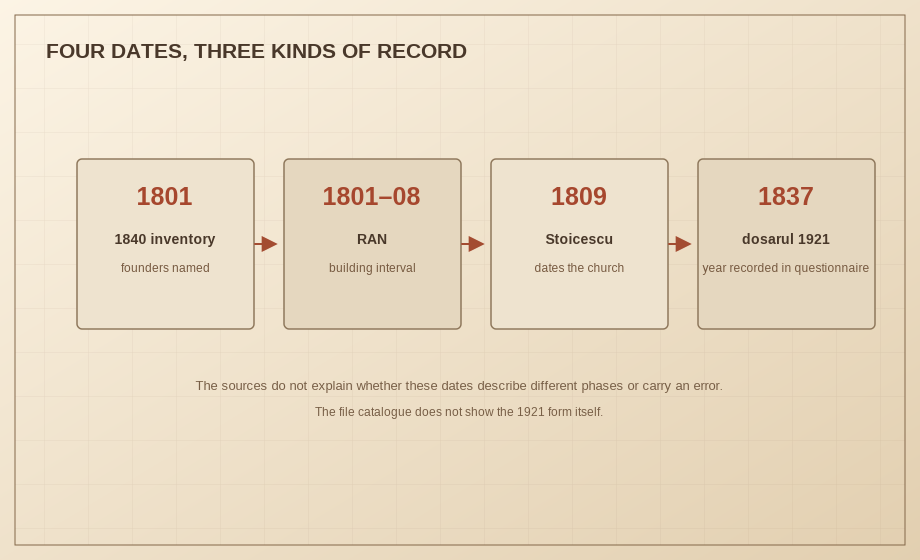
Where does 1837 come from?
The sources serve different purposes and do not fit one date
RAN dates construction to 1801–08. Chipurici’s study cites 1801 in the 1840 inventory, then notes that historian Nicolae Stoicescu published 1809. The Historical Monuments Commission Archive catalogue describes a questionnaire in file 3376 that lists 1837. [4] [1] [2]
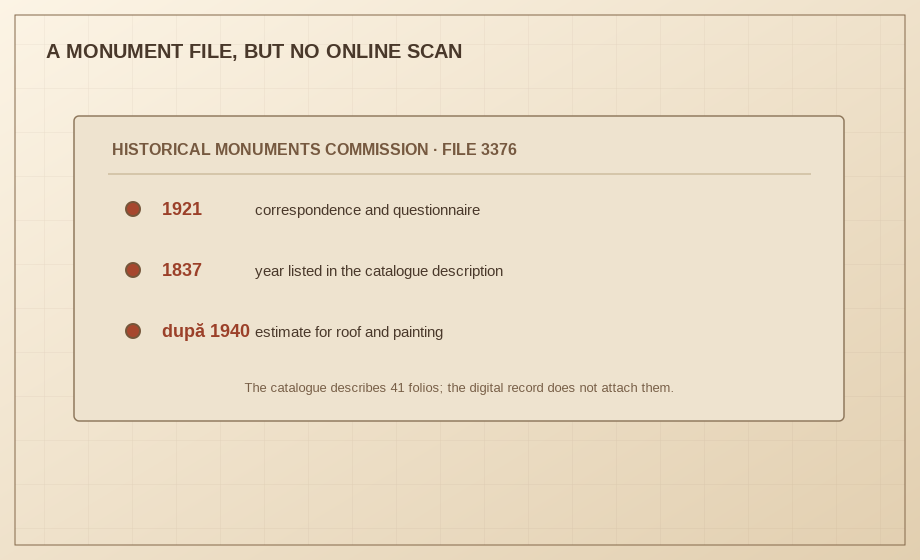
The catalogue record has no scan of the questionnaire. None of these entries explains whether 1837 refers to another repair, a building phase or a copying error. Until the document can be read directly and compared with an inscription or examination of the masonry, the date remains disputed. [2]
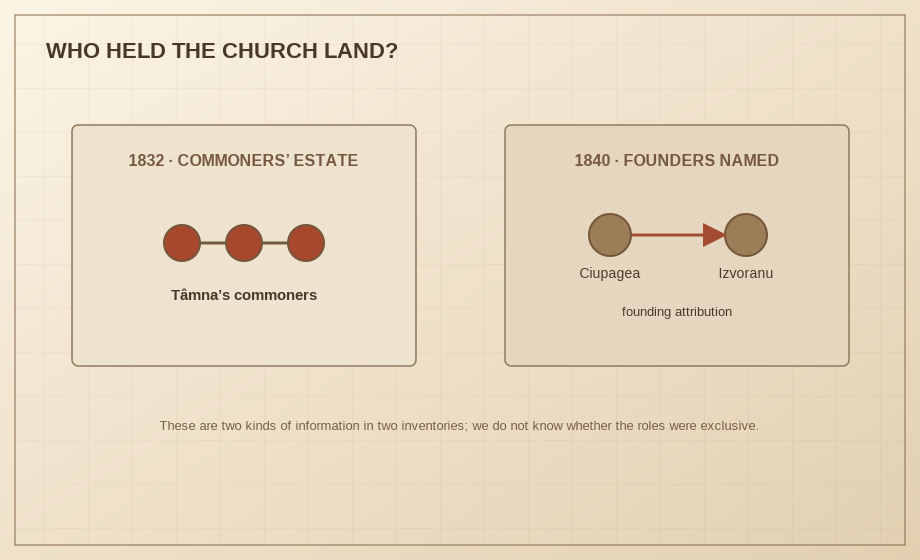
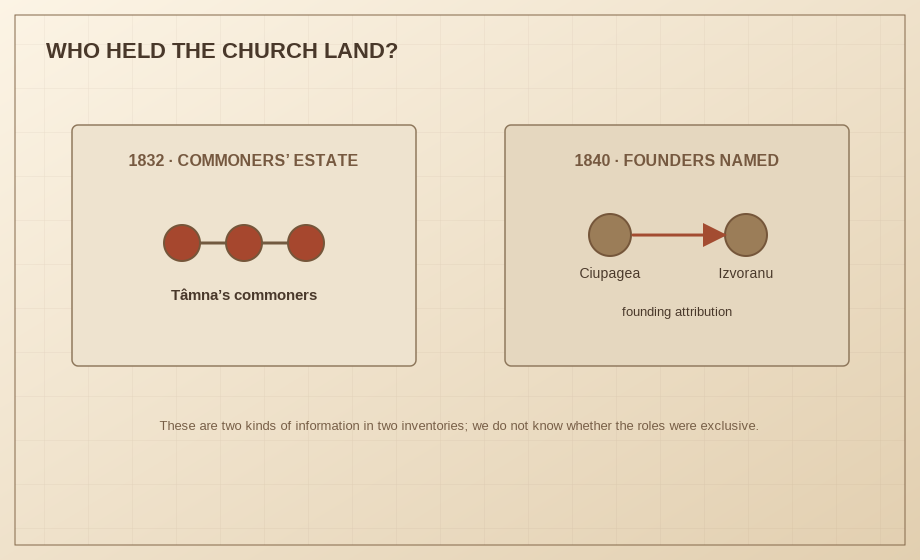
Commoners appear in 1832; boyars appear as founders in 1840
The inventories answer different questions
In 1832, Tâmna’s row places the masonry church on the estate of the Tâmneni commoners, villagers who held land jointly. In 1840, another inventory names two founders. The facts can coexist: a community’s land could hold a building established or funded by other people. [1]
But the records do not explain the legal or practical relationship between land and foundation. We do not know whether the commoners donated land, helped build the church or shared rights with its founders. The diagram keeps the facts in separate columns because the documents do not fill that gap. [1]
The commission’s 1921 correspondence
The catalogue shows the subject, not the original papers
File 3376 of the Historical Monuments Commission contains 41 folios, according to the archive catalogue. It describes correspondence from 1921, a questionnaire listing the year 1837, and papers about painting and repairs. The archive record also mentions an estimate for the roof and restoration of the painting after the 1940 earthquake. [2]
The file could clarify which date the commission accepted and what damage it saw, but its contents are not scanned on the digital record consulted. We therefore describe the catalogue entry rather than quote the original as though we had read it. The 41 folios are a research lead, not fully visible evidence. [2]
The church was repaired, then badly damaged
The 1940 earthquake began another phase of repairs
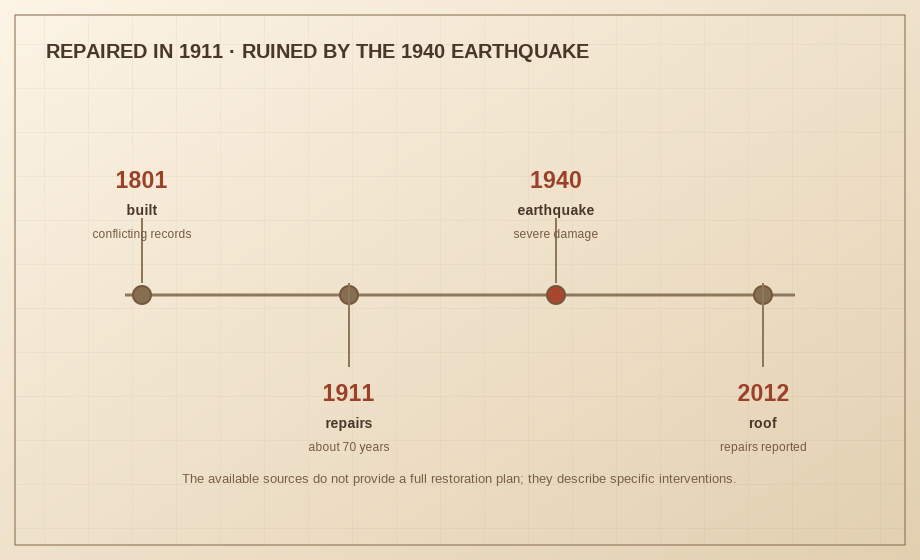
The Diocese says the masonry church was repaired in 1911. The earthquake of 9–10 November 1940 badly damaged it and left it in ruins, according to the same account. [3]
The church was insured after the earthquake, and the Commission archive catalogue later describes an estimate for the roof and restoration of the painting. In 2012, the diocese recorded new roof sheeting, gutter and plaster repairs, and exterior painting. These dates do not tell us how much of the present masonry belongs to each intervention. [3] [2]
What we know — and do not know — about today’s church
The location is clear; the exact date and sequence of works are not
The present point is precise: 44.57118517, 23.02394011, on St Nicholas Church. RAN recorded it in good condition in November 2022. It also preserves the account of an earlier timber church on whose site the stone building was built. [5] [4]
The records consulted do not resolve when each part of the building was made. The 1832 inventory proves a masonry church existed then; the 1840 inventory gives 1801; and the monument file catalogue records 1837. Resolving the difference would require seeing the original form and comparing it with inscriptions or a direct examination of the masonry. [1] [2]