Antarctica · Pointe Géologie · 66°40′S
115 days. No food. One egg on his feet.
An emperor penguin father holds his egg through the Antarctic winter while his mate walks to the sea and back. Stand the winter with him — 119 grams of his own fat a day, in huddles that can become warmer than your room, from winters scientists actually measured.
Two real calls wait in chapter 8 — sound stays off until you ask.
1 April · day 1 of 115
The walk inland
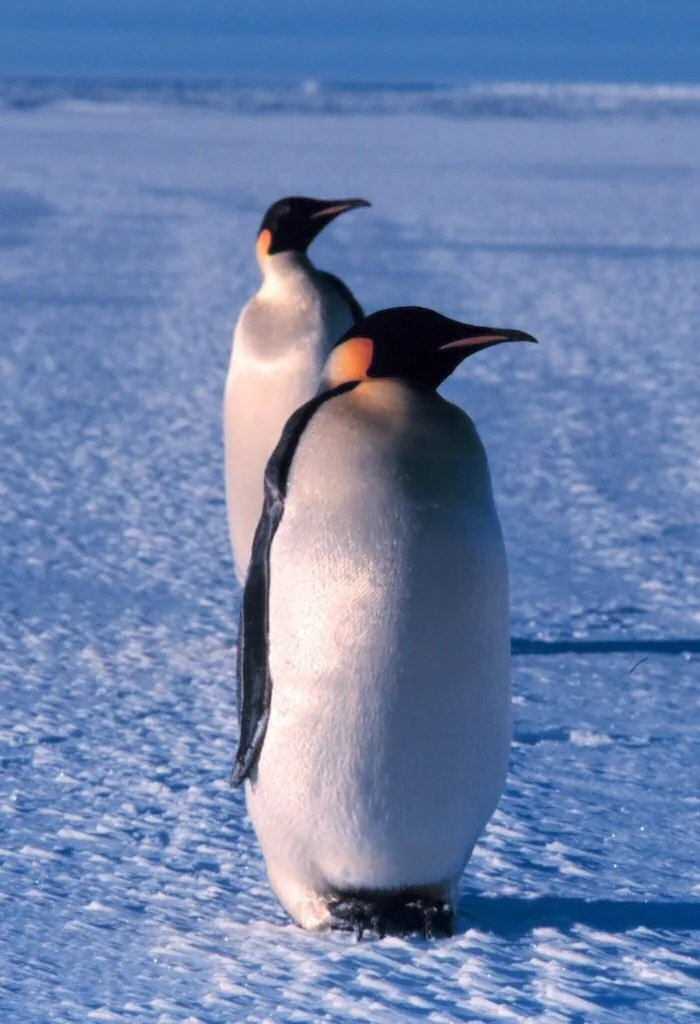
At the end of the Antarctic summer, the emperors leave the open water and walk inland — about a hundred kilometres — to the colony ice.
This winter is set at Pointe Géologie, where some 3,000 pairs gather within earshot of a French weather station. The male arriving now weighs nearly 38 kilos. He will not eat again for about 115 days.
- ≈38 kg on arrival
- ≈100 km from the sea
- ≈3,000 pairs
2 May · day 28
A single egg
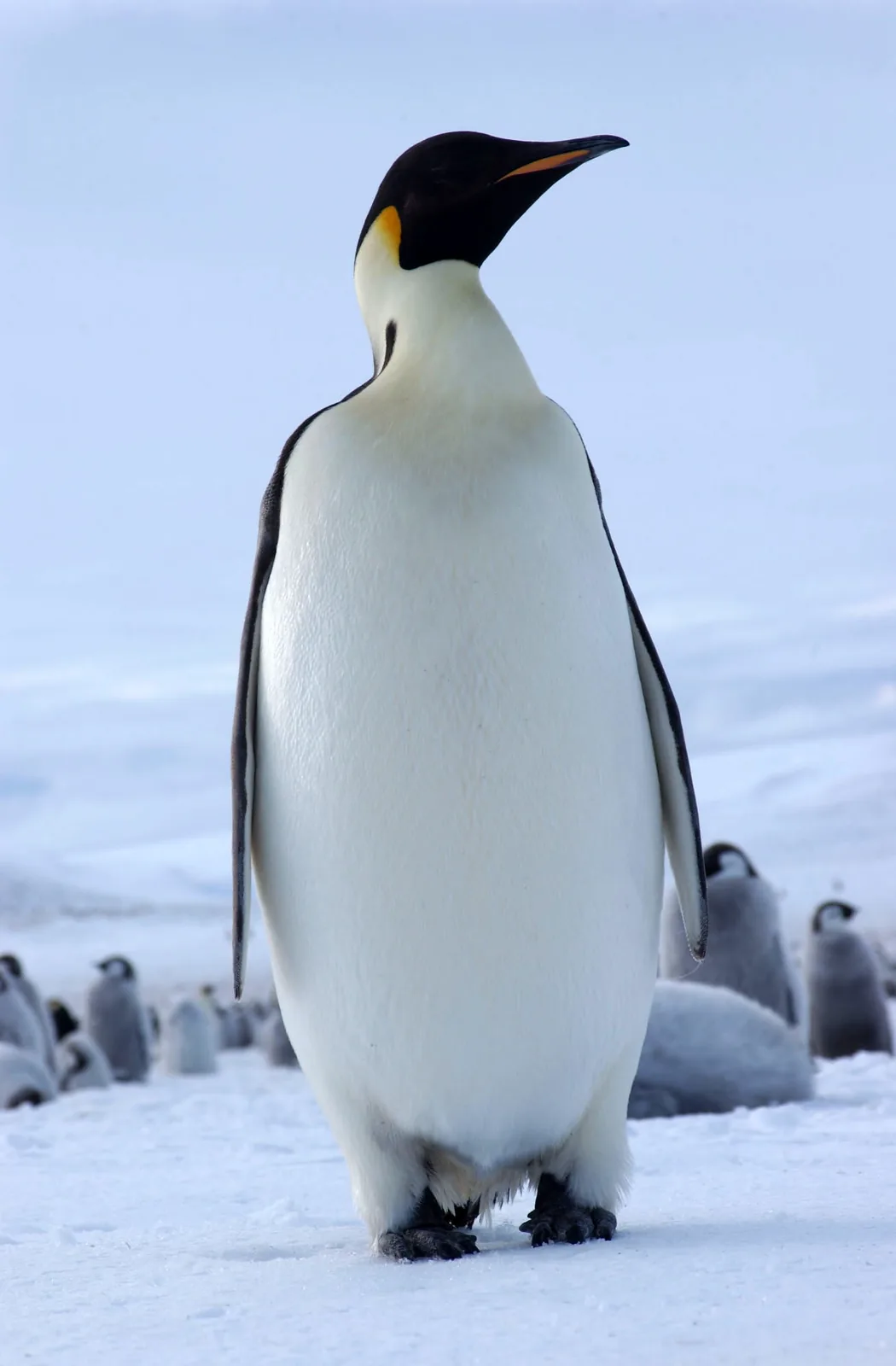
Each female lays one egg — about 445 grams. In May 2001, all five tagged females at Pointe Géologie laid within a single week, 16 to 22 May.
One egg. No nest. Nothing between it and the ice but feet.
3 19 May · day 46
Take the egg
She lays it onto her own feet, then — quickly, clumsily, with the whole season at stake — rolls it onto his. Then she turns and starts walking to the sea. She will be gone about seventy days.
Take it.
Take your time — letting go only pauses. There is no way to drop it here.
The egg is on your feet. It weighs about 445 grams and must be held at 36 °C (97 °F).
4 Late May · June · days 47–78
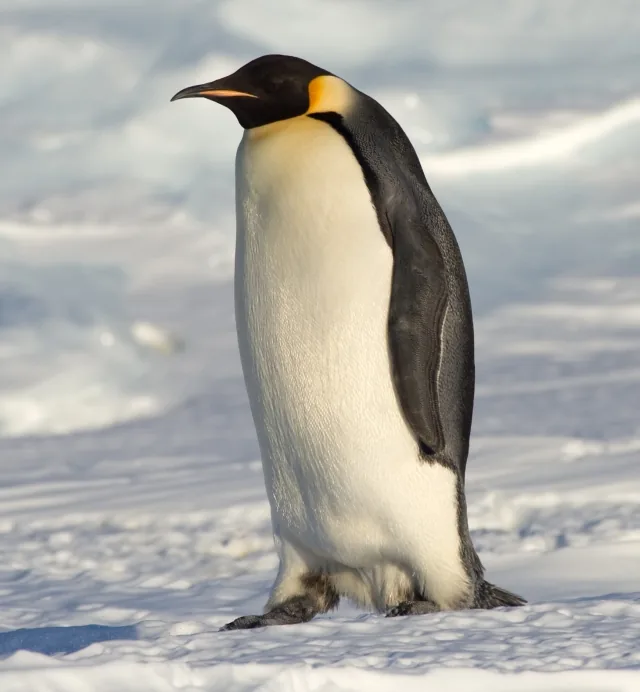
She walks to the sea
While he stands, she travels. In the winter of 1993, satellite tags watched females walk to the ice edge in about eight days, feed at sea for fifty to sixty, and walk back in four — some seventy days away, a hundred kilos of krill and fish eaten, six kilos gained.
He does none of that. He stands, loses 119 grams a day, and waits.
She is 1 day gone — walking to the sea.
5 21 June · day 79
The longest night
Two hours and one minute of sun; the other twenty-two hours the sun never clears the ice. Across the whole incubation, nearly three quarters of every day is night — and it is at night that he huddles: 96% of all huddling happens after dark.
Nine degrees further south, at Halley, the sun stays below the horizon from 30 April to 13 August. Here it still climbs, barely, above the ice.
6 Late June · July · days 80–110
What the huddle knows
He huddles more than a third of his time — thousands of males packed about twenty-one to the square metre, shifting every 30 to 60 seconds in waves that cross the huddle at twelve centimetres a second.
Storms rake the colony for days at a time — winds of 324 kilometres an hour have been recorded at the station 500 metres away.
Inside, the air he breathes can rise above 0 °C (32 °F) while outside it is about −17 °C (1 °F). In the tightest huddles it can pass 20 °C (68 °F). The hottest air logged in the Pointe Géologie study reached 37.5 °C (99.5 °F).
He holds his own core at 36.9 °C (98.4 °F) and burns almost pure fat: ninety-six parts fat to four of protein. But the mass bar only runs one way, and day 110 ends about half a kilo above the 24-kilo line — below it, the fast turns on him.
7 23 July · day 111
Born before she returns
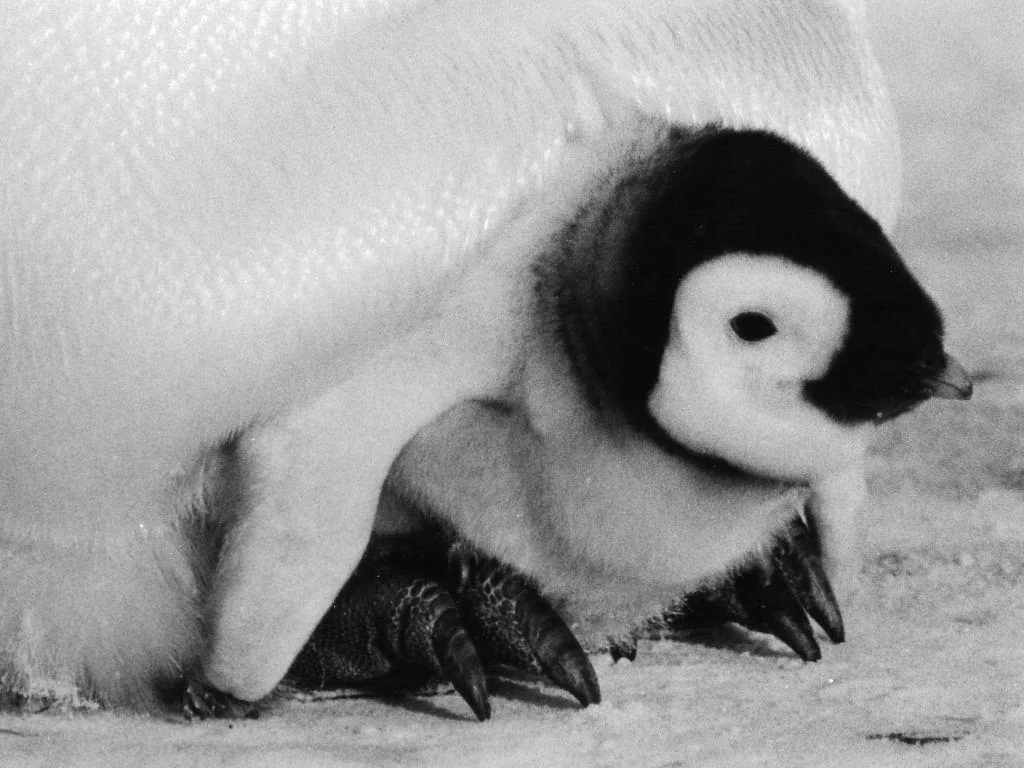
Midwinter. The chick breaks out of the shell — and she is not back.
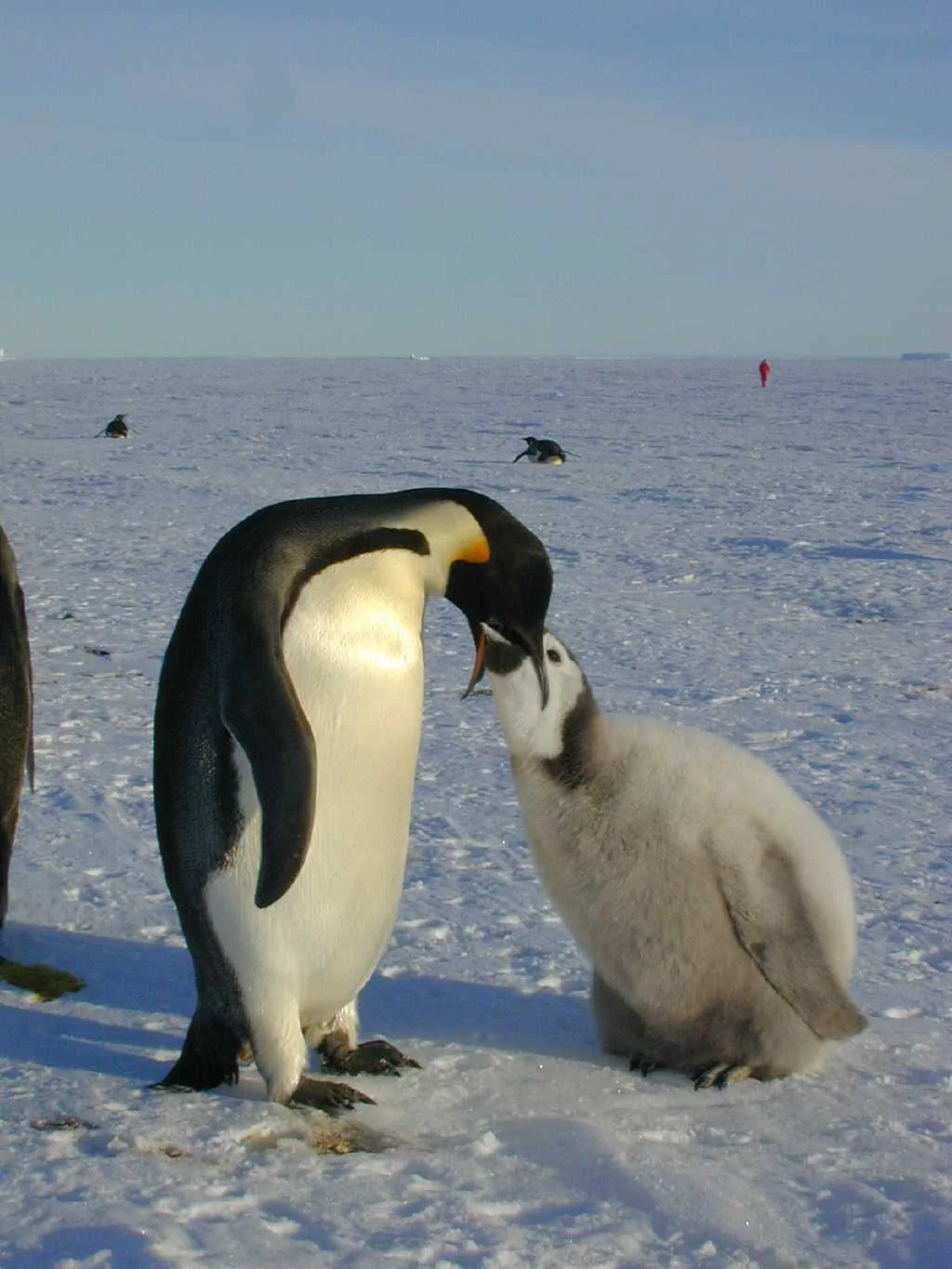
So the father feeds it himself — a pale curd from the wall of his own gullet, the secretion Prévost and Vilter described in 1963, made from a body that has eaten nothing for 111 days. It lasts days, not weeks. It is enough — if she comes.
8 Late July · days 112–115
Her voice finds him
She comes back from the sea after seventy days away and calls into a colony of thousands. He answers. They find each other by voice alone.
An emperor sings with two voices at once, and where they overlap they make a beat — a wobble unlike any other bird's in the colony. Play a mate's call with one voice stripped out and the bird does not answer; play the beat and it does. Fifty-eight calls from seven birds, and every one told apart.
Two calls taped at sea on frozen ice, Weddell Sea, February 2024 — not the winter colony. Which bird called is unknown; the recordist logged two individuals, one calling. Recordist steve, xeno-canto XC877994 and XC877995, CC BY-SA 4.0 — clips shared under the same licence.
9 Late July · day 115
His turn to eat
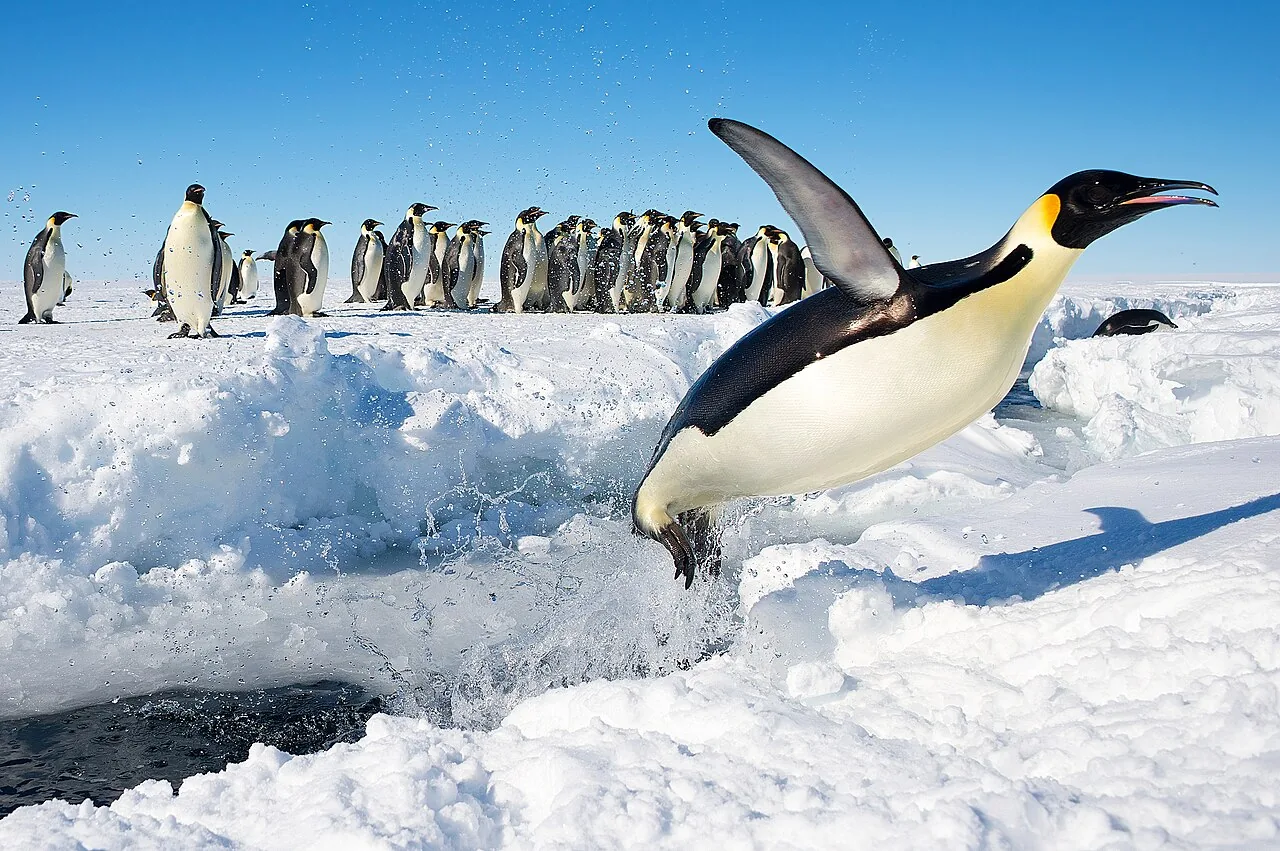
He hands the chick across — one more careful roll from feet to feet — and starts walking. Ahead: the sea, and his first meal in 115 days. Behind: a chick that will join a crèche.
115 days13.7 kilos lostone egg
The night is long. Hold someone warm.
How this winter was built
One bird, many winters. Every number on this page was measured in real emperor winters — but no single bird was followed for all of them. The mass curve is five males at Pointe Géologie in 2001; the huddle waves are Neumayer in 2008; her sea trip is Auster and Taylor Glacier in 1993; the 115-day fast is the classic Pointe Géologie figure — reported male totals run about 110 to 134 days across colonies and years, and Kooyman and colleagues argue some Cape Washington fasts are much shorter. The day-counter stitches them into one illustrative male.
What is measured: the 119-grams-a-day loss, the huddle fractions and air temperatures, the station temperature table, the 16–22 May laying window, her trip's length and catch, the call playbacks. What is modelled: the 19 May transfer date (midpoint of the measured laying window), which night each storm falls on, each flip in and out of the huddle, the light curve between its two computed points, and the mass past day 90 at the same measured rate. Day lengths come from the standard sunrise equation at 66°40′S, which gives two hours and one minute for 21 June. A simulation that follows its source curves shows the build is faithful, not that the biology is certain.
Sound and pictures. The two calls are real field recordings, taped at sea on frozen ice in the Weddell Sea in February 2024 — not in a winter colony; the wind is synthesised noise. All six photographs were taken in daylight in milder seasons; the winter itself is dark. The MP3 clips are shared under CC BY-SA 4.0 and the adapted portrait figure under CC BY-SA 3.0, matching their originals.
What this page does not claim: the Vostok −89.2 °C (−128.6 °F) record belongs to the inland plateau, never to a colony; the curd's composition and the return timings come from older work — Prévost and Vilter's 1963 congress paper and the Williams handbook account — carried here with attribution; and the tidy story of birds taking turns on the huddle's edge is not what the tracking studies show.
| What | Where | When | How many |
|---|---|---|---|
| Mass loss, 119 g/day | Pointe Géologie | 2001 | 5 males |
| Huddle air and time budget | Pointe Géologie | 1998 + 2001 | 8 birds |
| Huddle waves, ~21 birds/m² | Neumayer | 2008 | ≈2,000 observed |
| Her sea trip, ≈70 days | Auster + Taylor Glacier | 1993 | 2 satellite + 14 loggers |
| Voice recognition | colony playbacks | 1993 · 2000 | 58 calls, 7 birds · trials |
Sources
- Gilbert et al. 2006 — huddling behaviour, mass loss, laying dates (author manuscript, HAL) hal.science/hal-00127765/document
- Gilbert et al. 2007 — body temperature in huddling males (abstract) doi.org/10.1152/ajpregu.00912.2005
- Zitterbart et al. 2011 — huddle waves and density (PLoS ONE, full text) journals.plos.org/plosone/article?id=10.1371/journal.pone.002026
- Zimmer et al. 2009 — pair-phase huddling (Proc. R. Soc. B, full text) pmc.ncbi.nlm.nih.gov/articles/PMC2677610/
- Robin et al. 1988 — fasting phases and fuel use (abstract) doi.org/10.1152/ajpregu.1988.254.1.R61
- Ancel, Beaulieu & Gilbert 2013 — penguin breeding-strategies review (HAL record) hal.science/hal-00789518
- Kirkwood & Robertson 1997 — female winter foraging (abstract) oceanrep.geomar.de/id/eprint/52785/
- Kooyman, van Dam & Hückstädt 2018 — Cape Washington: some fasts much shorter than 115 days (abstract) doi.org/10.1242/jeb.170795
- Aubin, Jouventin & Hildebrand 2000 — the two-voice system (PMC) pmc.ncbi.nlm.nih.gov/articles/PMC1690651/
- Robisson, Aubin & Brémond 1993 — individuality in the emperor's voice doi.org/10.1111/j.1439-0310.1993.tb00445.x
- DWD climate tables — Dumont d'Urville (PDF) dwd.de/DWD/klima/beratung/ak/ak_896420_kt.pdf
- Dumont d'Urville wind records 1956–1992 (winter-over compilation of official data) gdargaud.net/Antarctica/MeteoDdU.html
- British Antarctic Survey — Halley and the polar night bas.ac.uk/polar-operations/sites-and-facilities/facility/halley/
- WMO extremes archive — the Vostok −89.2 °C (−128.6 °F) record wmo.int/media/magazine-article/wmo-archive-of-weather-and-climat
- XC877994 · XC877995 — emperor calls, Weddell Sea (CC BY-SA 4.0) xeno-canto.org/877994