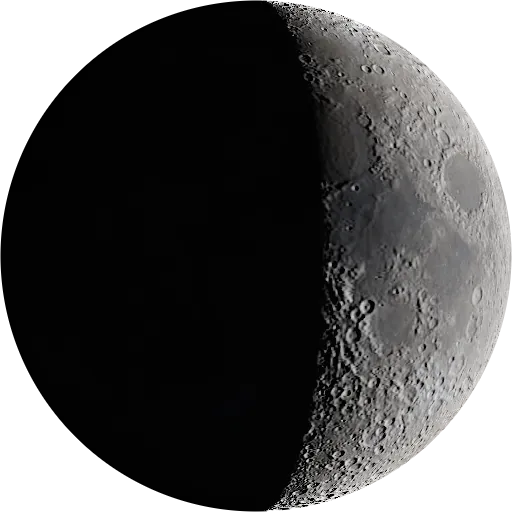
The Moon tonight
The Moon you were born under
On the night you arrived, the Moon had a shape. Put in your birthday and the sky will turn back to it.
Drag the Moon sideways, or use the arrow buttons
Your Moon
Waiting for your date
Put your birthday in at the top, and your Moon appears here.
It comes back
The Moon and the calendar almost line up every 19 years. 235 lunar months last 6,939.7 days; 19 years last 6,939.6. So your birthday Moon tends to come back at 19, 38, 57 and 76. The match is not exact: 235 lunar months run about two hours longer than 19 years, and leap days move the calendar by up to a day more, so now and then a return is missed, and now and then one lands in between.
Your birthdays, and the Moon on each
Put your birthday in at the top to see yours.
Numbers are your age. Tap one to see that birthday's Moon; the highlighted ones are almost the same Moon as yours.
Were you a full-moon baby?
Maternity wards have an old story: when the Moon is full, the babies come. Prompted by that belief among hospital staff, researchers in Phoenix, Arizona, checked 167,956 spontaneous vaginal deliveries at 37 to 40 weeks.
Compared day by day
Almost every birth in Romania from 1995 to 2025, and in the United States from 1994 to 2014, sorted by the Moon on the day. Each day is compared with the same weekday one, two and three weeks either side, which largely controls for weekday and seasonal patterns. Holidays are left out; the method below lists them.
- −0.09%New
- +0.06%Waxing crescent
- −0.07%First quarter
- −0.07%Waxing gibbous
- +0.21%Full
- +0.09%Waning gibbous
- −0.07%Last quarter
- −0.06%Waning crescent
- +0.06%New
- +0.13%Waxing crescent
- −0.08%First quarter
- +0.02%Waxing gibbous
- +0.08%Full
- −0.14%Waning gibbous
- −0.24%Last quarter
- +0.17%Waning crescent
a 10% full-moon rush would reach this line
Around the full Moon, births in the US were about two in a thousand higher than on an average day; in Romania, less than one in a thousand, and the full Moon was not even the busiest phase there.
The US bump shrinks under closer checks. Allowing neighbouring weeks to move together, the range includes zero; a model that follows the Moon's angle through the whole month puts it nearer one in a thousand.
At two in a thousand, a hospital delivering ten babies a day would wait about a year for one extra full-moon baby; at one in a thousand, about two years.
Published studies agree. Arliss and colleagues found no difference across the eight phases in 564,039 births in North Carolina; Windsperger and colleagues found none in 462,947 births across Austria.
Margot, reviewing the evidence in 2015, put the belief down to cognitive bias: the nights that fit the story are the ones people remember.
The same Moon, everywhere
At any one moment, everyone who can see the Moon sees the same phase, lit by the same amount. Only its angle changes: from the other hemisphere it appears roughly upside down.
Look up
The next time your birthday Moon comes back, go outside and find it.
It is the closest anyone gets to seeing the sky of the night they arrived.
And if someone who was there that night is still around, ask them if they remember the Moon.
Sources and method
The Moon's phase is calculated from the lunar and solar series in Jean Meeus's Astronomical Algorithms (the main terms). Daily phase values were checked against NASA JPL's DE440s ephemeris across 1900–2100: the largest difference is 0.06° of the Moon's angle from the Sun. Full-Moon timings were separately checked for 1950–2049 and agreed within 5.2 minutes. The Moon is shown for 9 p.m. on your date, in your device's time zone; it moves about 12° a day, so a birth in the early hours may have had a slightly different Moon.
The eight phase names split the cycle into equal slices of 45°. In this eight-slice scheme, “Full” covers every night when about 96.2% of the disc or more is lit. “Almost the same Moon” means a birthday Moon within 12° of yours, about a day of the Moon's motion. The Moon's mean orbital distance grows by 38.30 ± 0.09 mm a year (Williams, Boggs and Ratcliff, from lunar laser ranging); the page multiplies that by the time since your date. The actual distance swings by tens of thousands of kilometres every month.
Births: daily counts from Romania's National Institute of Statistics (6,532,338 births, 1995–2025) and from the CDC's National Center for Health Statistics (1994–1999) and the Social Security Administration (2000–2014), as published by FiveThirtyEight (85,712,738 births). Each day is divided by the average of the same weekday one, two and three weeks either side. Left out: 20 December to 3 January, Maundy Thursday to Easter Monday (Western and Orthodox, because Easter is set by the ecclesiastical, or Paschal, full Moon, which is not always the astronomical one), and any day more than 22% away from its neighbours (large calendar or reporting outliers). That leaves 6,071,755 and 79,107,680 births. The phase is taken at 18:00 UTC for the US (around midday in the central states) and 10:00 UTC for Romania (midday in winter, 13:00 in summer). Day-level 95% bootstrap intervals: full Moon +0.21% (0.00 to +0.41) in the US, +0.08% (−0.22 to +0.39) in Romania. In a phase-rotation (placebo) test, shifting the Moon by each whole degree produces a “full Moon” at least as large 3% of the time in the US and 24% in Romania.
Robustness. Because neighbouring days share the same comparison weeks, a moving-block bootstrap (2,000 resamples) is more honest than the day-level one: with 28-day blocks the US full-Moon excess runs −0.02% to +0.44%, Romania −0.32% to +0.48%; 56-day blocks give the same picture. Changing the trimming (10%, 15%, 30%, none) moves the US figure between +0.18% and +0.42% (the untrimmed figure is pulled by a few holidays) and Romania between −0.20% and +0.08%. Taking the phase at 00, 06, 12 or 18 UTC, or representing each day by four phase samples, at 00:00, 06:00, 12:00 and 18:00 UTC, changes the US figure by at most 0.03 points. A regression on the Moon's angle with year-by-weekday and seasonal controls and Newey-West standard errors gives +0.12% ± 0.10% at full Moon in the US and −0.08% ± 0.13% in Romania (± is one standard error).
Many births are planned: in Romania more than half are by caesarean section (514 per 1,000 live births in 2023: Eurostat caesarean counts, hlth_co_proc3, over Eurostat live births, demo_gind). Planned births could hide a natural rhythm, but the studies that looked only at births that started on their own (Staboulidou and colleagues, Hannover; Windsperger and colleagues, Austria, which left out planned caesareans and inductions) found no lunar effect either. The ward example multiplies ten births a day by an excess of 0.1–0.2% over the 46 nights a year that fall in the full-Moon slice.
The Moon is drawn from NASA's CGI Moon Kit (the LRO camera's colour mosaic and the LOLA elevation map), lit by the Sun's position; the relief is exaggerated so craters show at screen size. It is drawn with north at the top, as seen from the northern hemisphere; the real tilt in your sky depends on the hour and your latitude, and the Moon's small wobble (libration) is not shown. The stars and clouds are decoration, not the sky of that night.
- Meeus J. Astronomical Algorithms, 2nd ed. Willmann-Bell, 1998 (ch. 47, 48). Lunar and solar series used for the phase. archive.org/details/astronomicalalgorithmsjeanmeeus1991
- NASA JPL. DE440s planetary and lunar ephemeris, used to check the phase calculation. ssd.jpl.nasa.gov/planets/eph_export.html
- Espenak F. Phases of the Moon, 2001 to 2100 (astropixels.com). Published full-moon times. astropixels.com/ephemeris/phasescat/phases2001.html
- Williams JG, Boggs DH, Ratcliff JT. Lunar tidal recession. 47th Lunar and Planetary Science Conference, 2016, abstract 1096. hou.usra.edu/meetings/lpsc2016/pdf/1096.pdf
- Institutul Național de Statistică. Live births by date of birth, 1995–2025 (daily counts, supplied on request). insse.ro/cms/en
- FiveThirtyEight. U.S. births, 1994–2003 (CDC/NCHS; 1994–1999 used) and 2000–2014 (SSA), CC BY 4.0. github.com/fivethirtyeight/data/tree/master/births
- Arliss JM, Kaplan EN, Galvin SL. The effect of the lunar cycle on frequency of births and birth complications. Am J Obstet Gynecol 2005;192:1462–4. doi.org/10.1016/j.ajog.2004.12.034
- Morton-Pradhan S, Bay RC, Coonrod DV. Birth rate and its correlation with the lunar cycle and specific atmospheric conditions. Am J Obstet Gynecol 2005;192:1970–3. doi.org/10.1016/j.ajog.2005.02.066
- Staboulidou I, Soergel P, Vaske B, Hillemanns P. The influence of lunar cycle on frequency of birth… Acta Obstet Gynecol Scand 2008;87:875–9. doi.org/10.1080/00016340802233090
- Windsperger K, et al. The impact of lunar phases during day and night cycles on perinatal outcomes: a nationwide cohort study. Birth 2026;53:192–200. doi.org/10.1111/birt.70013
- Margot JL. No evidence of purported lunar effect on hospital admission rates or birth rates. Nurs Res 2015;64:168–73. doi.org/10.1097/NNR.0000000000000086
- Eurostat. Surgical operations and procedures (hlth_co_proc3), caesarean section, Romania 2023. ec.europa.eu/eurostat/databrowser/view/hlth_co_proc3/default/tab
- Eurostat. Population change, live births (demo_gind), Romania 2023. ec.europa.eu/eurostat/databrowser/view/demo_gind/default/table
- NASA's Scientific Visualization Studio. CGI Moon Kit (LROC WAC colour mosaic, LOLA elevation; NASA/GSFC/Arizona State University). svs.gsfc.nasa.gov/4720
- NASA's Scientific Visualization Studio. Moon phase and libration, South Up. svs.gsfc.nasa.gov/5188/