The pot in the wall

The pot in the wall
What was hidden in the fortress wall?
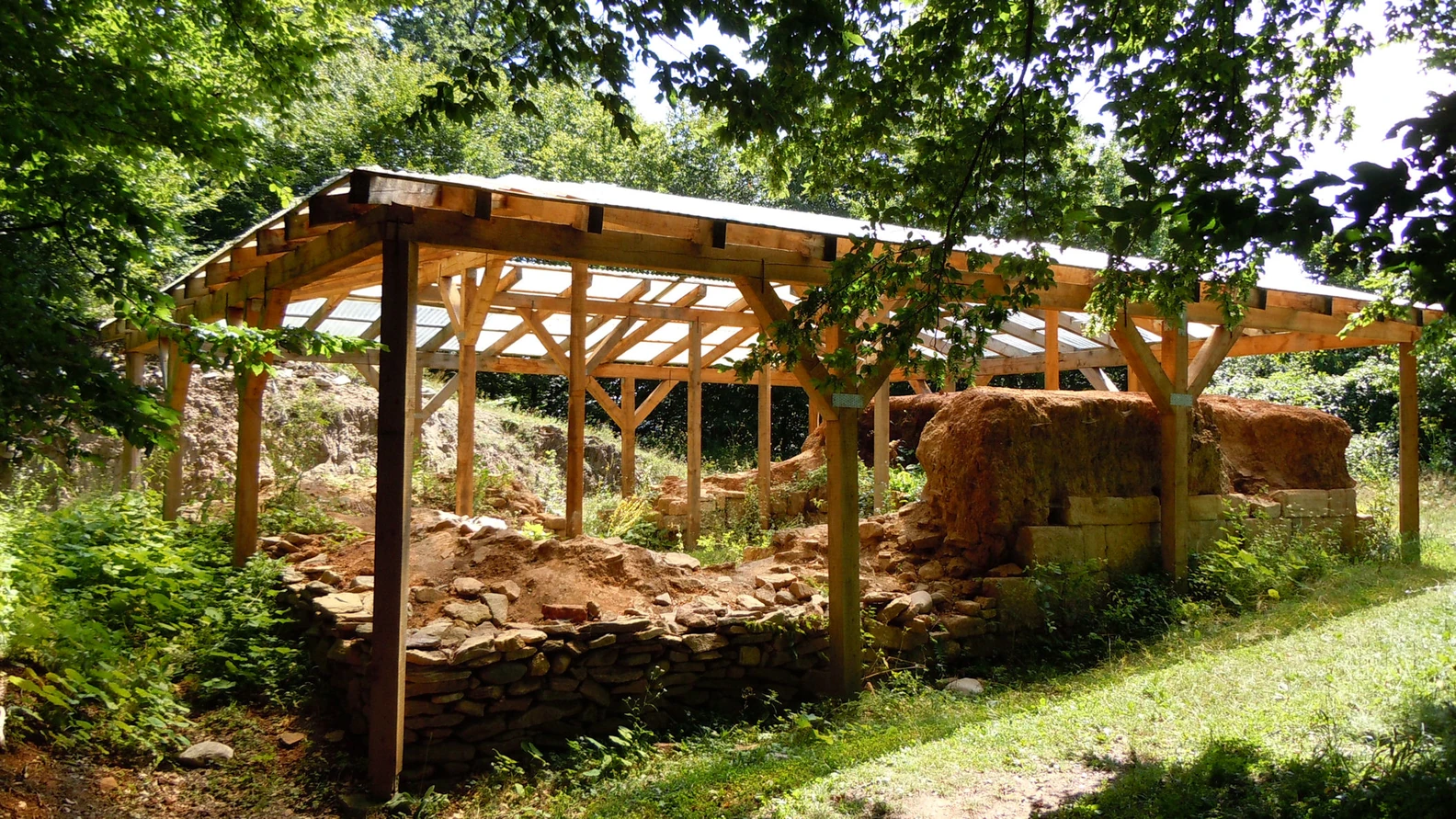
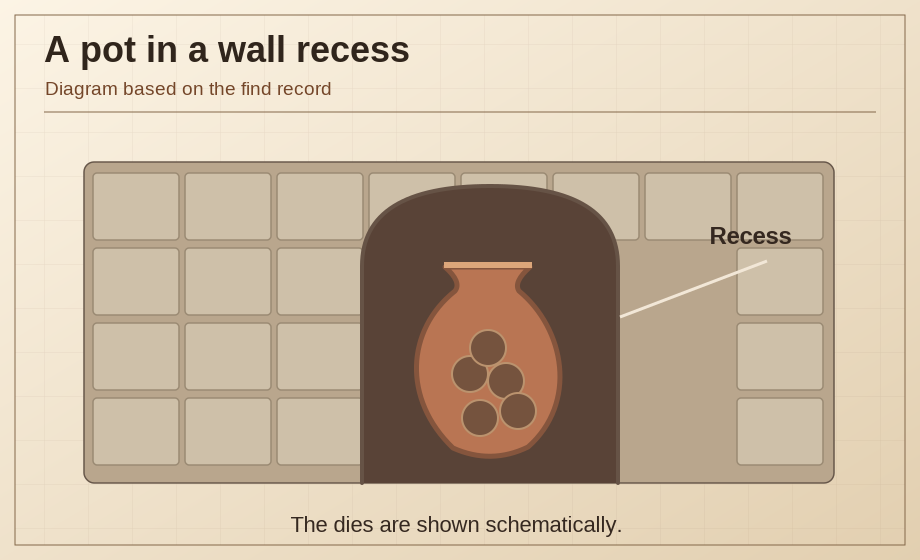
In 1961, excavations on Cățânaș hill, north of Tilișca in Sibiu County, uncovered a pottery vessel. It lay in a recess in the wall of a house-tower inside the Dacian fortress. There were bronze and iron tools inside it. [1] [3]
Archaeologist Nicolae Lupu described the discovery in the magazine Flacăra in May 1962. In the photograph, a hand holds one of the round pieces and others lie beside it. The museum catalogue also shows the pot and gives the objects’ inventory numbers. [2] [4]
Inside the pot
Why do two of the 14 pieces matter?
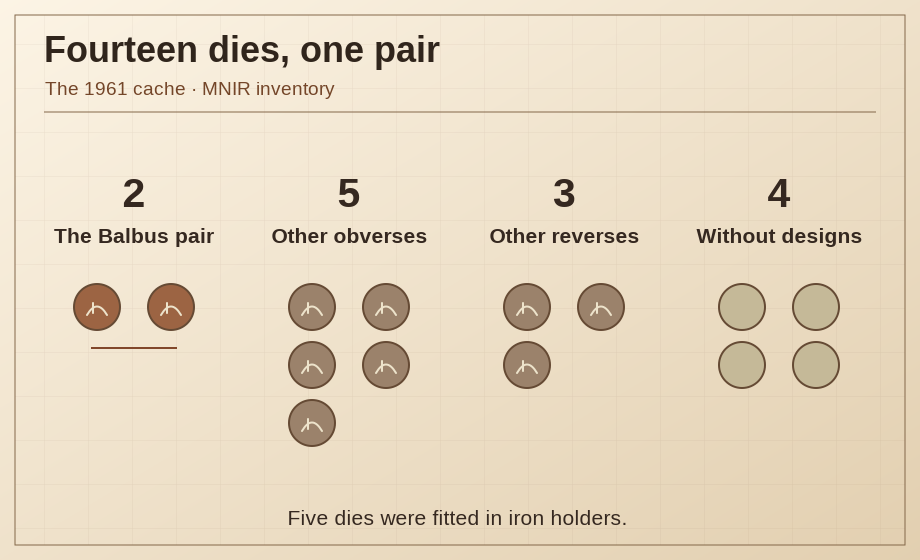
A die is a tool that impresses a design into metal. Five of the 14 bronze pieces were fitted in forged iron holders. Ten carried recessed faces or lettering. The other four had no engraving. [3] [4]
For most types of denarius, the pot held a die for only one face. The museum identified a complete pair for the issue of C. Naevius Balbus: one die for the side with Venus and one for Victory’s chariot. Those two pieces tie the find to a specific type in the Roman coin catalogue. [3] [5]
The Roman denarius
How do you recognise the coin they copied?
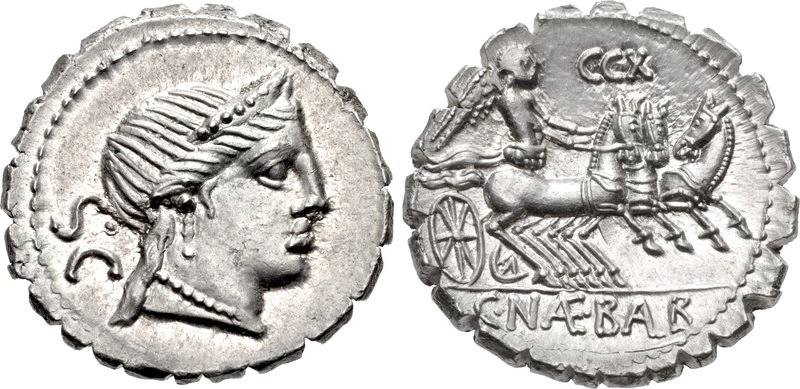
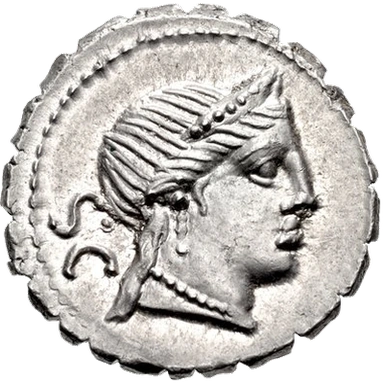
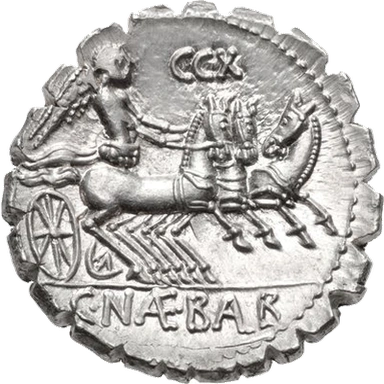
The denarius was a Roman silver coin. On the specimen in the photograph, Venus faces right. On the other side, Victory drives three horses and Balbus’s name appears below the chariot. The design and inscription identify the type even on a die, where the image is reversed. [5] [3]
C. Naevius Balbus was responsible for the issue at Rome in 79 BC. The photographed specimen illustrates the type archaeologists recognised in the two tools. Its catalogue entry gives no findspot. [5]

The recessed image
How does the coin’s portrait get into bronze?
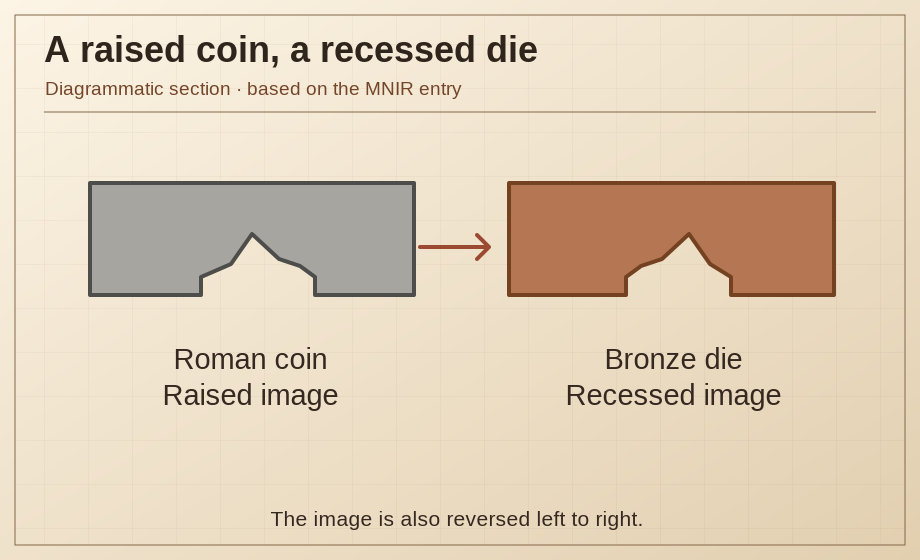
The museum describes a way to make dies that retain fine Roman details. A craftsperson used an authentic coin to impress its design into a heated bronze piece. The raised areas on the silver left depressions in the bronze. [3] [4]
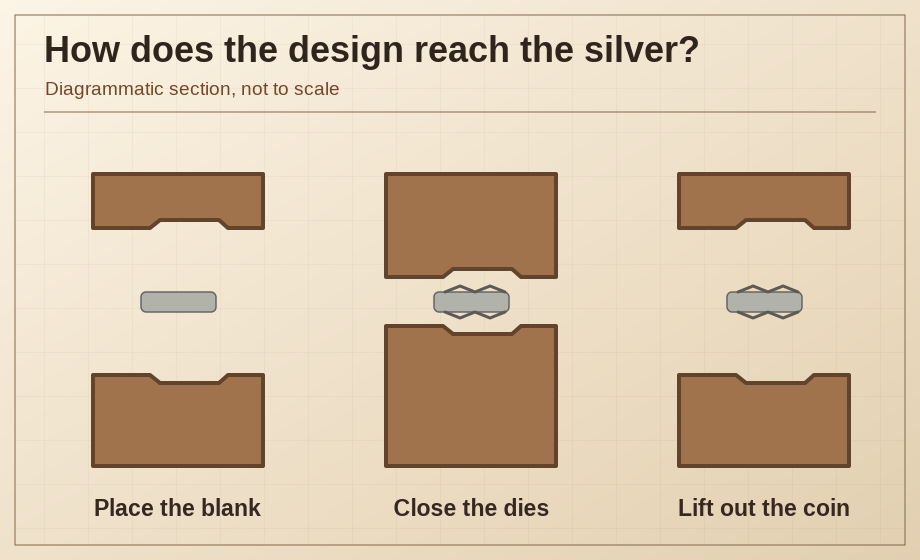
The profile and lettering on the face of the die are also reversed left to right. When the die strikes the design again, the second reversal restores the Roman coin’s orientation. The section shows how the surfaces relate. The museum explains the technique from the tools that survive. [3] [4]
Two faces in one strike
Where does the silver blank go?
The plain disc sits between the dies. When they come together, each die leaves a design on the disc. After the strike, separate the dies and turn the coin to see what each die printed. The section in the previous chapter explains how a recess produces a raised feature. [4]
The model illustrates striking with two dies. The details on their faces are based on the photograph of a Roman denarius. Their shapes and spacing are illustrative. The Tilișca pair could impress both faces, but the pot gives no count of how many coins were made. [3] [5] You can also open the object record for the reverse die found at Tilișca. [7]
Dates in the catalogue
When were the Tilișca dies made?
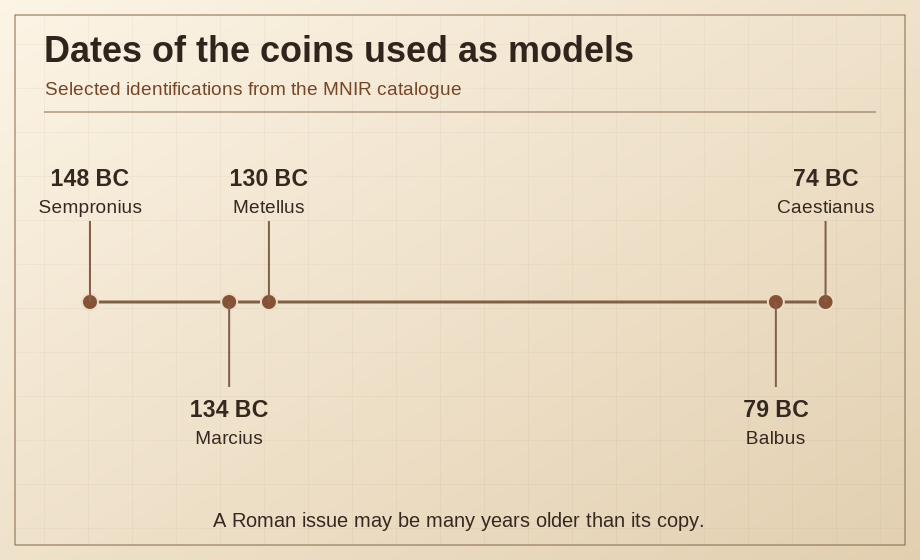
The dies match denarius types issued over several decades, from Sempronius in 148 BC to Caestianus in 74 BC. A Roman denarius could stay in circulation long after it was struck. A craftsperson could copy it once it reached them. [3]
The Caestianus issue sets the earliest possible date for the die that copied it. The catalogue dates the group broadly, from the mid-first century BC to the first century AD. The precise years remain unknown. [4]
Signs of use
How much coin was struck here?
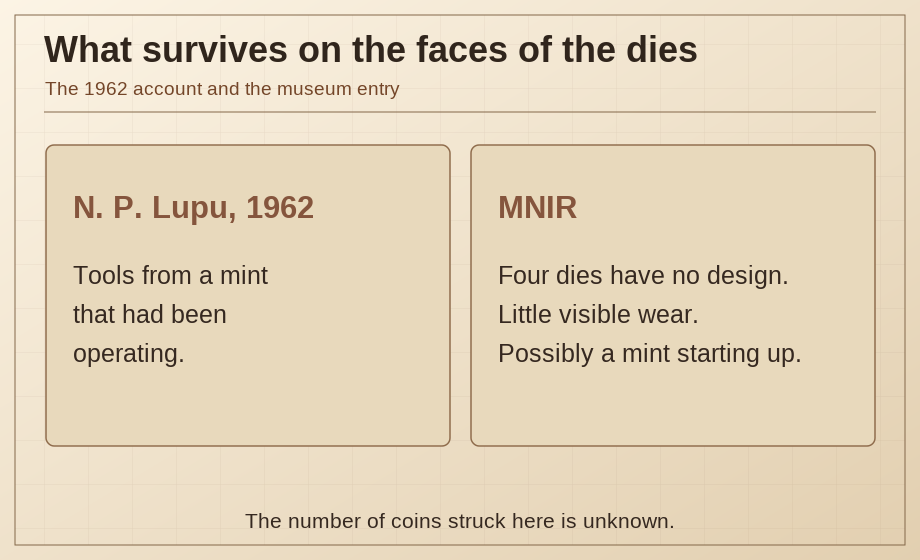
In 1962 Lupu presented the objects as tools from a mint that had operated at Tilișca. The museum’s description leaves open a narrower possibility: a workshop still being set up or just starting work. The dies show little wear, and four bear no image. [2] [3]
Finds at Ludești, Sarmizegetusa Regia and Poiana show that the technique was practised in several parts of Dacia. At Tilișca, the pair names the precise type of denarius the two tools copied. The scale of production at the fortress remains unknown. [3] [4]