Marius ComperTismana Monastery
Română

Tismana Monastery

4,086 boxes at Tismana

In 1944, the National Bank of Romania hid gold from its own reserves and gold entrusted to it by Bank Polski. Follow the boxes from Tismana’s monastery cellar into a cave and back to Bucharest.

Follow the gold from cellar to cave ↓
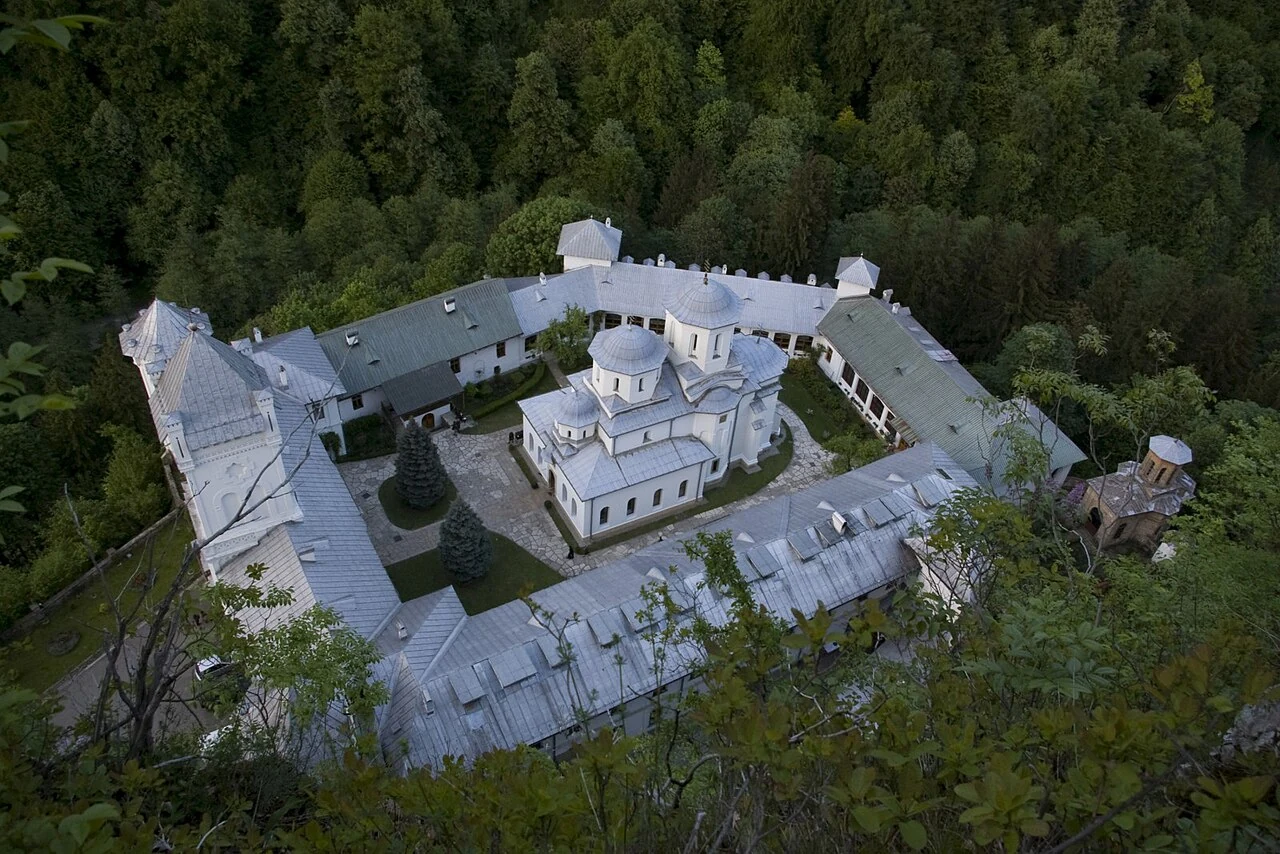
Aerial view of Tismana Monastery, photographed in 2011.
Photographed in 2011, 67 years after the storage operation. It does not document where the boxes were kept. (Source · Photograph: Alexandru Ene, Wikimedia Commons · CC BY-SA 3.0 RO — https://creativecommons.org/licenses/by-sa/3.0/ro/)

01 · July 1944

When the gold reached Tismana

In 1939, after Poland was invaded, 2.7 tonnes of Bank Polski fine gold were deposited with the National Bank of Romania, according to the 10 October record cited in the NBR study. In 1944, 51 boxes of Polish gold entered the inventory of the transport to Tismana. [1]

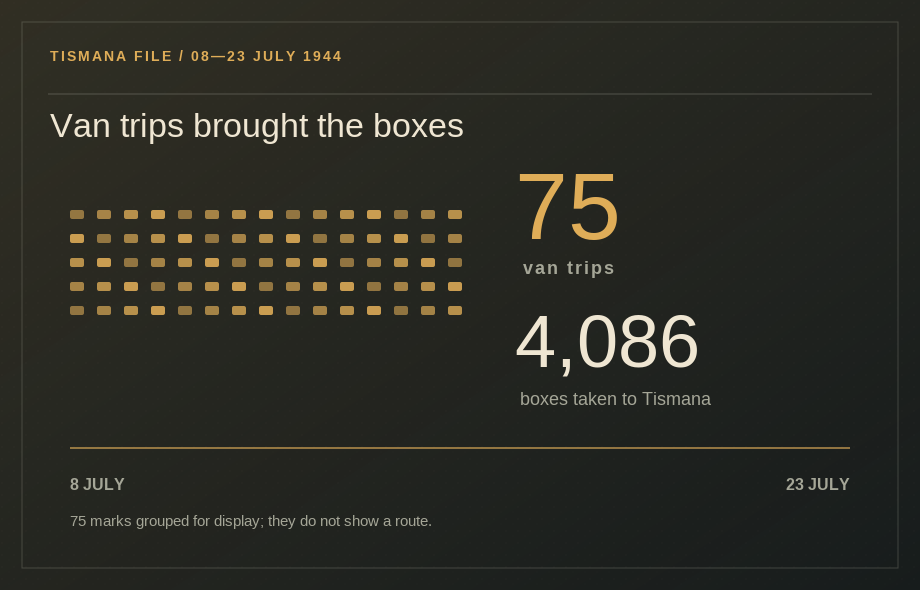
In the summer of 1944, the National Bank and the government organised Operation Neptune after efforts to move the reserve to Switzerland or Turkey failed. Between 8 and 23 July, 75 van trips brought 4,086 boxes of Romanian and foreign bars, coins and medals to Tismana. [1]

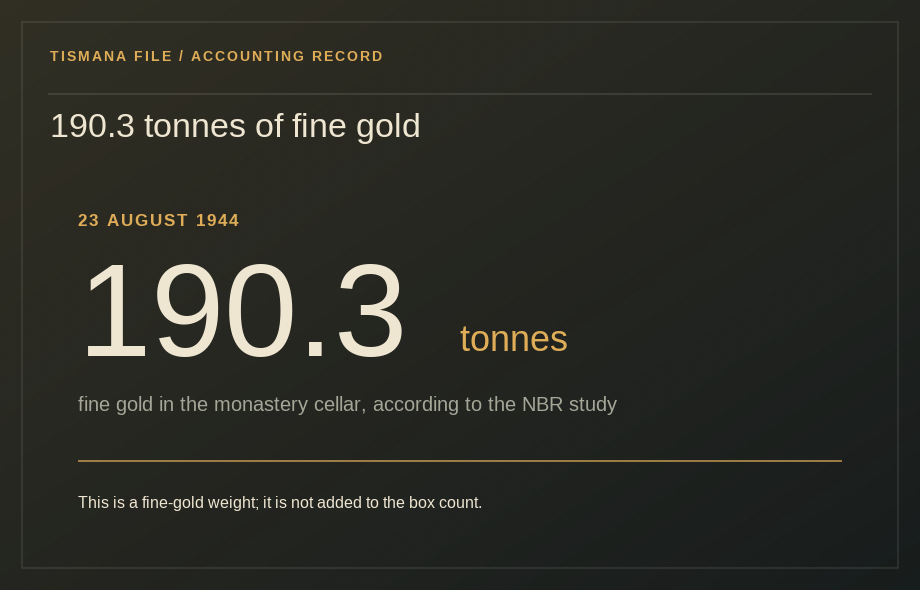
On 23 August, the NBR study records 190.3 tonnes of fine gold in the monastery cellar. That is a weight figure, separate from the box inventory. The aerial photograph here, taken in 2011, shows the present-day complex; it is not a photograph of the operation. This account follows Tismana in 1944–47; the Moscow evacuation took place in separate shipments in 1916–17. [1] [3] [4]
Aerial view of Tismana Monastery, photographed in 2011.
Photographed in 2011, 67 years after the storage operation. It does not document where the boxes were kept. (Source · Photograph: Alexandru Ene, Wikimedia Commons · CC BY-SA 3.0 RO — https://creativecommons.org/licenses/by-sa/3.0/ro/)
75 van trips represented by rectangles beside the total of 4,086 boxes.
75 marks grouped for counting; the drawing does not map the transport or depict historical vehicles. (Source)

02 · two units

Boxes and tonnes measure different things

The July inventory counts 4,086 boxes and explicitly includes 51 boxes of Polish gold. The remaining 4,035 in the diagram is only the subtraction 4,086 minus 51; the cited passage does not publish that remainder as a separate category. [1]

The same NBR study reports 190.3 tonnes of fine gold in the cellar, then says that this weight was moved to the nearby cave. The boxes held several kinds of property, and the Polish gold belonged to a separate owner. Switch between the box count and the fine-gold weight; the figures are not added together. [1]
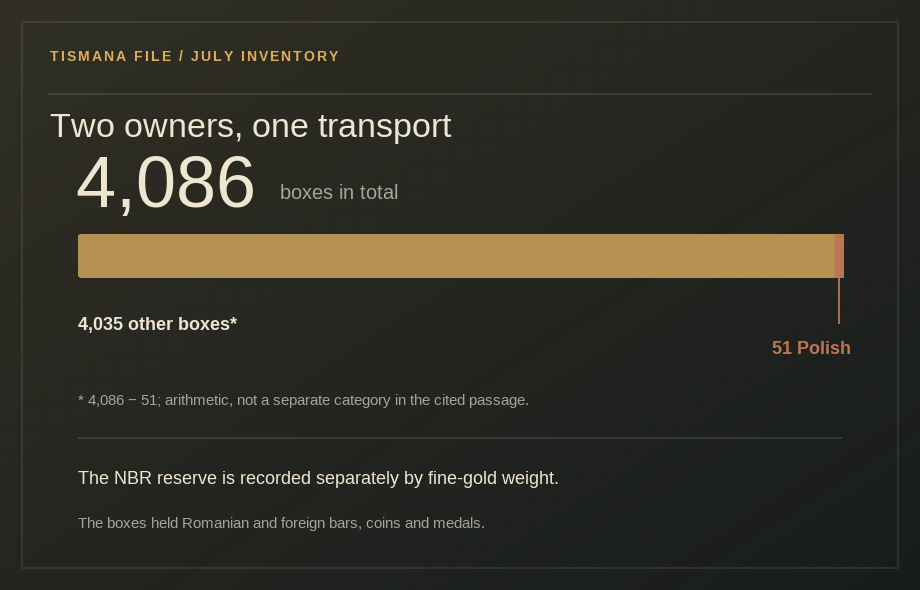
A bar of 4,086 boxes, with 51 Polish boxes marked separately.
The 51 Polish boxes are shown within the total of 4,086; the remaining segment is calculated by subtraction. (Source)
The figure 190.3 tonnes of fine gold, recorded on 23 August 1944.
The NBR study cites an accounting ledger for 190.3 tonnes of fine gold; this is not the gross weight of the boxes. (Source)

03 · September 1944

The cellar was emptied; the cave entrance was sealed

After a cave close to the monastery had been prepared, the gold was moved from the cellar on the night of 15–16 September. The NBR study then describes the entrance being sealed with concrete. The published account gives the sequence and date; the diagram does not imply a distance or a site plan. [1]

In the NBR account, 190.3 tonnes is the fine-gold weight transferred. The text does not say that every one of the 4,086 boxes contained gold, nor does it assign the Polish boxes to that figure. We keep the measures separate until the boxes are recorded distinctly in the transport inventory. [1]
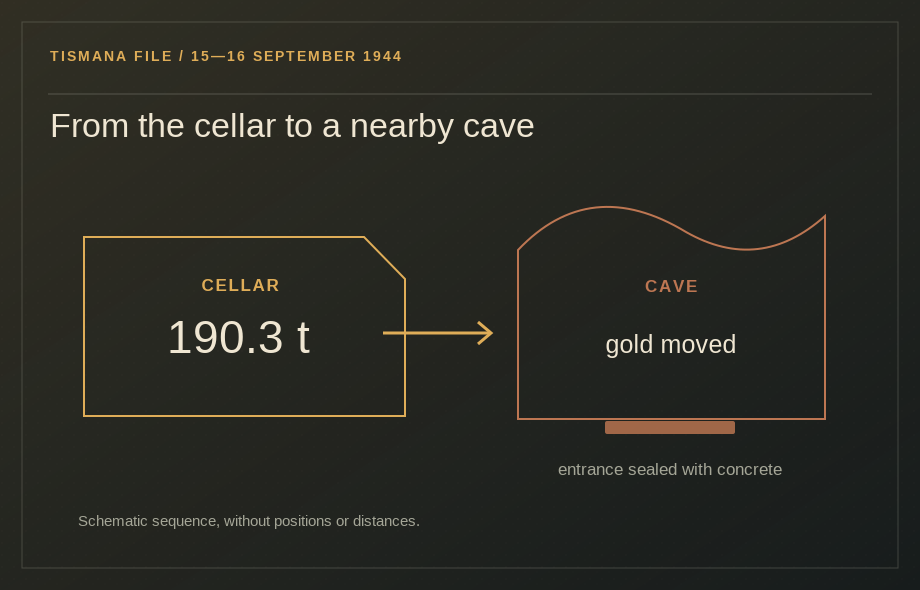
Cellar, arrow, cave and concrete seal; a sequence, not a map.
Diagram of the documented sequence. The shapes do not represent actual architecture or locate the cave. (Source)
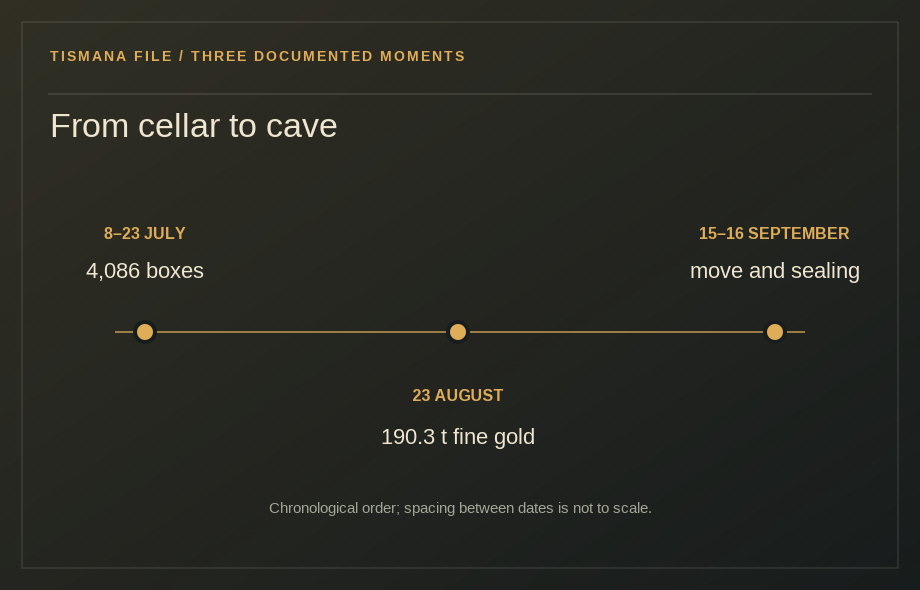
Three milestones: 4,086 boxes in July, 190.3 tonnes of fine gold in the cellar on 23 August, and the move to the cave in September.
The timeline links July’s transport, the weight recorded in August, and the September move. It does not show distances to scale. (Source)

04 · January 1945

210 boxes were taken out of the cave for medals

On 23 December 1944, Law 656 authorised the gold “Our Transylvania” medals. In January 1945, 210 boxes of international-type ingots were taken from the cave; they contained 10,219.7563 kg of fine gold. The entrance wall was then sealed again with concrete. [1]

The law describes a gold-and-copper alloy medal: 6.55 grams, 21 mm in diameter, and 900‰ gold. The drawing here reconstructs only the written specifications. It is not a photograph or facsimile of a medal, and it does not show that all the removed gold became finished pieces. [1]
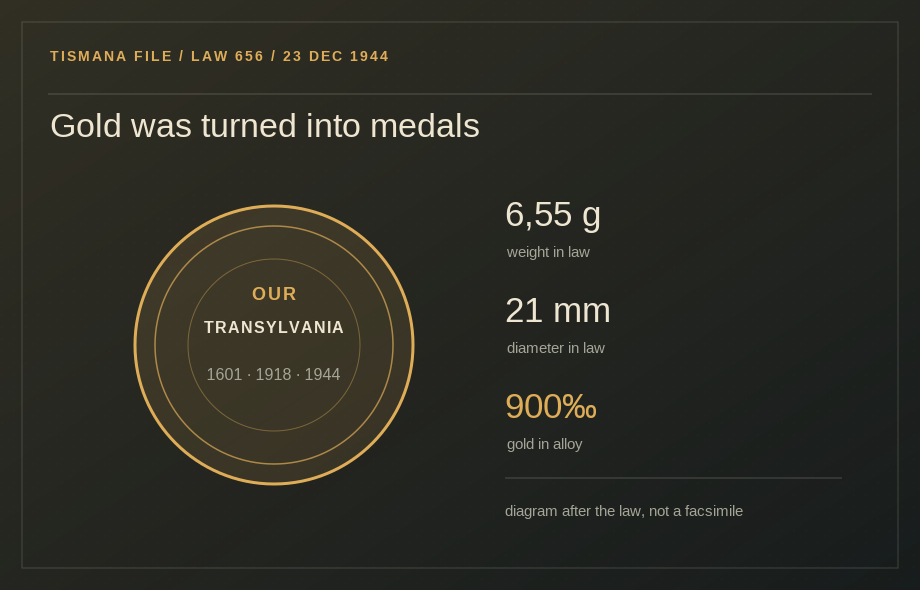
Schematic circle marked Our Transylvania beside three legal measures: 6.55 grams, 21 millimetres and 900 per mille gold.
Explanatory diagram based on the 1944 law; proportions and emblems are not a numismatic reconstruction. (Source)
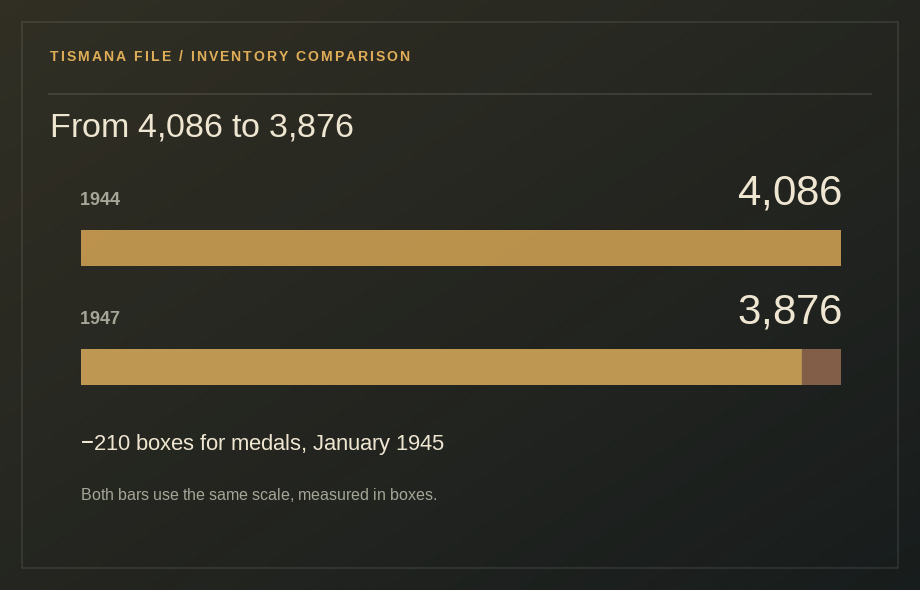
Comparison of 4,086 boxes, minus 210 used for medals, leaving 3,876 boxes.
Arithmetic subtraction from the box inventory: 4,086 − 210 = 3,876. It is not a weighing of the remaining contents. (Source)

05 · January–February 1947

Three trains carried the gold to Bucharest

On 23 January 1947, the wall at the cave entrance was dynamited. Between 24 January and 4 February, vans carried the boxes to Târgu Jiu station; 3,876 cases then travelled in three successive trains to the NBR treasury in Bucharest. The 51 boxes of Polish gold were among them. [2]

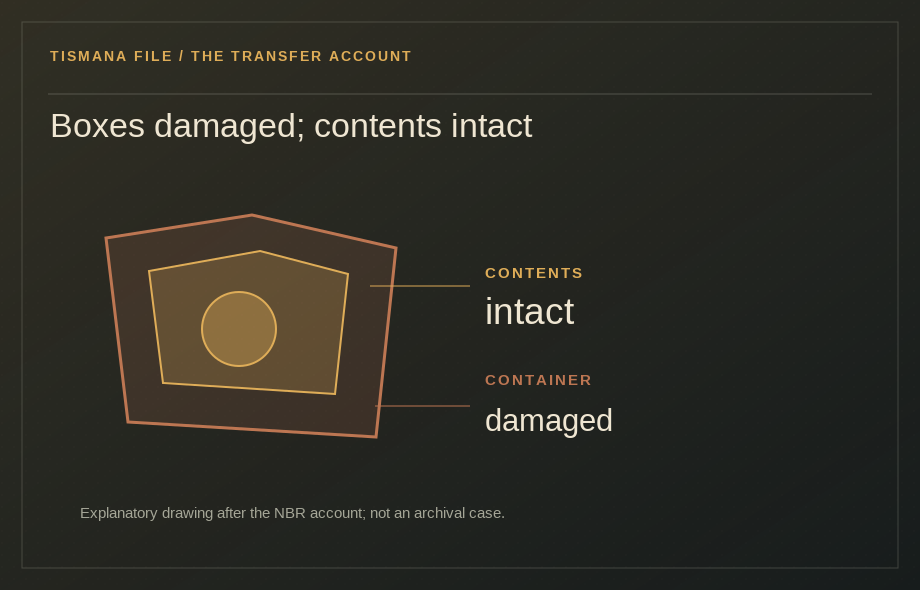
The NBR study says the gold inside was intact, although the boxes had deteriorated. It does not divide the 3,876 between the three trains; the drawing shows the sequence without inventing train-by-train figures. [2]
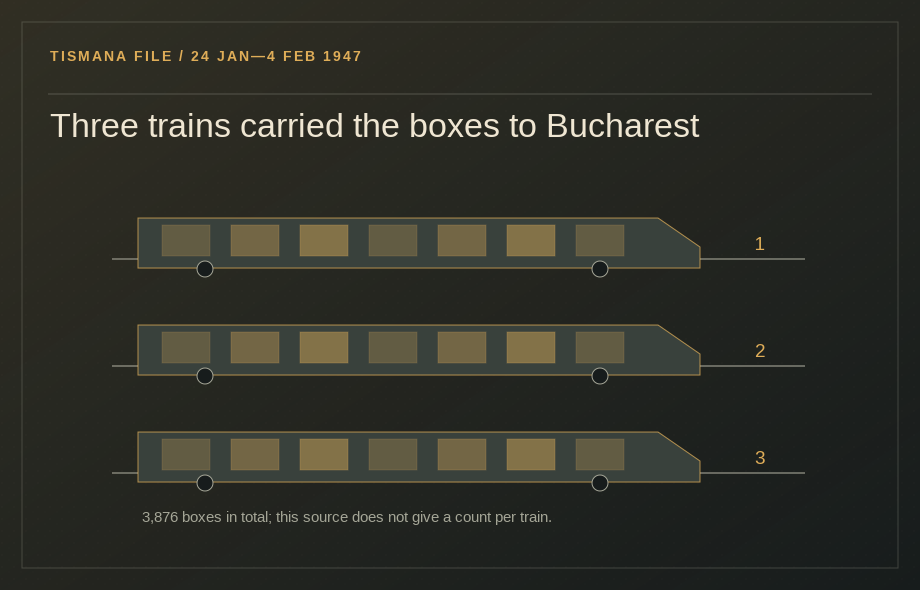
Three schematic trains, with no individual quantities, and a total of 3,876 boxes.
Three symbols for the successive trains; the cited source does not divide the boxes between trains. (Source)
A damaged outer container around intact contents, shown as an explanatory diagram.
The study describes the contents as intact and the boxes as damaged; the drawing does not reproduce an archival object. (Source)

06 · September 1947

Bank Polski gold had its own return

The 51 Polish boxes travelled to Bucharest with the other boxes, then were returned separately. A note in the NBR study dates the collection of 2.7 tonnes by two Polish aircraft to 17 September 1947, with the gold taken to Warsaw. [2]

The same note says the NBR charged no fee for eight years of storage. This concerns Bank Polski gold kept by the NBR, not the NBR reserve and not the 1916–17 shipments to Moscow. [2] [3]
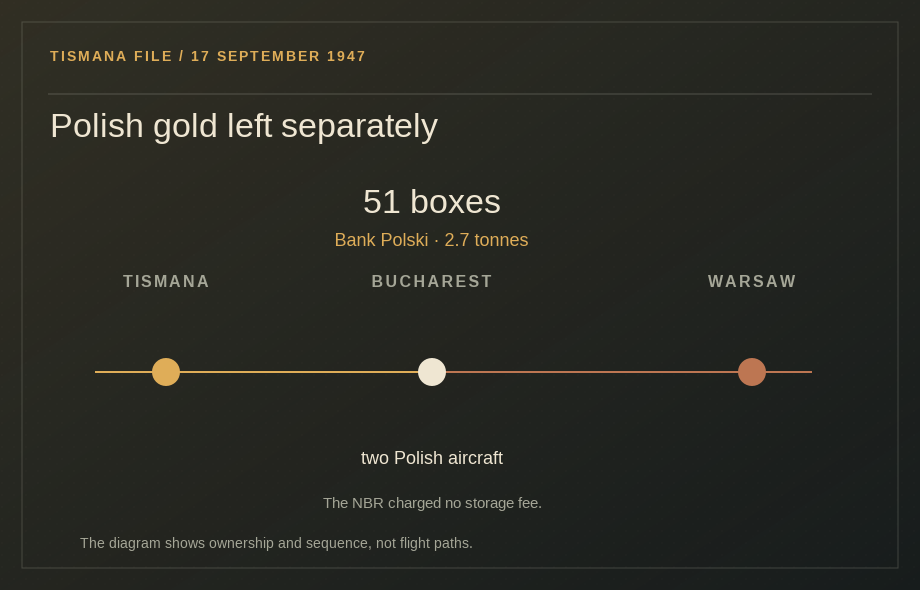
Sequence between Tismana, Bucharest and Warsaw; 51 boxes held by Bank Polski and returned separately.
NBR study note: 51 boxes, 2.7 tonnes, collected on 17 September 1947 by two Polish aircraft. The diagram does not show a flight path. (Source)

Sources

At Tismana, the box count closes the arithmetic: 4,086 arrived in 1944; 210 were taken out in January 1945; 3,876 went to Bucharest in 1947. The 51 Polish boxes also reached Bucharest, then returned to Warsaw. This 1944–47 episode is separate from the treasury evacuation to Moscow in 1916–17. [a] [b] [c]

  1. NBR, Caiete de studii no. 55 (2021), pp. 73–76Connects Operation Neptune to NBR records: it also notes 2.7 tonnes of Bank Polski fine gold deposited with the NBR in 1939; then gives 8–23 July, 75 van trips, 4,086 boxes and 51 containing Polish gold. It reports 190.3 tonnes of fine gold in the cellar on 23 August and the move to a nearby cave on 15/16 September. For January 1945, it cites the medal law and 210 boxes containing 10,219.7563 kg fine gold.
  2. NBR, Caiete de studii no. 56 (2021), p. 24Describes the cave opening on 23 January 1947, the 24 January–4 February transfer, and 3,876 boxes loaded on three trains, including 51 with Polish gold; says the contents were intact while the boxes were damaged. Note 74, citing the 2015 volume, dates the return of 2.7 tonnes of Polish gold to 17 September 1947.
  3. NBR, The History of the Leu (2016), 1916–17 chronologyDocuments the two separate treasury shipments to Moscow: December 1916 and July–August 1917. Used here only to distinguish the 1944–47 Tismana episode from the First World War evacuation.
  4. Alexandru Ene, aerial view of Tismana Monastery (2011)Contemporary photograph of the monastery complex, released under CC BY-SA 3.0 Romania. Shows the present-day site, not the wartime storage.