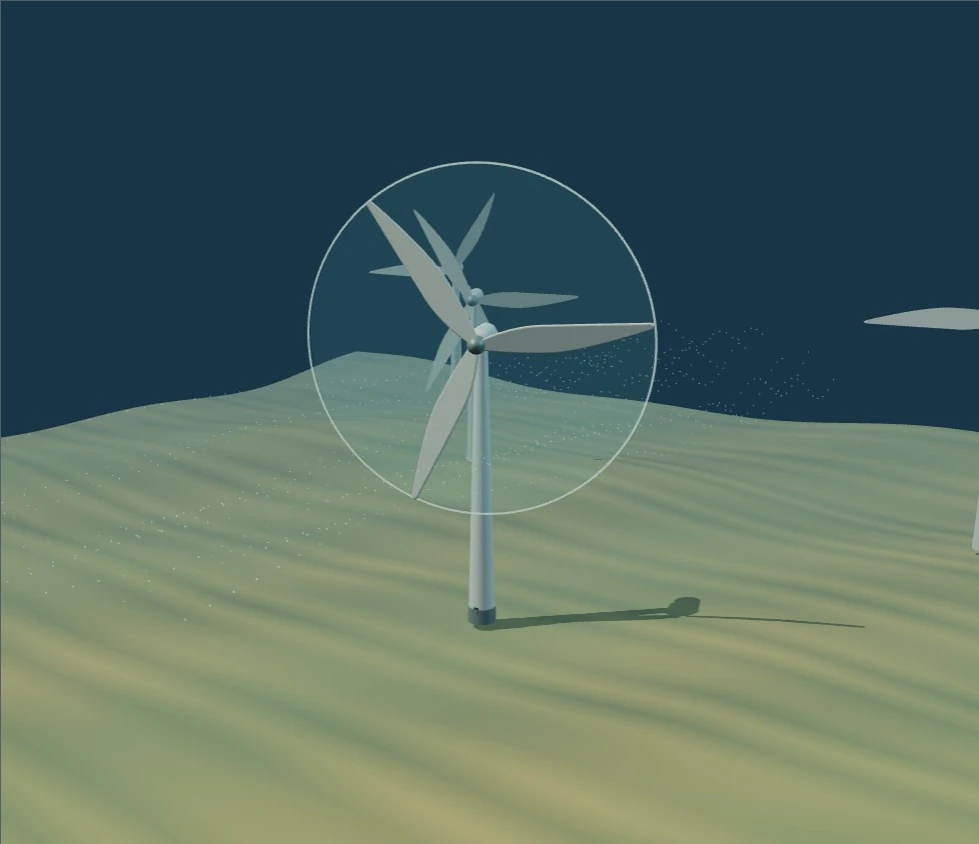
A three-dimensional wind turbine with its swept disc, flowing air and distant plateau.
The blades sweep a disc 90 metres across

Topolog, Tulcea

The circle drawn by the wind

From the ground on the plateau near Topolog, you see three blades and a tower. Follow the tip of one blade through a full turn and it traces a circle 90 metres across. 1 2

At Topolog in Tulcea County, a turbine seen from the road belongs to a wind farm spread across three places on the Casimcea Plateau. The other two are Luminița and Meșteru. The operator counts each group separately, although their turbines share the same rated power. 1

A disc that large gathers wind across an area you can scarcely judge from below.

Start the story
90 m

Three blades, one full disc

Vestas gives the V90 a swept area of 6,362 m². That is the area of a circle with a radius of 45 metres. Each blade moves through a different part of the circle as it turns, and the three pass through the same zone of air. 2

Pull the tower out of the frame and the circle is a measure of the area the machine can draw energy from.

Wind direction

When the wind comes from the side

Turn the head of the turbine and look towards it from upwind. The disc becomes an ellipse. At 60°, its projected area is half what you see face-on.

The ellipse narrows even though the blade tip stays 45 metres from the hub. From the side you are seeing the circle almost edge-on. Stand directly upwind of the rotor again and the full distance between the blade’s highest and lowest points comes back into view. 2

Pointing the rotor into the wind helps a turbine. The geometry shows why, even before blade controls and the behaviour of air flowing over the blades enter the picture. 2

Angle to the wind
0°

4–25 m/s

Strong winds can stop the rotor

The V90 specification gives a cut-in speed of 4 m/s and a cut-out at 25 m/s. Between them, the turbine changes both its rotation speed and the angle of its blades. The specification gives a restart speed of 23 m/s after a shutdown in high winds. 2

Those two upper limits mean that at 24 m/s the machine can be in either of two states. If the wind has been rising, the turbine can still be running. If it has just slowed after reaching the cut-out speed, the machine is still waiting to restart. 2

Move the wind from a calm to a gust. The visual shows the operating states described in the specification. Its rotor is not a speedometer or a model of power production.

Wind speed
8 m/s

Topolog, Luminița, Meșteru

How the 42 turbines add up

The operator divides Land Power into three generating sites. It counts 14 turbines at Topolog, 11 at Luminița and 17 at Meșteru. Their rated outputs of 2 MW per turbine add up to 84 MW. 1

That is the installed capacity. How much energy the farm puts out in any one hour depends on the wind and how many turbines are running. 1 3

The Casimcea Plateau

What you can see looking up

Next time you pass a turbine, follow the tip of one blade. The circle tells you how much air the rotor reaches. The direction of the disc tells you which way it is facing to meet that air.

Between the breeze that starts movement and the wind that stops it is the range in which the turbine can work. 2

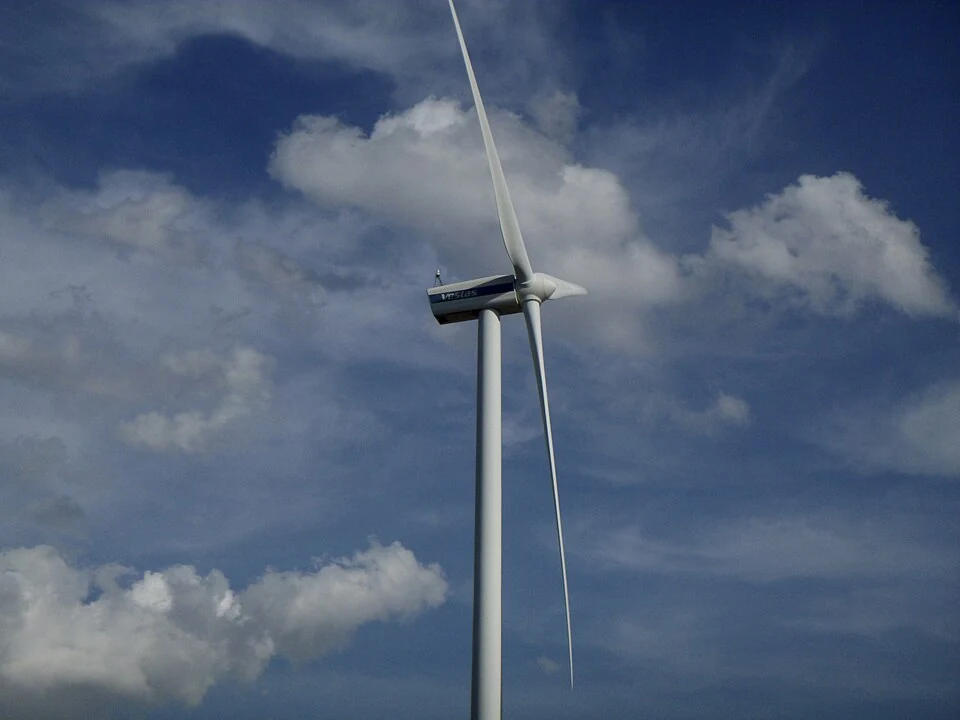
A Vestas V90-2.0 MW turbine photographed from below in Spain.
A turbine of the same model at Pujalt in Spain. Mrb-Wind, 2021 · CC BY-SA 4.0

Sources

The diameter and speed thresholds come from Vestas’s V90-2.0 MW specification. The section, turbine positions and air movement are schematic. The disc projection shows how the angle changes its geometric area. Actual power at a yaw angle depends on turbine controls and airflow.

  1. PPC Renewables, Land Power wind farm

    The turbine counts at each of the three generating sites and their rated capacity.

  2. Vestas, V90-2.0 MW specification

    Rotor diameter, swept area and the documented model’s cut-in and cut-out speeds.

  3. Vestas, power curve comparison

    A comparison showing why turbine power does not rise at the same rate at every wind speed.