Opening · A road with a tariff
Opening · A road with a tariff
What did it cost to pass Turnu Roșu?
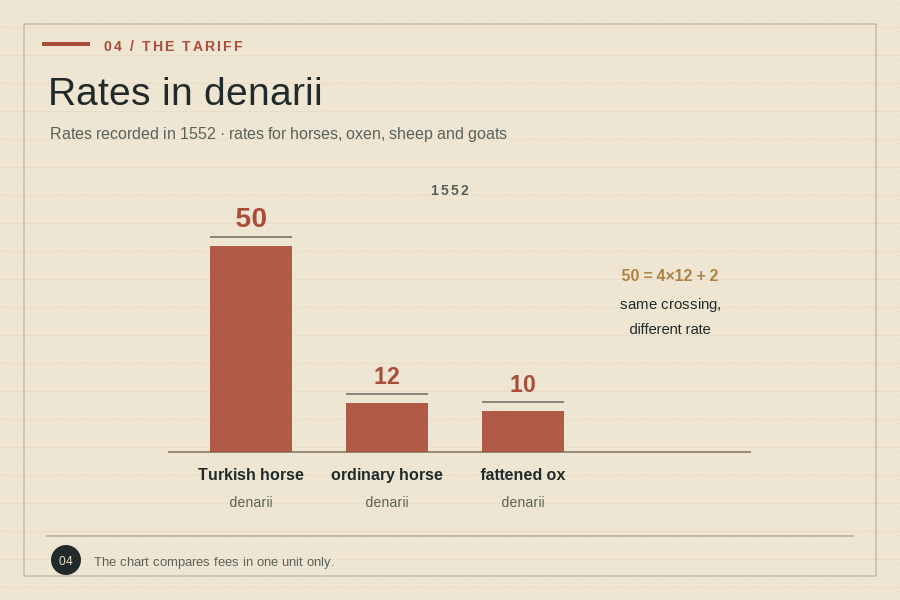
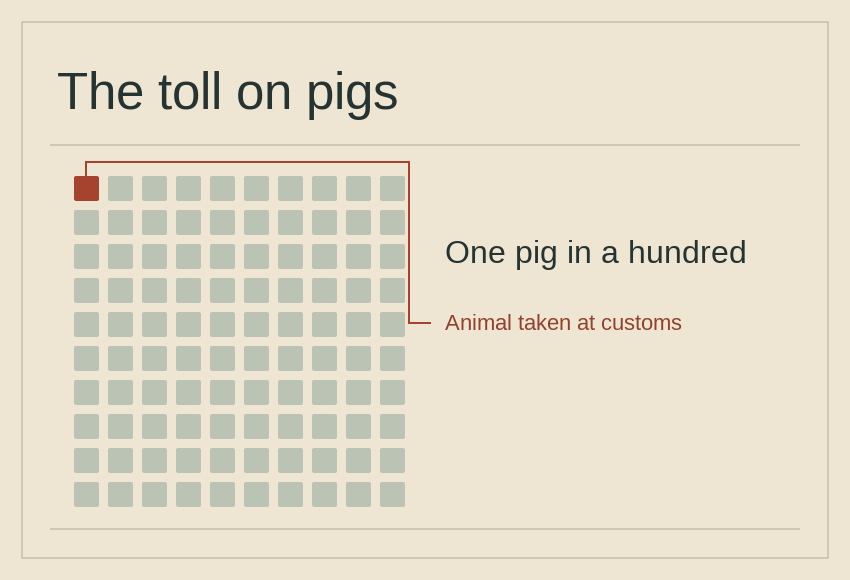
In 1552, a Turkish horse was charged 50 denarii and an ordinary horse 12. For every hundred pigs, the customs officer kept one; for every three sheep or goats, one denarius was due. These rates survive in accounts of the Turnu Roșu crossing. [4]
The fortress is not in the locality of Turnu Roșu. RAN records it in Boița, on the Olt at the gorge entrance from Sibiu. The county’s official list of communes records the communes of Boița and Turnu Roșu separately. The fortress’s name does not change its address: the pin is in Boița. [1][2][7]
We will follow one precise question: what made this place a customs point, who administered the duty, and what can the goods that crossed tell us about the road? The answer comes from a royal charter, customs ledgers cited in a monograph, and the masonry of a complex built in several periods. [5][4]
Orientation · Olt and the road
Boița is the village; Turnu Roșu is the pass
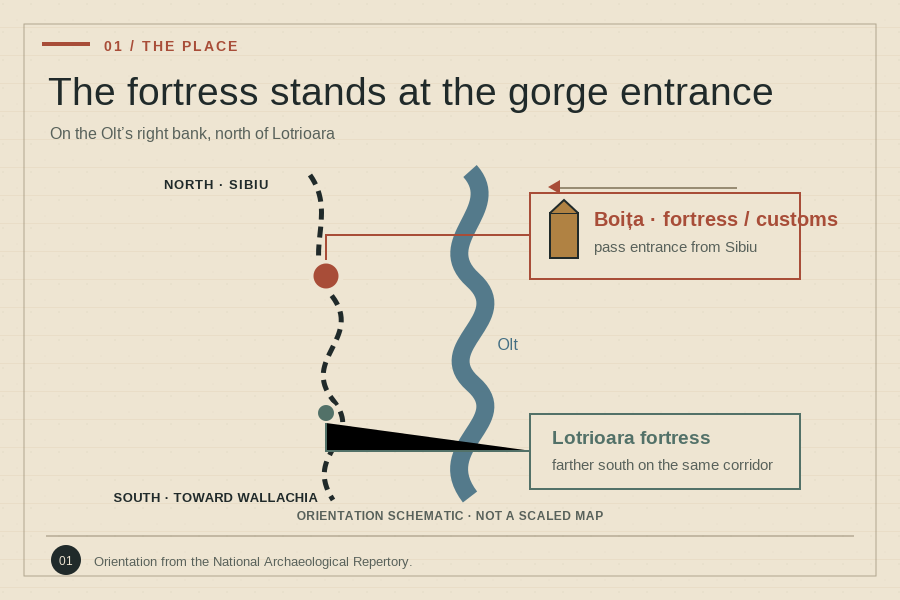
The RAN record gives the locality as Boița and the place-name as Turnul Roșu. It puts the site on the Olt’s right bank, at the pass entrance from Sibiu and north of Lotrioara fortress. The monuments list gives Strada Traian 342. These references place the castle in Boița, not in the village of Turnu Roșu. [1][2]
The route through the gorge linked Sibiu with Wallachia. Turnu Roșu and the fortification at Lotrioara guarded points along the same corridor; in 1453 the king named them together in the transfer document. The diagram shows only the north–south order recorded by RAN, not a map or measured distances. [1][5]
The confusion arises because Turnu Roșu is also the name of a separate commune in the county. RAN gives both the locality and commune for the monument: Boița. Here, “Turnu Roșu” names the fortress; its map pin remains in Boița. [1][7]
1453 · The terms of passage
The king transfers the fortress and toll together
On 3 February 1453, Ladislaus V transferred control of the fortresses at Tălmaciu, Lotrioara and Turnu Roșu to the Seven Saxon Seats. The condition was to strengthen the defences and demolish the ruined fortress at Tălmaciu. The grant also included the estate’s villages, among them Boița. [5][1]
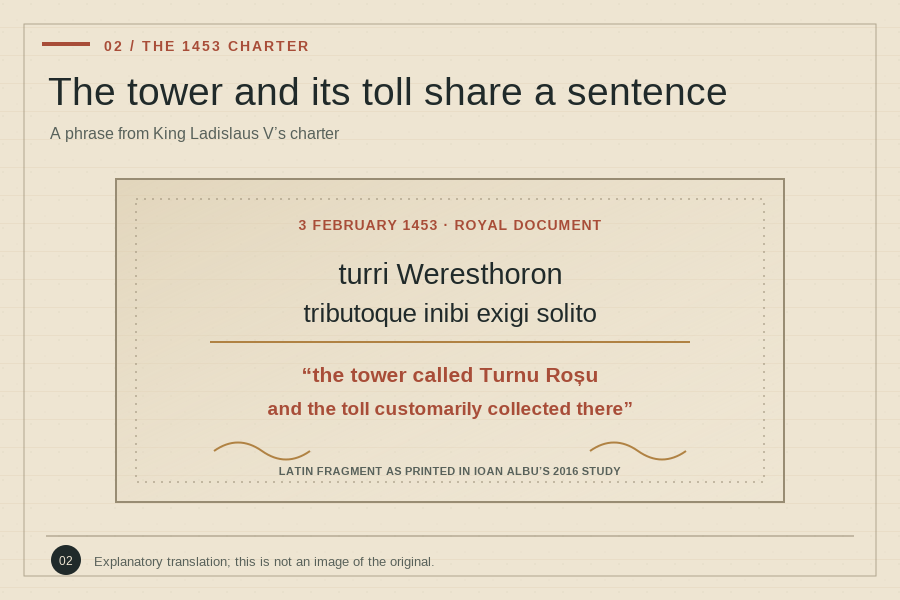
The Latin phrase quoted by historian Ioan Albu reads “turri Weresthoron tributoque inibi exigi solito”: the tower called Turnu Roșu and the toll customarily collected there. The fortress was more than an obstacle on the road. In this charter, it came with customs income and a duty to guard the pass. [5]
RAN dates the fortress broadly to the 14th–15th centuries and identifies 1453 as the first royal document that mentions it. A 2023 county concept note repeats a traditional 1360–1370 date. So 1453 establishes that the fortress existed by then; it is not a certain construction date. [1][3]
1386–1500 · The goods
Fish and livestock came through the pass; tools went out
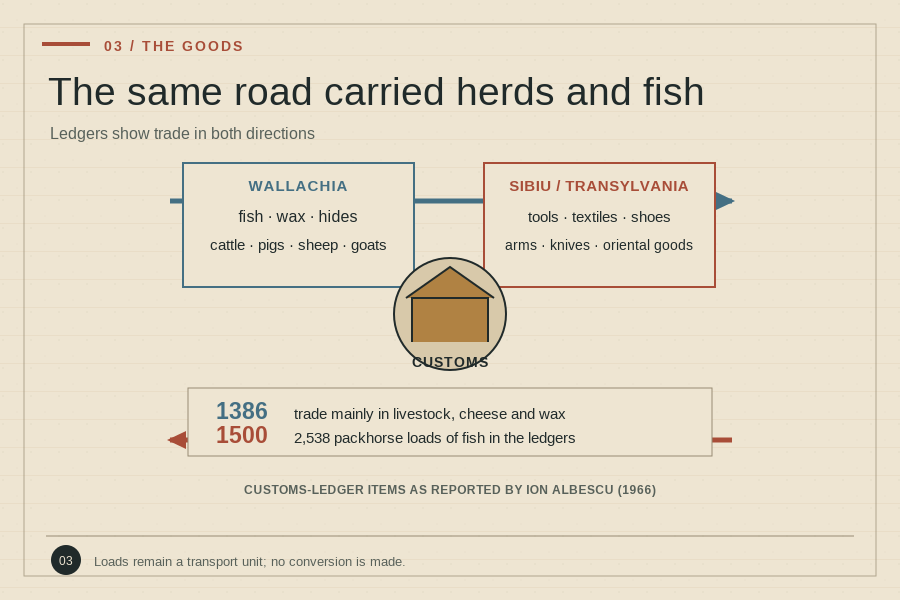
A note from 1386 describes trade through Turnu Roșu in terms of livestock and produce: cattle, pigs, sheep, goats, cheese and wax. Around 1500, the customs ledgers cited by Ion Albescu record 2,538 packhorse loads of fish brought from Wallachia. We keep the ledger’s unit and do not convert it into tonnes. [4]
Sibiu sent agricultural tools, textiles, shoes, arms and knives in the other direction. Some oriental goods continued in transit. Traders from Argeș, Râmnic, Câmpulung, Târgoviște and Bucharest used the customs point, as did people from nearby Boița, Rășinari and Veștem. [4]
The lists show a route carrying goods for different markets, not only an army road. In both directions, it moved what people needed for food, work and trade. The fortress administered passage, but the evidence we have describes taxed goods; it does not tell us how many people crossed in an ordinary year. [4][5]
1552 · Paying at customs
The fee changed with the animal or goods
In 1552, the toll was 50 denarii for a Turkish horse, 12 for an ordinary horse and 10 for a fattened ox. Three sheep or goats incurred a toll of one denarius. [4]
For pigs, the customs officer took one animal in a hundred. Ion Albescu’s monograph reports these rates from a customs register. [4]
Compare the rates in denarii with the toll in kind. A pig merchant had to hand over part of the shipment. For the other livestock shown here, the toll was paid in money. [4]
14th–20th centuries · Buildings layered over time
One name hides nine different buildings
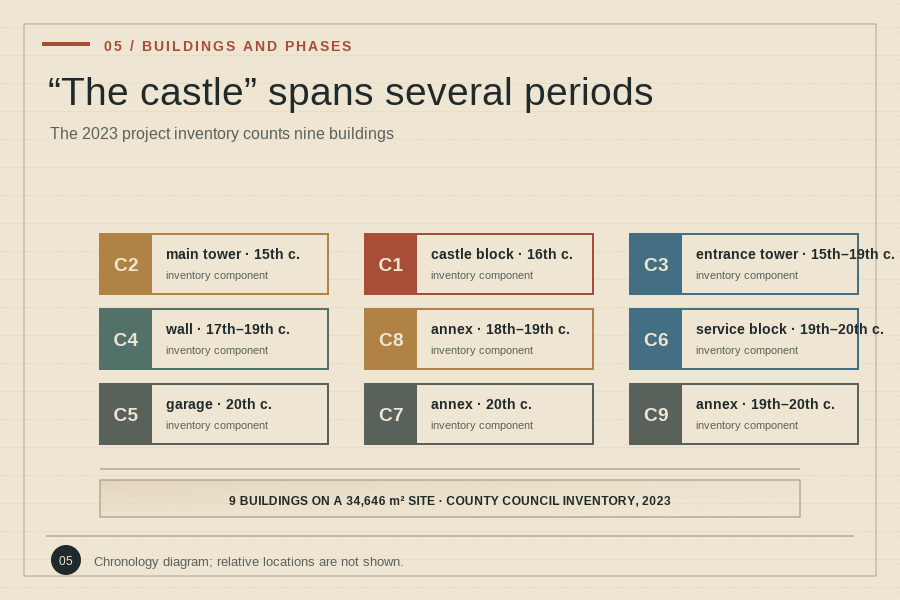
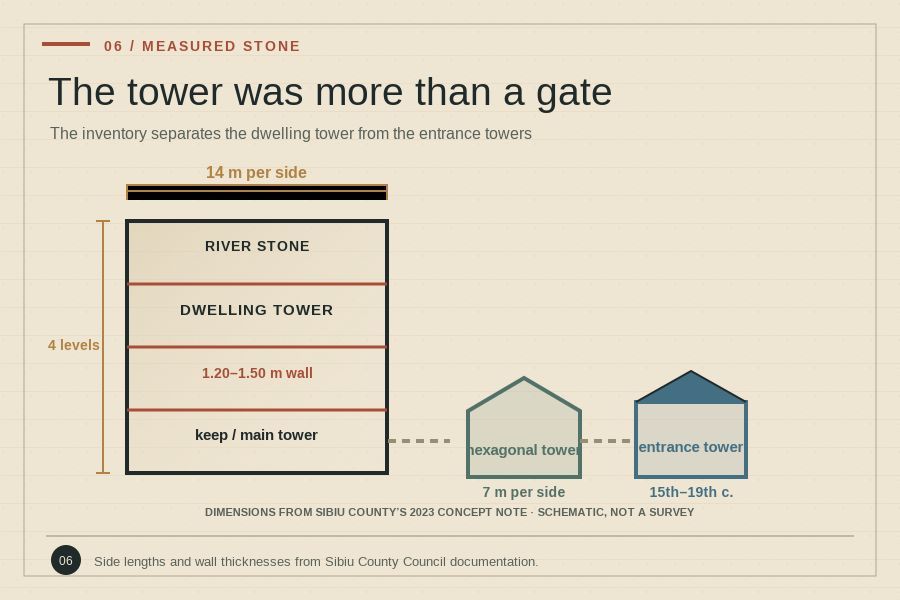
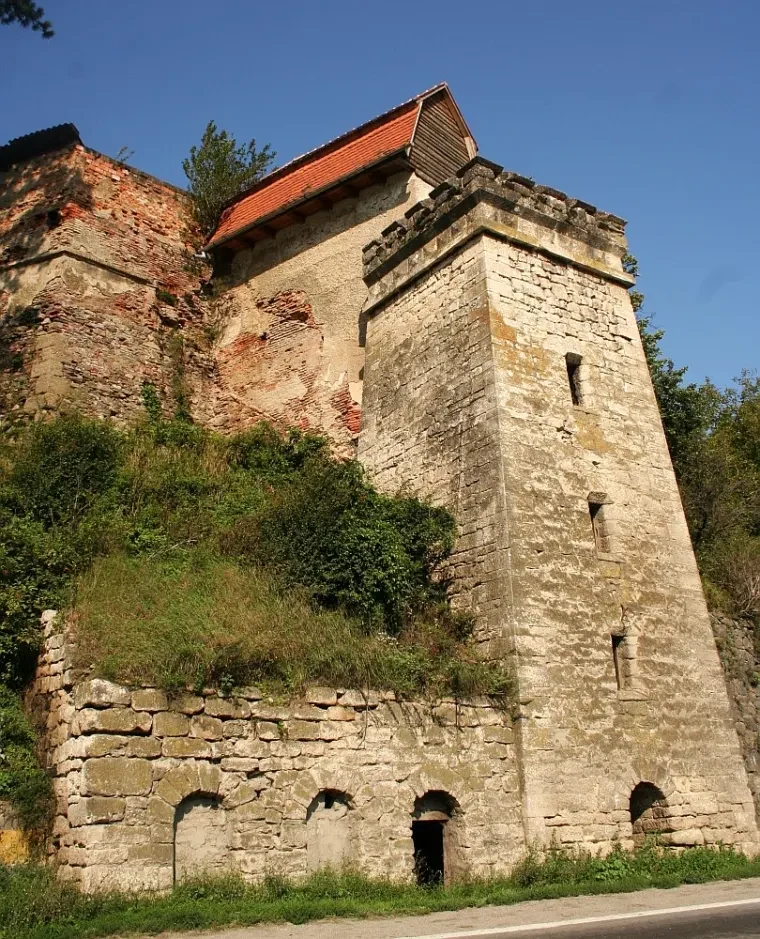
RAN describes a medieval fortress and tower from the 14th–15th centuries; the tower walls are river stone, 1.20–1.50 m thick. A 2023 Sibiu County Council inventory counts nine buildings on the complex and assigns them to different periods. [1][3]
In the project inventory, the main tower is dated to the 15th century, the castle block to the 16th, and the entrance tower from the 15th to 19th centuries. The wall and annexes are later. Another official list dates the monument as a whole to 1533–1930. These describe parts and the ensemble, not one certain foundation year. [3][2][1]
The inventory drawing does not show a medieval fortress left unchanged. It separates the buildings later used by the complex and the periods assigned to them by its assessors. “Turnu Roșu Castle” names a site where defence, customs and service buildings followed one another on the same ground. [3][2]