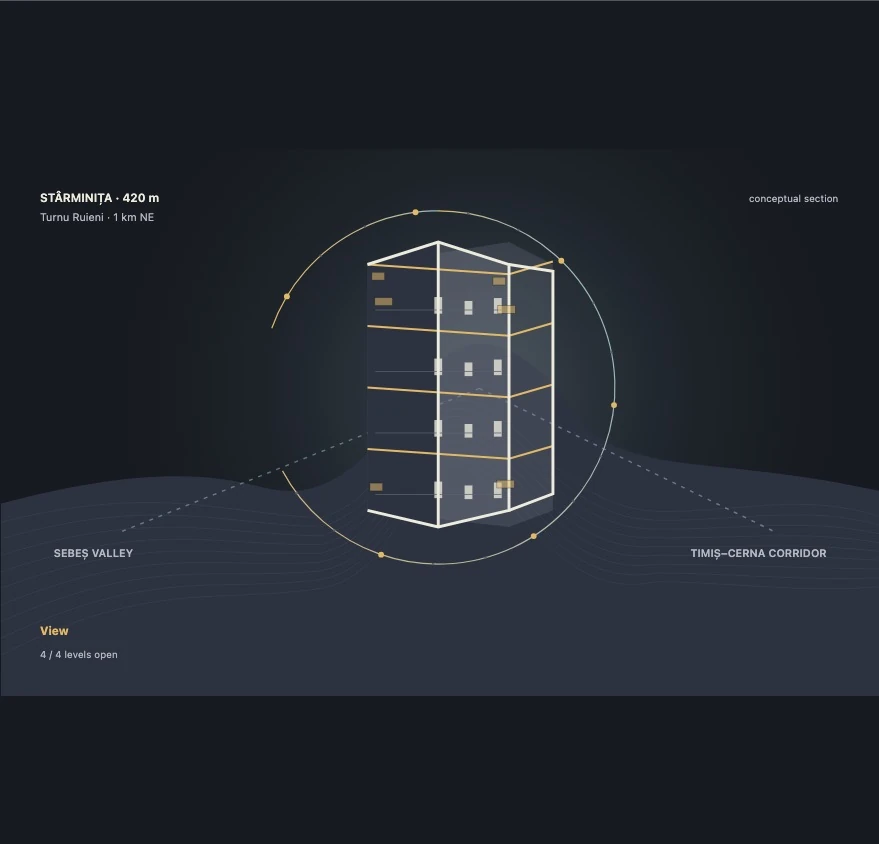
A square donjon opened in section, with four levels, on a hill above the Sebeș valley.
The donjon ruins stand on Stârminița Hill at 420 metres above sea level.

Caraș-Severin · Turnu Ruieni

The tower between the valleys

The National Archaeological Repertory locates the donjon one kilometre northeast of Turnu Ruieni commune, on Stârminița Hill. It classifies the site as a defensive dwelling. 1

A keep is a tower people could live in. At Turnu Ruieni in Caraș-Severin County, all four levels rose above the same four-sided base. Even in ruins its shape is quite different from a fortress wall that you might follow across the slope. 1 2

Choose how many levels to show in section. The architectural description divides the interior into four levels; the drawing lets you open them one by one. 2

Open the tower section

Interpretive model, not a measured architectural plan.

Start the story

420 metres above sea level

The ridge overlooks a corridor between valleys

The tower stands on the ridge at about 420 metres. The county tourism centre describes views towards the Sebeș Valley and the Timiș–Cerna corridor. 2

Its high position and classification as a defensive site support an interpretation as a lookout. The exact range of its historical views is not recorded here. 12

1467 · written record

A document names a stone tower

The county tourism centre cites a document issued in Oradea on 25 July 1467. Its Latin text calls the structure a “turris lapidea”, a stone tower, and links it to the Mâtnic noble family. 2

It was the historian Pesty Frigyes who connected the hilltop tower with the Oradea document. The identification is probable. The words in the document name the material of the family’s tower, while the view from Stârminița helps explain why the ruin here caught researchers’ attention. 2

That mention gives us a documentary reference. The construction date remains uncertain; a written mention does not tell us the year the tower was built. 2

Reused material

Roman limestone blocks were built into the walls

Limestone slabs interpreted as reused Roman building pieces are set into the corners of the walls. A firing niche survives in one wall. 2

These pieces show older material incorporated into the tower. By themselves, they do not prove that the medieval tower continued a Roman fortification at the same place. 2

Name and legend

Ovid entered the story, not the record

A legend says the poet Publius Ovidius Naso passed through on his way to exile at Tomis. The county tourism centre presents this as legend; no documentary evidence shows Ovid reached this tower. 2

The name “Ovid’s Tower” makes the ruin easy to remember. The masonry, hill and 1467 document are the historical traces we can follow. 2

Two villages, one name

The tower remains in the commune’s name

The county tourism centre records that Turnu Ruieni formed by the merger of the neighbouring villages of Turnu and Ruieni, and that its name comes from the lookout tower. 2

You can follow the place names back up the hill. The ruin lent its name to the settlement of Turnu. When Turnu joined Ruieni, people at the foot of the hill kept using that name. The poet’s legend survives in the name given to the tower itself. 2

Today the ruin is a listed historic monument and a starting point for a local story about defence, reused stone and memory. 12

Sources

Location and classification follow the National Archaeological Repertory; approximate dimensions and probable dating are given by the county tourism centre. The section is interpretive, not an architectural survey.

  1. Ovid’s Tower donjon · National Archaeological Repertory

    RAN classifies it as a defensive dwelling and locates it on Stârminița Hill, one kilometre northeast of Turnu Ruieni commune.

  2. A witness to history · Ovid’s Tower

    The county tourism centre: altitude, approximate dimensions, interior levels, the 1467 document, reused masonry and the Ovid legend.

  3. Caraș-Severin County Development Strategy, 2015–2020

    The county council notes the 1467 document and the donjon at Turnu Ruieni.