Marius ComperVârghiș Gorges & Bat Sanctuary
Română

Vârghiș Gorges & Bat Sanctuary

The Big Cave: what the layers still hold

Eighteen metres above the Vârghiș, the cave holds pottery, stone pieces and traces of earlier digging. Archaeologists returned with a small trench and a hard question: what can actually be dated?

Start the story ↓
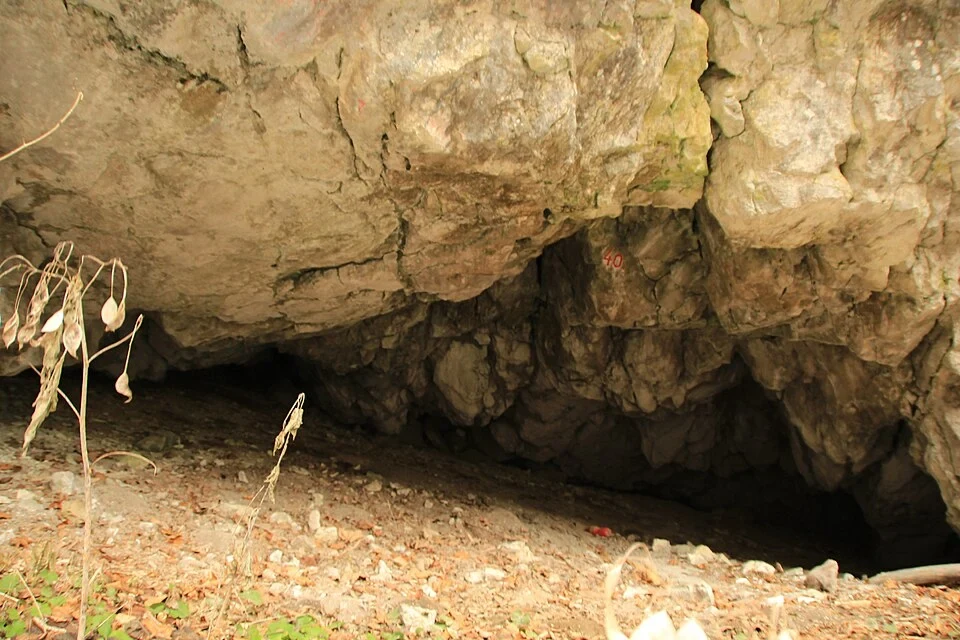
A cavity in the limestone at Vârghiș Gorges, photographed in February 2016.
A cavity in the limestone at Vârghiș Gorges, photographed in February 2016. (Source · Marius Pascu, 2016 · CC BY 3.0)

On the gorge wall

A cavity in the limestone at Vârghiș Gorges, photographed in February 2016.
A cavity in the limestone at Vârghiș Gorges, photographed in February 2016. (Source · Marius Pascu, 2016 · CC BY 3.0)

On the gorge wall

A small entrance to a 1,527-metre cave

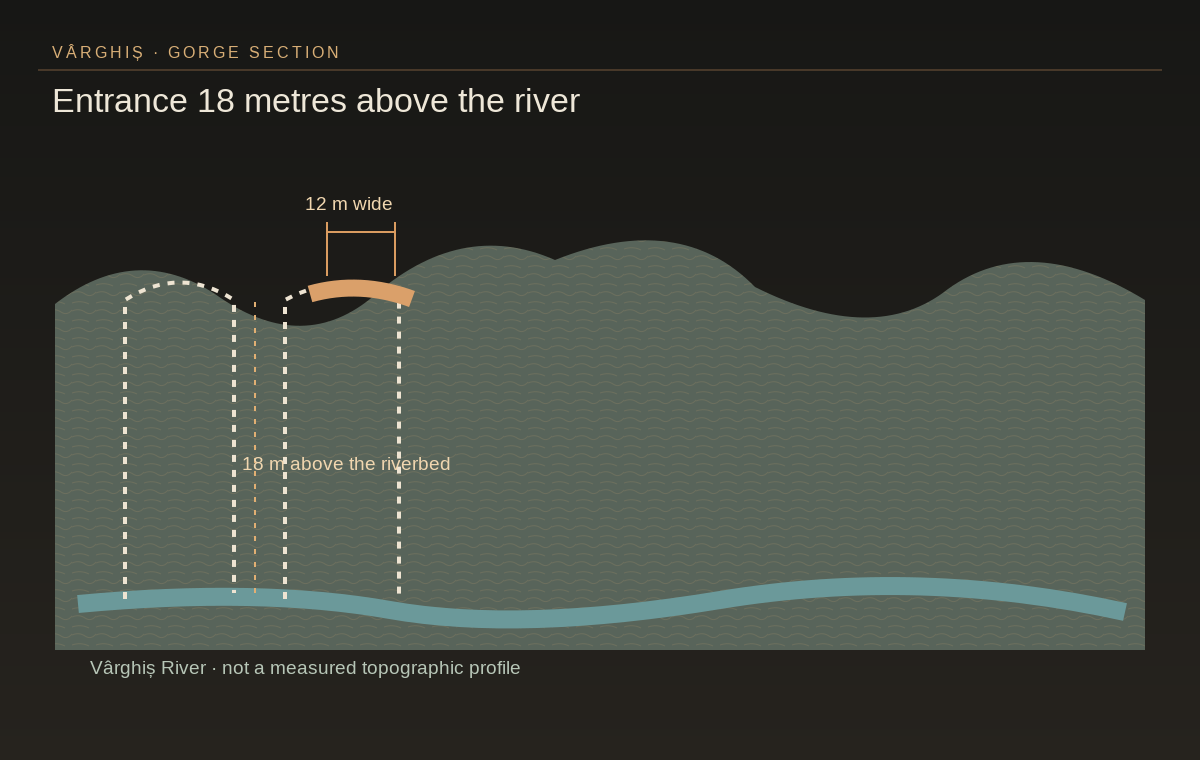
Peștera Mare opens on the left slope of Vârghiș Gorge, about 18 metres above the riverbed. The archaeological report describes its portal as an arch 12 metres wide and 6 metres high; beyond it, chambers and passages contain layers of sediment [1].

A 2025 study gives 1,527 metres of passages and 50 metres of vertical development. The 2019 archaeological report describes 1,100 metres of chambers and passages. The sources do not say whether they measured the same sections or used the same method, so each figure stays attached to its publication [1][3].
A cavity in the limestone at Vârghiș Gorges, photographed in February 2016.
A cavity in the limestone at Vârghiș Gorges, photographed in February 2016. (Source · Marius Pascu, 2016 · CC BY 3.0)
The gorge wall rises above the Vârghiș; the Big Cave portal is marked about 18 metres above the riverbed.
Context section based on the 2019 report. The portal and its height above the river are documented; the underground passage is not to scale. (Source)

Signs of earlier digging

The cave floor has been dug repeatedly

Julius Teutsch collected surface material from 1900 to 1902, then opened a trench in 1907, only 7–8 metres from the entrance. It reached 20–30 centimetres. Teutsch and L. Schmidt returned in 1932; Maria Mottl made two test pits in 1941–1942 [1].

The main chamber’s sediment was up to six metres thick, and some of it was extracted for phosphate fertilizer. The 2019 report says researchers cannot assign most visible floor pits to specific excavations; the only floor-level activity they can identify with confidence is guano extraction. A disturbed floor makes it harder to tie an object to a particular period [1].
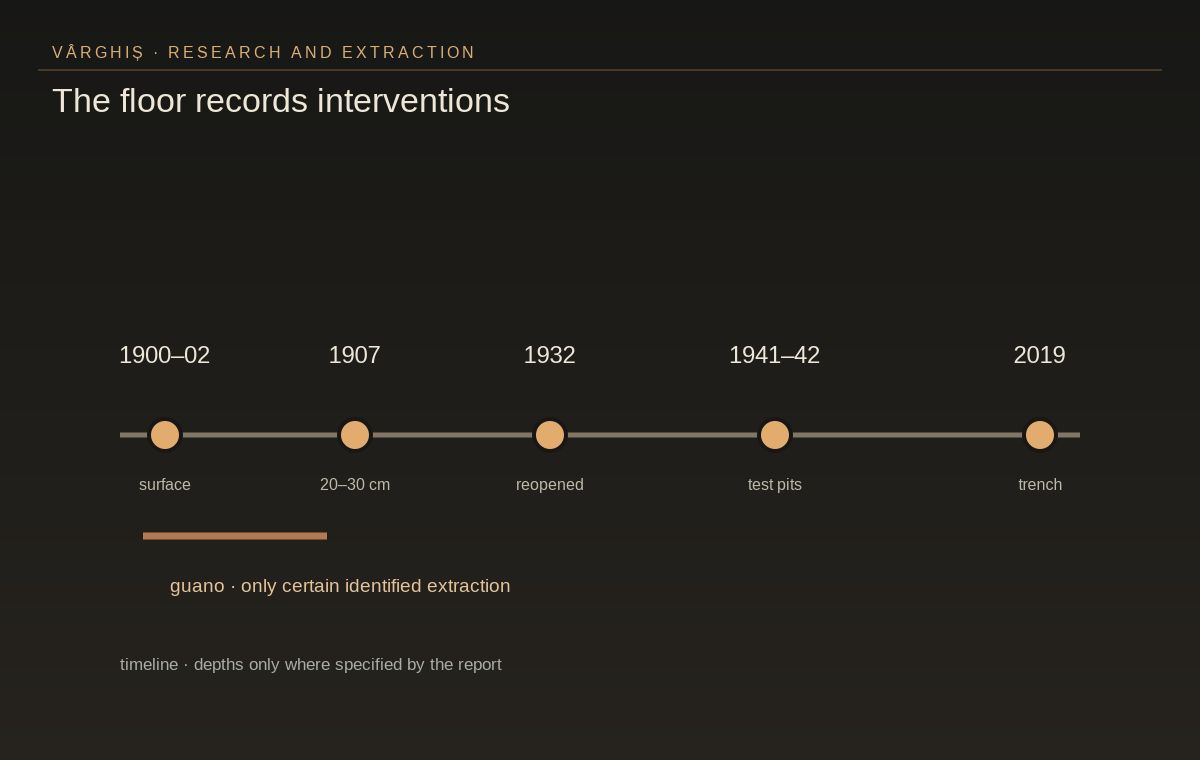
Dates 1900–1902, 1907, 1932, 1941–1942 and 2019 mark surface collecting, early trenches and a new archaeological section.
The axis shows documented interventions, not how much material each campaign removed. Guano extraction is the only pit confidently identified by the report. (Source)

A small trench

Seven bones place the sequence beyond 41,000 years

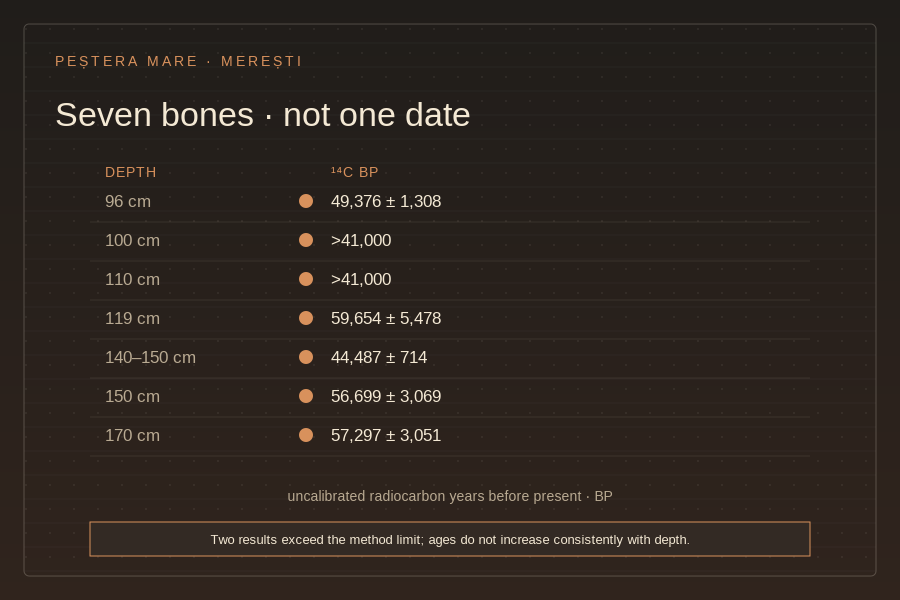
During the 2018–2019 campaigns, researchers collected seven bone samples from Peștera Mare at depths between 96 and 170 cm. Two exceeded radiocarbon’s limit, returning results above 41,000 radiocarbon years before present; the other five produced uncalibrated ages between 44,487 ± 715 and 59,654 ± 5,478 radiocarbon years [3]. In radiocarbon reporting, “present” means 1950 [3].

The authors treat these as minimum ages for the small excavated sequence. They do not date every stone artefact. The study’s OSL ages of 124,000–236,000 years come from Abri 122/1200, a separate rock shelter. Excavation at Peștera Mare reached 2 metres without reaching the base of the sediment [3].
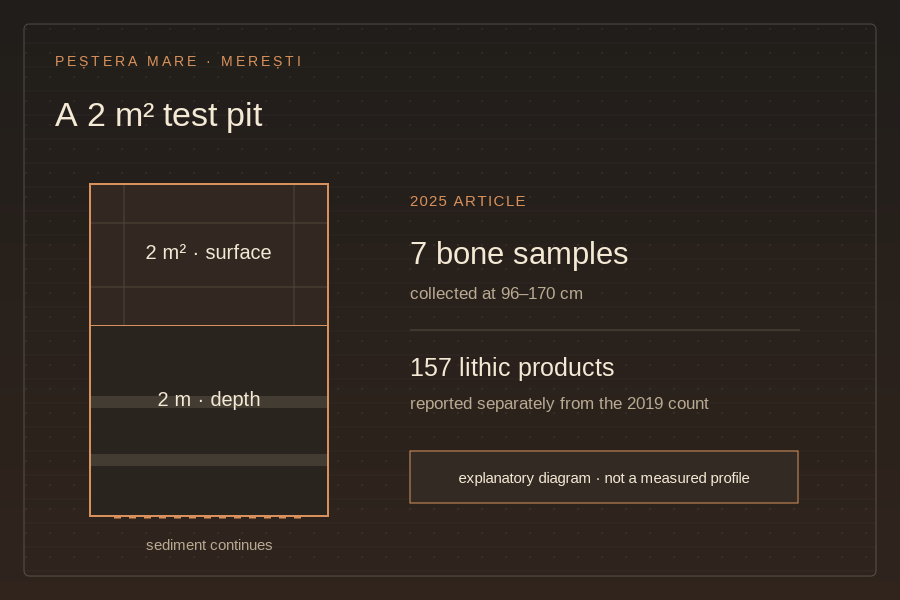
A 2 m² test pit and a section down to 2 m, with the sediment base still unreached.
Explanatory view of the test pit and its 2 m depth; not a measured stratigraphic profile. The base of the deposit was not reached. (Source)
Seven bone samples from 96 to 170 cm: two beyond 41,000 years and five uncalibrated radiocarbon values from about 44,500 to 59,700 uncalibrated years.
Depths and uncalibrated ages follow Table 1 of the study. Two results are minimum limits; their positions do not imply a chronological sequence in the sediment. (Source)

225 pieces

Two counts, two descriptions of the excavation

The 2019 preliminary report counts 225 pieces from the 0.45–1.7 m interval: 83 knapping products, 80 indeterminate fragments, 57 pebbles or fragments, and five pebbles with percussion marks. These are categories of recovered material; they do not prove that every fragment is a tool [1].

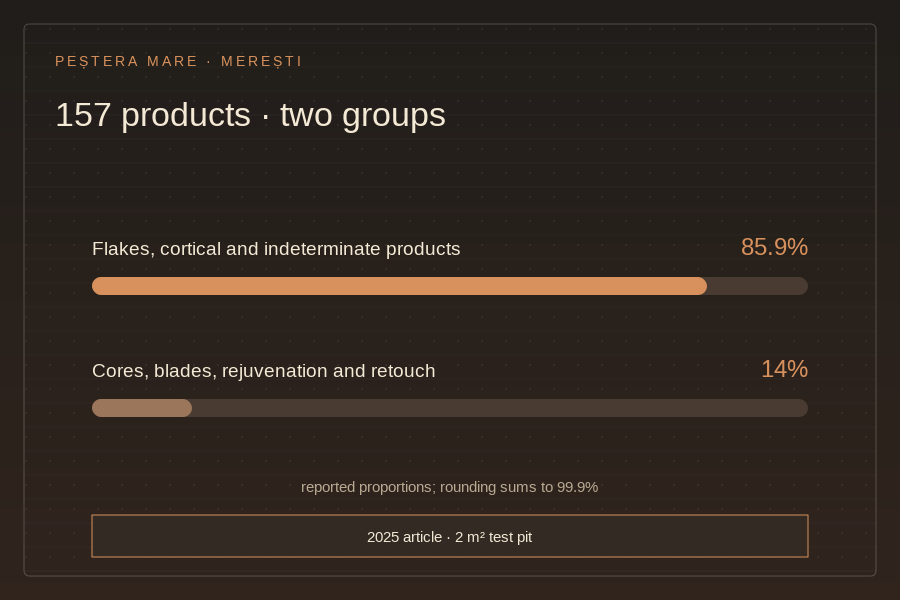
The 2025 article describes 157 knapped products from a 2 m² test pit: 85.9% are flakes, cortical products or indeterminate pieces; 14% are cores, blades, rejuvenation products and retouched pieces. The sources use different totals and categories. Without a published reconciliation, we neither add them together nor declare one “the correct count” [1][3].
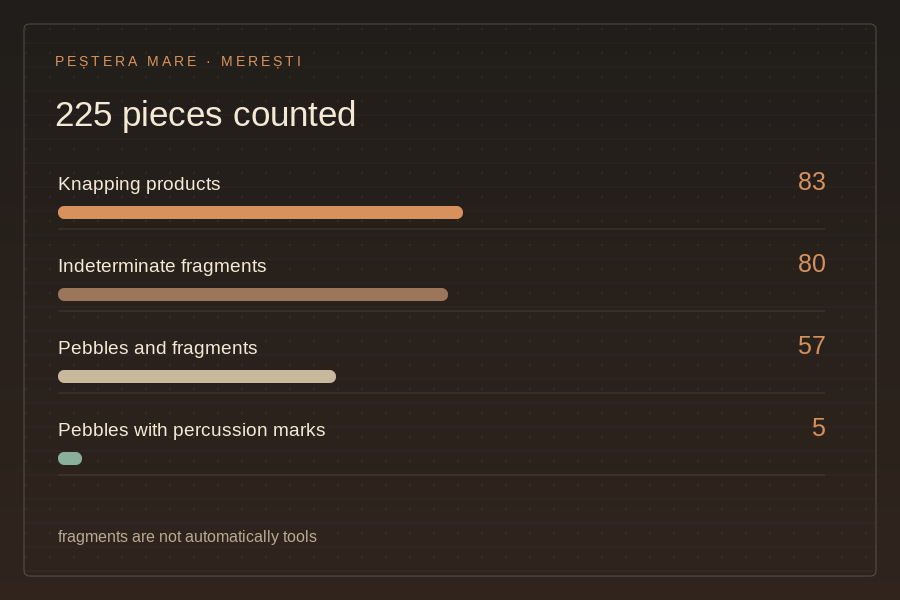
The 2019 report’s 225 pieces in four categories: 83 knapping products, 80 indeterminate, 57 pebbles, five pebbles with percussion marks.
The 2019 preliminary report’s categories: 83 + 80 + 57 + 5 = 225. Classification does not confirm that every piece is a tool. (Source)
157 products: 85.9% flakes, cortical and indeterminate products; 14% cores, blades, rejuvenation and retouched products.
Rounded proportions in Schmidt et al. (2025): 85.9% flakes, cortical and indeterminate products; 14% cores, blades and retouched products. This is not the same classification as in the 2019 report. (Source)

An open chronology

The 1857 painting cannot date the cave

The 2019 report mentions an 1857 painting that shows the cave entrance and a visitor’s ladder. The image can show how people reached the cave; it cannot date the sediment beneath the floor [1].

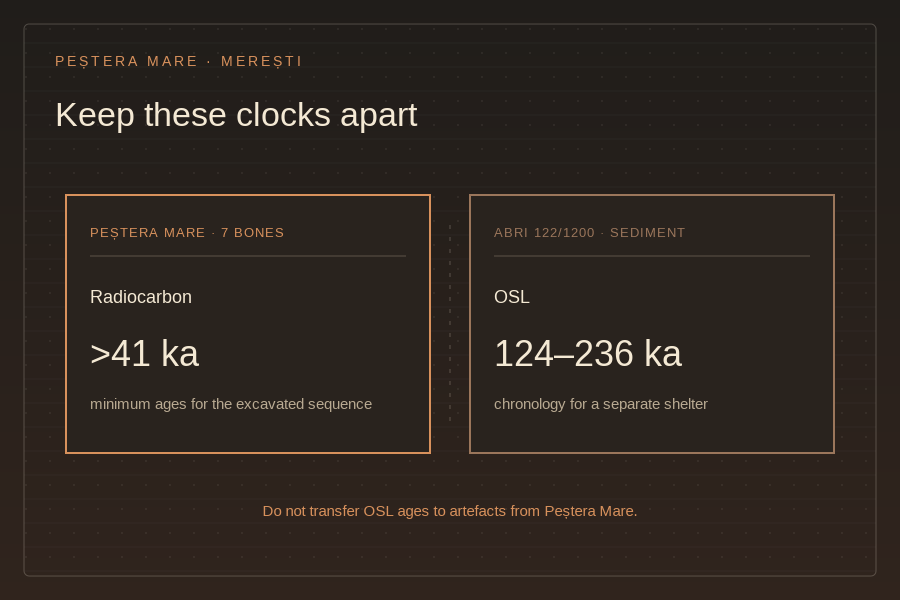
A 2025 study adds a stronger point of reference: bones sampled in Peștera Mare give minimum ages beyond 41,000 radiocarbon years for the excavated sequence. Much older ages, 124,000–236,000 years, come from sediment in Abri 122/1200 shelter, not Peștera Mare. The artefacts from this cave still need a fuller chronology [3].
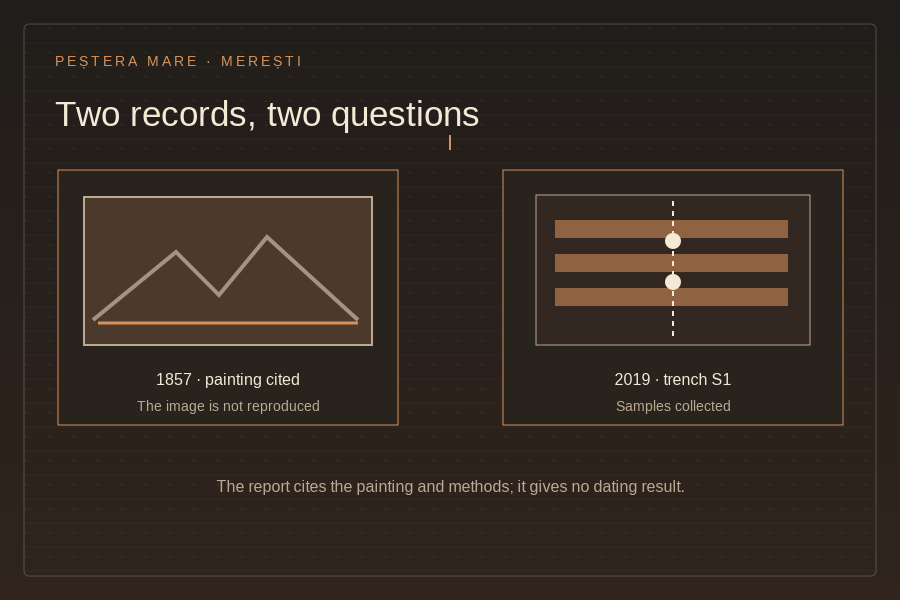
Two separate records: the 1857 painting records access; the 2019 research collected samples that later received minimum ages.
The report cites an 1857 painting and a 2019 sampling campaign. These records document access and research, not the age of the layers. (Source)
Peștera Mare: seven bones, radiocarbon minimum ages beyond 41,000 years; Abri 122/1200: OSL on sediments, 124–236 thousand years. They are separate sites.
The comparison separates radiocarbon-dated bones from OSL-dated sediments at Abri 122/1200. Ages cannot be transferred between sites. (Source)

Sources

Peștera Mare preserves an important archaeological sequence, but its floor is disturbed and the available dates are minimum limits. New results narrow what can be said: people used the cave tens of thousands of years ago; the exact age of each layer and artefact remains to be established.

  1. National Heritage Institute, Peștera Mare No. 14 report (2019 campaign)Primary archaeological report documenting the portal’s position and dimensions, earlier excavations, the 2019 S1 trench, 225 lithic pieces, upper ceramic finds and samples collected for C14, OSL and IRSL dating.
  2. Speomond 7–8 (2002–2003), Vârghiș Gorge survey overviewProvides speleological context and a published survey of the Big Cave. Its reported length differs from the later archaeological report and is not presented as the same measurement.
  3. Christina Schmidt et al., “Evidence for the oldest Middle Palaeolithic cave occupation in the Romanian Carpathians”, Journal of Quaternary Science, 2025Publishes seven radiocarbon results for bones from Peștera Mare and treats them as minimum ages for the excavated sequence; counts 157 lithic products from a 2 m² test pit; and separately reports OSL ages for Abri 122/1200 shelter. It confirms 1,527 m of passages and 50 m of vertical development for Peștera Mare.
  4. Limestone in the gorgeMarius Pascu, 2016. CC BY 3.0. Photograph resized.