mariuscomper.uk RO
3D relief of Romania and Crivăț wind streamlines on 3 February 1954

1–24 February 1954 · Romania's ANM Archive 1871–2026I.M.C. 1954

The Blizzard of 1954

Four blizzard waves buried south-eastern Romania under 173 cm of snow and −30.2 °C, while Transylvania stayed nearly dry. The storm reconstructed hour by hour across all 3,181 Romanian communes and cities.

MEASURED: ERA5 & 78 ISD 1954 stations · CALCULATED: Eurasian pressure field · DRAWN: 4 hPa isobars

Two air masses locked face to face

By late January 1954, a dome of dense Arctic air stretched from western Russia to the Dniester, reaching 1040.1 hPa on 31 January in the ERA5 Eurasian grid (and peaking at 1044.6 hPa on 14 February).

The pressure gradient drove that freezing air south-westward, straight toward Romania's Carpathian arc and the Danube plain.

MEASURED: ERA5 1954 reanalysis · CALCULATED: low-centre track · DRAWN: cyclonic spiral

A Mediterranean low deepens to 987.7 hPa

While the north stayed frozen, a Mediterranean depression deepened over southern Italy and the Adriatic to an ERA5 grid minimum of 987.7 hPa on 1 February 1954 at 18:00 UTC (20:00 EET).

Its track (smoothed across ERA5 grid nodes) crossed the Balkans onto an open, ice-free Black Sea, loading up with moisture.

MEASURED: Copernicus GLO-30 30 m & ISD 154200 · CALCULATED: ERA5 flow · DRAWN: 45,000 streamlines

The Carpathians block the gale and funnel it into the Bărăgan plain

The north-easterly Crivăț gale could not climb the 2,000-metre barrier of the Eastern and Southern Carpathians, Romania's mountain arc. Instead it accelerated around the bend across Moldova and Wallachia.

At Bucharest Băneasa airport, 10-minute sustained wind reached 20.1 m/s (72.4 km/h), while the Central Meteorological Institute (I.M.C.) recorded gusts of 126 km/h in Romania's capital.

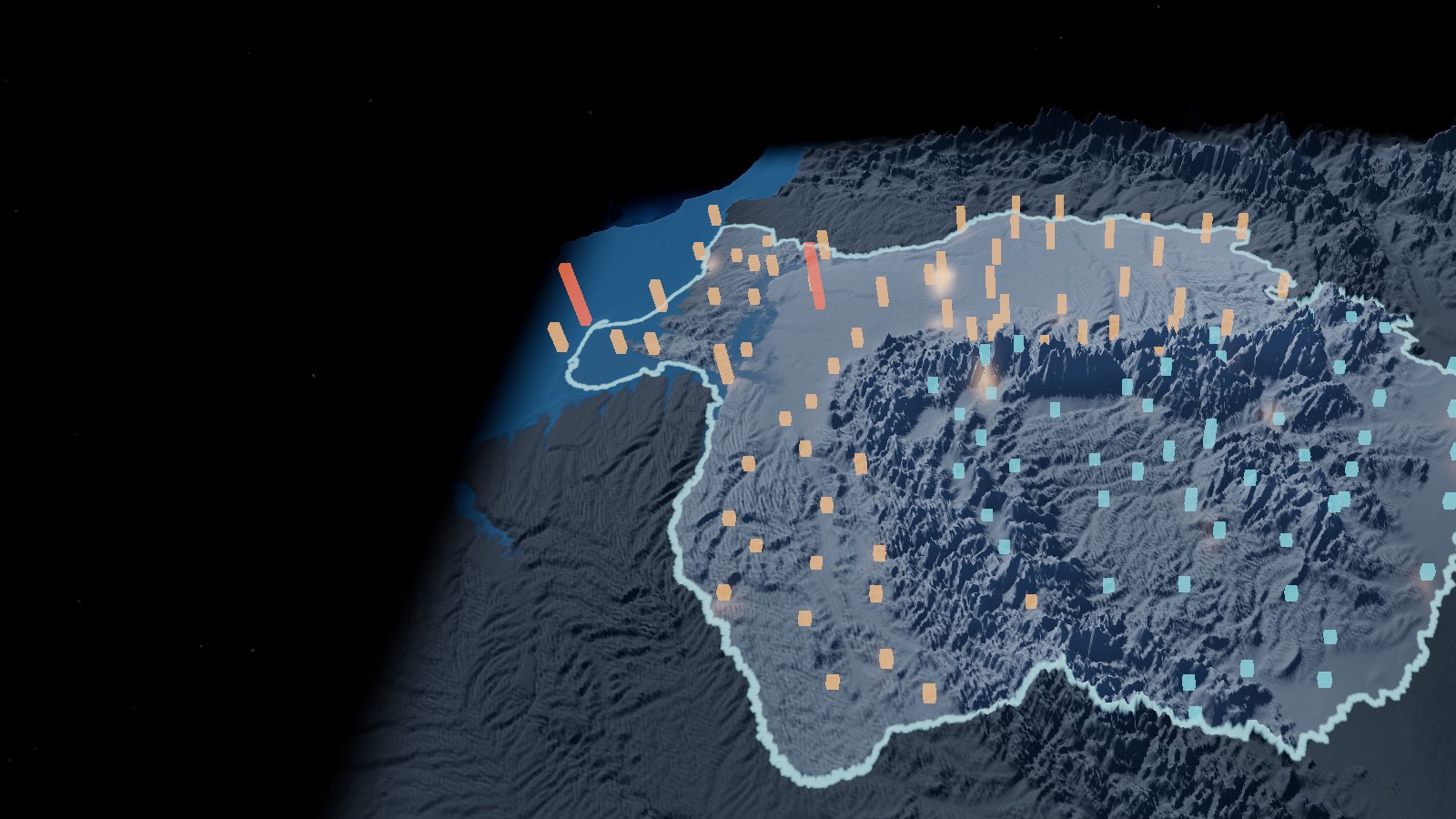
MEASURED: 119 ANM stations (1–4 Feb 1954) · CALCULATED: slope averages · DRAWN: ANM columns

One country, two worlds: 133.8 mm versus 0.1 mm

Between 1 and 4 February 1954, the 68 stations of ANM (Romania's national meteorological service) outside the Carpathian arc averaged 30.3 mm of water equivalent at daily mean temperatures ≤ 0 °C (median 26.6 mm). Inside the arc, in Transylvania and Banat, 51 stations averaged just 9.0 mm (median 8.5 mm) — a 3.4× divide.

Two towns sharing the same name tell the whole story: Sfântu Gheorghe in the Danube Delta recorded 133.8 mm in four days — including 116.4 mm on 3 February alone, Romania's all-time national February 24-hour record and the wettest lowland freezing day (<300 m) in the entire 1871–2026 ANM archive. Across the mountains, Sfântu Gheorghe in Covasna recorded 0.1 mm.

MEASURED: ISD 154200 synoptic log · CALCULATED: 6 h interpolation · DRAWN: ground whiteout

The night Băneasa's anemometer went silent

At 00:00 UTC (02:00 EET) on 3 February 1954, visibility at Bucharest Băneasa dropped to 400 metres at −13.9 °C. Six hours earlier, at 18:00 UTC on 2 February, the ISD wind field is missing (WND=9999), and the 06:00 UTC report is absent altogether.

Out on the Bărăgan plain at Grivița (Ialomița), the gauge caught 87.9 mm on 2 February and 55.0 mm on 3 February (144.8 mm in Wave 1), with daily minima down to −17.8 °C, as the blizzard raged uninterrupted for over 48 hours.

MEASURED: I.M.C. 1954 & WMO TD-872 · CALCULATED: catch ratio · DRAWN: Magheru cutaway

The measurement dispute: 109 cm, 173 cm, or five metres?

Eyewitnesses remember five-metre drifts on Bulevardul Magheru in central Bucharest — tanks crushing ice and families digging 45-degree snow tunnels from kitchen doors. Yet flat snow depth on Bucharest's meteorological lawns measured roughly 109 cm, while the lowland national record of 173 cm was reached at Călărași on 25 February.

None of these numbers is wrong; each measures a different physical process. The World Meteorological Organization intercomparison (Goodison, Louie & Yang 1998; Yang et al. 1999) proved that unshielded Hellmann gauges lose 70–80% of falling snow above 6–10 m/s: gale winds strip open fields and dump the snow against city facades.

MEASURED: ANM minima 5–6 Feb 1954 · CALCULATED: thermal field · DRAWN: freeze pillars

When the sky cleared, temperatures plunged to −30.2 °C

Over fresh powder, the clear nights of 5 and 6 February turned eastern and southern Romania into a radiative cold trap. By dawn on 5 February, Iași hit −26.9 °C, while Călărași and Cluj-Napoca reached −23.6 °C.

On 6 February 1954, Bucharest-Afumați dropped to −30.2 °C — the coldest February temperature ever recorded in Romania's capital.

MEASURED: Danube Commission & ANM · CALCULATED: ETOPO 2022 shelf · DRAWN: coastal pack ice

83 days of Danube ice at Brăila and floes reaching the Bosphorus

In early February the Black Sea was still ice-free, feeding moisture into the gale: Constanța accumulated 140.2 mm across February 1954 — its all-time February record versus a 28.1 mm 1961–2021 average (its Oct–Apr ≤ 0 °C proxy total was 113.8 mm).

Then prolonged cold locked the coast and the Danube. At Brăila, stationary river ice held for 83 days from 29 December 1953 to 21 March 1954 (see Dunărea îngheață), and Danube floes drifted south into the Bosphorus.

MEASURED: ANM daily series (1–28 Feb 1954) · CALCULATED: national pulse · DRAWN: eastern front

Four blizzard waves in a single month

Bucharest had barely dug out its main avenues with 140,000 mobilized citizens when the storm returned: first on 7–9 February, then with renewed force on 17–19 February.

On 18 February, nine ANM stations again topped 20 mm in a day (peaking at 60.9 mm), burying tramlines and cleared arteries all over again.

MEASURED: ANM network & ERA5 · CALCULATED: monthly total · DRAWN: Pontic track

A fourth wave pushes Călărași to 173 cm

Between 22 and 24 February 1954, a fourth cyclone followed the same Black Sea corridor, dropping up to 61.3 mm in a single day on 22 February.

The next morning, 25 February, Călărași measured 173 cm of flat snow — Romania's all-time lowland record — on top of 244.0 mm of freezing-day water equivalent that winter.

MEASURED: Scînteia / AGERPRES / PMR Ialomița archives · CALCULATED: gap · DRAWN: blocked rail

The casualty dispute: what 1954 newspapers left out

Romania's communist regime under Gheorghiu-Dej never published a central death toll for February 1954. State newspapers Scînteia and România Liberă celebrated heroic street-clearing and skiers delivering yeast while reporting cold deaths only in Western Europe — omitting isolated villages, stranded trains, and 1951 Bărăgan deportees sheltering in railway cantons.

Neither the National Archives nor CNSAS (Romania's Securitate archives council) holds a complete national casualty census. By contrast, during the February 2012 blizzards, the Ministry of Health openly reported 86 severe hypothermia deaths.

MEASURED: 5.25M ANM rows (1871–2026) · CALCULATED: 3-day ranking · DRAWN: station constellation

Where 1954 sits in 155 years of ANM records

Because digitized ANM station density reaches 100+ stations only from 1950 onward, national three-day rankings begin in 1950. By unweighted national water equivalent across 119 stations, 1–3 February 1954 (19.88 mm) ranks third, behind 15–17 March 1962 (23.74 mm) and 25–27 January 2014 (20.46 mm).

What sets it apart is temperature: March 1962 (−3.7 °C) and January 2014 (−5.6 °C) were relatively mild snowfalls. February 1954 struck at a national three-day mean of −11.4 °C — by far the coldest storm in the 77-year top ten. Winter 1953–54 ranks #1 out of 77 winters at 25 of 115 long-record stations.

MEASURED: ANM 1954 & 2012 + MAI 2012 · CALCULATED: matched-station split · DRAWN: Constanța coast

1954 head to head with the February 2012 blizzards

For younger readers, Romania's benchmark blizzard is February 2012 — when the Black Sea froze along Constanța's shore, Întorsura Buzăului hit −32.5 °C, and 54 localities were isolated in the first Interior Ministry bulletins.

On the exact same ANM stations (Oct–Apr freezing-day totals), 1954 far outweighed 2012 at Călărași (244.0 vs 61.5 mm), Buzău (149.2 vs 34.1 mm), and Bucharest Filaret (172.2 vs 126.2 mm). Only Bucharest Afumați saw more in 2012 (133.9 vs 96.2 mm).

MEASURED: ANM 1950–2026 · CALCULATED: Oct–Apr winter series · DRAWN: 77-winter map

77 winters: why another 1954 keeps getting rarer

Across all 77 winters from 1950 to 2026, freezing-day precipitation across south-eastern Romania has dropped sharply over the last decade.

At Călărași, the 2016–2026 average is 36.0 mm — nearly seven times less than 1954's 244.0 mm. At Constanța: 12.9 mm versus 113.8 mm.

MEASURED: 3,181 ANCPI UATs & ANM 1950–2026 · CALCULATED: nearest station · DRAWN: 77-winter chart

How the 1954 blizzard hit your town in Romania

Click anywhere on 3D Romania or search any of the 3,181 communes and cities below. See the nearest long-record ANM station's Wave 1 (1–4 Feb 1954) snow water, full February total, coldest morning, and Winter 1953–54 (Oct–Apr) rank out of 77 winters alongside 2012 and recent years.

Sources and method

Every figure is recomputed from ANM's 1871–2026 daily station archive, NOAA ISD 1954, ERA5 reanalysis, and Copernicus GLO-30 terrain. Winter freezing precipitation sums days with daily mean temperature ≤ 0 °C.

  1. Romanian National Meteorological Administration (ANM), Multi-year February characterization (1961–2021) — 1954 records (Sfântu Gheorghe Delta 116.4 mm, Bucharest-Afumați −30.2 °C, Constanța 140.2 mm) [Primary]. www.meteoromania.ro
  2. ANM, daily observation database 1871–2026 (5,256,583 daily rows across 160 stations) [Primary]. www.meteoromania.ro
  3. Bălescu, O. I., & Beșleagă, N. N. (1962), Viscolele în R.P. Română (Blizzards in Romania), Central Meteorological Institute (I.M.C.), Bucharest [Primary]. www.meteoromania.ro
  4. Goodison, B. E., Louie, P. Y. T., & Yang, D. (1998), WMO Solid Precipitation Measurement Intercomparison, WMO/TD-No. 872 [Primary]. library.wmo.int
  5. Yang, D. et al. (1999), Wind-induced precipitation undercatch of the Hellmann gauges, Nordic Hydrology 30(1) [Primary]. iwaponline.com
  6. NOAA Global Hourly Integrated Surface Database (ISD) 1954, Bucharest Băneasa station 154200 and Eurasian synoptic network [Primary]. www.ncei.noaa.gov
  7. ECMWF ERA5 Reanalysis (Open-Meteo Historical Archive, 1954 and 2012) [Primary]. open-meteo.com
  8. Danube Commission, Report 5.2.10 and Hydrological Yearbooks (stationary ice at Brăila, 1953–1954 and 2011–2012) [Primary]. www.danubecommission.org
  9. Simonov, A. I., & Altman, E. N. (1991), Hydrometeorology and Hydrochemistry of the USSR Seas, Vol. 4: Black Sea [Primary]. www.mdpi.com
  10. AGERPRES (2019), Documentary: Winter of 1954 (citing România Liberă 3 Feb, Scînteia 5 Feb, AGERPRES 8 & 12 Feb 1954) [Primary]. agerpres.ro
  11. Historia, Prizonierii Marelui Viscol din iarna anului 1954 (Pericle Marinescu diary and Dan Antoniu testimony). historia.ro
  12. Sighet Memorial, Viscol în Bărăgan, from the diary of Elena Spijavca (deported in 1951) [Primary]. www.memorialsighet.ro
  13. Romanian Ministry of Internal Affairs (19 Feb 2012), Situation of weather impacts [Primary]. www.mai.gov.ro
  14. Copernicus DEM GLO-30 (30 m) and NOAA ETOPO 2022 (Black Sea bathymetry) [Primary]. www.ncei.noaa.gov