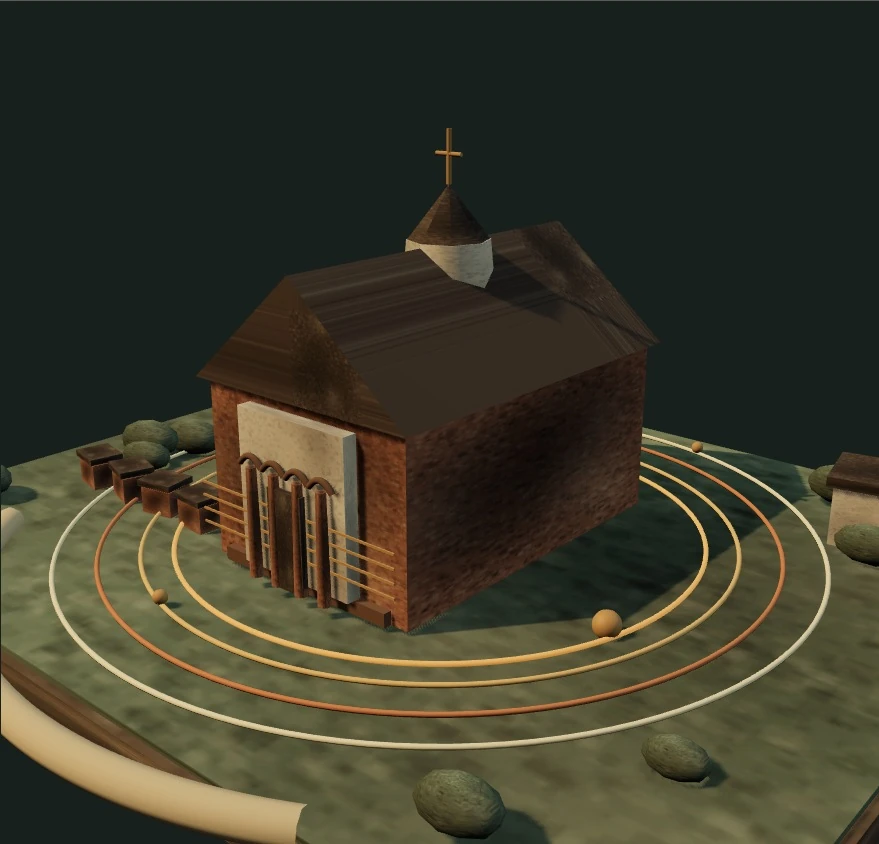
A brick village church surrounded by four rings marking documented stages in its parish history.
Saint Nicholas Church and its recorded stages

Vlădaia · Mehedinți

Four dates, one parish

The national archaeological record says the brick church at Vlădaia was built in 1859, at the expense of Uța Vlădoianu. The parish chronology published by the diocese begins earlier: with a foundation in 1730 and renewal in 1834. 1 2

Ask someone by the school in Vlădaia how old the church in the park is and you might receive two quite sincere answers. One would start with the family who founded a church here. The other would try to date the brick building you can see. 1 2

Drag the model or use the keyboard arrows to see it from another angle. In the next chapter, choose a date and follow what each source says it means.

Start the story

The parish begins

A foundation recorded in 1730

The Diocese of Severin and Strehaia attributes the church's foundation in 1730 to Barbu Vlădăianu. In that chronology, the village church is renewed later, and the following dates describe other interventions. 2

Choose a year below. The lit ring marks the selected reference; it does not measure how long the work lasted.

Chronology reference

A second stage

Uța and the renewal of 1834

According to the diocese, the 1840 register of churches in Mehedinți records the church's renewal in 1834 by Uța Vlădăianca. This is a distinct stage from the foundation in 1730. 2

One clue is the date of the written record itself. The Mehedinți church inventory was drawn up on 30 March 1840, six years after Uța's work. Its compiler already knew of a church that had been renewed. No entry made that day could have been describing work carried out in 1859. 2

Two descriptions in the sources

What the year 1859 means

The National Archaeological Repertory dates the brick church to 1859 and links the work to Uța Vlădoianu's expense. The diocese cautiously says the masonry church may have undergone major repairs around 1859. 1 2

The sources describe the intervention differently. The model marks their shared year without turning that difference into certainty.

Repair and reconsecration

Back in use in 1896

By 1891, the church had become badly worn. Repairs were completed in 1896, and it was reconsecrated on 2 November that year, according to the diocesan chronology. 2

By 1891 the question was whether services could continue at all. The district archpriest recommended suspending them, and permission was sought that same year to carry out repairs. That is why another consecration appears in the history of a church that had served the village for generations. 2

The fourth ring lights at the reconsecration. Space remains between it and the wall: these circles are references, not a time scale.

A landmark you can find

In the park at the village centre

The national record places the church in Vlădaia's central park, south of local road DC94 and east of the school. That is the physical place behind the four dates. 1

The chronology preserves what the sources recorded; it does not describe the appearance of each earlier building. This model shows the brick church as a landmark, not as a reconstruction of its forms in 1730 or 1834.

Sources

The church model is schematic, not an architectural survey. The national record does not describe the tower, porch or proportions; these drawn details are illustrative. The timeline keeps the National Archaeological Repertory's wording separate from the chronology published by the Diocese of Severin and Strehaia; the dates do not all describe the same work.

  1. National Archaeological Repertory · Saint Nicholas Church, Vlădaia

    Location, brick construction in 1859 and Uța Vlădoianu's name, according to the inscription.

  2. Diocese of Severin and Strehaia · Vlădaia parish

    Parish chronology based on the church register for Mehedinți and other records.