Marius ComperVutcani, Vaslui
Română

Vutcani

Vutcani, the tooth that lost its layer

In 2004, researchers in a ravine near Vutcani found a fossil horse molar and pieces of tusk attributed to a mammoth. They knew where they had picked them up. Where the tooth had come from was a separate question.

Start the story ↓
Figures 8–10 show Hipparion gracile jaws and teeth from Mont Léberon, France. They offer a comparison for the Vutcani tooth.
Figures 8–10 show Hipparion gracile jaws and teeth from Mont Léberon, France. They offer a comparison for the Vutcani tooth. (Source · Albert Gaudry, Animaux fossiles du Mont Léberon, 1873, planșa V · Domeniul public / Public domain)

Vutcani · Valea lui Darie
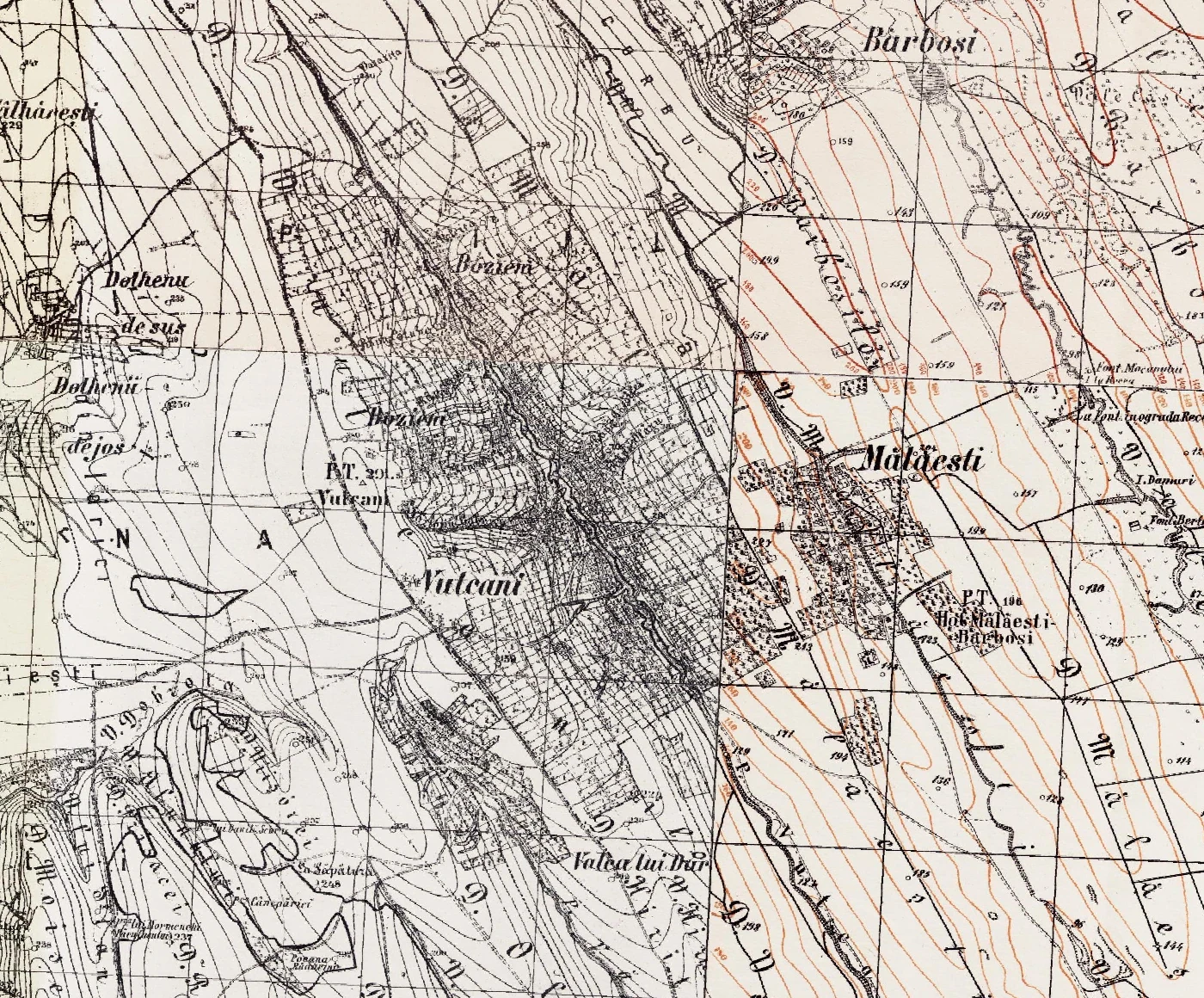
The military sheet preserves the village and valley names. The report places the ravine on the right side of the Valea lui Darie brook.
The military sheet preserves the village and valley names. The report places the ravine on the right side of the Valea lui Darie brook. (Source · Serviciul Geografic al Armatei / eHarta · CC BY-SA 4.0)

Vutcani · Valea lui Darie

Where they found the tooth

Vutcani is in Vaslui County, on the Bârlad Plateau. The military survey shows the village and the valley to the south. In 2004 researchers working with the Bârlad museum returned to the area and investigated a ravine on the right side of Valea lui Darie. [5] [1] [2]

The report calls it Râpa Clanței. That is where the team says it found the tooth. To understand what it can tell us about the valley’s past, we also need to read how it was found. [2]

The military sheet preserves the village and valley names. The report places the ravine on the right side of the Valea lui Darie brook.
The military sheet preserves the village and valley names. The report places the ravine on the right side of the Valea lui Darie brook. (Source · Serviciul Geografic al Armatei / eHarta · CC BY-SA 4.0)

Fieldwork record · 2004

Two finds, two entries

The authors record small pieces of tusk attributed to Mammuthus and a molar attributed to Hipparion, a fossil horse. The abbreviation “sp.” leaves the species unspecified. The researchers add one word to the molar’s entry, “reworked”. [2]

That word concerns the place the fossil came from. The report distinguishes remains still embedded in sediment from pieces that have fallen or moved. The tooth had a proposed identity, while its original layer remained to be established. [2]
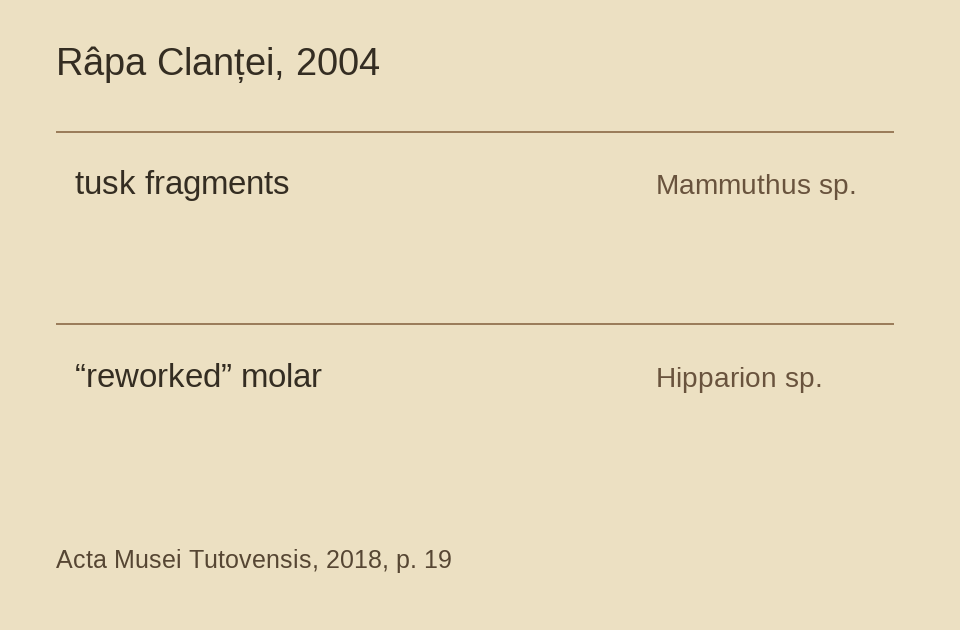
The report lists tusk fragments and a molar. It applies the term “reworked” to the molar.
The report lists tusk fragments and a molar. It applies the term “reworked” to the molar. (Source)
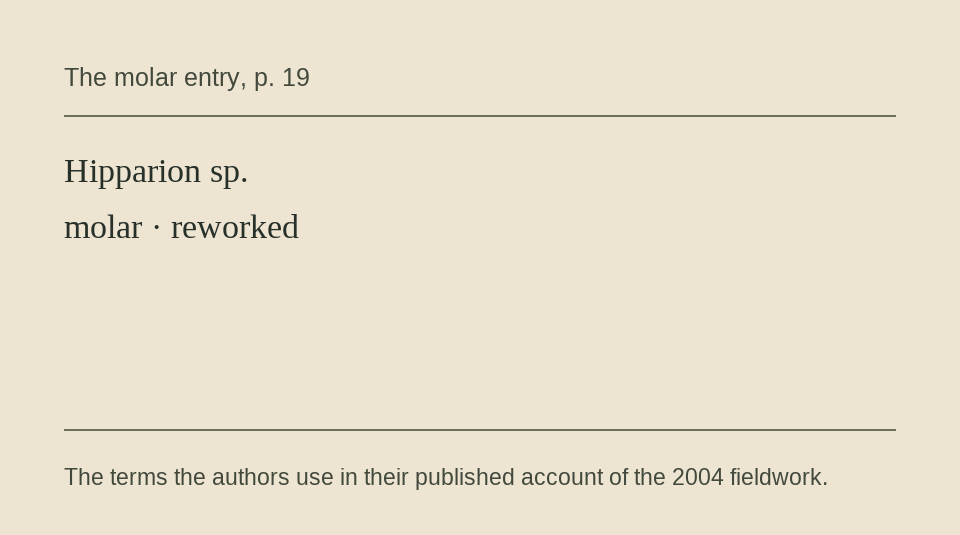
The terms the authors use in their published account of the 2004 fieldwork.
The terms the authors use in their published account of the 2004 fieldwork. (Source)

Mont Léberon, Plate V · 1873

What a tooth can still tell you

Albert Gaudry’s plate of jaws and teeth found in France allows their shapes to be compared long after removal from the ground. Look at the rows of teeth and the surfaces drawn at the foot of the plate. [3]

Those are comparative specimens. The Vutcani report gives the attribution to Hipparion and includes no drawing of that molar in the relevant passage. The French plate shows what kinds of detail a tooth can preserve, while the appearance of the ravine specimen remains undocumented here. [2] [3]
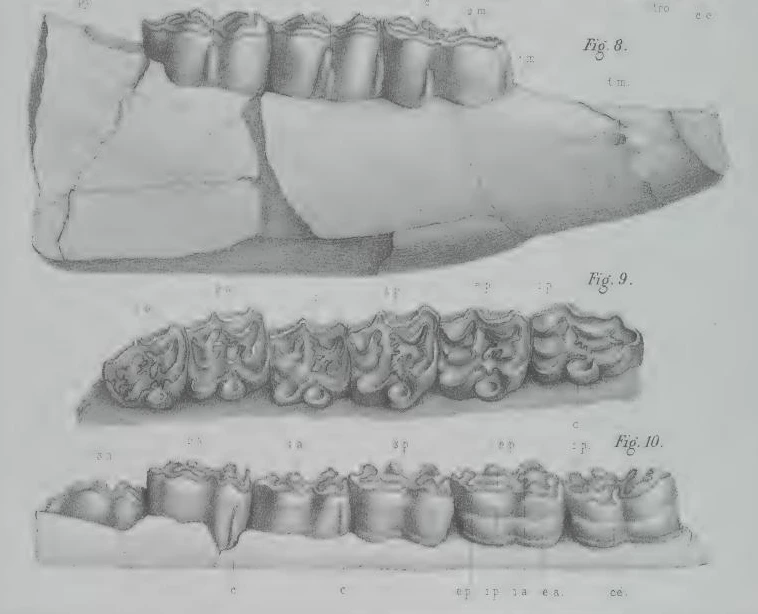
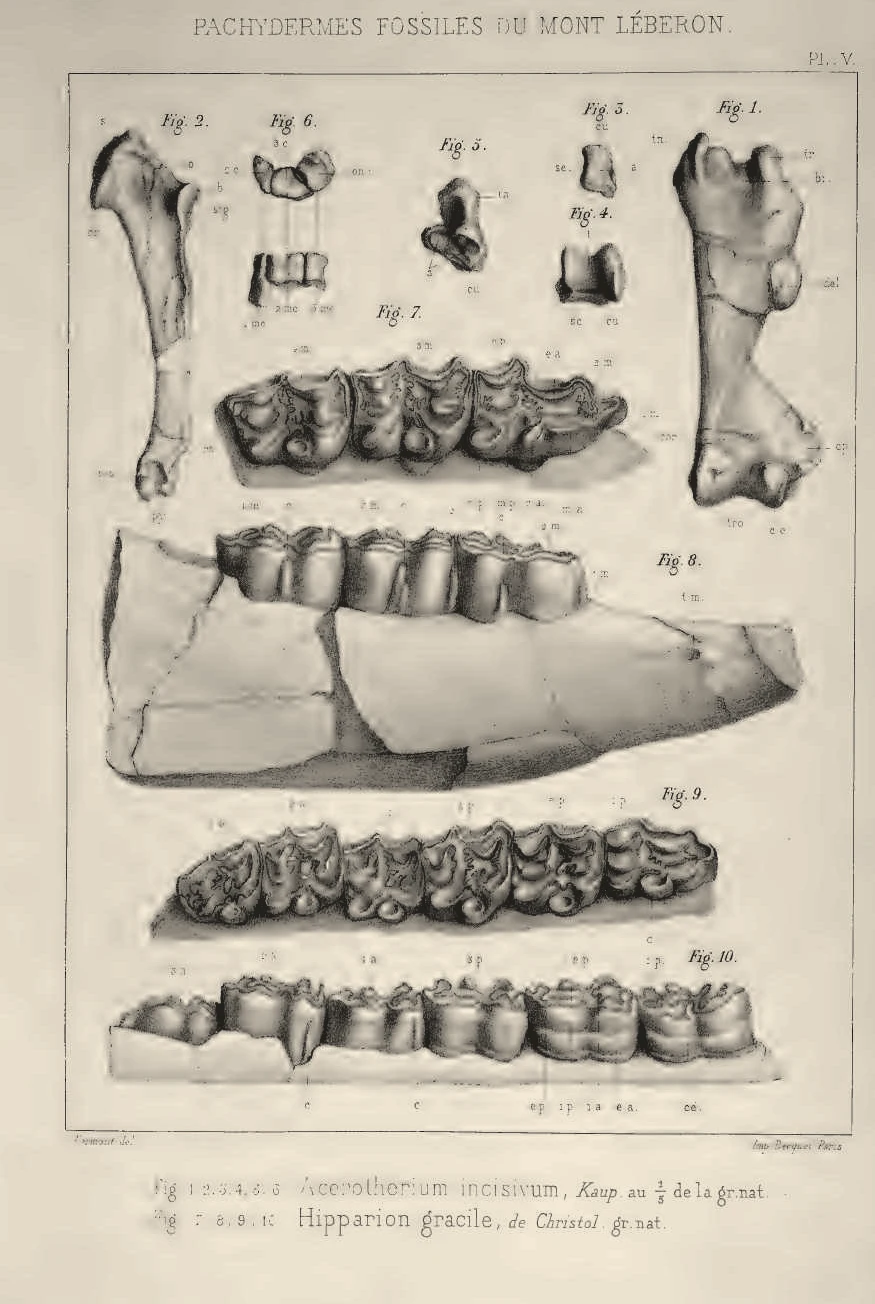
Figures 8–10 show Hipparion gracile jaws and teeth from Mont Léberon, France. They offer a comparison for the Vutcani tooth.
Figures 8–10 show Hipparion gracile jaws and teeth from Mont Léberon, France. They offer a comparison for the Vutcani tooth. (Source · Albert Gaudry, Animaux fossiles du Mont Léberon, 1873, planșa V · Domeniul public / Public domain)
Only figures 7–10 on Plate V show the fossil horse Hipparion gracile. Figures 1–6 show a different genus.
Only figures 7–10 on Plate V show the fossil horse Hipparion gracile. Figures 1–6 show a different genus. (Source · Albert Gaudry · Darwin Online · Public Domain Mark 1.0)

In its layer and after movement

In the rock, you also find the layer

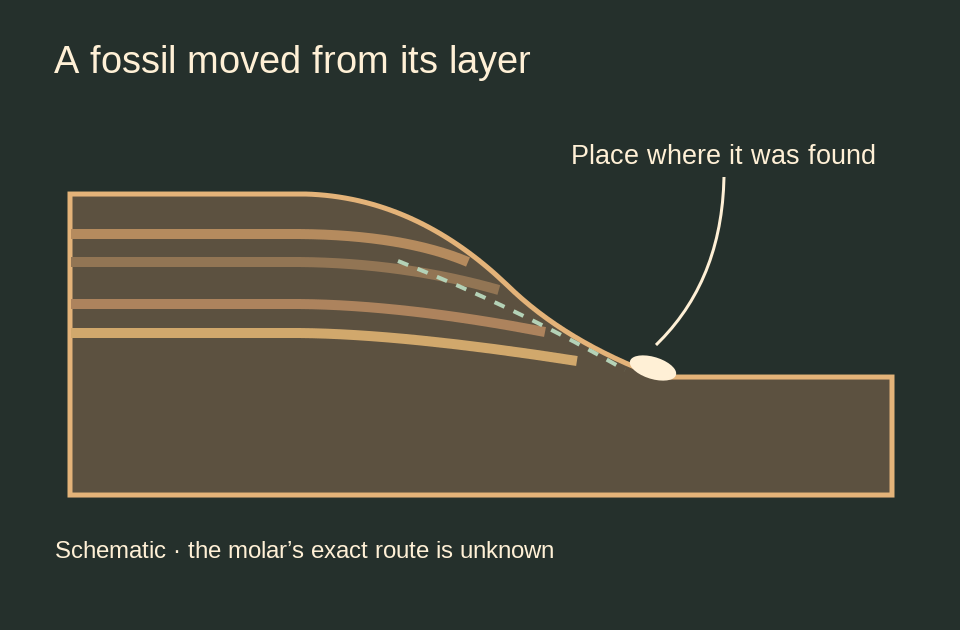
Choose the fossil in sediment, then the fossil after it has moved. In the first case, a researcher can record its layer and what surrounds it. In the second, the findspot may be some distance from its original layer. [2]

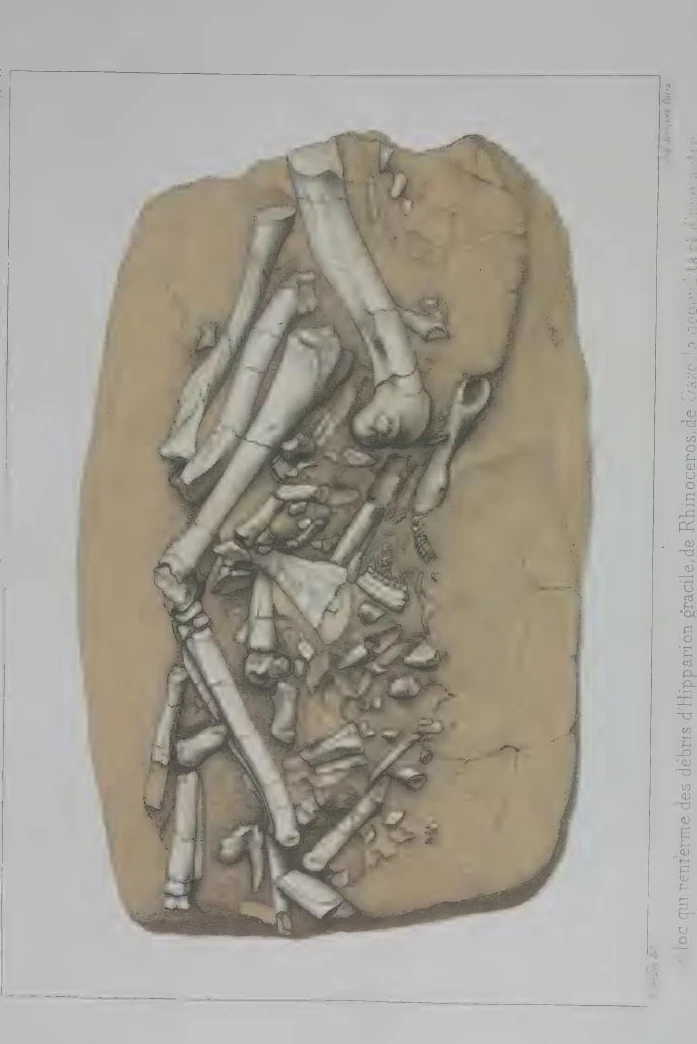
Gaudry separately illustrated a block of rock from Mont Léberon, with the bones drawn in place. The plate preserves relationships between rock and remains that a loose tooth cannot show. [4]
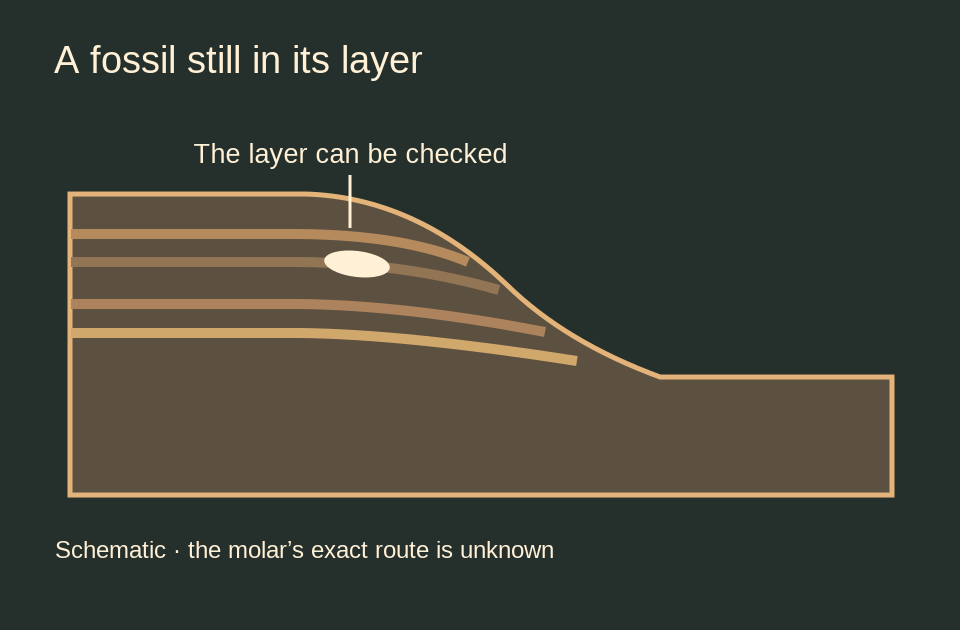
A fossil found in sediment can be recorded together with its layer. Schematic example.
A fossil found in sediment can be recorded together with its layer. Schematic example. (Source)
A fossil may arrive at the foot of a ravine after coming out of its layer. The line illustrates a possible movement.
A fossil may arrive at the foot of a ravine after coming out of its layer. The line illustrates a possible movement. (Source)
Plate I shows a block from Mont Léberon, France, with bones preserved in their positions in the rock.
Plate I shows a block from Mont Léberon, France, with bones preserved in their positions in the rock. (Source · Albert Gaudry · Darwin Online · Public Domain Mark 1.0)

Back to Râpa Clanței

What the findspot tells us

Reopen the 2004 entries. For the molar, “reworked” means it had broken free or moved before collection. Finding both kinds of remains in one ravine leaves open whether they came from the same layer. [2]

The report also says later checks at that spot yielded no additional finds. It leaves a useful field record and a particular reason for caution. The place the tooth was picked up can be mapped. Its place in the sediment sequence needs further evidence. [2]
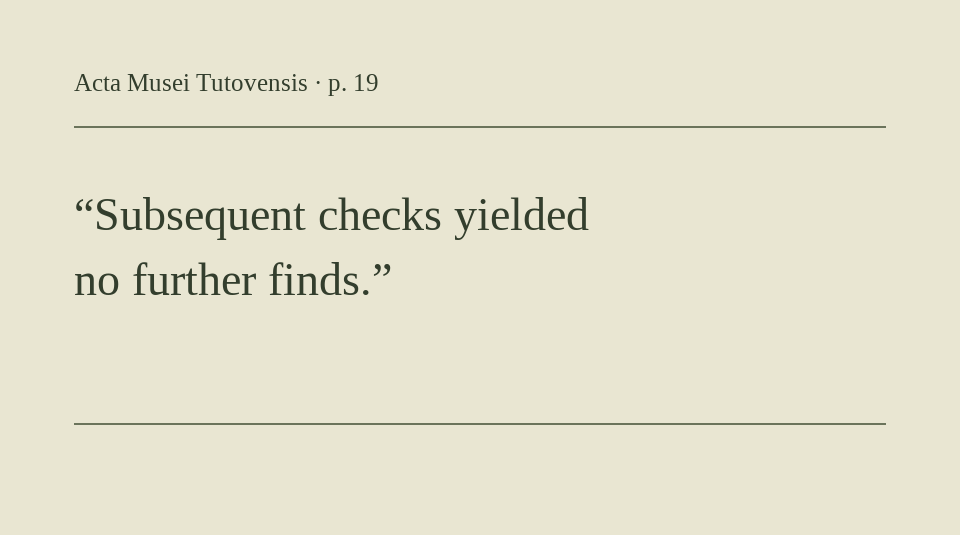
On p. 19 of the report, the authors record the result of later checks in the same area.
On p. 19 of the report, the authors record the result of later checks in the same area. (Source)
The report lists tusk fragments and a molar. It applies the term “reworked” to the molar.
The report lists tusk fragments and a molar. It applies the term “reworked” to the molar. (Source)

Sources

The Vutcani molar retains the form that led to its identification as a fossil horse tooth. The field record preserves something just as important, the difference between the ravine where it was found and the layer from which it came.

  1. Romanian military survey · VutcaniVutcani and the valley to the south on a military survey.
  2. Ursachi, Codrea, Rățoi and Brânzilă, Acta Musei Tutovensis, 2018, p. 19Account of the 2004 visit to Râpa Clanței and the distinction between fossils in place and reworked material.
  3. Albert Gaudry, Animaux fossiles du Mont Léberon, 1873, Plate VComparative material from France, showing teeth from a different site.
  4. Albert Gaudry, Plate IA block from Mont Léberon with bones drawn where they were found.
  5. OpenStreetMap, VutcaniThe village marker.