What is your body for?
Your legs are millions of years older than your brain
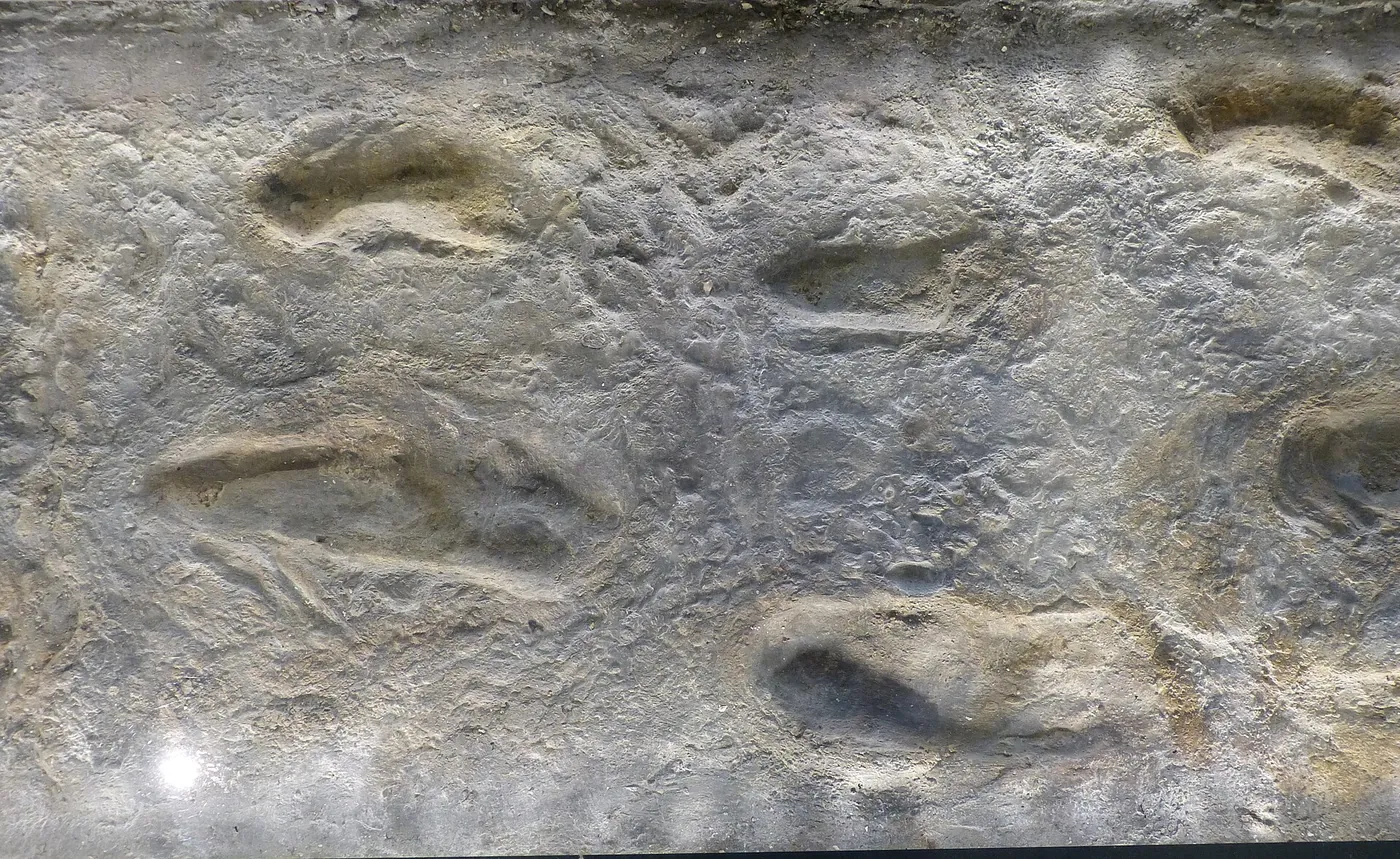
Upright walkers with brains the size of a chimpanzee’s left footprints in Tanzania 3.66 million years ago. The big expansion in brain size came much later, from around 2 million years ago. Drag the slider under the skeleton, from a chimpanzee through three fossils to you, and watch which parts change first.
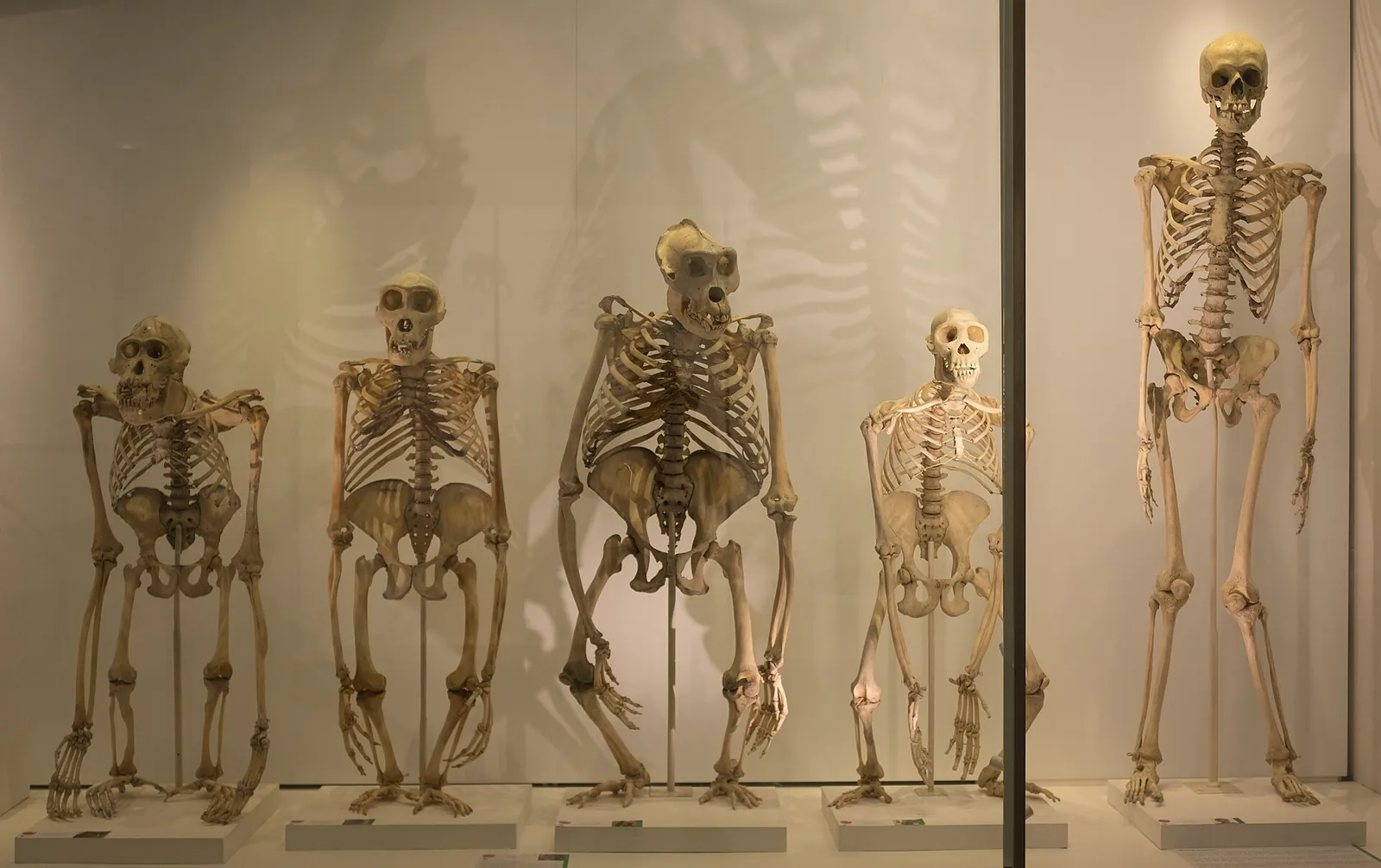
Chimpanzeeliving, for comparisonWalking upright on bent hips and knees, with a tall, narrow hip bone, a big toe that grasps and arms longer than its legs.
- Chimpanzee (living, for comparison). Walking upright on bent hips and knees, with a tall, narrow hip bone, a big toe that grasps and arms longer than its legs.
- Ardipithecus (4.4 million years ago). A shorter hip bone for walking upright on the ground and small canines, but a big toe that still grasped and a foot with no arch.
- Lucy (3.2 million years ago). A short, wide pelvis rebuilt for upright walking, an angled thigh bone and, in her species, arched feet with the big toe in line. Six skulls of her species held at most 550 cm³ of brain; a chimpanzee's holds about 384.
- Turkana Boy (1.6 million years ago). An early Homo erectus with long legs, short forearms and a body close to ours. Five African Homo erectus skulls from about 1.9 to 1.5 million years ago held 691 to 909 cm³.
- You (today). A brain of about 1,336 cm³, 3.5 times a chimpanzee's, a face tucked under it, and a chin.
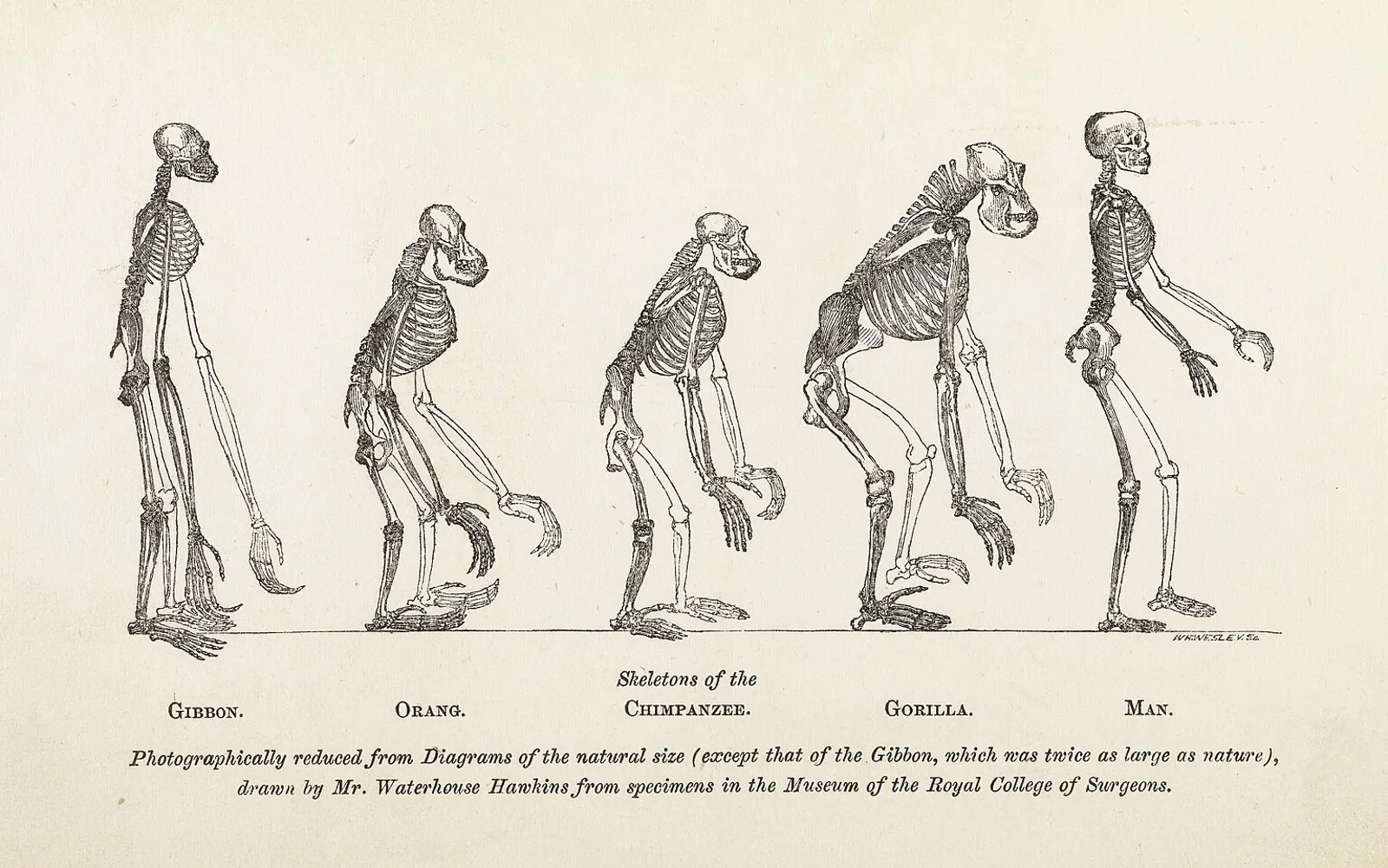
The chimpanzee is the closest living body to compare with, not our ancestor: its line has been evolving for as long as ours, since a split at least 7 to 8 million years ago by one estimate. Whether the common ancestor looked like a chimpanzee is still argued. At each fossil stop, parts that the bones do not show changing stay in the chimpanzee's form. The drawing is a side view to scale: arm and leg lengths follow measured ratios at the same trunk length; outlines and gait are drawn, not traced.
People have been making this comparison since 1699
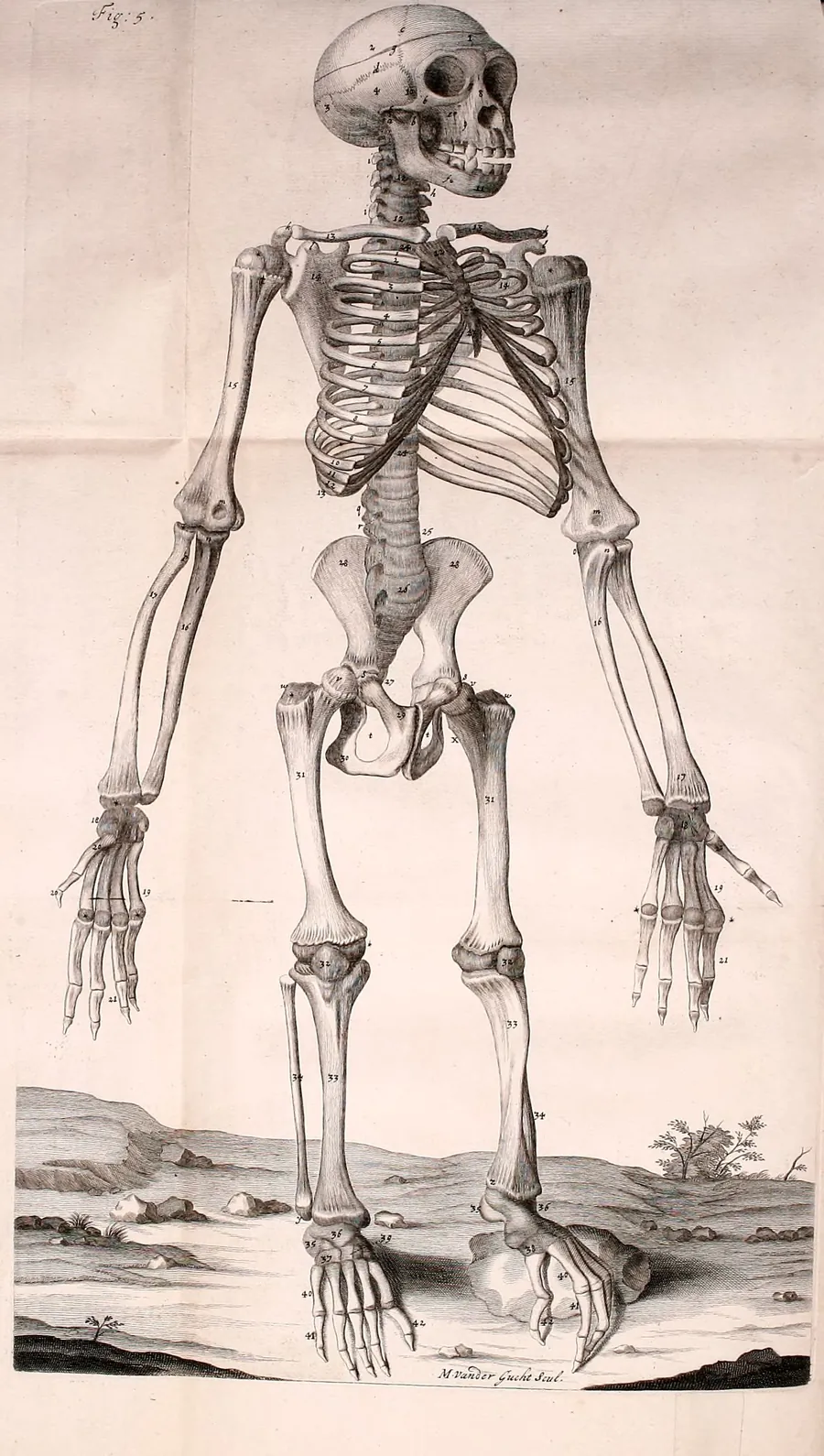
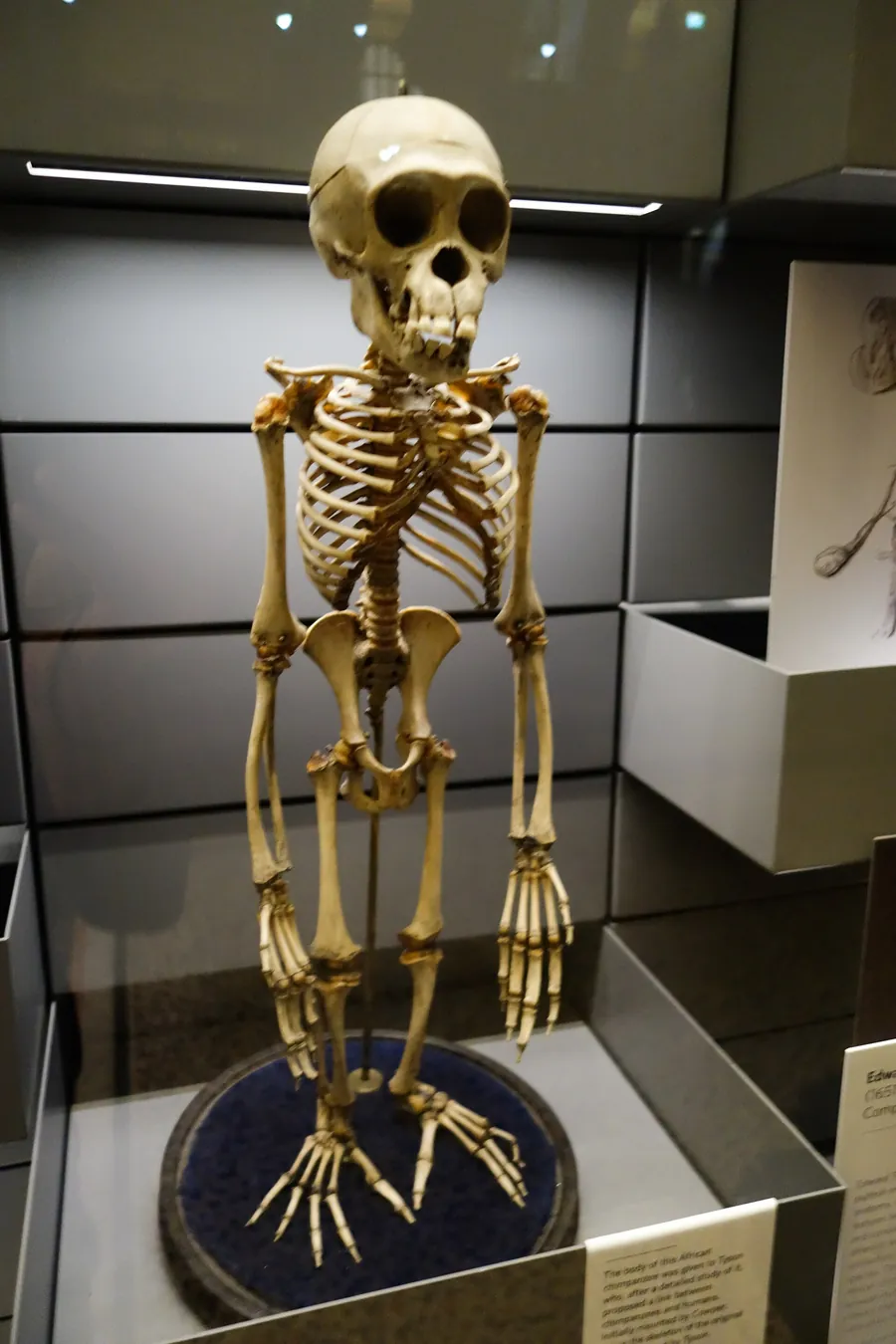
In 1699 the London physician Edward Tyson published the anatomy of a young ape brought from Angola, compared part by part with a monkey, an ape and a man. He called it a “Pygmie”; it was a chimpanzee. He ended with two lists: 48 ways in which it resembled a man more than apes and monkeys do, and 34 ways in which it did not.
His second list reads like the contents of this page: a ridge of bone above the eyes, a small thumb, a big toe “set at a distance from the other, like a thumb”, a hip bone “longer, narrower” than a man’s, thirteen ribs a side instead of twelve.
Tyson also got something wrong. He decided his animal was “designed by Nature to walk erect”. Chimpanzees can walk upright, but it costs them, as the numbers below show.
1 · Walking
A body built to walk far on little fuel
For each kilogram and metre, a chimpanzee walking upright uses about 4 times the oxygen you do. Almost every bone between your skull and your heel has been reshaped for walking upright, and the reshaping makes each step far cheaper.
Side by side
Drawn at the same trunk length
At the same trunk length the proportions speak first. A chimpanzee’s arms are longer than its legs. In one study, five chimpanzees and four people weighed about the same (60 and 69 kg on average), but the people stood with their hips twice as high: 92 cm against 46.
Head
The skull sits on top of the spine
The hole where the spinal cord leaves the skull, the foramen magnum, sits further forward in you than in any other primate measured, and points down. Your skull balances on the spine; a chimpanzee’s hangs forward of it and is held by neck muscles. Kangaroos and hopping rodents have a forward hole too.
The position and the angle of the hole can change separately, and ape and fossil values overlap, so the hole alone cannot prove that a fossil walked upright.
Lower back
A longer lower back, curved inward
Chimpanzees usually have four lumbar vertebrae, sometimes three; you usually have five. In apes the tall hip bones close round the lowest of them, so the lower back barely bends and the trunk leans forward. Your lower back curves inward and places the weight of the upper body over the hips. In women the curve is reinforced, which helps in carrying a pregnancy.
Pelvis
A hip bone that wraps round the side
A chimpanzee’s ilium is a tall, flat blade. Yours is short and wide and curves round the side of the body, so two buttock muscles, gluteus medius and minimus, sit at the side of the hip. When you stand on one leg they stop the pelvis sagging towards the lifted leg. A chimpanzee walking upright does it differently: it hitches that side up and throws its whole chest over the standing foot, and its steps are about 3 times wider than yours, relative to leg length.
The difference starts in the embryo: the growth plate of the human ilium is turned 90 degrees compared with a chimpanzee’s.
Legs
Straight legs, angled thighs
Ape hamstrings cannot straighten the hip past about 160 degrees, so a chimpanzee walks with bent hips and knees, which gives its muscles poor leverage and makes each step costly. Your hip opens to as much as 200 degrees in a normal stride.
Your thigh bones also slant inward to the knee, by 8 to 14 degrees, which puts your feet under your body. Babies are born without that angle. Walking builds it by age four to six; in a person who never walked, it did not develop.
Foot
A foot that pushes instead of grasping
A chimpanzee’s big toe sticks out sideways like a thumb, for gripping branches. Yours lines up with the others and is the last part to leave the ground at each step. Your foot is arched along its length and across it; the crosswise arch alone gives more than 40 percent of the foot’s stiffness, the way a banknote stiffens when you curl it.
The arch is not rigid: while the foot is on the ground, people bend the middle of the foot through a wider range than chimpanzees do.
The chimpanzees differed a lot. One 33-year-old female walked more cheaply on two legs than on four (0.16 against 0.29 ml), because she kept her legs straighter and her feet on the ground longer. Variation like hers is what natural selection could have worked on.
Cheap walking is one explanation for why our ancestors stood up, not a settled one. A later study found that chimpanzees spend about the same on two legs as on four, so the first upright steps may have saved nothing; the saving grew as legs lengthened and straightened.
When it happened
Ardipithecus ramidus, 4.4 million years ago in Ethiopia, walked upright on the ground but kept a grasping big toe and climbed. A shin bone of Australopithecus anamensis, 3.9 to 4.2 million years old, is already built for walking. Footprints left in wet volcanic ash at Laetoli, Tanzania, 3.66 million years ago show human-like steps on fairly straight legs, though slightly more bent than ours. Lucy, a little under 3.18 million years old, has a pelvis rebuilt for upright walking and the angled thigh bone. Older candidates, Sahelanthropus (6.7 to 7.2 million years) and Orrorin (about 6 million), are argued over: four papers since 2020 have read the same Sahelanthropus thigh bone both ways.
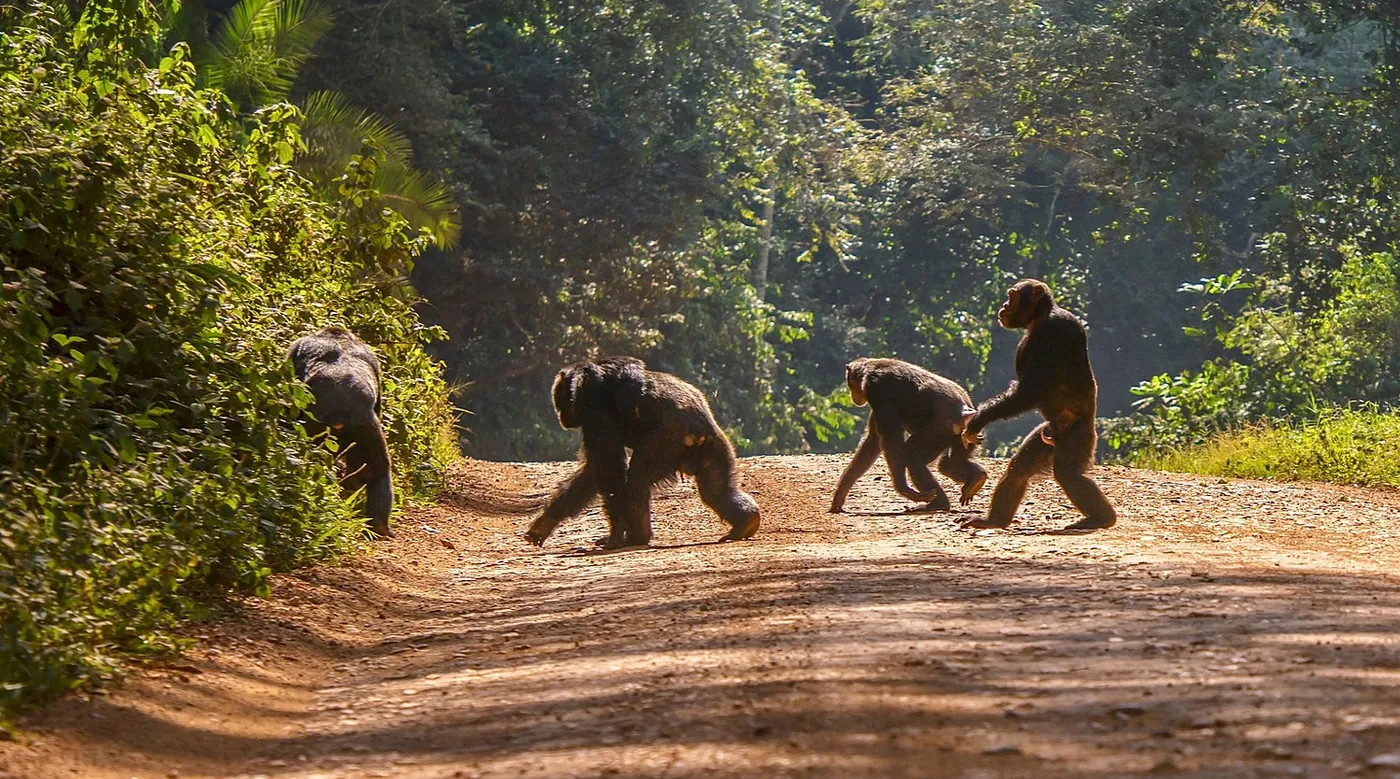
Upright walking did not begin with a march out of the forest onto open grass. The earliest hominins lived in mosaics dominated by woodland, with strips of forest along rivers, and a study of chimpanzees living in such a landscape today suggests that upright walking may first have been useful in the trees. The body built for long-distance running came much later, with Homo.
2 · Running
Built to run in the heat
Chimpanzees sprint, but no primate other than us runs for long. From around two million years ago, with early Homo, bodies gained parts that help running far more than walking: springs, stabilisers and a cooling system.
Heel
A spring in the heel
A chimpanzee’s calf muscle runs almost to the heel: its Achilles tendon is about 7.5 percent of the length of calf muscle and tendon together. Yours is 53 to 65 percent. Stretched at each landing and released at push-off, the tendon and the arch of the foot give back energy that muscle would otherwise have to supply.
When the long tendon appeared is argued. The classic account puts it with early Homo; a 2020 study of heel bones infers about 63 percent in Lucy’s species.
Buttocks
Buttock muscles that work when you run
Your buttock muscles weigh about 27 grams per kilogram of body weight; a chimpanzee’s about 17. The largest of them, gluteus maximus, barely works when you walk on the flat. It switches on when you run, and stops the trunk pitching forward at each footfall.
Neck
A band that keeps the head steady
Running mammals such as dogs and horses have a nuchal ligament, a band from the back of the skull down the neck that stops the head bobbing. Chimpanzees do not have one. You do, and the ridge where it attaches first shows on a skull of early Homo, between about 1.6 and 1.9 million years old.
In 2004 Dennis Bramble and Daniel Lieberman listed 26 features of the human skeleton that help in running; none appears in Australopithecus. They suggested that running let early humans chase animals to exhaustion, and in the same paper noted that it “might have been too energetically expensive”. That question is still open.
Same hair, more sweat
You have about as many hair follicles per square centimetre as a chimpanzee; your body hairs are just fine and short. The real change is in sweat glands: on average ten times as many for each patch of skin. Athletes typically sweat half a litre to two litres an hour. Chimpanzees sweat too; in a small 1976 test, two young chimpanzees in the heat also breathed faster, as every other primate tested did. People rely overwhelmingly on sweating; heat-induced panting has been reported in people too, but whether it does much to cool them is disputed.
An engine that runs hotter
People burn about 400 kcal a day more than chimpanzees and bonobos of the same lean body mass, and carry more fat: in one study 23 percent of body weight in men and 41 percent in women, against 8 to 9 percent in captive chimpanzees and bonobos. Despite all the sweating, people turn over 30 to 50 percent less water a day than other apes of the same size, activity and climate.
3 · Throwing and holding
Built to throw hard and hold things firmly
Your shoulder, waist and hand are tuned for two things a chimpanzee rarely does: throwing hard and straight, and pinching an object firmly between thumb and fingers.
Shoulder
A shoulder socket that faces sideways
A chimpanzee’s shoulder socket points upward, suited to hanging and climbing. Yours faces out to the side. Together with a tall waist that lets the hips turn separately from the chest, this lets you cock the arm far back and store energy in stretched tendons and ligaments, like a catapult. In a study of 20 throwers, that stored energy could supply about half the work of the arm’s inward twist: 54 percent, if 90 percent of it comes back.
The combination first appears together in Homo erectus, about two million years ago.
Upper arm
The fastest movement your body makes
As the arm uncoils, the upper arm twists inward faster than any other movement of the human body: on average 4,290 degrees a second in that study, and more than 9,000 in the fastest throwers measured elsewhere. The price is injury. The ligaments of the shoulder and elbow are not built to take the strain again and again, which is why pitchers tear them.
Hand
A long thumb, or short fingers
Measured bone by bone, your thumb is about three-quarters as long as your ring finger; a chimpanzee’s is about half. One analysis argues that it was the chimpanzee’s fingers that grew longer, for climbing, while ours stayed close to the ancestor’s; others disagree. Among great apes, only humans have a separate muscle to bend the tip of the thumb, which gives the strong pinch that holds a stone while you strike it.
Hands, tools and a chimpanzee raised as a child
Stone tools are older than our genus: hammers and flakes from Lomekwi, Kenya, date to 3.3 million years ago. Chimpanzees use tools too. In Côte d’Ivoire they crack nuts with stone hammers, and archaeologists have dug up their hammer stones from 4,300 years ago.
The curve of a chimpanzee’s finger bones seems to be inherited rather than built by climbing. A chimpanzee named Suzy, raised as a child in 1930s New York and rarely allowed to climb, still grew finger bones as curved as a wild chimpanzee’s: about 43 degrees, against about 24 in people.
Muscle fibres from chimpanzees are no stronger than ours. The difference is the mix: about two-thirds of the fibres in a chimpanzee’s hip and leg muscles are the fast, powerful type. In the same muscles, 53 to 69 percent of a person’s fibres are the slow type, which tires less. That is a trade of power for endurance.
4 · The head
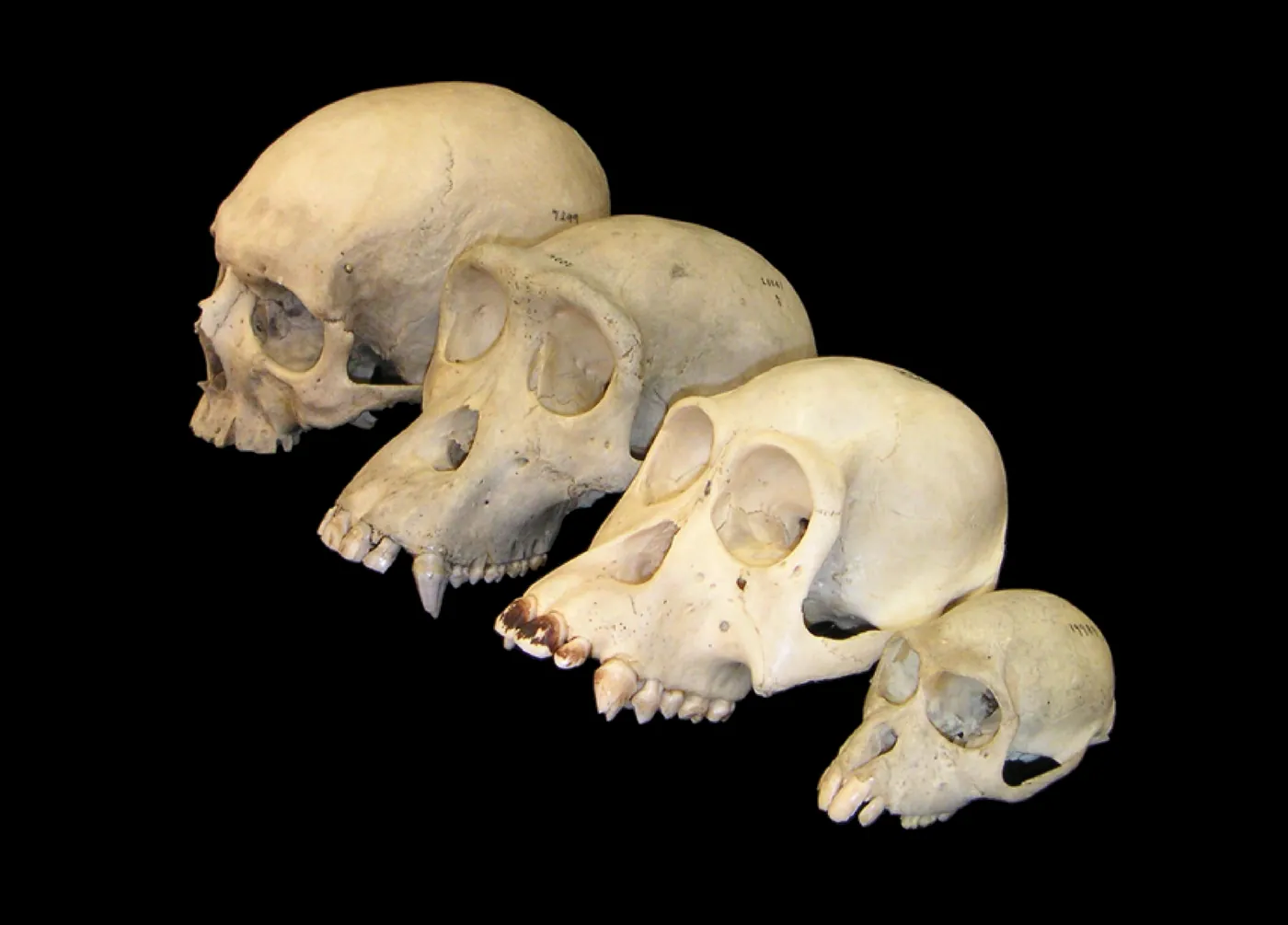
A big brain behind a small face
The brain is the last of the big changes, and the most expensive.
Teeth
Small canines, very early
Male chimpanzees carry long upper canines, kept sharp against the lower teeth. In Ardipithecus, 4.4 million years ago, male canines were only 6 to 13 percent bigger than females’, within the human range. In chimpanzees and orangutans the difference is 20 to 40 percent. Canines shrank early, at about the time upright walking appears.
Face
A face pulled in under the brain
Chimpanzees spend 37 percent of their waking day eating; people 4.7 percent. A primate of your size would be expected to spend 48 percent. The large chewing face shrank as food got easier to eat. If a third of the diet was meat, eating would have taken nearly two million fewer chews a year; slicing the meat with stone tools cut about 5 percent more, before cooking became common.
Brain
Three and a half times the brain
About 384 cm³ against 1,336. It is costly: in an adult the brain uses about a fifth of the body’s resting energy, against less than a tenth in a chimpanzee, and in a four-year-old it takes 66 percent.
How was it paid for? Eating raw food the way apes do, a brain the size of yours would need more than 9 hours of feeding a day, by one model: longer than any ape spends. Easier food is part of the answer. Your gut is also small for your size, with more than half of its volume in the small intestine; in apes the colon is the largest part. The popular idea that a shrinking gut paid for the growing brain did not hold up in a test across 100 mammal species.
Stomach acid like a scavenger’s
Your empty stomach sits at about pH 1.5. In a comparison of birds and mammals, animals that live on carrion averaged 1.3 and omnivores 2.9; a baboon measured 3.7. Each step down the pH scale is ten times more acid, so yours is about 160 times as acidic as the baboon’s. Acid kills microbes, and rotting meat carries plenty, so one explanation is that our ancestors ate more carrion than is usually assumed. Another is that strong acid protects against food-borne infections whatever the diet. And the comparison has a hole: when the study was published, no stomach acidity had been measured for any ape other than us, so nobody knows when the difference arose.
What we lost to talk
A low larynx is often called the key to speech. A chimpanzee’s larynx also descends in infancy, and a model built from X-ray film of a macaque’s moving vocal tract could synthesise an intelligible “Will you marry me?”. The monkey’s throat is not the main obstacle; control from the brain is. What changed in the human throat is a loss. Every other primate examined has thin membranes on the vocal cords; we don’t, and without them the voice is steadier.
The whites of your eyes
Human eyes show more white than any ape’s, and it is the most evenly white. It is not unique: 42 of 51 bonobos in one sample had whites lighter than the iris, while 48 of 50 chimpanzees had them darker. Whether chimpanzee eyes stand out or hide where they look is disputed by two recent studies.
The price of a big head: birth and a long childhood
A human baby is heavy for its mother and its head is a tight fit, yet its brain is less developed at birth than a chimpanzee’s.
Human pregnancy lasts 38 to 40 weeks; a chimpanzee’s about 32. Why human babies are born so helpless is argued. The classic answer, the “obstetric dilemma”, is that a pelvis narrow enough for walking cannot pass a bigger head. A 2012 study replied that the mother’s energy sets the limit: by nine months a pregnancy is close to the most a body can sustain, and human pregnancy is already 37 days longer than expected for our size. Later reviews defend a revised dilemma. A tight fit is real: in poorer countries obstructed labour is estimated to cause 8 to 17 percent of all maternal deaths.
Chimpanzees share more of human birth than once thought. In three filmed births the baby came out facing away from its mother and turned as it emerged, as human babies do. In humans the turn happens inside the birth canal and is forced by its shape; one explanation for that shape is that it helps the pelvic floor carry the weight of the organs above it.
Human babies also arrive fat, about 15 percent of their weight, where rats, pigs, sheep and bears are born with 1 to 4 percent. Their brains keep growing fast after birth, and the fat is thought to be a store for it.
Human foragers wean at about 2.5 years, chimpanzees at about 5, so human mothers have babies closer together (41 months apart against 67) while still caring for older children, with help from others. At 15, a forager can expect 39 more years, a wild chimpanzee 15. Menopause is not unique to us either: at Ngogo, in Uganda, female chimpanzees live about a fifth of adult life past the age when they can reproduce; hunter-gatherer women about two-fifths. Other chimpanzee communities studied show almost none.
The part that may not be for anything
One difference appears to belong to modern humans alone, among living apes and fossil humans alike: a bony chin. Explanations have been offered for more than a century; a 2016 review concluded that every one of them has “theoretical and/or empirical shortcomings”. One test found that as children grow and the chin becomes more prominent, the jaw does not get stiffer against the forces of chewing; it gets weaker against vertical bending.
In January 2026 a study tested whether the chin itself had been selected for, by comparing the rate of change in jaw and skull shape across the ape family tree. Of nine chin traits, only three showed direct selection. The authors concluded that the chin probably arose largely as a by-product of other changes, smaller front teeth and a reshaped face and skull, and not as an adaptation of its own. That does not settle the argument, but it makes a strange answer the likeliest one: the chin may not be for anything.
Most of your body can be read. The arch of the foot, the band at the back of the neck, the sideways shoulder socket and the small face each point to a job. The chin is a reminder that not every shape has one.
What this comparison cannot tell you
The chimpanzee is not the ancestor. Chimpanzees have been changing for as long as we have. The team that described Ardipithecus argues that the common ancestor was a careful climber, neither a knuckle-walker nor a hanger; others read the same bones, and newer ones, as signs of a chimpanzee-like ancestor. Where the ancestor was different, a trait shared by chimpanzees is not automatically the starting point.
How different are the genomes? Lined up letter by letter where they align, human and chimpanzee DNA differ at about 1.2 percent of positions, about 1 percent once differences within each species are set aside. Complete ape genomes published in 2025 show that 12.5 to 27.3 percent of an ape genome does not line up simply with another’s, so the real gap depends on what is counted. By one estimate from chimpanzee generation times, the lines split at least 7 to 8 million years ago; earlier DNA estimates were 4 to 6 million.
Small samples. Several of the numbers on this page come from a handful of animals: five chimpanzees on a treadmill, three throwing, skin from four. They are the measurements that exist.
Sources and method
The skeleton is drawn in side view. At the same trunk length, the limbs follow measured arm-to-leg ratios for chimpanzees and people; skull, pelvis and foot outlines are drawn from anatomical references and blend part by part between the two forms. The fossil stops change only the parts the cited fossils show. Walking motion is illustrative. Litres of oxygen in the walking calculator are the measured cost per kilogram and metre multiplied by the weight and distance you choose. Brain shares of adult size and the brain-size chart are computed from the published tables. Numbers read off published charts are marked “about”. Phrases such as “built to” describe what a feature does mechanically; they do not by themselves mean that natural selection produced it for that job.
Pictures: Wikimedia Commons, with author and licence under each image.
- Sockol MD, Raichlen DA, Pontzer H (2007). Chimpanzee locomotor energetics and the origin of human bipedalism. PNAS 104:12265–12269. pmc.ncbi.nlm.nih.gov/articles/PMC1941460/
- Pontzer H, Raichlen DA, Rodman PS (2014). Bipedal and quadrupedal locomotion in chimpanzees. J Hum Evol 66:64–82. pubmed.ncbi.nlm.nih.gov/24315239/
- Oxnard C, Obendorf PJ, Kefford BJ (2010). PLoS ONE 5:e13018 (table 4, limb proportions compiled from A. H. Schultz). pmc.ncbi.nlm.nih.gov/articles/PMC2946357/
- Russo GA, Kirk EC (2013). Foramen magnum position in bipedal mammals. J Hum Evol 65:656–670. pubmed.ncbi.nlm.nih.gov/24055116/
- McCollum MA et al. (2010). The vertebral formula of the last common ancestor of African apes and humans. J Exp Zool B 314:123–134. pubmed.ncbi.nlm.nih.gov/19688850/
- Williams SA, Pilbeam D (2021). Homeotic change in segment identity derives the human vertebral formula from a chimpanzee-like one. Am J Phys Anthropol 176:283–294. pubmed.ncbi.nlm.nih.gov/34227681/
- Whitcome KK, Shapiro LJ, Lieberman DE (2007). Fetal load and the evolution of lumbar lordosis in bipedal hominins. Nature 450:1075–1078. pubmed.ncbi.nlm.nih.gov/18075592/
- White TD et al. (2015). Neither chimpanzee nor human, Ardipithecus reveals the surprising ancestry of both. PNAS 112:4877–4884. pmc.ncbi.nlm.nih.gov/articles/PMC4413341/
- Senevirathne G et al. (2025). The evolution of hominin bipedalism in two steps. Nature 645:952–963. pmc.ncbi.nlm.nih.gov/articles/PMC12460174/
- Thompson NE et al. (2018). Step width and frontal plane trunk motion in bipedal chimpanzee and human walking. J Hum Evol 125:27–37. pubmed.ncbi.nlm.nih.gov/30502895/
- Kozma EE et al. (2018). Hip extensor mechanics and the evolution of walking and climbing capabilities in humans, apes, and fossil hominins. PNAS 115:4134–4139. pmc.ncbi.nlm.nih.gov/articles/PMC5910817/
- Tardieu C, Trinkaus E (1994). Early ontogeny of the human femoral bicondylar angle. Am J Phys Anthropol 95:183–195. pubmed.ncbi.nlm.nih.gov/7802095/
- Ward C. Bicondylar angle of the femur. CARTA Matrix of Comparative Anthropogeny. carta.anthropogeny.org/moca/topics/bicondylar-angle-femur
- Venkadesan M et al. (2020). Stiffness of the human foot and evolution of the transverse arch. Nature 579:97–100. pubmed.ncbi.nlm.nih.gov/32103182/
- Holowka NB et al. (2017). Chimpanzee and human midfoot motion during bipedal walking. J Hum Evol 104:23–31. pubmed.ncbi.nlm.nih.gov/28317554/
- Raichlen DA et al. (2010). Laetoli footprints preserve earliest direct evidence of human-like bipedal biomechanics. PLoS ONE 5:e9769. journals.plos.org/plosone/article?id=10.1371/journal.pone.000976
- Hatala KG, Demes B, Richmond BG (2016). Laetoli footprints reveal bipedal gait biomechanics different from those of modern humans and chimpanzees. Proc R Soc B 283:20160235. pmc.ncbi.nlm.nih.gov/articles/PMC5013756/
- White TD et al. (2009). Ardipithecus ramidus and the paleobiology of early hominids. Science 326:75–86. pubmed.ncbi.nlm.nih.gov/19810190/
- Leakey MG et al. (1995). New four-million-year-old hominid species from Kanapoi and Allia Bay, Kenya. Nature 376:565–571. pubmed.ncbi.nlm.nih.gov/7637803/
- Institute of Human Origins, Arizona State University. About the fossil Lucy. iho.asu.edu/aboutLucy
- Williams SA et al. (2026). Earliest evidence of hominin bipedalism in Sahelanthropus tchadensis. Sci Adv 12:eadv0130. pmc.ncbi.nlm.nih.gov/articles/PMC12758524/
- Macchiarelli R et al. (2020). Nature and relationships of Sahelanthropus tchadensis. J Hum Evol 149:102898. doi.org/10.1016/j.jhevol.2020.102898
- Daver G et al. (2022). Postcranial evidence of late Miocene hominin bipedalism in Chad. Nature 609:94–100. doi.org/10.1038/s41586-022-04901-z
- Richmond BG, Jungers WL (2008). Orrorin tugenensis femoral morphology and the evolution of hominin bipedalism. Science 319:1662–1665. doi.org/10.1126/science.1154197
- Bramble DM, Lieberman DE (2004). Endurance running and the evolution of Homo. Nature 432:345–352. doi.org/10.1038/nature03052
- McNutt EJ, DeSilva JM (2020). Evidence for an elongated Achilles tendon in Australopithecus. Anat Rec 303:2382–2391. doi.org/10.1002/ar.24387
- Payne RC et al. (2006). Morphological analysis of the hindlimb in apes and humans. J Anat 208:709–724. pmc.ncbi.nlm.nih.gov/articles/PMC2100225/
- Lieberman DE et al. (2006). The human gluteus maximus and its role in running. J Exp Biol 209:2143–2155. doi.org/10.1242/jeb.02255
- Kamberov YG et al. (2018). Comparative evidence for the independent evolution of hair and sweat gland traits in primates. J Hum Evol 125:99–105. pmc.ncbi.nlm.nih.gov/articles/PMC6289065/
- Baker LB (2017). Sweating rate and sweat sodium concentration in athletes. Sports Med 47 (Suppl 1):111–128. pmc.ncbi.nlm.nih.gov/articles/PMC5371639/
- Hiley PG (1976). The thermoregulatory responses of the galago, the baboon and the chimpanzee to heat stress. J Physiol 254:657–671. pmc.ncbi.nlm.nih.gov/articles/PMC1309216/
- Pontzer H et al. (2016). Metabolic acceleration and the evolution of human brain size and life history. Nature 533:390–392. pmc.ncbi.nlm.nih.gov/articles/PMC4942851/
- Pontzer H et al. (2021). Evolution of water conservation in humans. Curr Biol 31:1804–1810. doi.org/10.1016/j.cub.2021.02.045
- Kuzawa CW (1998). Adipose tissue in human infancy and childhood: an evolutionary perspective. Yearb Phys Anthropol 41:177–209. doi.org/10.1002/(SICI)1096-8644(1998)107:27+%3C177::AID-AJPA7%3E
- O’Neill MC et al. (2017). Chimpanzee super strength and human skeletal muscle evolution. PNAS 114:7343–7348. pmc.ncbi.nlm.nih.gov/articles/PMC5514706/
- Roach NT et al. (2013). Elastic energy storage in the shoulder and the evolution of high-speed throwing in Homo. Nature 498:483–486 (with supplementary information). doi.org/10.1038/nature12267
- Almécija S, Smaers JB, Jungers WL (2015). The evolution of human and ape hand proportions. Nat Commun 6:7717. pmc.ncbi.nlm.nih.gov/articles/PMC4510966/
- Tocheri MW et al. (2008). The evolutionary history of the hominin hand since the last common ancestor of Pan and Homo. J Anat 212:544–562. pmc.ncbi.nlm.nih.gov/articles/PMC2409097/
- Wallace IJ, Burgess ML, Patel BA (2020). Phalangeal curvature in a chimpanzee raised like a human. PNAS 117:11223–11225. pmc.ncbi.nlm.nih.gov/articles/PMC7260939/
- Harmand S et al. (2015). 3.3-million-year-old stone tools from Lomekwi 3, West Turkana, Kenya. Nature 521:310–315. doi.org/10.1038/nature14464
- Mercader J et al. (2007). 4,300-year-old chimpanzee sites and the origins of percussive stone technology. PNAS 104:3043–3048. pmc.ncbi.nlm.nih.gov/articles/PMC1805589/
- DeSilva JM (2011). A shift toward birthing relatively large infants early in human evolution. PNAS 108:1022–1027. pmc.ncbi.nlm.nih.gov/articles/PMC3024680/
- Du A et al. (2018). Pattern and process in hominin brain size evolution are scale-dependent. Proc R Soc B 285:20172738 (table S1). pmc.ncbi.nlm.nih.gov/articles/PMC5832710/
- Kuzawa CW et al. (2014). Metabolic costs and evolutionary implications of human brain development. PNAS 111:13010–13015. pmc.ncbi.nlm.nih.gov/articles/PMC4246958/
- Fonseca-Azevedo K, Herculano-Houzel S (2012). Metabolic constraint imposes tradeoff between body size and number of brain neurons in human evolution. PNAS 109:18571–18576. pmc.ncbi.nlm.nih.gov/articles/PMC3494886/
- Organ C et al. (2011). Phylogenetic rate shifts in feeding time during the evolution of Homo. PNAS 108:14555–14559. pmc.ncbi.nlm.nih.gov/articles/PMC3167533/
- Zink KD, Lieberman DE (2016). Impact of meat and Lower Palaeolithic food processing techniques on chewing in humans. Nature 531:500–503. doi.org/10.1038/nature16990
- Suwa G et al. (2021). Canine sexual dimorphism in Ardipithecus ramidus was nearly human-like. PNAS 118:e2116630118. pmc.ncbi.nlm.nih.gov/articles/PMC8670482/
- Milton K (1999). Nutritional characteristics of wild primate foods. Nutrition 15:488–498. doi.org/10.1016/S0899-9007(99)00078-7
- Navarrete A, van Schaik CP, Isler K (2011). Energetics and the evolution of human brain size. Nature 480:91–93. doi.org/10.1038/nature10629
- Nishimura T et al. (2003). Descent of the larynx in chimpanzee infants. PNAS 100:6930–6933. pmc.ncbi.nlm.nih.gov/articles/PMC165807/
- Fitch WT et al. (2016). Monkey vocal tracts are speech-ready. Sci Adv 2:e1600723. pmc.ncbi.nlm.nih.gov/articles/PMC5148209/
- Nishimura T et al. (2022). Evolutionary loss of complexity in human vocal anatomy as an adaptation for speech. Science 377:760–763. pubmed.ncbi.nlm.nih.gov/35951711/
- Perea-García JO et al. (2019). Scleral pigmentation leads to conspicuous, not cryptic, eye morphology in chimpanzees. PNAS 116:19248–19250. pmc.ncbi.nlm.nih.gov/articles/PMC6765245/
- Caspar KR et al. (2021). Ocular pigmentation in humans, great apes, and gibbons is not suggestive of communicative functions. Sci Rep 11:12994. pmc.ncbi.nlm.nih.gov/articles/PMC8217224/
- Dunsworth HM et al. (2012). Metabolic hypothesis for human altriciality. PNAS 109:15212–15216. pmc.ncbi.nlm.nih.gov/articles/PMC3458333/
- Grunstra NDS et al. (2023). There is an obstetrical dilemma. Am J Biol Anthropol 181:535–544. pmc.ncbi.nlm.nih.gov/articles/PMC10952510/
- Haeusler M et al. (2021). The obstetrical dilemma hypothesis: there’s life in the old dog yet. Biol Rev 96:2031–2057. pmc.ncbi.nlm.nih.gov/articles/PMC8518115/
- Stansfield E et al. (2021). The evolution of pelvic canal shape and rotational birth in humans. BMC Biol 19:224. pmc.ncbi.nlm.nih.gov/articles/PMC8507337/
- Hirata S et al. (2011). Mechanism of birth in chimpanzees: humans are not unique among primates. Biol Lett 7:686–688. pmc.ncbi.nlm.nih.gov/articles/PMC3169058/
- Kaplan H et al. (2000). A theory of human life history evolution. Evol Anthropol 9:156–185. doi.org/10.1002/1520-6505(2000)9:4%3C156::AID-EVAN5%3E3.0.CO;2-7
- Wood BM et al. (2023). Demographic and hormonal evidence for menopause in wild chimpanzees. Science 382:eadd5473. pmc.ncbi.nlm.nih.gov/articles/PMC10645439/
- Pampush JD, Daegling DJ (2016). The enduring puzzle of the human chin. Evol Anthropol 25:20–35. pubmed.ncbi.nlm.nih.gov/26800015/
- von Cramon-Taubadel N, Scott JE, Robinson CA, Schroeder L (2026). Is the human chin a spandrel? Insights from an evolutionary analysis of ape craniomandibular form. PLoS ONE 21:e0340278. doi.org/10.1371/journal.pone.0340278
- White MD (2018). Panting as a human heat loss thermoeffector. Handb Clin Neurol 156:233–247. doi.org/10.1016/b978-0-444-63912-7.00014-x
- Tsuji B et al. (2016). Characteristics of hyperthermia-induced hyperventilation in humans. Temperature 3:146–160. pmc.ncbi.nlm.nih.gov/articles/PMC4879782/
- Beasley DE, Koltz AM, Lambert JE, Fierer N, Dunn RR (2015). The evolution of stomach acidity and its relevance to the human microbiome. PLoS ONE 10:e0134116. pmc.ncbi.nlm.nih.gov/articles/PMC4519257/
- Drummond-Clarke RC et al. (2022). Wild chimpanzee behavior suggests that a savanna-mosaic habitat did not support the emergence of hominin terrestrial bipedalism. Sci Adv 8:eadd9752. pmc.ncbi.nlm.nih.gov/articles/PMC9750136/
- Holton NE et al. (2015). The ontogeny of the chin: an analysis of allometric and biomechanical scaling. J Anat 226:549–559. pubmed.ncbi.nlm.nih.gov/25865897/
- Chimpanzee Sequencing and Analysis Consortium (2005). Initial sequence of the chimpanzee genome and comparison with the human genome. Nature 437:69–87. doi.org/10.1038/nature04072
- Yoo D et al. (2025). Complete sequencing of ape genomes. Nature 641:401–418. pmc.ncbi.nlm.nih.gov/articles/PMC12058530/
- Langergraber KE et al. (2012). Generation times in wild chimpanzees and gorillas suggest earlier divergence times in great ape and human evolution. PNAS 109:15716–15721. pmc.ncbi.nlm.nih.gov/articles/PMC3465451/
- Tyson E (1699). Orang-Outang, sive Homo Sylvestris: or, the Anatomy of a Pygmie Compared with that of a Monkey, an Ape, and a Man. London. archive.org/details/orangoutangsiveh00tyso