The whole flight, in words
The 17 stops, in the order of the flight. Each says how it is known.
Three ways of knowing
- Documenteddates, times, orbits, sizes from sources; it looks like the real material and takes all the light
- Reconstructedthe interior rebuilt from drawings and descriptions; it looks like a matt mock-up, without colour
- Assumedwhere each object sat, who had which couch; a white outline only, with no surface
How did Soyuz 40 reach the station?
1 Documented
Launch: 14 May 1981, 17:16 UTC
The Soyuz-U rocket leaves Baikonur at 17:16:38 UTC (20:16:38 in Romania). In the capsule are the commander, Leonid Popov, and Senior Lieutenant Engineer Dumitru Prunariu, aged 28, born in Brașov, a city in the Carpathians. The crew's call sign is "Dnepr".
Almost nine minutes later the ship is in orbit. The first set of orbital elements kept in the archive shows it between 192 and 270 kilometres up. Run backwards, the same set puts the ship, nine minutes after lift-off, 1,690 kilometres north-east of the pad in a straight line.
The dashed line between the pad and the orbit only marks that the exact path of the climb is not known: it is not in the orbital elements.
Sources
- Jonathan McDowell, orbital launch log, row 1981-042
- Spacefacts, Soyuz 40 mission report
- Yearbook of the Great Soviet Encyclopedia, 1982: space research in 1981 (in Russian, archived copy)
- Historia, Dan Gîju, "The story of the Soyuz 40 capsule", 6 June 2011
- Digi24, "The space odyssey of the only Romanian cosmonaut", 29 May 2016
- Archived NORAD orbital elements for Salyut 6 (object 10382) and Soyuz 40 (12454), in Jonathan McDowell's historical archive
2 Documented
20:00 UTC: the station crosses Romania, the ship far behind
Two hours and 44 minutes after the launch, Salyut 6 crosses Romania. At 20:00:47 UTC (23:00:47 local time) it stands 67 degrees above the horizon of Brașov. It is night on the ground, but 340 kilometres up the station is still in sunlight: from below it could be seen as a moving star, if the sky was clear.
Only Vladimir Kovalyonok and Viktor Savinykh are aboard; they have lived there since March. Soyuz 40 is on a lower orbit, some 9,200 kilometres behind, measured along the orbit. It crosses Brașov too, 20 minutes later, inside the Earth's shadow and so unseen.
3 Documented
A day-long chase: four sets of elements, four distances
A ship on a lower orbit goes round the Earth faster. That is how Soyuz 40 catches the station from behind: from 192–270 kilometres it climbs, burn by burn, almost to the station's height.
The archive keeps four sets of the ship's elements from the chase. For each one the distance to the station, along the orbit, can be computed: 8,100 kilometres on launch night (21:32 UTC), 6,200 at 00:30, 4,100 at 06:31 and 300 at 17:01, less than two hours before docking.
The ship's solid line passes through these four sets. Between them the position is an average of two computations.
4 Documented
Docking: 15 May, 18:50 UTC
Soyuz 40 docks at the station's aft port at 18:50 UTC (21:50 in Romania), on the ship's 18th orbit. At the forward port sits Soyuz T-4, the ship that had brought Kovalyonok and Savinykh.
By the orbital elements the complex is then over southern Russia, near the Sea of Azov. On the ground the Sun is 16 degrees below the horizon; the station is still lit.
The leak check takes two orbits. Only then are the hatches opened, and the supper for four lasts, by Savinykh's diary, until about five in the morning.
The last 300 kilometres of the approach are in no set of elements, so the ship's path over that stretch is an assumption. The station's attitude to the Earth is chosen, not documented.
Sources
- Yearbook of the Great Soviet Encyclopedia, 1982: space research in 1981 (in Russian, archived copy)
- Spacefacts, Soyuz 40 mission report
- A. Anikeev, timeline of the Soyuz 40 flight (in Russian, archived copy)
- Viktor Savinykh, diary kept aboard the station, chapter 3 (in Russian, archived copy)
- Archived NORAD orbital elements for Salyut 6 (object 10382) and Soyuz 40 (12454), in Jonathan McDowell's historical archive
How cramped is a Soyuz capsule?
5 Reconstructed from drawings
The capsule: two men in less than four cubic metres
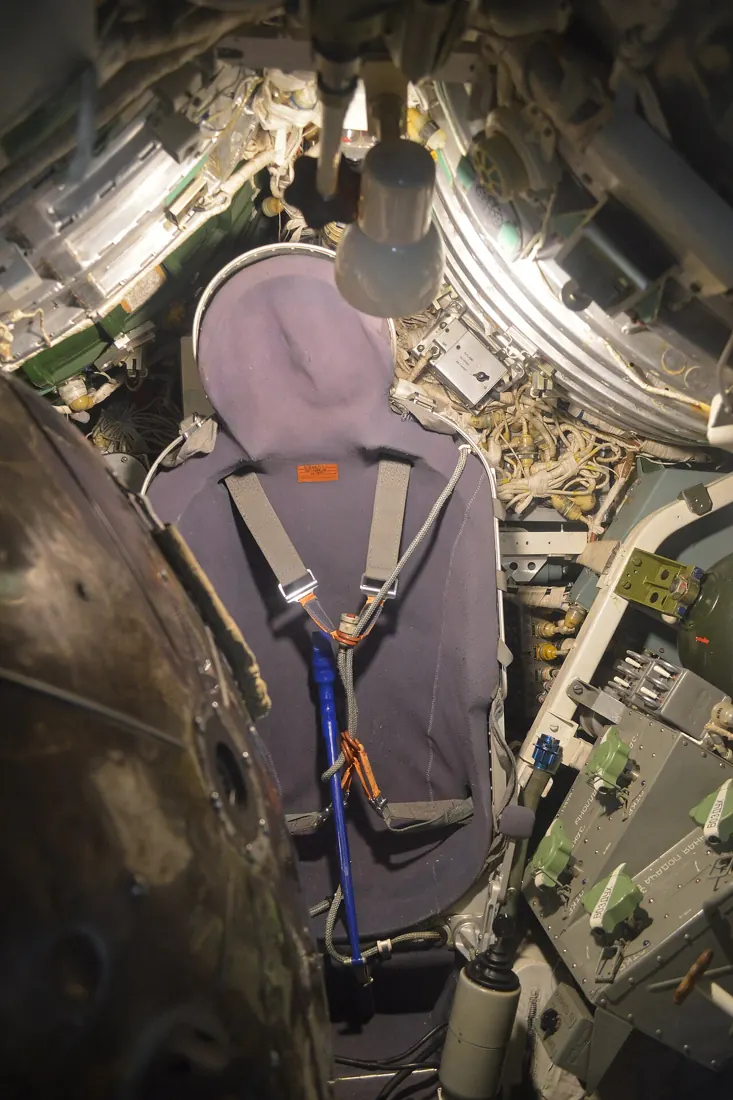

The ship's descent module is 2.17 metres across and, depending on the source, has between 3.5 and 3.8 cubic metres of living space. The hatch at the top is 60 centimetres wide, and each of the two side portholes 23 centimetres.
After 1971 ships of this type flew with two couches instead of three: the third place went to the equipment for pressure suits. The couches have liners moulded to each man's body.
The capsule's shape and sizes are published. The couches and the instrument panel are rebuilt from drawings and from capsules in museums, without detail. The two men are outlines only: which couch each of them had is not known.
6 Documented
Through the hatches, from ship to station
From the capsule the way leads into the ship's orbital module, then through the docking tunnel, 80 centimetres wide, into the station's intermediate chamber and from there into the work compartment. All lie on one axis.
The intermediate chamber is two metres across. Around it, outside the pressurised space, are the engines: two main ones and 32 small ones for attitude.
What was Salyut 6 like inside, and which experiments were done?
7 Reconstructed from drawings
Salyut 6: 90 cubic metres for four people
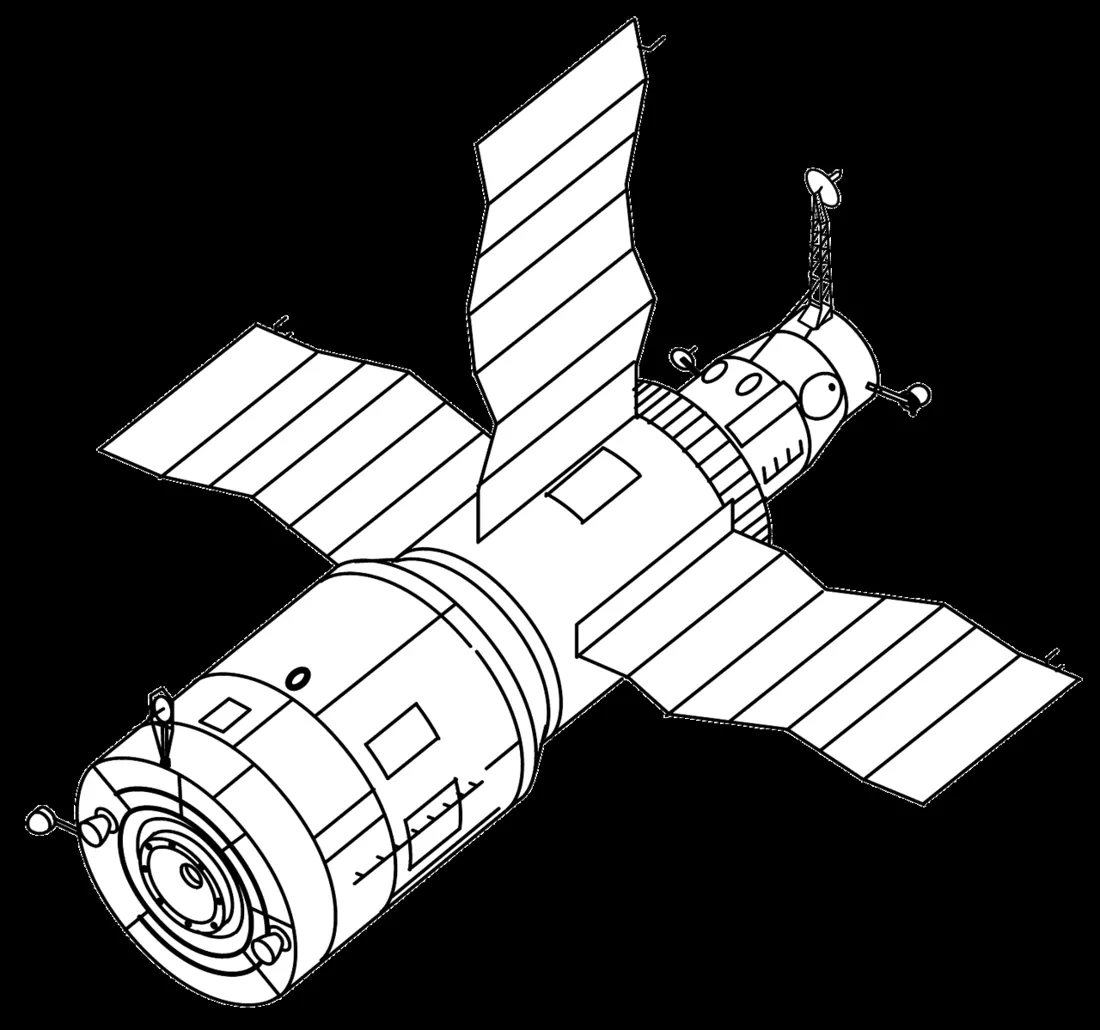

The work compartment is made of two cylinders: one 2.9 metres across, the other 4.15 metres, joined by a cone 1.2 metres long. On the first station of the series the narrow part was 3.8 metres long. The whole station has 90 cubic metres of living space. For a week, four people share it.
At the front is the central control post, with two places. Behind it comes the table. In the wide part, on the floor, is the conical housing of the BST-1M telescope, open downwards, to space. The treadmill, the exercise bicycle and the shower are there too.
The walls were covered with cloth panels in pastel colours, whose exact shades are not published; the fit-out is rebuilt from descriptions and drawings. So all of it shows as a mock-up, without colour or instruments. The exact place of each object is not published.
8 Assumed
At the porthole
The station has 20 portholes. Most of those in the work compartment are covered by instruments; the free ones are mainly in the transfer compartment at the front.
Prunariu has said he had about an hour and a half of free time a day, which he spent looking out. Of his own country he said (in translation): "From up there, Romania looked the size of a golden home-baked loaf."
A floor porthole follows from the description of the cameras that photographed the Earth; its exact place is not published. What shows through it is computed from the orbit and the Sun's position. What one man saw in a given minute cannot be rebuilt: neither the clouds of May 1981 nor the station's attitude at that moment are in the sources used.
Sources
- US Congress, "Soviet Space Programs 1976–80", part 2 (1984): description of Salyut 6
- NASA RP-1357, David S. F. Portree, "Mir Hardware Heritage", 1995: pp. 22–26 (Soyuz), pp. 67 and 75 (Salyut), p. 88 (the flight)
- Alba24, "14 May 1981: the story of the first spaceflight of a Romanian cosmonaut", 14 May 2022
- Revista Biz, interview with Dumitru Prunariu, 24 May 2019
9 Documented
Sixteen sunrises a day
One trip round the Earth takes 91 minutes. On 18 May the station enters the Earth's shadow at 18:24 UTC, seven minutes after crossing Brașov, and leaves it at 18:49. Night aboard lasts 25 minutes.
A day holds 16 sunrises and 16 sunsets. The light outside is not softened by air: where the Sun falls the wall is white; beside it the shadow is black. When the station is over the lit side of the Earth, a bluish light comes up through the floor portholes.
10 Documented
Capilar, Astro, Nanobalanța: the experiments prepared in Romania
Capilar ("capillary"), prepared by Romanian specialists, runs in the Soviet electric furnaces Splav and Kristall. Molten germanium, plain or with added gallium, rises through a slit of 1–2 millimetres in a molybdenum die and sets into a crystal that takes the slit's shape.
Astro looks in cosmic rays for unknown forms of nuclear matter. The detectors are made of cellulose nitrate. Astro-1 is put out into vacuum, in one of the station's airlocks. Astro-2 works inside and has a moving detector that shifts with the station's latitude, so that each track can be tied to a place on the orbit.
Nanobalanța ("nano-balance"), also in the airlock, measures how the mass of a film of silicon dioxide, a protective material for optical parts, changes in vacuum.
Beside the shower, on the "ceiling", the station had two small airlocks; one was used for the Splav furnace. Their exact place is not published, so they are not shown.
11 Documented
What happens to the body: Pneumatic, Reo, Biodoza
In the first days without weight, blood shifts towards the head. Pneumatic tries tight cuffs on the legs, which keep blood down as on Earth. Reo, proposed by Romanian specialists, follows the circulation in the brain and the body at rest, under effort and under mental load. Ballisto measures how the heart contracts.
Biodoza ("bio-dose") measures radiation in several places of the work compartment. The Romanian instrument Minidoza and the Hungarian Pille show how much of the dose comes from the Earth's radiation belts. Imunitatea ("immunity") follows the effect of flight on the defence against viruses. Informația ("information") tests how a man perceives and processes information under high g-loads and then without weight.
Romanian sources count 22 experiments for the whole flight. The Soviet yearbook also names those done by the full crew: Operator, Opros, Rabotosposobnost, Dosug, Interferon, Neptun and Guler ("collar").
Sources
- Yearbook of the Great Soviet Encyclopedia, 1982: space research in 1981 (in Russian, archived copy)
- Viktor Savinykh, diary kept aboard the station, chapter 3 (in Russian, archived copy)
- Newsweek România, 14 May 2021
- Alba24, "14 May 1981: the story of the first spaceflight of a Romanian cosmonaut", 14 May 2022
- Dumitru-Dorin Prunariu, presentation at the Academy of Romanian Scientists, 12 May 2016
When did the station pass over Romania?
12 Documented
18 May, 18:16 UTC: almost straight over Brașov
Of the passes over Brașov when the station could be seen from the ground, sunlit against an already dark sky, the highest is that of 18 May. At 18:16:50 UTC (21:16:50 local time) the station is 77 degrees above the horizon, 347 kilometres from the city.
On the ground the Sun had set and stood five degrees below the horizon: a dusk sky. Up there the station was still in full sunlight. From a street in Brașov, anyone looking up could see a bright point crossing the sky in a few minutes, if there were no clouds.
There are four people in the station. One was born in the city below.
The time and the height come from the orbital elements. Sets from neighbouring days give, for the same moment, positions that differ by 4 to 35 kilometres, a few seconds of flight at most. On 20 May the station passed 82 degrees up, but in daylight, when it could not be seen.
13 Documented
Romania in daylight, only in the last days

In the first days the high passes over Brașov come only late in the evening and at night: on 15 May at 00:46 and 18:47 UTC, on 16 May at 19:09. Local time is three hours ahead. The passes come almost an hour earlier every two days.
At Brașov, the first pass higher than 30 degrees with the Sun above the horizon is that of 19 May, at 17:03 UTC, the Sun six degrees up. On 20 May, at 17:25, the station passes 82 degrees above Brașov, with the Sun still three degrees above the horizon. On 21 May, at 16:17, the Sun is 14 degrees up: the only high pass with the country in full light.
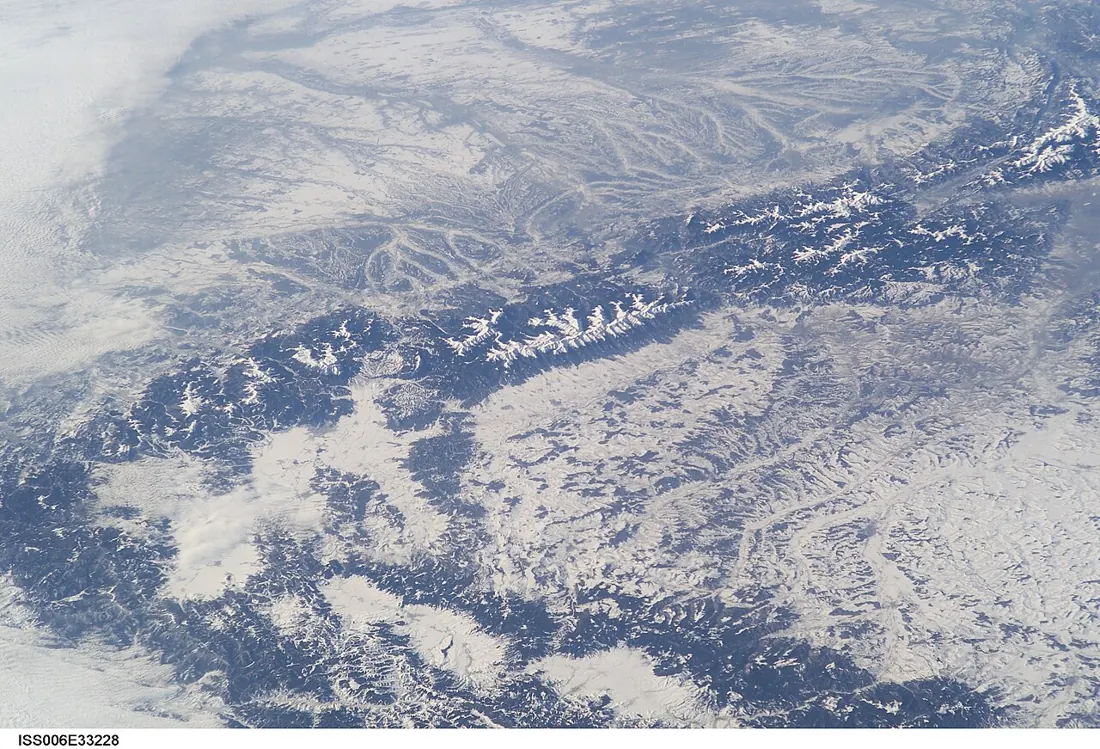
NASA's history of the programme says the same: Earth observations had to wait until the last day, when the station at last passed over Romania in daylight. Prunariu speaks of the course of the Danube with its delta and of the curve of the Carpathians.
The Earth is shown without clouds: the weather of May 1981 is not in the sources used. The surface is NASA's mosaic of 2004, and the night lights are from 1992, the earliest year in the series used.
Sources
- Archived NORAD orbital elements for Salyut 6 (object 10382) and Soyuz 40 (12454), in Jonathan McDowell's historical archive
- NASA RP-1357, David S. F. Portree, "Mir Hardware Heritage", 1995: pp. 22–26 (Soyuz), pp. 67 and 75 (Salyut), p. 88 (the flight)
- Alba24, "14 May 1981: the story of the first spaceflight of a Romanian cosmonaut", 14 May 2022
- Revista Biz, interview with Dumitru Prunariu, 24 May 2019
14 Documented
20 May: the orbit rises
Until 20 May the complex sinks slowly, braked by the thin air: from 332 by 347 kilometres on launch day to 330 by 343. The set of elements of 20 May, 06:28 UTC, still shows the low orbit. The next, at 14:05, shows 339 by 374 kilometres.
Between the two, the engines raised the orbit. The sources read do not give the time of the burn. The two sets, carried forward and back, meet at 12:32 UTC less than a kilometre apart: an estimate of when the burn came, not a documented time. Prunariu gives 384 kilometres as the highest point of the flight; computed above the Earth's real, slightly flattened surface, it comes out at 386.
How did the flight end?
15 Documented
22 May, 10:37 UTC: undocking
Soyuz 40 leaves the station at 10:37 UTC (13:37 in Romania), on orbit 123. Popov and Prunariu are back in the capsule, in their suits. Kovalyonok and Savinykh stay; they will come down four days later, the last people to live on Salyut 6.
One set of the ship's elements, at 10:36:59, shows it still on the station's orbit. The next, at 13:11, has the lowest point of its orbit below the Earth's surface: the braking engine had fired. Computed for its own moment, this set lies four kilometres from the station's orbit; the burn probably came shortly before, but its time is not documented.
Between undocking and the burn the ship stayed close to the station; how far it drew away is not published.
16 Documented
Landing: 13:58 UTC, on the Kazakh steppe
The last set of orbital elements, taken after the braking burn, shows the ship sinking towards the atmosphere over Central Asia, about 20 minutes before landing. Beyond that the elements no longer describe the flight.
The capsule touches down at 13:58:30 UTC (16:58:30 in Romania), 225 kilometres south-east of Dzhezkazgan. The flight lasted seven days, 20 hours, 41 minutes and 52 seconds. Sources count 124 completed orbits; Prunariu speaks of 125, probably counting the one begun. The orbital periods give 124 as well.
Below 100 kilometres the orbital elements no longer describe the flight: the dashed line to the landing place only marks the link. The place itself is known only as a distance and a direction from the town.
Sources
- Spacefacts, Soyuz 40 mission report
- Yearbook of the Great Soviet Encyclopedia, 1982: space research in 1981 (in Russian, archived copy)
- RKK Energia, table of Soyuz flights (in Russian, archived copy)
- Archived NORAD orbital elements for Salyut 6 (object 10382) and Soyuz 40 (12454), in Jonathan McDowell's historical archive
- Dumitru-Dorin Prunariu, presentation at the Academy of Romanian Scientists, 12 May 2016
- Revista Biz, interview with Dumitru Prunariu, 24 May 2019
17 Documented
The capsule is in Bucharest today
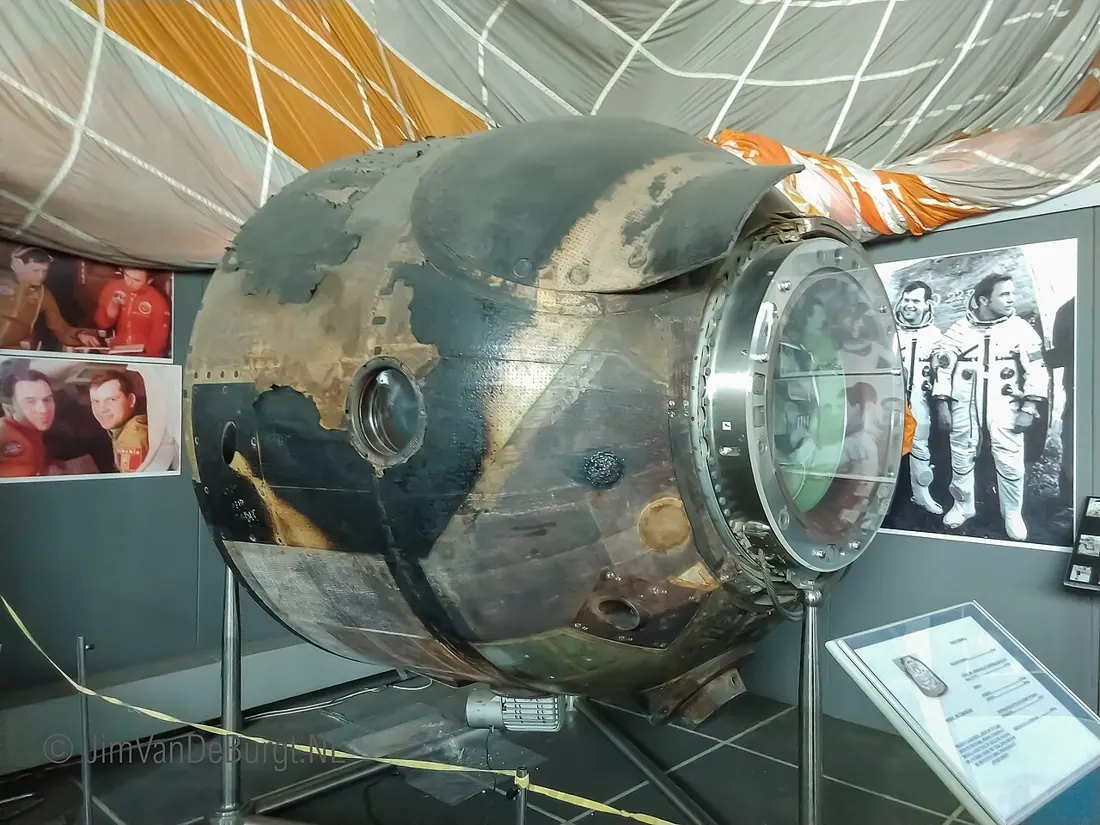

The descent module of Soyuz 40 is on show at the "King Ferdinand I" National Military Museum in Bucharest. It was handed to Romania in February 1982, as a gift from the USSR Academy of Sciences. The museum also keeps the landing parachute.
Soyuz 40 was the last Soyuz of the old series and the last flight of the first stage of the Interkosmos programme, in which cosmonauts from nine countries flew. Prunariu was the 103rd person to reach space.
How exact the reconstruction is
The orbit comes from the NORAD orbital elements kept in Jonathan McDowell's archive: 11 sets for Salyut 6 between 14 and 22 May 1981 and seven for Soyuz 40. Positions are computed with SGP4, the model these elements were made for. Between two sets the position is a weighted average of the two computations.
How well the sets agree: each set, carried forward to the time of the next one, lands 4–35 kilometres from it, a few seconds of flight at most. The exception is 20 May, when the orbit was raised between two sets; there the error can reach 180 kilometres.
The computation agrees with what was published separately: the initial orbit of 192 by 270 kilometres, the height of the complex at docking (331 by 345), the undocking time, 124 orbits, and the fact that the station crossed Romania in daylight only at the end.
The hulls of the station and the ships have the sizes published in NASA's history of the programme: 15.8 metres overall, diameters of 2.9 and 4.15 metres, the 1.2-metre cone, the six metres of the wide part. The 3.8-metre length of the narrow part is that of the first station of the series. How the six metres divide between the pressurised compartment and the engine bay is read off the drawing. There were 20 portholes; the place of each is not published, which is why their frames show as a mock-up.
The station's attitude is not known for each moment. Here the long axis always points along the flight, with the "floor" towards the Earth. So what shows through a porthole at a given minute is an assumption, even though the Earth below is in its right place. For the same reason there is no direct sunlight inside: where its patches fell would depend on an unknown attitude.
The Earth has no clouds, because the weather of May 1981 is not in the sources used. The surface is NASA's "Blue Marble" mosaic of 2004. The night lights are from 1992, the earliest year of the series used: the Romania of 1981 was probably darker. The Sun's position is computed for every second.
For your town, the computation looks for the moments when the station stood highest in the sky and says whether it was sunlit and how dark the sky was. "Could be seen" means the geometry allowed it. Whether the sky was clear that evening is not known.
Sources
Times, orbits and distances come from the orbital elements and the flight reports. Sizes come from NASA's history of the programme and from published descriptions of the station. Quotations carry their source beside them.
- Jonathan McDowell, orbital launch log, row 1981-042
- Spacefacts, Soyuz 40 mission report
- Yearbook of the Great Soviet Encyclopedia, 1982: space research in 1981 (in Russian, archived copy)
- Historia, Dan Gîju, "The story of the Soyuz 40 capsule", 6 June 2011
- Digi24, "The space odyssey of the only Romanian cosmonaut", 29 May 2016
- Archived NORAD orbital elements for Salyut 6 (object 10382) and Soyuz 40 (12454), in Jonathan McDowell's historical archive
- NASA RP-1357, David S. F. Portree, "Mir Hardware Heritage", 1995: pp. 22–26 (Soyuz), pp. 67 and 75 (Salyut), p. 88 (the flight)
- RKK Energia, table of Soyuz flights (in Russian, archived copy)
- Alba24, "14 May 1981: the story of the first spaceflight of a Romanian cosmonaut", 14 May 2022
- A. Anikeev, timeline of the Soyuz 40 flight (in Russian, archived copy)
- Viktor Savinykh, diary kept aboard the station, chapter 3 (in Russian, archived copy)
- Encyclopedia Astronautica, Soyuz 7K-T descent module
- NASA NAGW-659, "Soviet Space Station Analogs", 2nd edition
- US Congress, "Soviet Space Programs 1976–80", part 2 (1984): description of Salyut 6
- Revista Biz, interview with Dumitru Prunariu, 24 May 2019
- Newsweek România, 14 May 2021
- Dumitru-Dorin Prunariu, presentation at the Academy of Romanian Scientists, 12 May 2016
- NASA, the "Blue Marble: Next Generation" mosaic (2004), through the GIBS service
- Chen et al., night-time lights 1992–2025 rebuilt on the VIIRS scale (year 1992)
- NOAA, ETOPO 2022 global relief
- GeoNames, the world's places
On the same subject: Everything still up there