Teleorman county, Romania · June 1877
Zimnicea, 27 June 1877: 25,000 men crossed the Danube in 20 hours, with no bridge
Seven boat turns between Zimnicea and Sistova: wind and current scatter the first turn, the plan is dropped after it, and the boats then leave company by company. The bridge arrived days later — turn by turn on the engineers' 1879 plan.
25,000 men · 20 hours · no bridge
Why Zimnicea
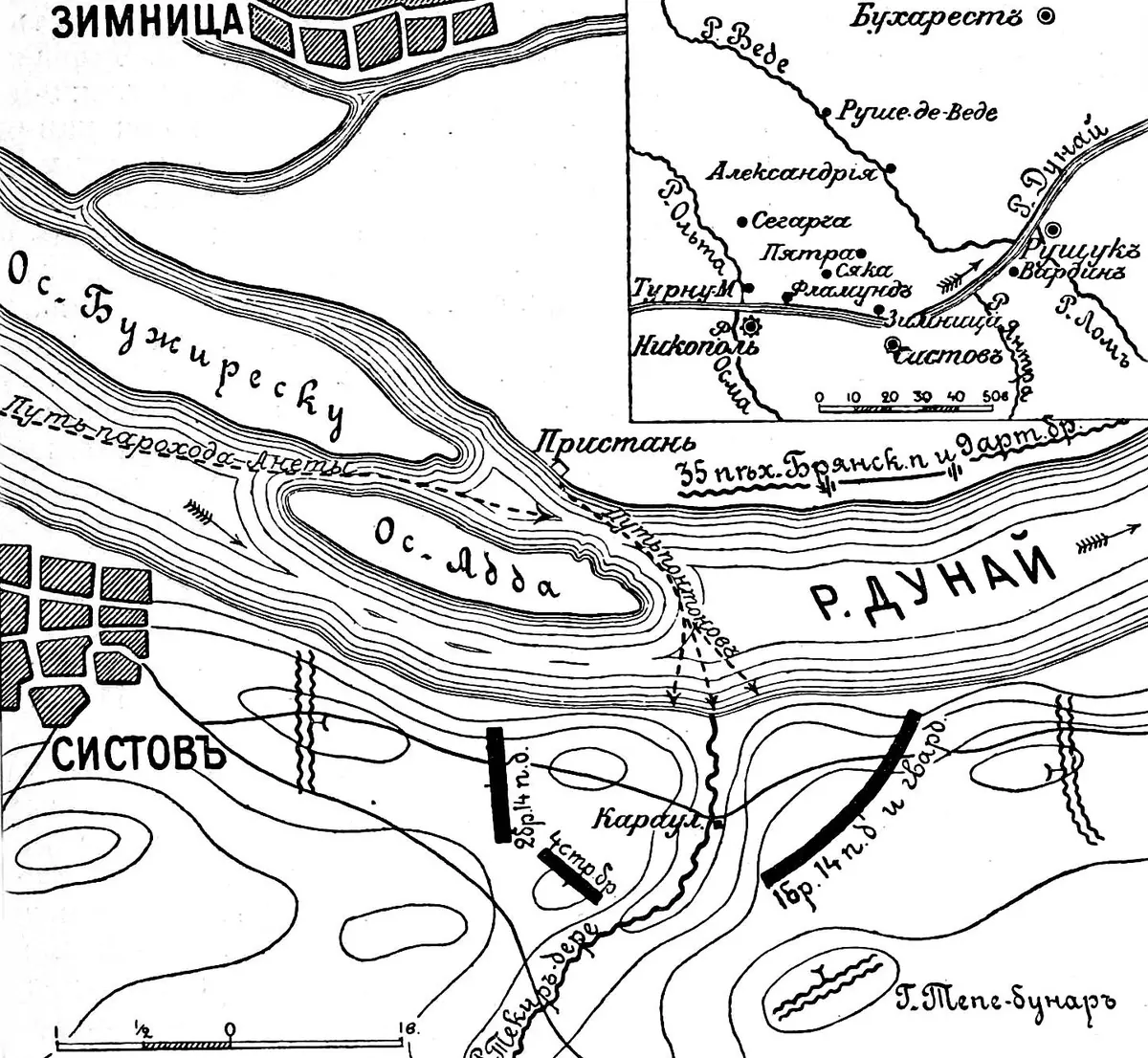
The Russians could cross the Danube anywhere between Vidin and Ruse — or so the Turks believed. Passage through Romania was allowed by the convention of 4/16 April, which also guaranteed the country's integrity; the spot was chosen in the last week, by water, by railway, and by a four-day ride along the bank.
High water
The first plan was Zimnicea–Sistova — Svishtov, in today's Bulgaria — but the river ran too high to force, so the staff moved the plan to Nikopol, for 24 June. Then the pontoons' delay on the railway halted the army on the Vedea line, equidistant from Nikopol, Sistova and Ruse: neither the place nor the day was fixed any more.
The four-day ride
Between 20 and 24 June, Grand Duke Nicholas and his chief of staff rode the bank from Turnu to Sistova and saw two things: the works at Nikopol were too strong to force, and the water at Zimnicea had fallen enough to allow a passage. The decision fell at the last hour, on the bank, not on the map.
The Flămânda decoy
To keep Turkish eyes westward, IX Corps was ordered to prepare a crossing at Flămânda, just below Nikopol — a mere feint. The Tsar's headquarters moved to Turnu Măgurele, and the concentration at Zimnicea, 13/25 to 15/27 June, escaped Turkish observation.
Guns, mines, noise
Greene records the order for the siege batteries to open on Ruse on the 24th and Nikopol on the 25th; the Russian staff ordered, Old Style, three days from 14 June against Ruse, Nikopol and Vidin. Mine barriers go down at Parapan, Flămânda and Corabia, to cut vessel movement between Nikopol and Ruse, and Romanian artillery fires on 14/26–15/27 June to mask the landing preparations. Parapan sits on the map schematically, at the Romanian-bank end opposite Mechka island, after Sytin; the village was not found on today's maps.
The secret order
The pontoons came by rail; the boats and rafts were built at Slatina, on the Olt, and floated down to Zimnicea. The 14th Division, the 4th Rifle Brigade, the two mountain batteries and the pontoon battalions received secret orders: Zimnicea, on the night of 14/15 June Old Style — 26/27 June New Style. The Russians stretched the railway from Giurgiu to the bridge site. Even the Tsar learned the place only on the evening of the 14th, Old Style.
The night of the seven turns
The plan is simple on paper: seven turns, each of 12 companies, 60 Cossacks and 8 guns, two hours there and back. The night plays out on the engineers' 1879 plan, turn by turn.
- 0:00 embarking (Greene)
- 1:00 the boats push off (Greene)
- 2:00 turn 1 moves (Sytin)
- 2:00 the stream banks taken (Greene)
- 3:00 turn 1 ashore (Sytin) · 2,500
- 5:00 Dragomirov crosses
- 6:00 the Turks retreat on the eastern front
- 8:30 Anneta with the barges
- 10:30 the detachment ashore · 15,000
- 11:00 the brigades form
- 14:00 the heights crest
- 15:00 the town
- 21:00 VIII Corps ashore · 25,000
How much water
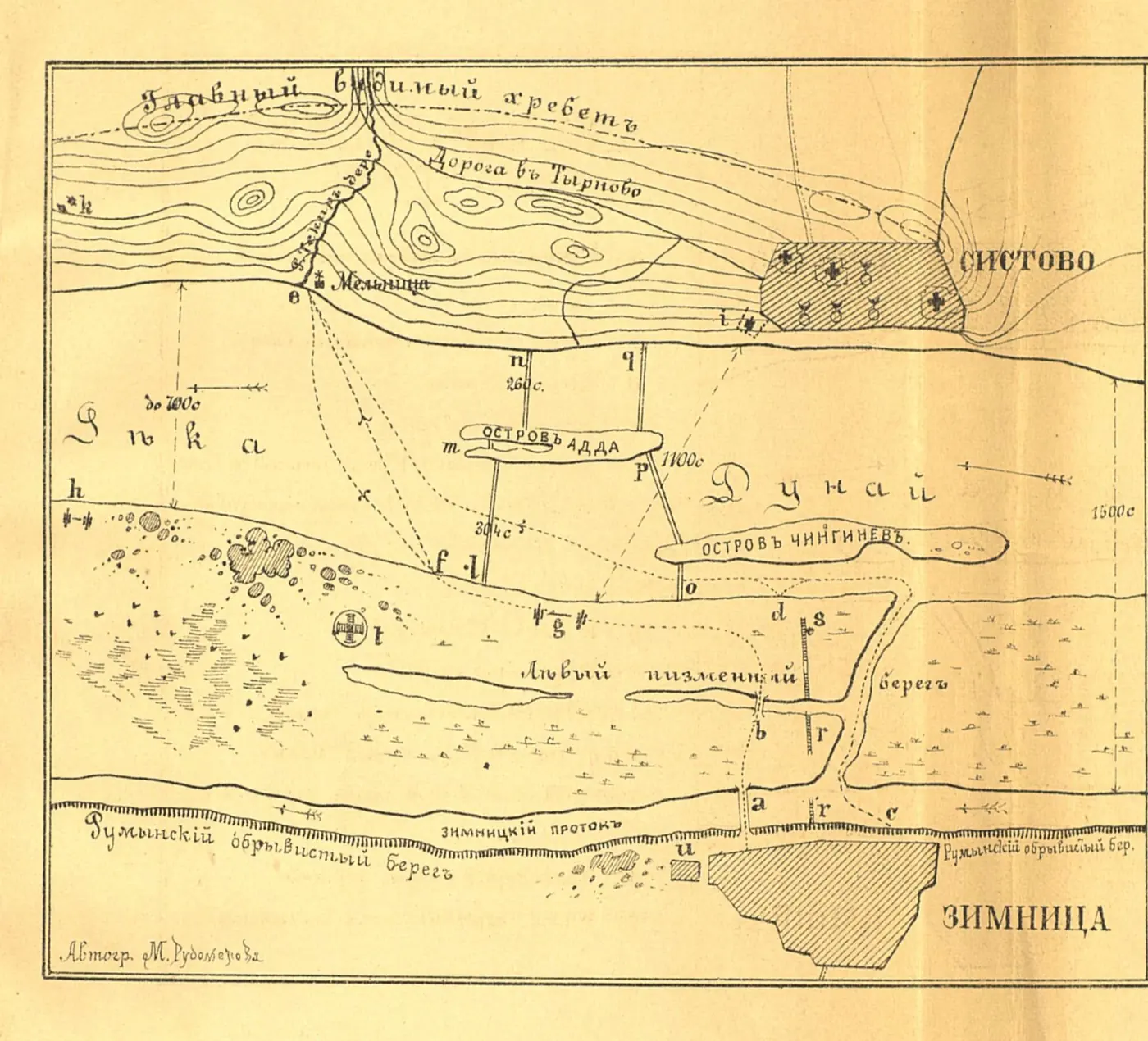
On the 1879 plan, the first bridge joins the Turkish bank to Adda island across 260 sazhens, and Adda to the Romanian bank across 304. Added: 564 sazhens of water — 1,203 metres — in two parts, with the island between. (A sazhen is 2.13 m.)
Three measures, one river
The sources measure the water three ways: 1,000 yards at the bridge site (914 m), “up to 500 sazhens” (1,067 m), “up to 700” off the landing (1,494 m). The bridge spanned 1,203 m of water; the islands named then — Adda and Chinginev on the 1879 plan, Adda and Buzhiresku in Sytin — no longer appear on today's map, and the only island in the area, Hayduk, lies 8.4 km east. The mismatch between the maps is measured; its cause is not in this page's sources.
Midnight: the first turn
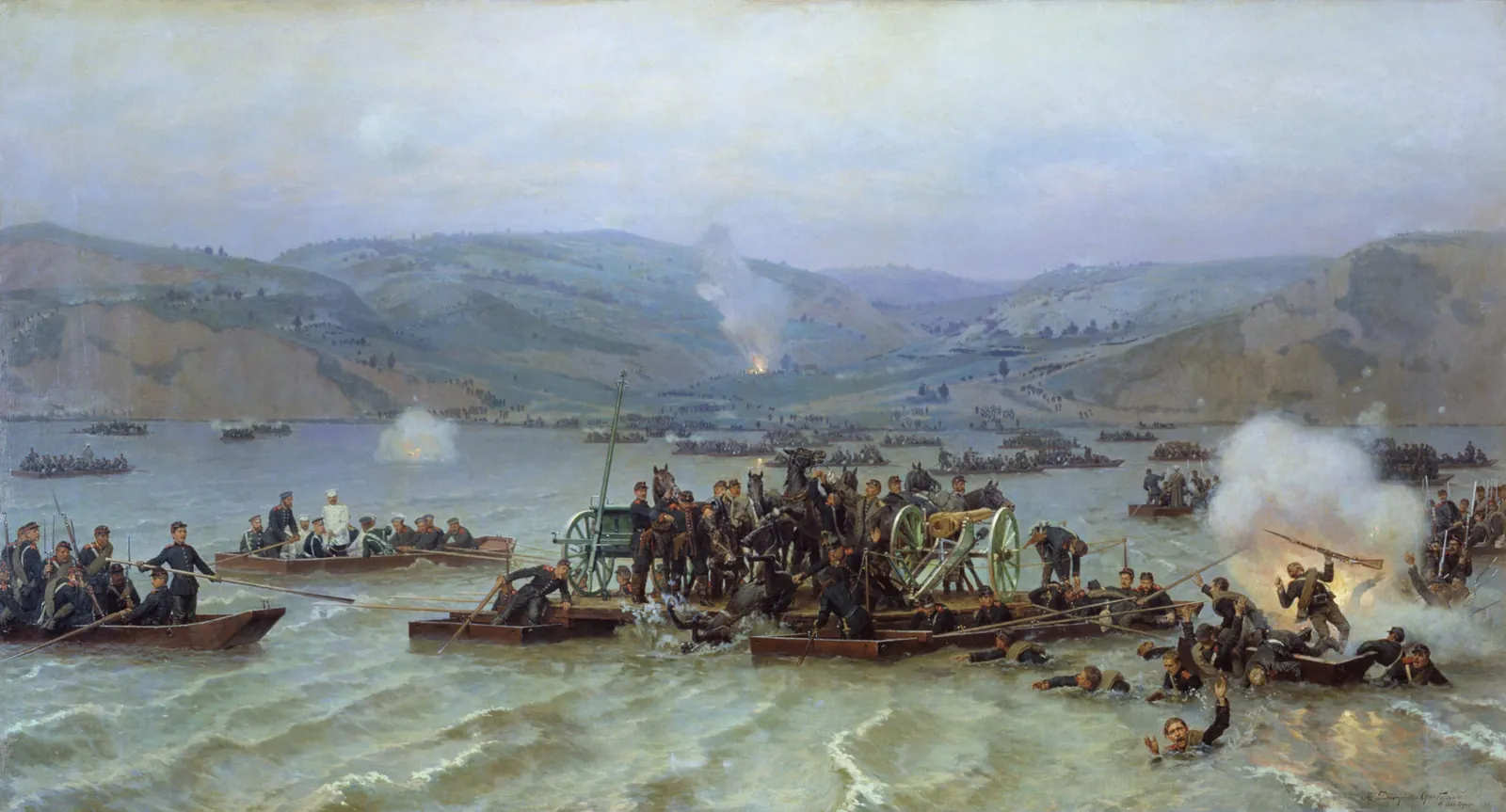
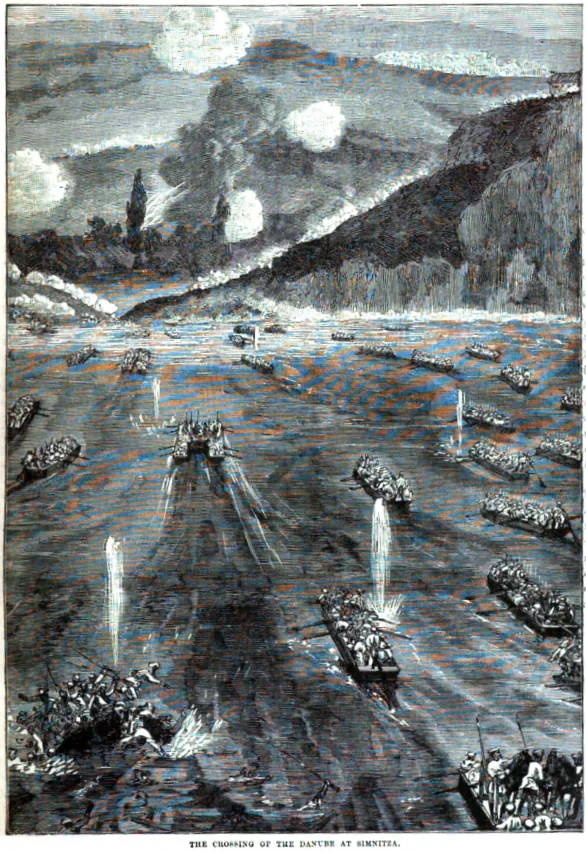
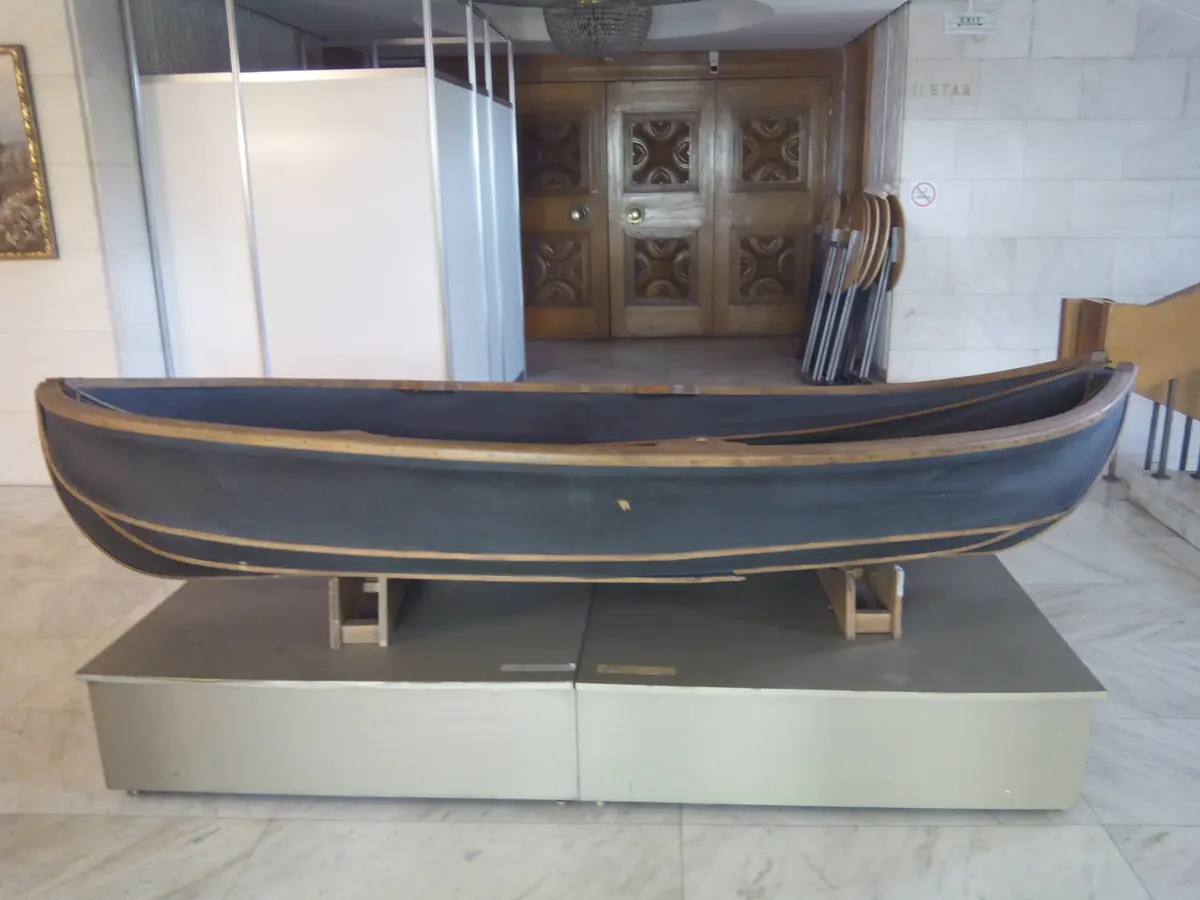
Embarking begins at midnight; about 1 AM, by Greene's account, the boats push off for the Tekir-Dere mouth, 3 miles below Sistova. Beyond Adda, wind and current scatter the pontoons: only some reach the mouth, the rest beach where they can, above or below. The Turkish pickets spot the landing only at 200–300 paces. The seven-turn plan breaks after the first: waiting for a whole detachment took too long, Greene writes, so the boats reload as they return, company by company.
The bridgehead
About 3 AM the whole first turn — some 2,500 men — stands on the Turkish bank, and 60 Cossacks leave to cut the Ruse telegraph. The Turks press in from Vardim and Sistova; two mountain guns stop the advance, then the honour-escort companies and the 3rd Volynsky Battalion arrive. About 6 AM the Turks retreat along the whole eastern front, and toward Sistova there is only skirmishing.
Morning: the river beats the plan
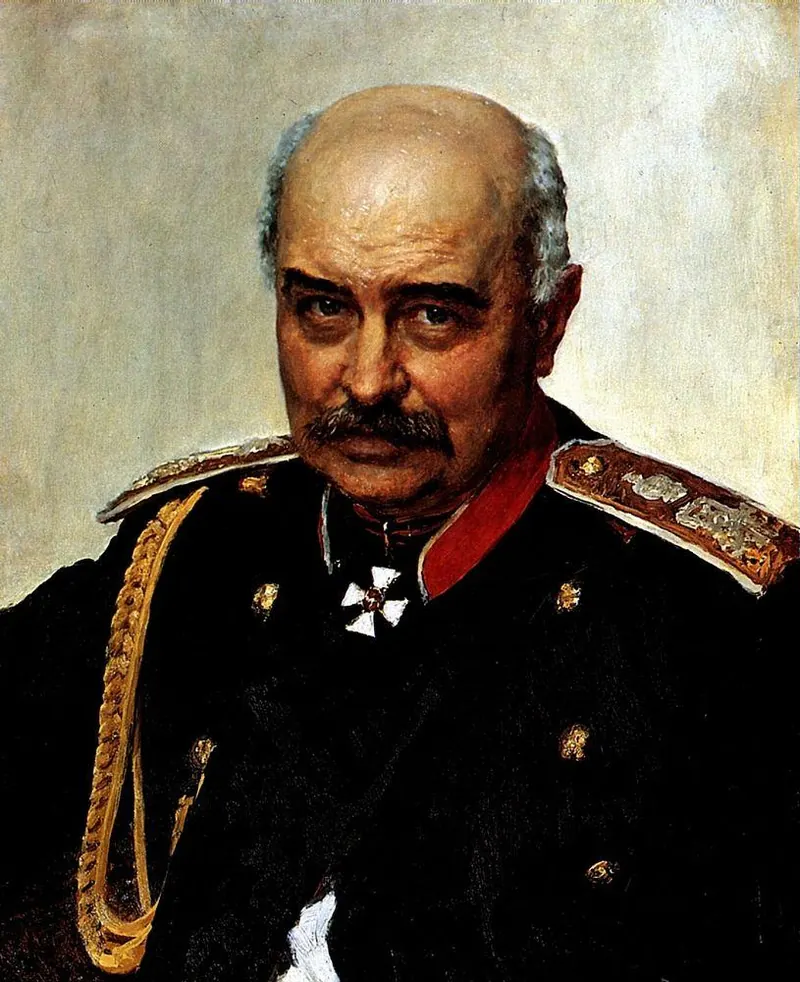
At 5 AM Dragomirov crosses the river, General Skobelev volunteering beside him. At 8:30 the steamer Anneta, run past the Nikopol batteries in the night, speeds the crossings with two barges. At 10:30 AM the whole detachment — some 15,000 men — stands on the far bank: eight and a half hours of ferrying counted from Sytin's 2:00, against the plan's 14.
The heights and the town
At 11 AM the 2nd Brigade and the 4th Rifle Brigade form right of Tekir-Dere. At 2 PM the Russians take the Sistova heights crest, at 3 they enter the town. The Turks retreat toward Nikopol, Tarnovo and Vardim; no one pursues.
9 PM: the reckoning
By 9 PM the whole VIII Corps and the 4th Rifle Brigade — 25,000 men — stand on the Turkish shore. Twenty hours of labour, 800 men lost by Greene's count — and still no bridge. The next day, 28 June, the 35th Division crosses by boat as well.
The bridge comes after
The bridge begins on 28 June, but on the night of 18 June Old Style a storm sinks the iron pontoons set among the wooden ones. Sytin has it finished on the evening of 19 June Old Style — 1 July New Style; Greene dates it to 2 July: the accounts differ by one day. Over it the corps cross one after another: Gurko on 2–3 July, XII and XIII on 3–8 July, IX by the 10th, for Nikopol, XI on 10–15 July, IV on 20–30 July.
The sources do not say how many men each turn actually carried, where the boats scattered in the dark, or how many Turks fell.
The other bank: Turnu–Nikopol
In July the war reaches Nikopol too: the fortress falls, and a Romanian division crosses the river there. The Romanian army's own bridge comes only in August, further west.
The feint's guns
By Greene's account, the siege batteries across the Danube are ordered to bombard Nikopol from 25 June, until further orders — with Romanian artillery support from Turnu Măgurele and Flămânda. On 15 July the bombardment runs lively all day. The Turks hold the fortress; the Russian mass is already across, at Sistova.
16 July: Nikopol capitulates
IX Corps reaches Nikopol on 13 July, carries the field works on the 15th, and on the 16th the fortress capitulates. Osman leaves Vidin on the 13th with 19 battalions and reaches Plevna on the 19th — too late for Nikopol, in time for Plevna.
The Romanians at Nikopol
A Romanian division had already crossed at Nikopol in July; elements of the 4th Division join the fortress garrison beside the Russian 19th Regiment.
The Romanian bridge moves to Turnu
The rest of the Romanian army crosses on its own bridge — the document's dates, read as Old Style against Ilinca: ferry runs on 10–11 August; the 1,036 m bridge at Siliștioara–Măgura, 7 km east of Corabia, built on 14–19 August and serving while the army crosses, on 20–22 August. Then the bridge is dismantled and moved to Turnu–Nikopol, where it serves supply and evacuation until 19 March 1878, as printed — its calendar style inferred.
What date the night carries
The landing night carries several dates, depending on who tells it: the Russian army kept Old Style, 12 days behind the New. Each telling stands on its own axis, in New Style days.
Two lanes sit further right than all the rest.
The loss accounts
How many fell at Sistova depends on who counts. The accounts do not agree with each other and are not rounded together.
- 800 Greene and Britannica, rounded, in prose: “a loss of 800 men”.
- 812 The Russian staff: 30 officers and 782 men, killed, drowned, missing and wounded together.
- 821 Greene's table: 9 officers and 291 men killed, 22 and 446 wounded, 53 missing.
- ≈850 Recent Romanian scholarship: some 850 Russian killed and wounded — and Turks about as many.
- unknown The Turkish losses, after Greene: “their losses are not known”.
On top: 19 pontoons and 2 mountain guns went down, 5 boats sunk by Turkish fire and about 100 men hit in the boats.
After
A century later, the earthquake of 4 March 1977 strikes Teleorman county among others — fifth among the affected counties, with Alexandria and Zimnicea listed among its towns — while at Svishtov the clock tower and the church come out badly damaged, the church under restoration for decades.
Svishtov was the first liberated city, and the idea of the landing's monuments was born among officers and soldiers during the operations.
Sources and method
The night rests on two accounts that check each other — the American attaché and the Russian staff — plus the engineers' 1879 plan. Where the sources disagree, they all stand in view instead of one chosen.
Contemporary accounts
- F. V. Greene, Report on the Russian Army and its Campaigns in Turkey in 1877–1878, New York, 1879: the American attaché with the Russian army — the 20–24 June reconnaissance, the secret order, 104 pontoon boats and 100 local boats, company-by-company crossing, the night's hours, the 25,000 men by 9 PM, the 2 July bridge, the fall of Nikopol, the Romanian division of July and the Corabia bridge. archive.org (full text)
- Plan of the Sistova crossing place, 1879, from V. Krestovsky, Twenty Months in the Active Army: the banks, the Adda and Chinginev islands, the bridges, embarkation and landing, the boat routes, the 260, 304 and 700 sazhen figures. Wikimedia Commons (public domain)
- Cassell's Illustrated History of the Russo-Turkish War, 1885: the Simnitza crossing engraving. Wikimedia Commons (public domain)


Military scholarship
- Sytin military encyclopaedia, “Zimnitsa” (1911–1915), after the official Description, vol. II: the detachment's composition, the 7 turns, the scattering, the hours, the Anneta, the 30 officers and 782 men lost, the 18 June Old Style storm, the second bridge. ru.wikisource.org
- Encyclopaedia Britannica, 1911, “Russo-Turkish Wars”: rail-borne pontoons, the Slatina boats, the night of 26/27 June, the bridge and its 1,000 yards, the corps schedule, 16 July at Nikopol. en.wikisource.org
- D. Ilinca, “The Danube, a strategic vector…” (in Romanian), Military Sciences Review: the Flămânda variant, the decoy with the Tsar's headquarters at Turnu Măgurele, the Romanian artillery of 14/26–15/27 June, the 210 craft, ≈850 losses, the 19/31 July telegram, the bridge dispute, Siliștioara–Măgura. aos.ro (PDF)
- M. Gargaz, “Romanian Army pontoon troops – 150 years” (in Romanian): the Corabia ferry, the 1,036 m bridge (built 14–19 August, serving 20–22 August), the move to Turnu–Nikopol until 19 March 1878. Document dates, read as Old Style. acmrrag.ro (PDF)
- Șt.-C. Florescu, “Russia and the Romanian Independence”: the 4/16 April 1877 convention, art. II–III. npissh.ro (PDF)
Data, maps, earthquake
- Relief: AWS Terrain Tiles (Terrarium); towns, waters and the Tekir-Dere mouth: OpenStreetMap (© OpenStreetMap contributors). The night plan is redrawn schematically after the 1879 plan and the Sytin map — approximate positions; the text's lengths are the figures written on the plan.
- Svishtov municipality profile: the landing “on the night of 27th June 1877”, the first liberated city, the monuments, the 1977 damage. investmap.government.bg (PDF)
- E.-S. Georgescu, A. Pomonis, “The Romanian earthquake of March 4, 1977 revisited”, 14th WCEE 2008: Teleorman, fifth among the affected counties. iitk.ac.in (PDF)
- The two Wikipedia pages (English and Romanian) put the night on 27/28 June, with a bridge: en.wikipedia.org · ro.wikipedia.org
Pictures
- N. Dmitriev-Orenburgsky, The Russian army crossing the Danube at Zimnitsa, 15 June 1877, 1883, public domain. Wikimedia Commons
- I. Repin, Mikhail Dragomirov, 1889, public domain. Wikimedia Commons
- An 1877 landing boat, kept at Svishtov — photo: Ilikeliljon, CC BY-SA 3.0. Wikimedia Commons


