mariuscomper.uk

Ancient eclipses · the Earth’s rotation

The day is getting longer: the ancient eclipses that show the Earth slowing down

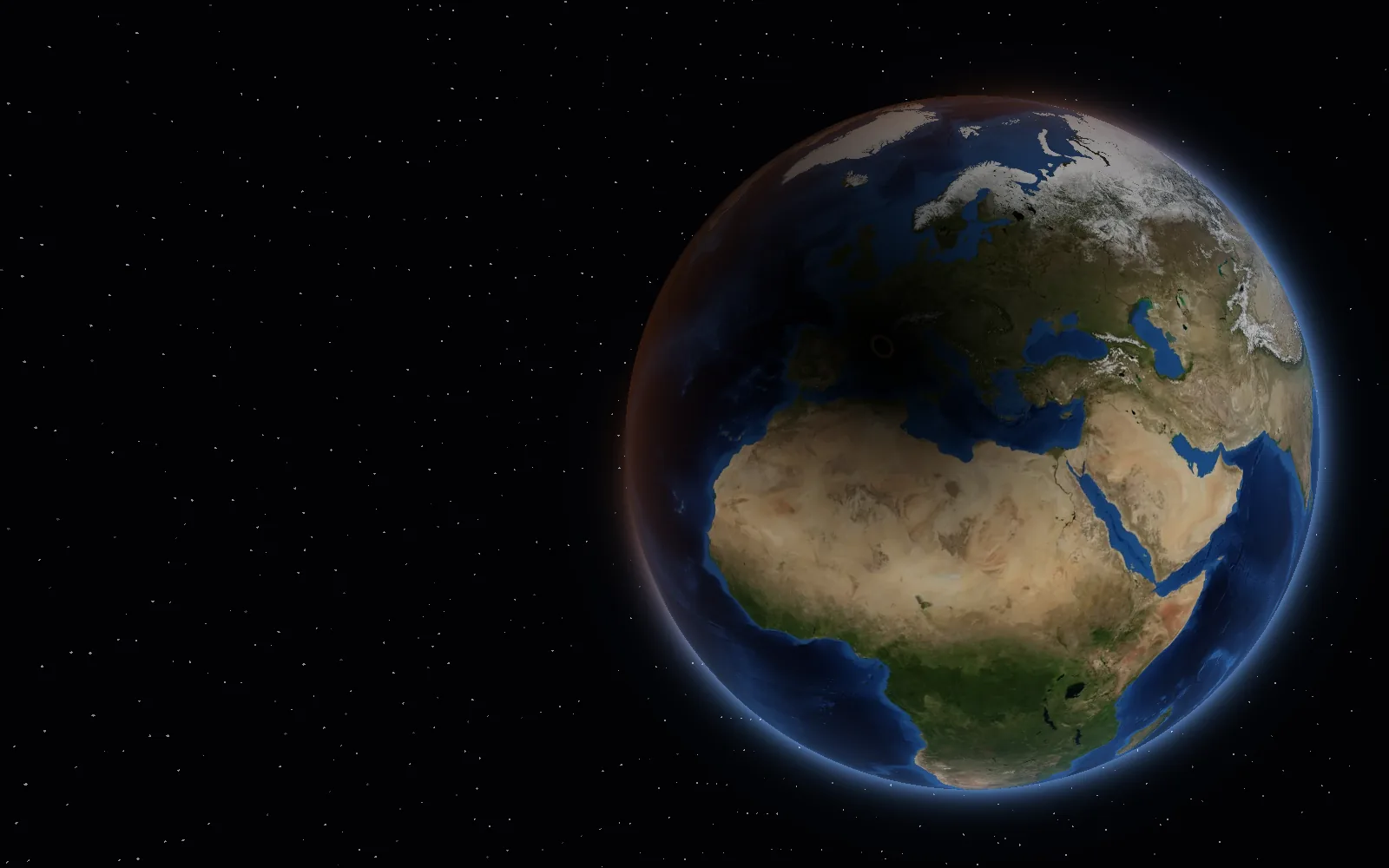
On 15 April 136 BC astronomers in Babylon recorded that the Sun was totally eclipsed and that Venus, Mercury, Jupiter, Mars and stars could be seen. The globe shows that eclipse, computed from the orbits of the Moon and the Earth, as it would fall if the planet had always turned at the pace of an atomic clock. The shadow misses Babylon. The day itself has grown by only about two thousandths of a second a century, but over two thousand years that adds up to hours.

The dotted lines bound the strip where the Sun disappeared completely: it crosses Morocco and Algeria, clips the south-east of Spain and runs over France into central Europe. Babylon, the gold point, stays in sunlight; the nearest edge of the strip is about 3,100 km away.

Turn the Earth until Babylon goes dark

Drag the globe sideways, or move the bar under this text. You are setting the planet back: each hour of lag carries Babylon 15 degrees to the west, into the shadow’s path. The counter keeps the tally.

Babylon is in the shadow only if, in 136 BC, the Earth’s turning stood between 3 h 07 min and 3 h 23 min behind a perfect clock of 86,400-second days, set to agree with the Earth today. Astronomers call this lag ΔT (“delta T”). Without it, the strip of totality falls on Morocco, Spain’s south-east and central Europe instead.

What the tablets say

“In 18° of daytime it made a total (eclipse).”Babylonian goal-year text, trans. Hermann Hunger

Babylonian astronomers kept diaries of the sky for centuries. This eclipse is described on two separate tablets, one of which adds that Jupiter and Mars “were visible in its eclipse”. Stephenson, Morrison and Hohenkerk call them perhaps the finest accounts of a total solar eclipse from antiquity.

No clock time is needed. The bare fact that the eclipse was total in Babylon fixes how far the Earth had turned, because the strip of totality is narrow: here it is crossed in about a quarter of an hour of turning.

The Moon’s tides alone would get it wrong

The tides raised by the Moon (and, more weakly, by the Sun) drag on the spinning Earth and slow it down. Laser ranging to the Moon and the orbits of satellites measure that brake well. On its own it predicts a lag of 4 h 27 min for 136 BC.

Press it and Babylon slides out of the shadow: the scribe would have seen a partial eclipse. So something has been speeding the Earth up a little at the same time. The paper names two likely causes: the ground still rebounding where the ice sheets of the last glaciation melted, which changes the planet’s shape, and the coupling between the liquid core and the mantle.

709 BC · Qufu

709 BC: the oldest direct record of a total solar eclipse

“The Sun was eclipsed; it was total.”Chunqiu (Spring and Autumn Annals), state of Lu

This line in the chronicle of the state of Lu is, in Stephenson, Morrison and Hohenkerk’s words, the earliest direct record of a total solar eclipse in any civilisation. The court sat at Qufu, in today’s Shandong. Nearly six centuries before Babylon, the Earth must be set back much further.

Qufu is in the shadow for a lag between 5 h 37 min and 5 h 52 min.

181 BC · Chang’an

181 BC: an omen at the Han court

“This is on my account.”The Empress Dowager, in the Hanshu and the Shiji

The Hanshu records a total eclipse and the Shiji says it grew dark in the daytime; both tell of the empress dowager’s fear that the sign was about her. Neither suggests a place other than the capital, Chang’an (today’s Xi’an).

Chang’an is in the shadow for a lag between 3 h 16 min and 3 h 32 min.

AD 454 · Jiankang (Nanjing)

AD 454: the stars come out over Jiankang

“The Sun was eclipsed; it was total. The constellations were very bright.”Songshu, history of the (Liu) Song dynasty

The bright stars confirm totality. The record names no place; the likely one is the capital of the Liu Song dynasty, where the imperial observatory was, on the site of today’s Nanjing.

Jiankang (Nanjing) is in the shadow for a lag between 1 h 42 min and 2 h 12 min.

AD 1124 · Novgorod

AD 1124: Novgorod in the dark

“The Sun began to diminish and perished completely.”Novgorod First Chronicle, trans. Vyssotsky

A Russian chronicle, written from an eyewitness account, describes darkness and stars before the evening service, and a town glad when the Sun came back.

Novgorod is in the shadow for a lag between 16 min and 45 min.

AD 1133 · Reichersberg

AD 1133: the last check, on the Inn

“Very many stars were seen.”Chronicle of Magnus of Reichersberg

The chronicle of Magnus, a canon of the Augustinian house of Reichersberg on the Inn (then in Bavaria, now in Austria), says the Sun was entirely hidden. By the Middle Ages the lag is down to less than an hour.

Reichersberg is in the shadow for a lag between 9 min and 29 min.

Each record leaves a window, and the windows draw a curve

Every town you put in the shadow left a bar: the range of lag that makes its record true. The pale bars are other records from the same study, computed the same way; the two hollow ones, from 601 and 549 BC, were set aside by its authors: 601 BC would need a very large lag at Qufu (they ask whether it was seen in another state), and neither has the later confirmation that backs 709 BC. The further back the record, the larger the lag, and it grows faster than in proportion to time.

Each record leaves a window, and the windows draw a curve0123456700 BC400 BCAD 1500100015002000How far behind the clock the Earth stood (hours)Babylon 136 BC: 3 h 07 min – 3 h 23 minQufu 709 BC: 5 h 37 min – 5 h 52 minChang’an 181 BC: 3 h 16 min – 3 h 32 minJiankang (Nanjing) AD 454: 1 h 42 min – 2 h 12 minNovgorod AD 1124: 16 min – 45 minReichersberg AD 1133: 9 min – 29 minAugsburg AD 1133: −1 min – 19 minChang’an AD 761: 28 min – 55 minCoimbra AD 1560: −8 min – 4 minQufu 601 BC: 5 h 52 min – 6 h 05 minQufu 549 BC: 4 h 29 min – 6 h 01 min
a window you foundfitted curve (Morrison, Stephenson, Hohenkerk, Zawilski 2021)tides alone

A lag that grows with the square of time is what a day that lengthens at a steady rate produces. Fitted to windows like these and to hundreds of thousands of timed observations, the long-term average day has grown by 1.78 thousandths of a second per century. Tides alone would make it 2.3. The plotted curve also follows slower swings from century to century, so it does not pass through every window.

Thirty-five thousandths of a second

On the long-term average, a day in 136 BC was about 35 thousandths of a second shorter than 86,400 seconds. Nobody could feel that.

But a shorter day means the planet turns a little faster, every day, for about 716,000 days, with the shortfall shrinking steadily to nothing around the 1820s, when the long-term average day was 86,400 seconds. So since 136 BC the Earth has made slightly more turns than a clock of 86,400-second days would count. Wind both back from today and in 136 BC the planet stands a little over three hours of turning behind the clock: the parabola fitted to the records gives 3 h 23 min, right at the upper edge of the window you found for Babylon. The published curve, which also follows the slower swings from one century to the next, gives 3 h 19 min, inside it.

A Romanian note from 17 June 1433

Romanian chronicles and notes record about a hundred solar eclipses between 1386 and 1867. In a survey of them, Magda Stavinschi, Vasile Mioc and Suzanne Débarbat list stars seen during totality on 17 June 1433.

OrșovaDrobeta-Turnu SeverinTimișoaraBucharestSofiaIașiCluj-Napoca
Strip of total eclipse on 17 June 1433, computed with a lag of 7 min; a few minutes more or less move its edge by tens of kilometres. Today’s borders and towns.

With the published lag for that year (7 min), the strip of totality came across the Balkans from central Europe and its northern edge ran close to the Danube at the Iron Gates. Whether Orșova, Drobeta-Turnu Severin or Timișoara saw totality turns on about a minute of lag, which is not known that precisely for the fifteenth century. That makes a dated note with a named place worth looking for: it could narrow the lag itself. The published abstract of the survey does not give the place.

The clocks today

Since the 1950s the Earth’s turning has been timed against atomic clocks. The day wanders by up to a few thousandths of a second over months and decades, as the atmosphere, the oceans and the core trade angular momentum with the solid Earth. Between 1972 and 2016 the world’s time signal was held to the Earth by 27 leap seconds; since 2016 the Earth has turned slightly faster on average and none has been needed.

Eclipse maps still need ΔT. For the total eclipse of 12 August 2026 over Spain it was about 69 seconds. Leave it out and the path would be drawn about 24 km too far west.

More on the modern clock: the leap seconds of your lifetime · why none has been added since 2016 · the eclipses seen from Romanian towns

How the shadow is computed

The positions of the Sun and the Moon come from NASA JPL’s DE422 ephemeris, through the Skyfield library, for each eclipse in Terrestrial Time, the uniform time of the orbits; dates are in the Julian calendar. Turning the Earth by ΔT rotates the ground under that fixed geometry. For each place and each value of the lag, the page tests every four seconds of the eclipse whether the Moon covers the whole Sun there, with the Sun above the horizon, on the WGS84 ellipsoid with a lunar radius of 0.2725076 Earth radii.

The windows were checked against those printed by Stephenson, Morrison and Hohenkerk (2016). Over 11 records the limits agree within 47 seconds; the paper rounds its limits before 1500 to the nearest 20 seconds and used a different lunar ephemeris. The globe’s surface is NASA’s Blue Marble (2004 mosaics), with today’s coasts and no city lights. The fitted curve is the spline published in the 2021 addendum and bundled with Skyfield.

RecordPlaceThis pageStephenson et al.Published curve
136 BCBabylon11,232 – 12,158 s11,220 – 12,140 s11,968 s
709 BCQufu20,198 – 21,138 s20,160 – 21,100 s20,169 s
181 BCChang’an11,787 – 12,713 s11,780 – 12,700 s12,519 s
AD 454Jiankang (Nanjing)6,115 – 7,910 s6,120 – 7,900 s6,017 s
AD 1124Novgorod983 – 2,707 s980 – 2,700 s1,138 s
AD 1133Reichersberg535 – 1,734 s520 – 1,740 s1,108 s
AD 1133Augsburg−45 – 1,155 s−60 – 1,160 s1,108 s
AD 761Chang’an1,709 – 3,281 s1,700 – 3,260 s3,246 s
AD 1560Coimbra−489 – 212 s−480 – 210 s177 s
601 BC (rejected by the authors)Qufu21,100 – 21,919 s21,120 – 21,900 s18,457 s
549 BC (set aside by the authors)Qufu16,155 – 21,687 s16,160 – 21,640 s17,659 s

Sources

  1. F. R. Stephenson, L. V. Morrison, C. Y. Hohenkerk (2016). Measurement of the Earth’s rotation: 720 BC to AD 2015. Proc. R. Soc. A 472: 20160404 (open access, with supplementary tables S10 and S15 and commentary S3). doi.org
  2. L. V. Morrison, F. R. Stephenson, C. Y. Hohenkerk, M. Zawilski (2021). Addendum 2020 to ‘Measurement of the Earth’s rotation: 720 BC to AD 2015’. Proc. R. Soc. A 477: 20200776. doi.org
  3. W. M. Folkner et al. JPL planetary and lunar ephemeris DE422. ssd.jpl.nasa.gov
  4. B. Rhodes. Skyfield (Python astronomy library), v1.55. rhodesmill.org
  5. M. Stavinschi, V. Mioc, S. Débarbat (1998). Solar eclipses recorded in old Romanian chronicles and notes. Acta Historica Astronomiae 3, p. 243 (abstract). astro.uni-bonn.de
  6. H. Hunger (2006). Astronomical Diaries and Related Texts from Babylonia, vol. VI; A. J. Sachs, H. Hunger (1996), vol. III. Quoted in Stephenson et al. 2016, supplement S3.
  7. NASA Visible Earth. Blue Marble Next Generation, 2004 monthly mosaics (public domain). visibleearth.nasa.gov
  8. Natural Earth. Admin 0 countries, 1:10m (public domain). www.naturalearthdata.com