1900–2100 · every solar eclipse over your town
When will the sky go dark at noon over your town?
In 1961 and in 1999, the Sun went out over Romania in broad daylight. Pick the nearest town and see all of its eclipses from 1900 to 2100: which were total, how much Sun was left each time, and what comes next.
See your town's eclipsesYour town
Pick the nearest town
The list holds all 42 county capitals. If you live in a village or a small town, pick the nearest one: a few dozen kilometres away the sky looks the same, except right on a shadow's edge.
- Alba IuliaAlba County
- AlexandriaTeleorman County
- AradArad County
- BacăuBacău County
- Baia MareMaramureş
- BistrițaBistrița-Năsăud County
- BotoșaniBotoșani County
- BrașovBrașov County
- BrăilaBrăila County
- Bucharestcapital
- BufteaIlfov
- BuzăuBuzău County
- Cluj-NapocaCluj County
- ConstanțaConstanța County
- CraiovaDolj
- CălărașiCălărași County
- DevaHunedoara County
- Drobeta-Turnu SeverinMehedinți County
- FocșaniVrancea
- GalațiGalați County
- GiurgiuGiurgiu County
- IașiIași County
- Miercurea-CiucHarghita County
- OradeaBihor County
- Piatra NeamțNeamț County
- PiteștiArges
- PloieștiPrahova
- ReșițaCaraș-Severin County
- Râmnicu VâlceaVâlcea County
- Satu MareSatu Mare County
- Sfântu GheorgheCovasna County
- SibiuSibiu County
- SlatinaOlt
- SloboziaIalomița County
- SuceavaSuceava
- TimișoaraTimiș County
- TulceaTulcea County
- TârgovișteDâmbovița County
- Târgu JiuGorj County
- Târgu MureșMureș County
- VasluiVaslui County
- ZalăuSălaj County
No town by that name in the list. Try another spelling.
Loading eclipses…
The town's data could not be loaded.
Do you remember 11 August 1999?
What did your town see that day? Guess before you look.
Totality: 2 minutes 22 seconds. Maximum was at 14:07 EEST.
When does your town enter the shadow next?
The next totality over your town comes…
No totality to 2100. Between 2000 and 2080, Romania catches no totality anywhere.
1900–2100
Every eclipse over your town
Each row is one eclipse seen from the chosen town: the disc shows how much of the Sun the Moon covered. Open a row for exact times.
58 eclipses seen from Bucharest between 1900 and 2100.
28 May 1900Partial53% of the Sun
Maximum: 17:57 UTC+1:44. From 17:00 UTC+1:44 to 18:49 UTC+1:44. Sun 15° above the horizon. Worldwide: total. Saros family 126.
11 November 1901Partial57% of the Sun
Maximum: 07:39 UTC+1:44. From 06:27 UTC+1:44 to 09:00 UTC+1:44. Sun 7° above the horizon. Worldwide: annular. Saros family 141.
31 October 1902Partial2% of the Sun
Maximum: 08:31 UTC+1:44. From 07:58 UTC+1:44 to 09:06 UTC+1:44. Sun 17° above the horizon. Worldwide: partial. Saros family 151.
30 August 1905Partial60% of the Sun
Maximum: 15:27 UTC+1:44. From 14:20 UTC+1:44 to 16:29 UTC+1:44. Sun 33° above the horizon. Worldwide: total. Saros family 143.
17 April 1912Partial53% of the Sun
Maximum: 14:26 UTC+1:44. From 13:08 UTC+1:44 to 15:39 UTC+1:44. Sun 44° above the horizon. Worldwide: hybrid. Saros family 137.
21 August 1914Partial86% of the Sun
Maximum: 14:36 UTC+1:44. From 13:22 UTC+1:44 to 15:44 UTC+1:44. Sun 44° above the horizon. Worldwide: total. Saros family 124.
23 January 1917Partial53% of the Sun
Maximum: 08:44 UTC+1:44. From 07:42 UTC+1:44 to 09:51 UTC+1:44. Sun 10° above the horizon. Worldwide: partial. Saros family 149.
8 April 1921Partial44% of the Sun
Maximum: 10:50 UTC+1:44. From 09:33 UTC+1:44 to 12:12 UTC+1:44. Sun 50° above the horizon. Worldwide: annular. Saros family 118.
28 March 1922Partial36% of the Sun
Maximum: 16:27 UTC+1:44. From 15:16 UTC+1:44 to 17:31 UTC+1:44. Sun 19° above the horizon. Worldwide: annular. Saros family 128.
29 June 1927Partial54% of the Sun
Maximum: 06:50 UTC+1:44. From 05:54 UTC+1:44 to 07:51 UTC+1:44. Sun 24° above the horizon. Worldwide: total. Saros family 145.
12 November 1928Partial24% of the Sun
Maximum: 10:43 UTC+1:44. From 09:29 UTC+1:44 to 12:01 UTC+1:44. Sun 26° above the horizon. Worldwide: partial. Saros family 122.
21 August 1933Partial48% of the Sun
Maximum: 07:03 EEST. From 06:07 EEST to 08:03 EEST. Sun 6° above the horizon. Worldwide: annular. Saros family 134.
19 June 1936Partial86% of the Sun
Maximum: 06:58 EEST. From 06:04 EEST to 07:57 EEST. Sun 13° above the horizon. Worldwide: total. Saros family 126.
10 September 1942Partial20% of the Sun
Maximum: 18:32 EET. From 17:47 EET to 19:14 EET. Sun 0° above the horizon. Worldwide: partial. Saros family 153.
9 July 1945Partial56% of the Sun
Maximum: 16:38 EET. From 15:31 EET to 17:39 EET. Sun 33° above the horizon. Worldwide: total. Saros family 145.
28 April 1949Partial4% of the Sun
Maximum: 09:08 EET. From 08:32 EET to 09:45 EET. Sun 40° above the horizon. Worldwide: partial. Saros family 147.
25 February 1952Partial30% of the Sun
Maximum: 11:41 EET. From 10:38 EET to 12:45 EET. Sun 35° above the horizon. Worldwide: total. Saros family 139.
30 June 1954Partial79% of the Sun
Maximum: 15:19 EET. From 14:05 EET to 16:27 EET. Sun 48° above the horizon. Worldwide: total. Saros family 126.
2 December 1956Partial35% of the Sun
Maximum: 09:01 EET. From 07:52 EET to 10:17 EET. Sun 12° above the horizon. Worldwide: partial. Saros family 151.
2 October 1959Partial13% of the Sun
Maximum: 14:46 EET. From 13:55 EET to 15:33 EET. Sun 30° above the horizon. Worldwide: total. Saros family 143.
15 February 1961Total100% of the Sun
Maximum: 09:54 EET. From 08:43 EET to 11:11 EET. Sun 23° above the horizon. Totality: 2 minutes 9 seconds. Worldwide: total. Saros family 120.
20 May 1966Partial83% of the Sun
Maximum: 11:45 EET. From 10:20 EET to 13:13 EET. Sun 65° above the horizon. Worldwide: annular. Saros family 137.
22 September 1968Partial41% of the Sun
Maximum: 13:04 EET. From 11:53 EET to 14:12 EET. Sun 44° above the horizon. Worldwide: total. Saros family 124.
25 February 1971Partial20% of the Sun
Maximum: 11:59 EET. From 11:05 EET to 12:53 EET. Sun 36° above the horizon. Worldwide: partial. Saros family 149.
30 June 1973Partial0% of the Sun
Maximum: 13:53 EET. From 13:33 EET to 14:13 EET. Sun 61° above the horizon. Worldwide: total. Saros family 136.
11 May 1975Partial13% of the Sun
Maximum: 08:11 EET. From 07:25 EET to 09:01 EET. Sun 34° above the horizon. Worldwide: partial. Saros family 118.
29 April 1976Partial68% of the Sun
Maximum: 12:52 EET. From 11:12 EET to 14:29 EET. Sun 59° above the horizon. Worldwide: annular. Saros family 128.
15 December 1982Partial38% of the Sun
Maximum: 10:51 EET. From 09:28 EET to 12:21 EET. Sun 20° above the horizon. Worldwide: partial. Saros family 122.
4 December 1983Partial1% of the Sun
Maximum: 15:07 EET. From 14:38 EET to 15:34 EET. Sun 12° above the horizon. Worldwide: annular. Saros family 132.
12 October 1996Partial45% of the Sun
Maximum: 17:52 EEST. From 16:44 EEST to 18:53 EEST. Sun 7° above the horizon. Worldwide: partial. Saros family 153.
11 August 1999Total100% of the Sun
Maximum: 14:07 EEST. From 12:41 EEST to 15:28 EEST. Sun 59° above the horizon. Totality: 2 minutes 22 seconds. Worldwide: total. Saros family 145.
31 May 2003Partial66% of the Sun
Maximum: 06:09 EEST. From 05:14 EEST to 07:08 EEST. Sun 4° above the horizon. Worldwide: annular. Saros family 147.
3 October 2005Partial36% of the Sun
Maximum: 12:31 EEST. From 11:15 EEST to 13:50 EEST. Sun 41° above the horizon. Worldwide: annular. Saros family 134.
29 March 2006Partial71% of the Sun
Maximum: 13:57 EEST. From 12:44 EEST to 15:09 EEST. Sun 48° above the horizon. Worldwide: total. Saros family 139.
1 August 2008Partial9% of the Sun
Maximum: 13:07 EEST. From 12:19 EEST to 13:54 EEST. Sun 63° above the horizon. Worldwide: total. Saros family 126.
15 January 2010Partial3% of the Sun
Maximum: 08:14 EET. From 07:37 EET to 08:53 EET. Sun 3° above the horizon. Worldwide: annular. Saros family 141.
4 January 2011Partial67% of the Sun
Maximum: 10:35 EET. From 09:08 EET to 12:08 EET. Sun 19° above the horizon. Worldwide: partial. Saros family 151.
20 March 2015Partial43% of the Sun
Maximum: 11:55 EET. From 10:48 EET to 13:04 EET. Sun 45° above the horizon. Worldwide: total. Saros family 120.
21 June 2020Partial4% of the Sun
Maximum: 08:39 EEST. From 08:08 EEST to 09:12 EEST. Sun 30° above the horizon. Worldwide: annular. Saros family 137.
25 October 2022Partial38% of the Sun
Maximum: 13:38 EEST. From 12:26 EEST to 14:49 EEST. Sun 33° above the horizon. Worldwide: partial. Saros family 124.
2 August 2027Partial51% of the Sun upcoming
Maximum: 12:32 EEST. From 11:24 EEST to 13:40 EEST. Sun 61° above the horizon. Worldwide: total. Saros family 136.
1 June 2030Partial83% of the Sun upcoming
Maximum: 08:09 EEST. From 07:01 EEST to 09:26 EEST. Sun 25° above the horizon. Worldwide: annular. Saros family 128.
20 March 2034Partial24% of the Sun upcoming
Maximum: 12:54 EET. From 11:54 EET to 13:54 EET. Sun 45° above the horizon. Worldwide: total. Saros family 130.
16 January 2037Partial44% of the Sun upcoming
Maximum: 11:41 EET. From 10:10 EET to 13:15 EET. Sun 24° above the horizon. Worldwide: partial. Saros family 122.
2 July 2038Partial5% of the Sun upcoming
Maximum: 17:38 EEST. From 17:00 EEST to 18:13 EEST. Sun 34° above the horizon. Worldwide: annular. Saros family 137.
11 June 2048Partial66% of the Sun upcoming
Maximum: 17:10 EEST. From 15:46 EEST to 18:24 EEST. Sun 38° above the horizon. Worldwide: annular. Saros family 128.
14 November 2050Partial52% of the Sun upcoming
Maximum: 16:28 EET. From 15:13 EET to 17:35 EET. Sun 2° above the horizon. Worldwide: partial. Saros family 153.
12 September 2053Partial49% of the Sun upcoming
Maximum: 11:41 EEST. From 10:30 EEST to 12:55 EEST. Sun 45° above the horizon. Worldwide: total. Saros family 145.
5 November 2059Partial56% of the Sun upcoming
Maximum: 09:53 EET. From 08:35 EET to 11:20 EET. Sun 23° above the horizon. Worldwide: annular. Saros family 134.
30 April 2060Partial63% of the Sun upcoming
Maximum: 13:40 EEST. From 12:28 EEST to 14:51 EEST. Sun 60° above the horizon. Worldwide: total. Saros family 139.
5 February 2065Partial45% of the Sun upcoming
Maximum: 12:22 EET. From 11:00 EET to 13:42 EET. Sun 30° above the horizon. Worldwide: partial. Saros family 151.
12 September 2072Partial6% of the Sun upcoming
Maximum: 11:05 EEST. From 10:28 EEST to 11:44 EEST. Sun 41° above the horizon. Worldwide: total. Saros family 155.
13 July 2075Partial79% of the Sun upcoming
Maximum: 07:35 EEST. From 06:30 EEST to 08:46 EEST. Sun 17° above the horizon. Worldwide: annular. Saros family 147.
26 November 2076Partial52% of the Sun upcoming
Maximum: 13:50 EET. From 12:28 EET to 15:08 EET. Sun 20° above the horizon. Worldwide: partial. Saros family 124.
3 September 2081Partial99% of the Sun upcoming
Maximum: 11:00 EEST. From 09:51 EEST to 12:13 EEST. Sun 43° above the horizon. Worldwide: total. Saros family 136.
21 April 2088Partial87% of the Sun upcoming
Maximum: 13:59 EEST. From 12:39 EEST to 15:18 EEST. Sun 56° above the horizon. Worldwide: total. Saros family 130.
18 February 2091Partial22% of the Sun upcoming
Maximum: 12:03 EET. From 10:48 EET to 13:19 EET. Sun 34° above the horizon. Worldwide: partial. Saros family 122.
23 July 2093Partial87% of the Sun upcoming
Maximum: 16:24 EEST. From 14:51 EEST to 17:45 EEST. Sun 45° above the horizon. Worldwide: annular. Saros family 147.
Map of shadows
Four shadows over Romania
The only eclipses that put, or will put, the shadow on Romania between 1900 and 2100: two totals in the past, one total and one annular to come. Pick a town on the map.
- Total, 15 February 1961
- Total, 11 August 1999
- Total, 3 September 2081 (predicted)
- Annular, 23 July 2093 (predicted)
Nine towns stand right on a shadow's edge: there, the Moon's mountains can move the line by a few kilometres. And the 2081 and 2093 tracks are predictions: they assume Earth's spin keeps following the curve measured so far.

The mechanism
Why the Moon can cover the Sun
The Sun is about 400 times wider than the Moon and stands about 390 times further away. The two numbers match almost exactly, so the Moon's disc covers the Sun's disc almost exactly.
The match is not perfect, which is why eclipses differ. When the Moon is nearer Earth, its disc outgrows the Sun's and totality follows; when it is further, a ring of Sun stays visible around it: an annular eclipse. In 1999 the ratio was 1.014, a margin of one and a half percent.
Eclipses return in families. One Saros lasts 18 years and 11 days: after that the Moon and the Sun line up the same way, but Earth has turned another 120 degrees, so the shadow falls on another meridian. The 1999 eclipse and the American one of 2017 are sisters, of Saros 145; the 2027 eclipse over Egypt and the 2081 eclipse over Oltenia are sisters too, of Saros 136, three generations apart.

How to watch safely
Only totality is safe for the naked eye, while the Moon covers the Sun's disc completely. A partial or annular eclipse must never be watched without proper equipment, and sunglasses are not proper equipment. The full rules, at NASA
The quiz
Eight true-or-false questions
Every answer is checked against NASA's Canon and this page's sums.
The answers, in short:
- True. Bucharest saw two total eclipses in the 20th century. On 15 February 1961, for 129 seconds, and on 11 August 1999, for 142 seconds. None since, and none to 2100. NASA Canon + this page's computation
- True. In 1999 the Moon looked bigger than the Sun. The ratio of apparent diameters was 1.014: the Moon covered the Sun with a one-and-a-half percent margin. NASA, 1999 path table
- False. The August 2026 total eclipse was visible from Romania too. At maximum the Sun was already below the horizon everywhere in the country: the eclipse set with it. Nothing was visible from Romania. NASA Canon + this page's computation
- False. A partial eclipse can be watched through sunglasses. It is never safe to look at a partial or annular eclipse without proper equipment. Only totality is safe for the naked eye. B. R. Chou, NASA Eye Safety
- False. Eclipses repeat the same, in the same place, every 18 years. After one Saros of 18 years and 11 days, the path falls about 120 degrees further west. The same place sees it again only after three Saroses: 54 years and 34 days. F. Espenak, Eclipses and the Saros, NASA
- True. The 1999 eclipse peaked over Romania. Greatest eclipse fell at 45.076° N, 24.298° E, in the Southern Carpathians, about 6 km from Râmnicu Vâlcea. The longest duration, 2 minutes 23 seconds, was measured there. NASA Canon + this page's computation
- True. Romania's next totality comes on 3 September 2081. The shadow crosses the south: Drobeta-Turnu Severin gets 256 seconds, Craiova, 254 seconds. Bucharest misses it by about 20 km. NASA Canon + this page's computation
- True. Buzău caught no totality in 200 years, though it twice came close. In 1961 it stood at 0.9993 of totality, in 1999 at 0.9904: each time the shadow's edge passed a few kilometres away. NASA Canon + this page's computation
Sources and method
Where the numbers come from
The list starts from NASA's Canon of solar eclipses: 454 eclipses between 1900 and 2100, each with date, time, type and Saros series. For every eclipse and every town, a program found the minute the Moon came nearest the Sun in that town's sky, using the JPL DE440 ephemeris and Romanian time with its historical rules. Until July 1931 the clock followed the Sun over Bucharest (UTC+1:44); since then, Eastern European Time, with summer time in some years.
The sums were checked in two places. For Bucharest in 1961 they give the same times the press of the day printed, to the second; for 1999 they give 142 seconds of totality, against 142.5 seconds in NASA's table for the centre line, which passes 3 km from the city centre.
What the sums leave out: the mountains on the Moon's edge. So in nine cases right on a shadow's edge the page says “on the edge” instead of deciding between total and partial. The 2081 and 2093 tracks are predictions too: they assume Earth's spin keeps following the curve measured so far.
The towns are the 42 county capitals, with GeoNames coordinates. Differences from nearby villages run to minutes and a few percent, except on the edges. Only eclipses where the Moon covers at least 1% of the Sun are listed; smaller grazes cannot be seen and are left out.
The eclipse catalogue
- Espenak, Meeus. Five Millennium Canon of Solar Eclipses: -1999 to +3000. NASA/GSFC (Besselian table, CSV format). eclipse.gsfc.nasa.gov (CSV) — the list of 454 eclipses in 1900–2100: date, time, type, Saros, magnitude
- Espenak. Five Millennium Catalog of Solar Eclipses. NASA/GSFC. eclipse.gsfc.nasa.gov/SEcat5 — the Canon's front page and table key
- Espenak. Key to Catalog of Solar Eclipses. NASA/GSFC. eclipse.gsfc.nasa.gov/SEcat5 — magnitude means the fraction of the Sun's diameter covered
Shadow tracks
- Espenak. Path of the Total Solar Eclipse of 1999 Aug 11. NASA/GSFC. tabelul traiectoriei — shadow limits and centre line, minute by minute; the 02m23s duration
- Espenak. Path of the Total Solar Eclipse of 1961 Feb 15. NASA/GSFC. tabelul traiectoriei — shadow limits over southern Romania; the 02m45s duration
- Espenak. Path of the Total Solar Eclipse of 2081 Sep 03. NASA/GSFC. tabelul traiectoriei — the predicted path over Oltenia and Muntenia
- Espenak. Path of the Annular Solar Eclipse of 2093 Jul 23. NASA/GSFC. tabelul traiectoriei — the predicted path over northern and eastern Romania
Mechanism and safety
- Espenak. Eclipses and the Saros. NASA/GSFC. eclipse.gsfc.nasa.gov/SEsaros — the 18-year-11-day Saros; the 120-degree westward shift
- Chou. Eye Safety During Solar Eclipses. NASA/GSFC (after NASA RP 1383). eclipse.gsfc.nasa.gov/SEhelp — only totality is safe for the naked eye
- Williams. Moon Fact Sheet. NASA NSSDC. nssdc.gsfc.nasa.gov — the Moon's radius, 1,737.4 km; semimajor axis, 384,400 km
- Williams. Sun Fact Sheet. NASA NSSDC. nssdc.gsfc.nasa.gov — the Sun's radius, 695,700 km; mean distance, 149.6 million km
Computation
- Rhodes. Skyfield: ephemerides and astronomical positions in Python. rhodesmill.org/skyfield — the library used to compute each town's times and coverage
- Park et al. JPL Planetary and Lunar Ephemeris DE440. NASA/JPL SSD. ssd.jpl.nasa.gov — the Sun and Moon ephemeris used in the computation
- Espenak, Meeus. Polynomial Expressions for Delta T. NASA/GSFC. eclipse.gsfc.nasa.gov/SEcat5 — the dynamical-minus-universal time difference across the range
- Espenak. Uncertainty in Delta T. NASA/GSFC. eclipse.gsfc.nasa.gov/SEcat5 — why far-future paths are predictions, not measurements
Towns, time and the sibling page
- GeoNames. Geographical database (CC BY 4.0). geonames.org — the coordinates of the 42 county capitals
- IANA. Time Zone Database. iana.org/time-zones — the Europe/Bucharest zone and daylight-saving rules
- Marius Comper. Eclipsa din 1961 la București: două minute sub nori. mariuscomper.uk/eclipsa-1961 — the sibling page: shared 1961 figures are identical here
Pictures
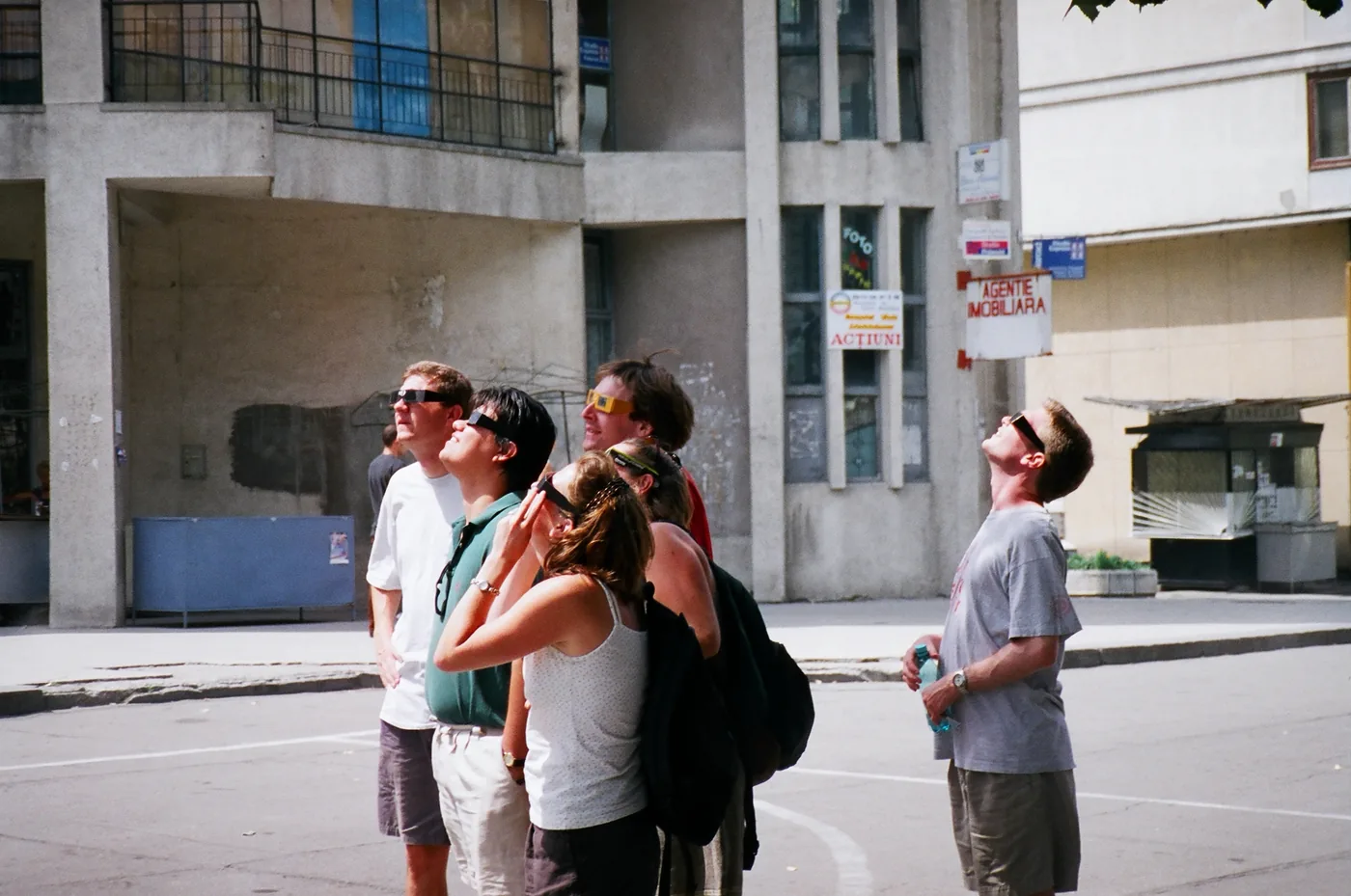
- Watching the 1999 eclipse in Romania: Ray_LAC (Flickr), Wikimedia Commons, CC BY 2.0
- Total solar eclipse of 11 August 1999, France: Luc Viatour, Wikimedia Commons, CC BY-SA 3.0
- Reverse of the 1999 Romanian 2000 lei eclipse banknote: Nicolae Săftoiu / National Bank of Romania, Wikimedia Commons, Public domain
.jpg)

