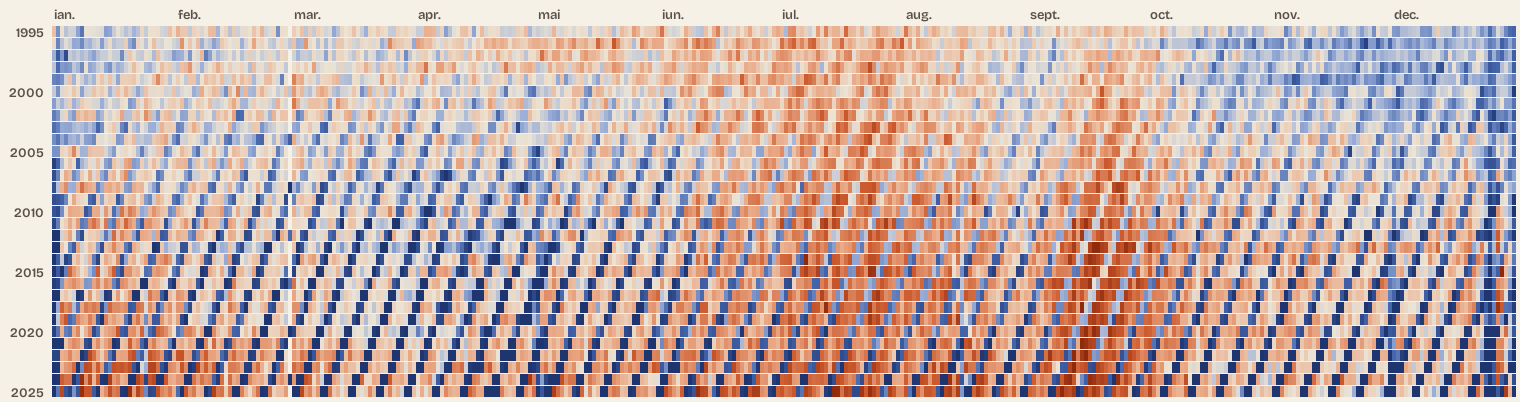
In 1995 the day of the week mattered little: a Sunday had 4% fewer births than an average day. In 2025 a Sunday had 33% fewer, and a Monday 18% more. The 2025 figures are still semi-final; in 2024, the latest final year, the gaps were almost the same: Sunday −32%, Monday +17%.
The day spontaneous labour begins is not scheduled. A planned caesarean or an induction, by contrast, can within limits be arranged for a particular day, usually a weekday, when the maternity ward has its full team. The INS table does not record how each baby was born, so it cannot show directly how much of the gap comes from caesareans or inductions. But the pattern is consistent with a growing share of births whose timing can be scheduled: the days that lose births are exactly the days an intervention can be moved away from.
Caesarean sections became much more common over the same period. Romania reported 23,883 of them to Eurostat in 1995 and 82,299 in 2023, while births fell by almost 30%. For comparisons between countries, Eurostat measures the procedure against population: in 2023 Romania recorded 431.8 caesareans per 100,000 inhabitants, against an EU average of 246.1; only Cyprus was higher, at 664.2 (Eurostat, surgical operations).
The same scheduling shows on the clock: Ora nașterii (in Romanian) shows births bunching up in the morning, as the working day starts.