INS data · births in Romania, day by day, 1995–2025
How rare is your birthday?
Pick your birthday to see where it ranks among the 365 dates of the year, by how often babies are born on it. The same data show how the birth calendar has changed: fewer and fewer babies are born at weekends, on public holidays, on the 13th of any month and on 29 February.
The ranking comes from 6,532,338 births registered in Romania between 1995 and 2025, counted by INS, the national statistics office. Add the year to see how many babies were born on your exact birthday.
7 March
229 of 365
Tap any day on the ring
Birthday
7 March
229of 365 dates, from most common to rarest
2% fewer babies are born than on an average day of the same year.
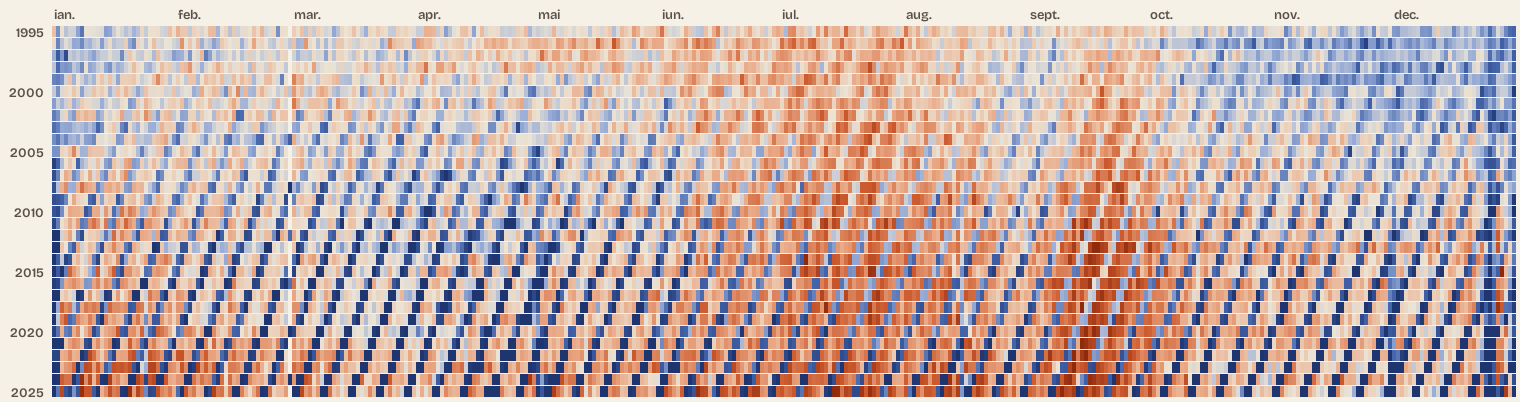
Each row below is a year, from 1995 at the top to 2025 at the bottom. Each square is a day. The colour compares the day with that year's average: orange means more births, blue fewer.
In the mid-1990s the map is almost even. Only summer shows, a little more orange, and the end of December, in blue. Towards 2025 evenly spaced diagonal stripes appear: Saturdays and Sundays. They slant because each year shifts the weekdays by one place, and a leap year by two.
Comparing with each year's average matters because births fell, from 236,640 in 1995 to 145,725 in 2025. Without it, recent years would simply look paler.
fewer birthsmore· an average day = background colour
Each square compares a day with the daily average of its year. On narrow screens the map turns: each column is a year and the days run downwards. Source: INS.
In 1995 the day of the week mattered little: a Sunday had 4% fewer births than an average day. In 2025 a Sunday had 33% fewer, and a Monday 18% more. The 2025 figures are still semi-final; in 2024, the latest final year, the gaps were almost the same: Sunday −32%, Monday +17%.
The day spontaneous labour begins is not scheduled. A planned caesarean or an induction, by contrast, can within limits be arranged for a particular day, usually a weekday, when the maternity ward has its full team. The INS table does not record how each baby was born, so it cannot show directly how much of the gap comes from caesareans or inductions. But the pattern is consistent with a growing share of births whose timing can be scheduled: the days that lose births are exactly the days an intervention can be moved away from.
Caesarean sections became much more common over the same period. Romania reported 23,883 of them to Eurostat in 1995 and 82,299 in 2023, while births fell by almost 30%. For comparisons between countries, Eurostat measures the procedure against population: in 2023 Romania recorded 431.8 caesareans per 100,000 inhabitants, against an EU average of 246.1; only Cyprus was higher, at 664.2 (Eurostat, surgical operations).
The same scheduling shows on the clock: Ora nașterii (in Romanian) shows births bunching up in the morning, as the working day starts.
470babies on an average Monday in 2025
268on a Sunday
Births on each weekday against an average day of the same year. The dotted line is the average day. Source: INS.
Public holidays
After becoming public holidays, all six dates recorded fewer births#
From 2009 to 2024, six fixed dates became public holidays by law: 15 August, 30 November, 24 January, 1 June, and 6 and 7 January. Before, about as many babies were born on them as on the days around them. As days off they lose on average between 21% and 34% of their births. For 15 August, 30 November, 24 January and 1 June, every weekday year after the law sits below every weekday year before it.
Each dot compares births on a date with the average for the same weekday in the three weeks before and after, leaving out holidays and Christmas and New Year's Eve. Only years in which the date fell Monday to Friday are shown; weekends are emptier anyway. An open circle means the date coincided with Orthodox Easter or Pentecost, which are days off in any case.
15 August
Dormition of the Virgin · a day off since 2009
Before: +1%. As a day off: −23%.
30 November
St Andrew · a day off since 2012
Before: −1%. As a day off: −25%.
24 January
Union of the Principalities · a day off since 2017
Before: +1%. As a day off: −22%.
1 June
Children's Day · a day off since 2017
Before: +1%. As a day off: −21%.
6 January
Epiphany · a day off since 2024
Before: +2%. As a day off: −30%. Only one year so far.
7 January
St John · a day off since 2024
Before: 0%. As a day off: −34%. Only one year so far.
The old holidays emptied too
The holidays that were already days off in the 1990s needed no new law. Orthodox Easter Monday had 10% fewer births than the surrounding days in 1995–2004, and 34% fewer in 2015–2025. Christmas Day went from −13% to −39%, and 1 January from −8% to −39%. That is why the bottom of the ranking belongs to 25 December, 31 December, 1 January and 26 December.
1 January
1995–2004: −8%. 2015–2025: −39%.
25 December
1995–2004: −13%. 2015–2025: −39%.
1 May
1995–2004: −4%. 2015–2025: −29%.
Orthodox Easter Monday
1995–2004: −10%. 2015–2025: −34%.
Rare dates
Births on the 13th and 29 February have become much rarer#
No law makes the 13th a day off. Yet between 2015 and 2025 a 13th that fell on a weekday had on average 7% fewer births than the same weekday around it. In 1995–2004 the gap was 1%.
Tuesday the 13th, the unlucky day in Romanian tradition, does not stand out: every 13th from Monday to Friday loses between 5% and 9%. 13 April and 13 December are among the bottom 12 dates of the ranking.
29 February went the same way. In 1996 it had 4% fewer births than the surrounding days; in 2024, 39% fewer. In each of the eight leap years, 1 March had more births than the days around it, by 6% to 18%. Both patterns are consistent with some birth dates being chosen, through a scheduled caesarean or induction. The INS data do not show who chose the date, or why.
Each year's weekday 13ths against the same weekday in the three weeks before and after. The horizontal lines are ten-year averages. Source: INS.The eight leap years from 1996 to 2024, each date against the same weekday around it. Source: INS.
236,640 births in 1995, 145,725 in 2025. The fall does not change the ranking, because each day is compared with the average of its own year.
Two INS notes matter here. Since 2012 the count covers babies whose mothers had their domicile or usual residence in Romania and whose birth was registered in the country; before, the criterion was the mother's domicile. And the 2025 figures are semi-final: births registered late will still be added.
National Institute of Statistics (INS), Romania: the table “Live births by date of birth (day, month and year)”, 1995–2025, supplied on request no. 65897 of 15 September 2026. It covers 11,323 days and 6,532,338 births; the days add up exactly to the annual total INS gives for each year. Download the daily data (CSV).
What is counted
Live births, by date of birth. Until 2011, babies whose mothers had their domicile in Romania; from 2012, those whose mothers had their domicile or usual residence in Romania and whose birth was registered at a Romanian civil registry office. Figures for 2013–2023 are revised, 2024 is final and 2025 semi-final.
The ranking
For each year, births on a day are divided by that year's daily average. A date's rank comes from the average of this ratio over the 31 years, so years with many births do not weigh more than years with few. 29 February exists in only eight years and is left out of the ranking.
Surrounding days
For holidays, the 13th and 29 February, each day is compared with the average of the same weekday in the three weeks before and the three weeks after. The comparison leaves out every date that is or became a public holiday, plus 24 and 31 December. Fixed-date holidays use only the years in which they fell Monday to Friday.
The table does not say how a baby was born, at what time or in which county. The explanation through caesareans and scheduled births is inferred from the pattern of days.