Roșia Montană, AD 131
The employment contract signed in wax, in a gold mine, on 6 February 131
On a fir tablet coated with wax, a jurist named Valerius Firmus wrote an employment contract at the request of some Illyrian miners. Only one fragment survives, but the dating line is intact: the consuls Pontianus and Rufinus, the eighth day before the Ides of February. It is the oldest document from Alburnus Maior, the mining town beneath present-day Roșia Montană.
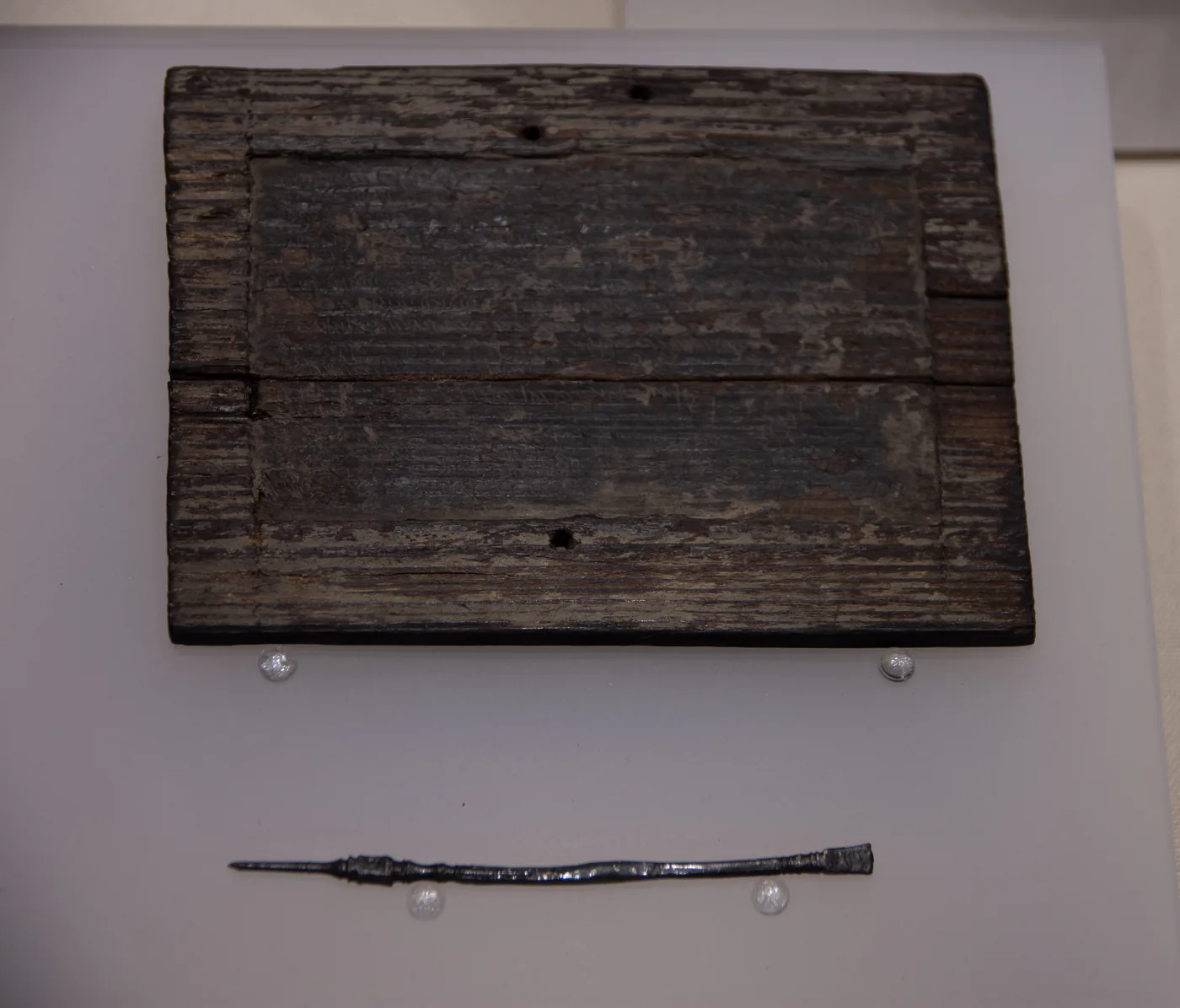
The line that gives the date
Of the contract concluded on 6 February 131, a single piece of the triptych remains. The text is full of gaps, but its opening reads clearly. Pick a fragment.
[Po]ntiano [et] Rufino co(n)s(ulibus)
VIII idus Februarias
Valerius Firmus s[cripsi rogatus]
Verzone Beusantis … Dasius Verzonis
[Al]burno Maiori
Pick a fragment of the dating line.
Tablet XVIII is the oldest of the 25 wax tablets recovered from the galleries of Roșia Montană. Of the fir triptych — three bound tablets, waxed on the inner faces — a single part survives, waxed on one face only and framed by a protective rim. It measures 145 by 70 millimetres: it fits in a palm.
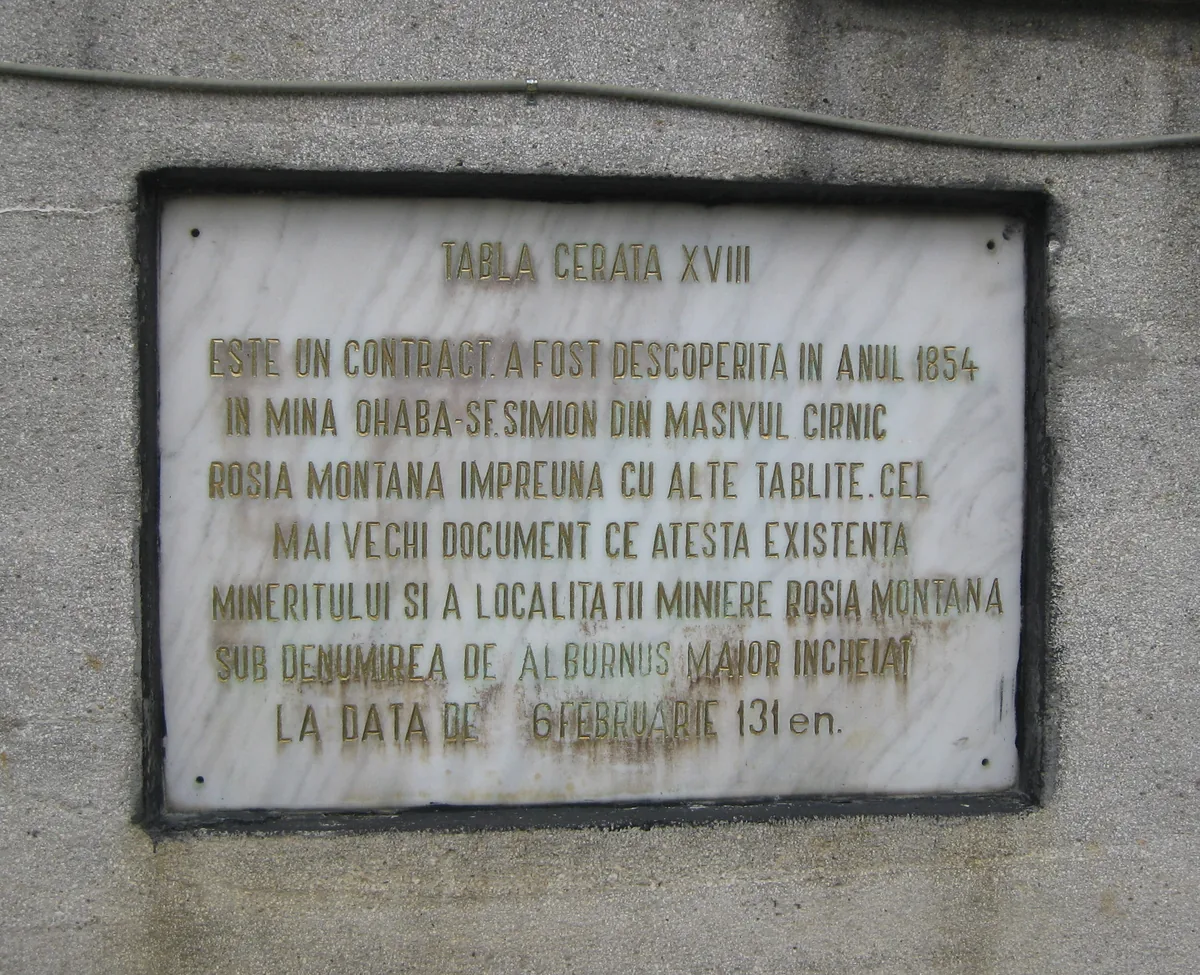
It was found in 1854, in the Ohaba–Saint Simeon gallery of the Cârnic massif, together with ten other tablets. It now sits in the National Museum of Romanian History under inventory number 54186. In February 2026 the museum put it on display as exhibit of the month, 1,895 years after it was signed.
The Romanian- and Hungarian-language Wikipedias date the tablet to 6 January. The error probably comes from an easy slip: the sixth day of the month was written the same in January and February, the only difference being the name of the month. But the surviving Latin text reads Februarias, and both the museum and the memorial plaque at Roșia Montană say February.
- Where
- Alburnus Maior, the mining town beneath present-day Roșia Montană, Alba County
- When
- 6 February 131, under the consuls Pontianus and Rufinus, in the reign of Hadrian
- Number
- Tabula Cerata D. XVIII; National Museum of Romanian History, inv. 54186
- Size
- 145 by 70 millimetres, fir wood with wax, a single triptych panel
- Found
- 1854, Ohaba–Saint Simeon gallery, Cârnic massif

One contract, whole, from end to end
Tablet XVIII is a fragment. But the same museum holds proof that such contracts also survive whole: tablet XI, a hiring of labour from 20 May 164, with every clause in place. The panel measures 143 by 105 millimetres and keeps the binding holes of the triptych. Open the clauses one by one.
1. The date
[Macri]no et Celso co(n)s(ulibus) XIII Kal(endas) Iunias
Under the consuls Macrinus and Celsus, on the thirteenth day before the Kalends of June.
By the Roman count, the thirteenth day before 1 June falls on 20 May 164.
2. The scribe
Flavius Secundinus scripsi rogatus a Memmio Asclepi quia se lit[ter]as scire negavit
I, Flavius Secundinus, have written this, asked by Memmius, son of Asclepius, because he said he knew no letters.
The worker could not write, so he speaks through the jurist's pen. The formula matches the one of 131: scripsi rogatus.
3. The hiring
it quod dixsit se locas[se] et locavit operas s[ua]s opere aurario Aurelio Adiutori ex ha[c] die [in] Idus Novembres proximas
Because he said he had hired himself out, and hires out his labour for gold-mine work to Aurelius Adiutor, from this day until the coming Ides of November.
The Ides of November fall on the 13th: the hiring runs from 20 May to 13 November. Aurelius Adiutor, a Roman citizen, owned a gold mine.
4. The pay
[denarios se]pt(u)aginta liberisque [denarios … mer]c[ede]m per [t]empora accipe[re] debebit
Seventy denarii, with the pay due in its season, as a damaged passage mentioning the children also shows.
The legible sum is 70 denarii; the editors read a further sum for the children in the damaged passage.
5. The worker's duty
qu[as] operas sanas v[ale]ntes [ed]e[re] debebit conductori
And he will owe the contractor named above labour that is sound and strong.
The contract demands a whole body and strength: gallery work forgave nothing.
6. The penalty
quod si invito condu[c]tore decedere aut c[e]ssare volue[rit dare] debebit in dies singulos [H]S V num(mos) (a)ere octus[s(is)] c[ond]uct[or]i
But if he wishes to leave or go idle against the contractor's will, he will owe him, for each day, five sesterces and eight asses.
The fine runs by the day, not by the month: every missed day costs.
7. The water
si laborem fluor inpedierit pro rata c[o]nputare de[bebit c]onduc[tor]
If water hinders the work, the contractor will reckon the pay pro rata.
Water breaking into the galleries was the daily hazard of ancient mining; the contract puts it in a clause.
8. Late payment
[si t]empore peracto mercedem sol[v]endi moram fecerit ead[em] p[oena] tenebitur exceptis cessatis tribus
If, the term fulfilled, he delays payment, he will be held to the same penalty, except for three days of grace.
The penalty is a mirror: what the worker pays for a missed day, the contractor pays for a delayed day, after three days of grace.
9. Place and witnesses
actum Immenoso Maiori. Titus Beusantis qui et Bradua. Socratio Socrationis. [M]emmius Asclepi.
Done at Immenosum Maius. Titus, son of Beusas, also called Bradua. Socratio, son of Socratio. Memmius, son of Asclepius.
The place, Immenosum Maius, has never been located in the field. The witnesses bear Illyrian and Greek names: the mining town gathered people from across the Empire.
The Latin of the contract is the Latin spoken in the mine: dixsit for dixit, inpedierit for impedierit, it quod for id quod. Here and there the traces of an older text show through: the panel had been used once and scraped clean for the new contract. The parties come from different worlds: the contractor and the scribe are Roman citizens, while the worker and the witnesses are peregrini — residents without citizenship — with Illyrian, Dalmatian, and Greek names.
English rendering of the Latin text: Marius Comper, after the transcription of the National Museum of Romanian History.
The California of Antiquity
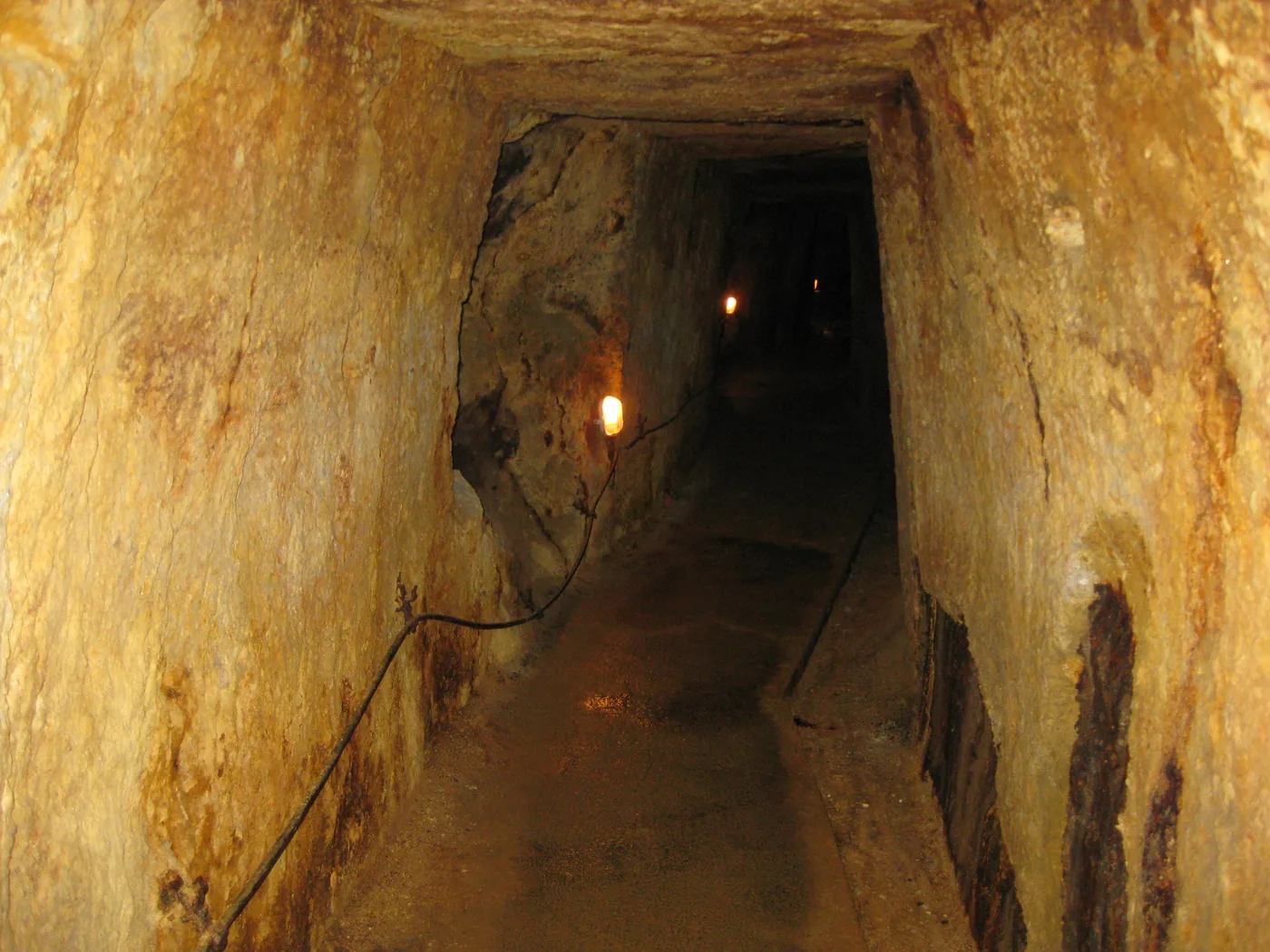
Alburnus Maior was founded by the Romans under Trajan as a mining town, with Illyrian colonists from southern Dalmatia — among them the Pirustae, a tribe famed for mining. Its inhabitants were peregrini, residents without Roman citizenship. Gold was dug here for generations, and tens of kilometres of Roman galleries can still be walked today.
The historian Vasile Pârvan called the district the California of Antiquity: peoples from across the Roman world came here for gold. The tablets prove him right: two contracts hold Illyrian, Dalmatian, Greek, and Roman names.
In July 2021 the mining landscape of Roșia Montană entered the UNESCO World Heritage List, after a two-decade campaign against reopening the mine.

Twenty-five tablets
The tablets came to light between 1786 and 1855, as modern mining reopened the ancient galleries. The richest lot came out in 1854 from the Saint Simeon gallery: eleven pieces, nine of which now sit in the National Museum in Budapest.
What survives is an archive of everyday life: slave sales — the girl Passia, six years old, for 205 denarii; the boy Apalaustus, Greek by nation, for 600; a woman from Crete for 420 — loans of money, one of them written in Greek itself, and the winding-up of a burial association, that of Jupiter Cernenus, whose members had lost interest.
Tablet XI was given to the museum in Cluj by the mining technician L. Diószegi and reached Bucharest later. Other pieces of the archive sit in Budapest, Cluj-Napoca, Blaj, and Alba Iulia.
- 131The contract of Alburnus Maior is concluded: tablet XVIII, the town's oldest document.
- 142The sale of the boy Apalaustus: 600 denarii, on 16 May.
- 164The hiring of Memmius: tablet XI, preserved almost whole.
- 167The winding-up of the burial association of Jupiter Cernenus.
- 1786–1855The tablets leave the galleries, one by one, as mining reopens.
- 1854The Saint Simeon gallery lot: eleven pieces.
- 2021Roșia Montană enters the UNESCO World Heritage List.
Sources
The facts and the Latin texts belong to the National Museum of Romanian History, through the historian Mihaela Simion. English rendering of the Latin texts: Marius Comper.
- National Museum of Romanian History: “Exhibit of the month for February — Epigraphic discoveries from Alburnus Maior” (February 2026). mnir.ro
- Mihaela Simion: “The wax tablets of Alburnus Maior” — the transcriptions of tablets XVIII and XI and the English translation of the 164 contract, preserved on historyofinformation.com. historyofinformation.com
- Rada Varga: “The wax tablets of Alburnus Maior”, EAGLE Portal (13 May 2015). eagle-network.eu
- “1,900-Year-Old Roman Employment Contracts Reveal Life in an Ancient Gold Mine”, Ancientist (2026). ancientist.com
- Tamás Nótári: “Tăblițele cerate de la Roșia Montană: context și conținut”, RRID 01/2021 (PDF). rrid.ro (PDF)
- Geographical study of the Roșia Montană area (West University of Timișoara, PDF): the 1786–1855 discovery range, the 1854 lot, the Budapest pieces. cbg.uvt.ro (PDF)
- German Wikipedia: “Roșia Montană” — the tablets of 131–167, CIL III p. 921 ff. de.wikipedia.org
- “Neither a Truant nor a Fugitive” (Univ. of Michigan, ICP) and Moldovan, Curentul Juridic — the sale of 16 May 142. quod.lib.umich.edu · revcurentjur.ro (PDF)
- The consuls of 131: Sergius Octavius Laenas Pontianus and Marcus Antonius Rufinus. en.wikipedia.org
- New East Digital Archive: “Romania's ancient Roșia Montană becomes UNESCO heritage site” (July 2021). new-east-archive.org