1868 – 1880
How did a railway nearly topple Carol?
In September 1868 the Romanian state guaranteed 7.5% a year for 915 km of railway that did not exist. Twelve years later it bought them all back. Between the two signatures: a bankruptcy, a republic for a day, and an abdication that never came.

The affair in four chapters
The concession map
Four sections, 915 kilometres promised by decree, from Roman to Vârciorova. The routes on the map are representative, drawn through the decree's towns.
Below the map, the guarantee ticks: 7.5% a year, paid by the state, trains or no trains. The counter starts from a reference sum of 1,000,000 gold lei — the real interest was levied on the bonds sold, which the sources never total.
The four sections
- Roman – Mărășești – Tecuci – Galați
- Tecuci – Bârlad
- Galați – Brăila – Buzău – Ploiești – Bucharest
- Bucharest – Pitești – Slatina – Craiova – Vârciorova
Representative route
The guarantee ticks
0.0000 gold lei
75,000 gold lei a year, from the state · 205.48 gold lei per day · 7.5% × 1,000,000
Reference sum: 1,000,000 gold lei. The real interest was levied on the bonds sold, which the sources never total.
- 1868The law of 10 September and the decree of 21 September: 915 km, 90 years, 7.5%.
- 1870The Franco-Prussian war; the Strousberg payments cease. On 8 August, the Republic of Ploiești.
- 1871On the night of 22–23 March Carol prepares to abdicate; the Catargiu government stops him.
- 1872The company enters forced liquidation.
- 1873The Carp mission to Berlin: fresh credits and a calmed Bismarck, until April.
- 1880The buyback law of 29 January; CFR on 11/23 April; 921 km for the state.
Chapter I
The Concession
1868 · 1868, the signature
- Chapter
- 1868
- The law
- 10 September 1868
- The decree
- 21 September 1868, 915 km
- The guarantee
- 7.5% a year, from the state
In 1866 Romania received its foreign prince and had almost no railways. The government said so openly: without quick, safe and cheap transport, the country could neither sell its grain nor build an industry. The first line, Bucharest–Giurgiu, had been entrusted to the Englishmen Barkley and Staniforth — 196,500 gold francs per kilometre, 13,775,000 gold lei in total, the result published in the Gazette on 7 April 1867.
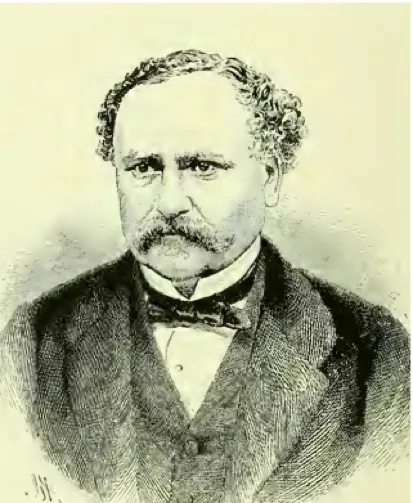

Then came the great affair. By the law of 10 September 1868, the company represented by H. Strousberg received the three sections of the general network plan, and the decree of 21 September sealed it all: a 90-year concession, 915 kilometres in four sections — Roman–Mărășești–Tecuci–Galați, Tecuci–Bârlad, Galați–Brăila–Buzău–Ploiești–Bucharest, Bucharest–Pitești–Slatina–Craiova–Vârciorova. The state kept the right to buy the lines back after 30 years and guaranteed the bonds at 7.5% a year.
The mechanism deserves a second reading: the interest flowed from the budget whether the trains ran or not. That same year Parliament also voted the Offenheim concession — Roman–Pașcani–Suceava, with the branches to Iași and Botoșani — and by 1869 the conceded network counted about 1,378 km, at an average cost of 306,000 gold lei per kilometre.
The lack of quick, safe and cheap transport is in this regard the biggest obstacle. Only the railways can today satisfy this requirement.
The Romanian government, Official Gazette, 17 August 1866 (as quoted in English)
Meanwhile Also in 1868, the Lemberg–Cernăuți–Vicșani–Suceava line joined Vienna to Suceava — Eminescu rode it to university in the autumn of that year.
Chapter II
The Bankruptcy
1870 – 1875 · 1870–1875, the collapse
- Chapter
- 1870 – 1875
- Payments cease
- 1870, after the outbreak of war
- The liquidation
- 1872
- The personal bankruptcy
- 1875
The Vârciorova–Roman line was in full construction when the Franco-Prussian war broke out in 1870. The war shook the whole European market, and Strousberg's great enterprise rocked: soon after the outbreak of the war, payments ceased. So Professor Gheorghe Tașcă records the moment — dryly, like a balance sheet.

The details read like a novel of manners: Ambron, a former administrator of the House of Hohenzollern and the German government's commissioner to the company, risked 30 million in financial speculation and replaced them with worthless mortgages — the blow that bankrupted the entire affair. Shoddy workmanship and stalled sites did the rest, and the criticism reached as far as diplomatic complications.
In 1872 the company was forced into liquidation. Strousberg himself survived the panic of 1873, but in 1875 he was declared bankrupt — Hansemann and Bleichröder bought his railways for nothing — and in 1876, after a trial in Russia, he was expelled. He died in 1884, in Berlin, aged 60.
The great enterprise of Stroussberg is rocked and, soon after the outbreak of the war they ceased payments.
Gheorghe Tașcă, as quoted in English (spelling as in the source)
Meanwhile Romania did not enter the war of 1870–1871 — but the war entered Carol's reign.
Chapter III
The Throne
1870 – 1871 · 1870–1871, the brink
- Chapter
- 1870 – 1871
- Ploiești
- 8 August 1870, under 24 hours
- The brink
- 22–23 March 1871
- The Catargiu government
- 1871 – 1876
Carol was a German prince on the throne of a francophile country, and distrust had smouldered since 1866. On 8 August 1870 the radical liberals tried to end it by force: at Ploiești, Alexandru Candiano-Popescu seized the prefecture and proclaimed the republic. The movement lasted less than 24 hours, and the liberal leaders were arrested.

The heavy blow came the following spring. On the evening and night of 22–23 March 1871, after hostile demonstrations, Carol prepared to abdicate. On 22 March he dismissed Ion Ghica's liberal government and called in the conservative Lascăr Catargiu — and the new cabinet persuaded him to stay. The conservatives then governed without interruption between 1871 and 1876, the longest government until then.
The railway bankruptcy had poured fuel on the fire: historians show how it set off the anti-German rhetoric of public life, tied to Bismarck's imperialism — Bismarck was mixed up in renegotiating the concession to Romania's disadvantage. How a Prussian prince had reached Bucharest five years earlier is told in the sister page carol-i-1866.
After demonstrations on the evening and night of 22–23 March, Carol prepared to abdicate, but the formation of a new conservative cabinet under Lascăr Catargiu convinced him to stay.
Encyclopedia of World History, as quoted
Meanwhile Candiano-Popescu was pardoned by the king, joined the army and, a major in 1877, took part in the assault on the Grivița redoubt on 30 August.
Chapter IV
The Buyback
1873 – 1880 · 1873–1880, the bill
- Chapter
- 1873 – 1880
- The Carp mission
- until April 1873
- The law
- 29 January 1880, 921 km
- CFR
- 11/23 April 1880
With the throne saved, the bill remained. Petre P. Carp was sent as head of Romania's mission to the German Empire, where he stayed until April 1873: he negotiated further German credits for the railways and persuaded Bismarck not to cross over to the 'enemies of Romania', writing the troubles off as a short-lived liberal prank.
.jpg)
The ending came in 1880. The law of 29 January bought back the railways of the Shareholders' Company — 921 km of working single track, rolling stock and installations included — and on 11/23 April the Princely Directorate of the Romanian Railways was founded: today's CFR initials date from then. On 1 December the workshops of Bucharest, Galați and Turnu Severin passed into state hands.
Xenopol the historian called the buyback a good deal: the country's main artery of communication had passed into its hands. From the law of 1868 to the law of 1880, 12 years elapsed — and on 1 July 1882, with the other lines bought back too, Romania's network was fully unified.
The redemption had made the country a good deal, putting in our hands the main communication artery of the country.
A. D. Xenopol, as quoted in English
Meanwhile On 10 May 1877 Romania declared its independence, voted by Parliament and promulgated by Carol.
The concession audit
Five questions from the file: the guarantee, the term, the network, the payments and the ending. Choose, then check against the sources.
-
1
The guarantee
The interest the state paid every year was:
What actually happened
7.5% a year, guaranteed by the state to the bondholders — trains or no trains.
-
2
The term
The Strousberg concession was granted for:
What actually happened
90 years, redeemable after 30: the state signed the guarantee for nearly a century.
-
3
The network
The decree promised a network of:
What actually happened
915 km in four sections; 306,000 was the average cost in gold lei per kilometre, not the length.
-
4
The payments
After the outbreak of the Franco-Prussian war:
What actually happened
Payments ceased, soon after the outbreak of the 1870 war — so Tașcă notes.
-
5
The ending
The affair ended when:
What actually happened
The state bought the lines back in 1880 — 921 km in operation — and founded CFR.
Answer one card to begin.
Six plates of the affair
Six images, in story order: the concessionaire, the prince, the chancellor, the satirical press, the republic for a day, and the locomotive.
Plate 1868The concessionaire
The concessionaire Unknown photographer · Wikimedia Commons - Bethel Henry Strousberg, the concessionaire of the summer of 1868.
- A deputy in the North German Confederation's Reichstag, 1867–1871.
- Bankrupt in 1875; Hansemann and Bleichröder took his railways.
Plate 10 mai 1866The prince
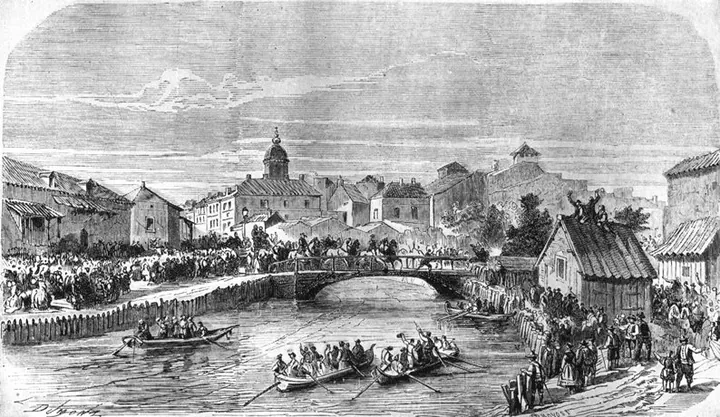
The prince Contemporary print, 1866 · Wikimedia Commons - Carol entering Bucharest, 10 May 1866.
- Come from Sigmaringen with Bismarck's urging to take the throne.
- Five years later, the railway nearly sent him back.
Plate 1871The chancellor
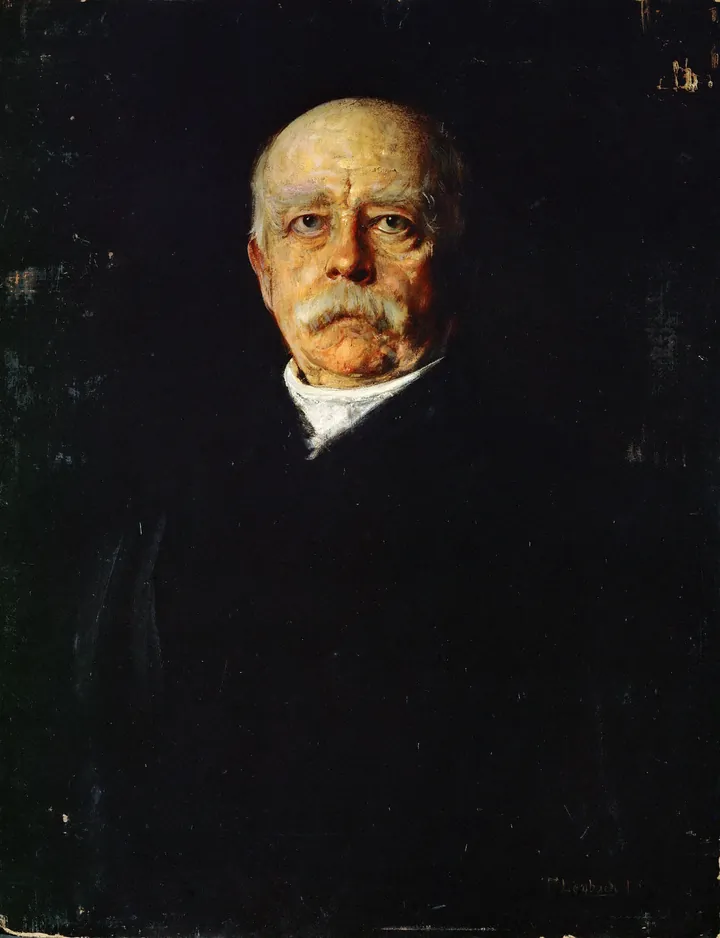
The chancellor Franz von Lenbach, 1871 · Wikimedia Commons - Otto von Bismarck, painted by Lenbach in 1871.
- He was mixed up in renegotiating the concession — to Romania's disadvantage.
- Carp persuaded him not to cross to the 'enemies of Romania'.
Plate 1872The satire
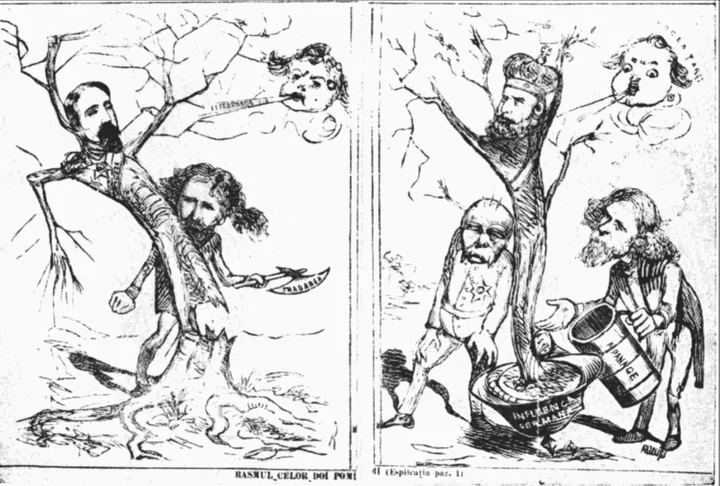
The satire Ghimpele, 1872 · Wikimedia Commons - Ghimpele, 1872: Cuza betrayed by Brătianu, Carol with Bismarck.
- Carol feeding off German influence and privilege.
- The satire says it all: the affair had become politics.
Plate 1870 / 1884The republic for a day
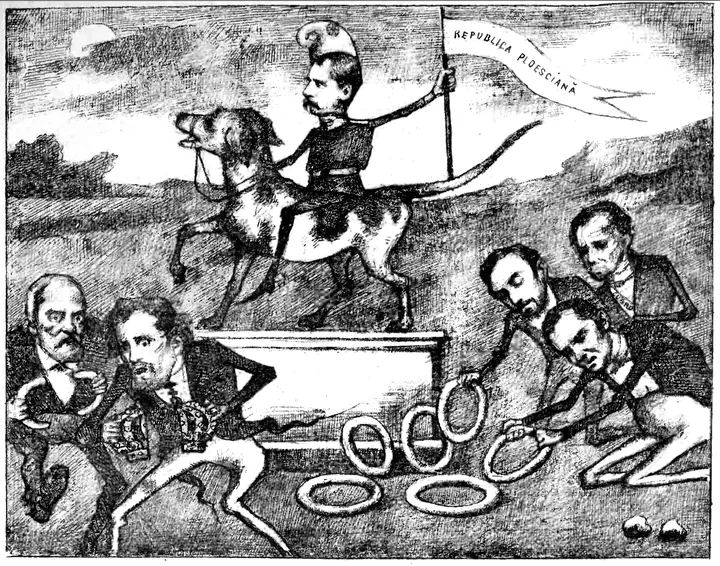
The republic for a day Ciulinul, 19 August 1884 · Wikimedia Commons - Ciulinul, 19 August 1884: the coup of 8 August 1870.
- Candiano-Popescu in a phrygian cap, riding a dog.
- The republic lasted hours; the joke, decades.
Plate 1872The locomotive
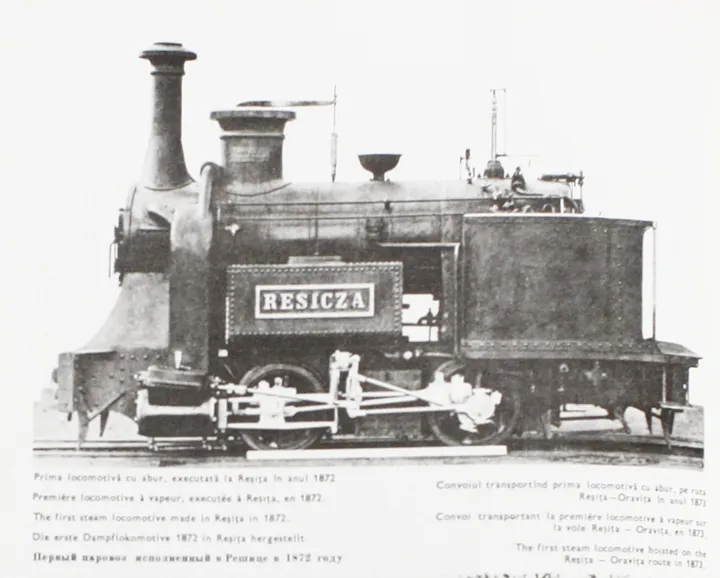
The locomotive Unknown photographer, 1872 · Wikimedia Commons - The first steam locomotive built at Reșița, 1872.
- Unknown photographer; the country was learning to build its own trains.
- Meanwhile, the Strousberg lines were changing masters.

Images via Wikimedia Commons (public domain). The dates are the plates'.
The affair in six numbers
Every number below comes from the cited sources. The 12 years are the editors' arithmetic: 1880 minus 1868.
- 915
- kilometres promised by decree
- 90
- years of concession on paper
- 7.5
- state-guaranteed interest, per year
- 4
- sections in the decree
- 921
- kilometres bought back in 1880
- 12
- from law to buyback
Three things people get wrong
'The foreigners robbed us'
The paper was Romanian: the law of 10 September 1868 and the 7.5% guarantee were the state's signature, not a highway robbery. The scandal came afterwards — when the guarantee fell due, and a private bankruptcy became public debt.
'Carol abdicated in 1871'
He did not abdicate. He prepared to do so on the evening and night of 22–23 March 1871, but Lascăr Catargiu's new conservative cabinet persuaded him to stay — and the conservatives governed until 1876.
'The Strousberg lines never ran'
False: in 1880 the state bought back 921 km in operation, rolling stock and installations included, and on 1 July 1882 Romania's network was unified. Xenopol was right: the main artery of communication had passed into the country's hands.
Sources and method
The story follows the 1868 law and decree, the CFR chronology and the press of the day, with dates checked in the cited histories. Where the sources proved unreachable — the price per kilometre, a particular 1871 insolvency date, Bismarck's letters — the page claims nothing: the gaps are logged as undocumented in SOURCES.md.
The era's Romanian dates are Old Style, 12 days behind the New Style; the page gives them as the sources give them. The concessionaire's name appears in documents as 'Strussberg' too — the person is Bethel Henry Strousberg.
All six images are public domain, via Wikimedia Commons, with the licence verified on each file. The era's anti-German and antisemitic rhetoric is described through historians, never reproduced.
The Concession
The Bankruptcy
The Throne
The Buyback
Images
- Unknown photographer · Wikimedia Commons
- Contemporary print, 1866 · Wikimedia Commons
- Franz von Lenbach, 1871 · Wikimedia Commons
- Ghimpele, 1872 · Wikimedia Commons
- Ciulinul, 19 August 1884 · Wikimedia Commons
- Unknown photographer, 1872 · Wikimedia Commons