
Loading 269,284 lights…
Drag to move, scroll or pinch to zoom, click to see what was named from a place.
This map needs WebGL. The text and figures still work.
A map of type specimens
The atlas of noveltyWhere the specimens behind 269,284 species names were collected, and how long each waited for its name
Each light marks the place where the specimen that carries a species’ name was collected, before it went into a museum drawer. A fern collected in the Dominican Republic in 1929 waited until 2011 for its name. The brightest patches show where collectors went and whose museums mapped their finds. Pick any place to see what was named from there.
Each new name is tied to one specimen#
When a scientist names a new species today, the name is tied to one specimen, the holotype: in the words of the zoological code, “the single specimen upon which a new nominal species-group taxon is based in the original publication”. The botanical code has a similar rule; many older names rest on several specimens instead. The holotype stays in a museum or herbarium with a label saying where and when it was collected. That place is the species’ type locality, and it is where its light sits on this map.
GBIF, the global biodiversity database, holds 1,079,639 records flagged as holotypes. 433,042 of them have coordinates. Leaving out fossils and keeping one record per species name gives 269,284 lights.
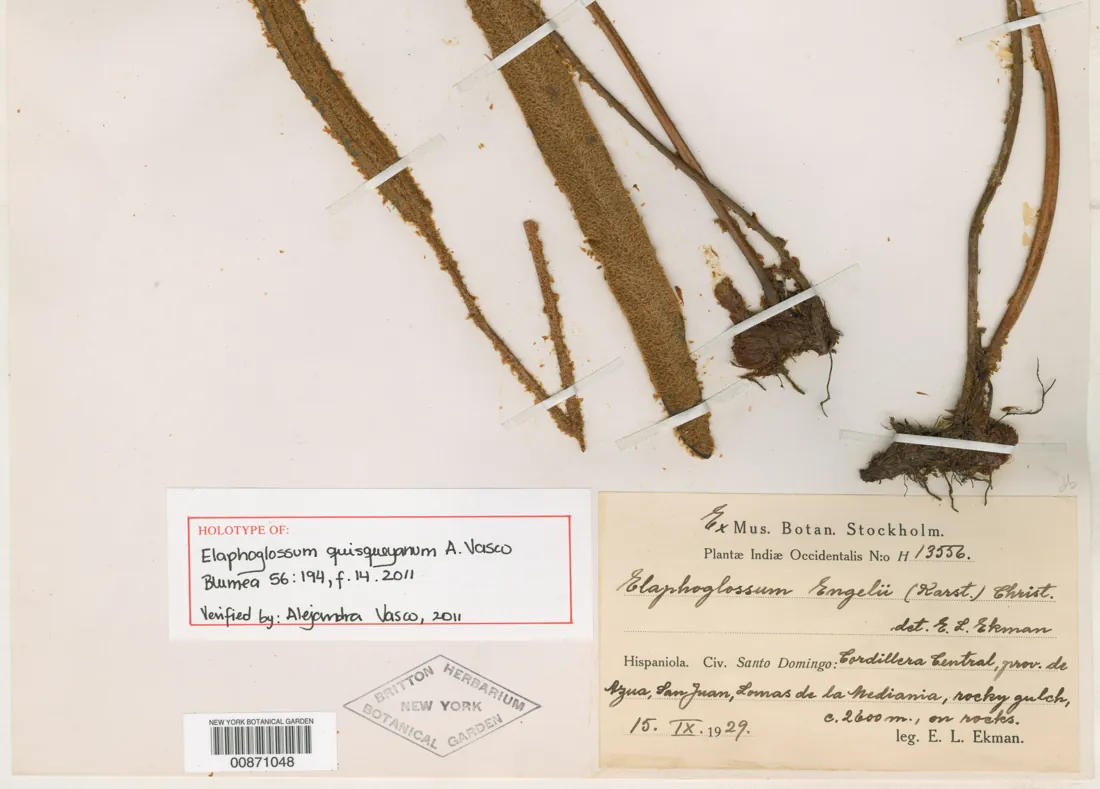
Collected on 15 September 1929 by Erik Ekman, on rocks at about 2,600 m in the Cordillera Central of the Dominican Republic. Ekman filed it under a species already known. In 2011 the botanist Alejandra Vasco saw that it was new and named it Elaphoglossum quisqueyanum, 82 years later. Another specimen of the same fern, collected in 1912, had waited 99 years.
Holotype NY 00871048, New York Botanical Garden, CC BY 4.0
Two and a half centuries of names#
Scroll and the years run from 1758, the year from which animal names count. A dim light is a specimen already collected for a species that has no name yet. It brightens in the year the name is published.
In 1990 at least 28,175 of these specimens were already in collections, waiting for names they got later. After 2000 the dim lights fade: many of the names they will get have not been published yet.
Names whose year is not in the record, most of them fungi, appear only at the end.
Keep scrolling: the years run as you read.
How long does a new species wait for its name?#
Guess first. Between the day its holotype was collected and the year its name was published, how long does a typical species wait?
Half of the 162,625 species whose holotype carries both dates waited 8 years or longer. One in five (20%) waited more than 20 years, and 3.5% more than half a century.
The real wait since discovery is longer. The holotype is often not the first specimen of its species: in a study of species named in 2007, Benoît Fontaine and colleagues counted from the earliest specimen cited in each description and found a median of 12 years. For names published in 2007, the holotypes on this map waited a median of 11 years.
The wait grew during the 20th century#
For names published from 1900 to 1909, the holotype had typically been collected 4 years earlier. For names published from 2000 to 2009 it was 10, and 26% waited more than 20 years, against 7% a century before.
The rise shows for animals (3 years then, 10 in 2000–2009) and for plants (5 then; 12, 10 and 8 in the three decades since 2000). Fontaine’s team argued that most of the wait is spent “resting in museum drawers, waiting for an available specialist”.
Median wait Middle half
Long waits, checked one by one#
In the database, 485 names show a wait of more than a century, but the longest waits are often typing errors: a catalogue number read as a year, or the year of a later name. These were checked against the specimen’s label, the museum’s own catalogue or the description.
- 85yearsLepidopora decipiens · hydrocoral
collected 1879, named 1964 · off Guadeloupe, collected by the US survey ship Blake - 82yearsElaphoglossum quisqueyanum · fern
collected 1929, named 2011 · Dominican Republic, by Erik Ekman - 68yearsLepidopora clavigera · hydrocoral
collected 1918, named 1986 · off Barbados, by Charles Nutting - 59yearsAsteron tasmaniense · spider
collected 1942, named 2001 · Tasmania, by V. V. Hickman - 58yearsCoenypha trapezium · spider
collected 1965, named 2023 · Neuquén, Argentina, by A. Giai - 53yearsErythroneura bakeri · leafhopper
collected 1954, named 2007 · Illinois, by Herbert H. Ross - 51yearsNarella laxa · deep-sea coral
collected 1885, named 1936 · south of Georges Bank, trawled by the steamer Albatross
Why Australia shines brighter than the Congo#
More than one light in four (30%) lies in the United States or Australia. It shows which museums have put coordinates on their type specimens and shared them. Another 637,511 holotype records in GBIF have no coordinates at all, including 109,431 from South America, 94,110 from North America, 80,439 from Asia and 62,350 from Africa.
Of the mapped holotypes outside those two countries, most have come from the tropics for a century: 64% of the names published from 1900 to 1924, and 68% of those published from 2000 to 2024.
What the map cannot show#
The holotypes without coordinates are not on the map. Of the 21,549 fungus names on the map, only 1,558 carry a naming year, because the sources used here give none for fungi.
And most of Earth’s species have no holotype at all yet. A 2011 estimate by Camilo Mora and colleagues put the total at about 8.7 million species of plants, animals, fungi and other complex life, and suggested that 86% of them still await description. Estimates vary widely, and most suggest that the majority of species have no name yet.
What was named from your area?#
Pick any place on the map, use your location, or type a town. The answer counts species names whose holotype was collected within 50 km (150 km where there are fewer than ten).
Or pick any place on the map.
Try: · · · ·
126 species names rest on holotypes collected within 50 km of London.
The most recent: Chalarus zyginae, collected in 1938 and named in 1992.
How the map was made#
Every point is a GBIF occurrence flagged as a holotype with clean coordinates (433,042 records, downloaded on 18 October 2026). Where several databases carry the same holotype, only the most complete record for each species name is used. Subspecies, varieties and fossils were left out.
The year a name was published comes from its own author citation for animals (only when the database matched the record to the same name) and from Kew’s World Checklist of Vascular Plants for plants, using the year of the original name when a plant was later moved to another genus. The wait is that year minus the year the holotype was collected. 11,503 names whose naming year came before the collection year, an error in one of the two fields, were left out of the waits.
Errors remain. The longest waits in the database are often wrong (a catalogue number read as a year, or a genus’s author taken for the species’), so the waits named on this page were checked one by one. The medians barely move when the tail changes.
What no one has checked
No one has verified each of the 269,284 points. A light marks where the database says the holotype was collected; for old specimens that place was often worked out later from a label.
Sources#
- GBIF occurrence search: holotypes with coordinates
- Fontaine, Perrard & Bouchet (2012), 21 years of shelf life between discovery and description of new species, Current Biology
- Mora et al. (2011), How many species are there on Earth and in the ocean?, PLoS Biology
- International Code of Zoological Nomenclature, Articles 73 and 76
- Kew, World Checklist of Vascular Plants
- NOAA ETOPO1 relief
- Šavrič, Patterson & Jenny (2018), The Equal Earth map projection