


43
days on foot, from Cârțișoara to Rome
1,916 km between schematic waypoints
about 45 km per day if the schematic route is divided by 43 days; his actual pace is unknown
Cârțișoara–Rome, 1849 – 1911
In 1867 a shepherd boy learned to read from another shepherd; for thirty years he carried Romanian books over the Făgăraș. In January 1896 he set off on foot for Rome – a reported 43 days, with 1,916 km between schematic map waypoints – to sleep at Trajan's Column.
Representative road
In 1867 a shepherd boy took his forty sheep over the mountains and learned to read; for thirty years he carried books back the other way. In January 1896 he set off on foot for Rome, and in October 1899 he laid the Orientalists' wreath at Trajan's Column.
The roads on the map are representative lines; the dates and figures are the sources' own.
Chapter I
1849 – 1882 · 1849–1882, the making
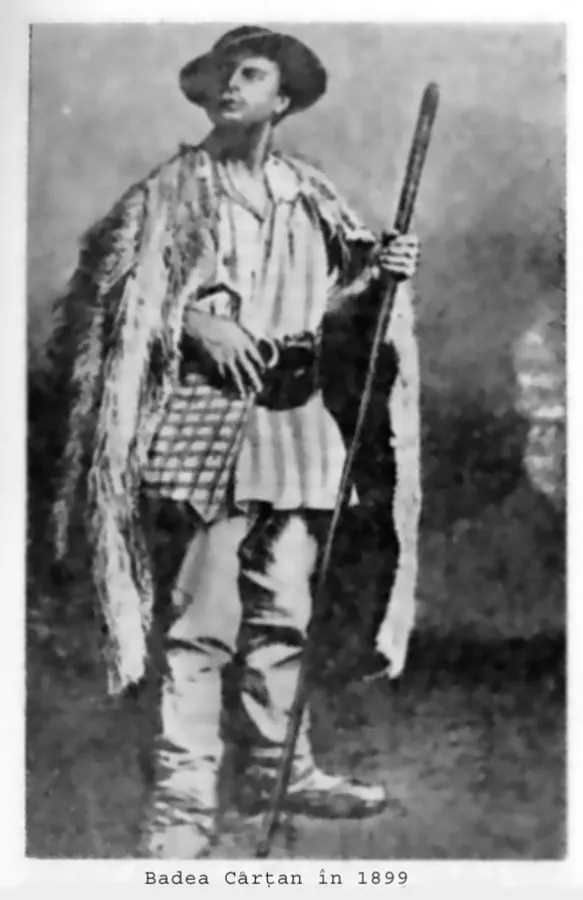
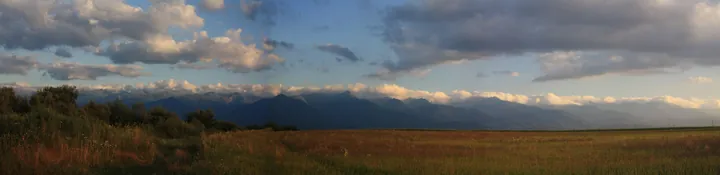
He was born in 1849 at Cârțișoara, in the Făgăraș country, into a shepherd household that smelled of the sheepfold and kept its children out of school; at eleven he was already pasturing sheep up the mountain. In 1864, still a boy, he crossed the imperial border with the flock, illegally, to see with his own eyes the country where his free Romanian brothers lived.
On 23 May 1867 he took his forty inherited sheep and crossed into Romania with Ion Cotigă, a Brașov intellectual turned shepherd by choice. Cotigă taught him some history and philosophy, then reading and writing – Plato and Socrates, Livy and Herodotus, and Trajan and Decebal, the forefathers of the Romanian people.
Armies interrupted the lessons: in 1877 the Romanian Army took his 1,200 sheep and he volunteered for the Independence War without ever reaching the battlefield; then the imperial army drafted him to the 31st Infantry at Zemun and Bosnia-Herzegovina, where he learned German. Discharged on 8 May 1881, he returned to Transylvania in the spring of 1882 with 400 sheep – and lost them all to fines.
He learned to read while he walked the sheep out to pasture.
Radio România Cultural, 7 August 2020
Meanwhile Across the mountains, Romania won its independence in the war of 1877–1878 – the war he volunteered for.
Chapter II
1882 – 1906 · 1882–1906, the smuggling
On a moonless night, on a Făgăraș path known only to him, he climbed toward the ridge with his traista full of Romanian books from the Old Kingdom. So he walked for over thirty years, for pupils, priests, teachers and peasants: tradition speaks of over 250,000 copies weighing over 20 tonnes; the English histories say 200,000.
The empire answered with searches, confiscations and arrests: any writing that mentioned Romanian history was banned, and in May 1894 he was arrested and beaten at Cluj for attending the Memorandists' trial – a mere shepherd could not be there on his own initiative, the gendarmes reasoned.
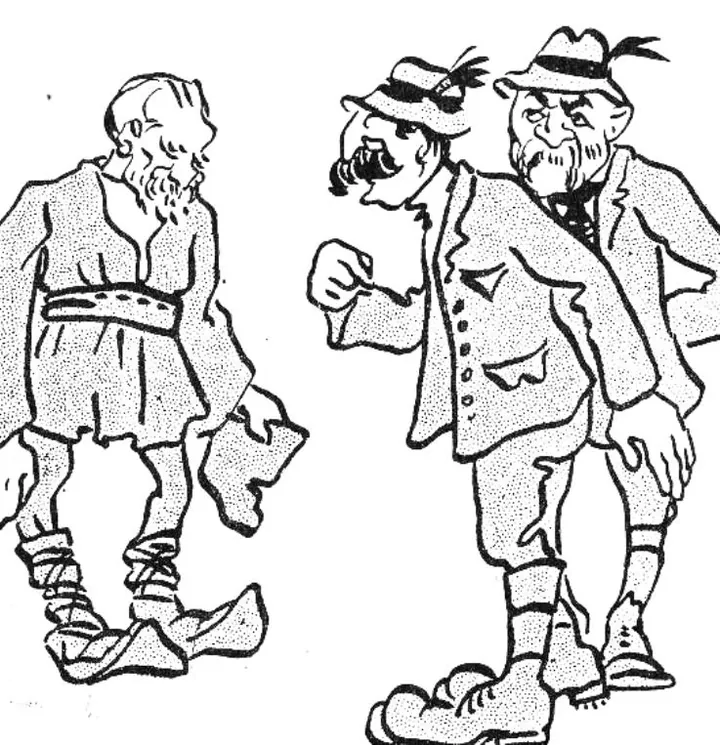
The documented floor stands: on 15 December 1905 the gendarmes seized 4,000 volumes in five languages, bringing the confiscated total to 70,000; the indictment of 25 March 1906 recommended heavy prison years, but the trial was stopped and the books – after a year-long trial of their own – were burned.
He is said to have carried, for over 30 years, over the mountains to Ardeal, more than 250,000 copies of books written in Romanian, weighing over 20 tonnes.
Radio România Cultural, 7 August 2020
Meanwhile At Cluj, the Memorandum trial of May 1894 put the whole national movement in the dock.
Chapter III
1896 · 1896, the walk
On a frosty January morning in 1896 he tied his traista to his back – a fistful of home soil and wheat grains for the Roman forefathers, plus the recommendation letters of professor Urechia, who backed him morally and financially – and set off on foot for Rome, through Timișoara, Szeged, Budapest, Vienna, Salzburg, Innsbruck and Genoa: 1,916 km summed between this map’s schematic waypoints, without a measurement of his actual road.
He walked 20 days to Vienna and 23 more to Rome: 43 days in all, arriving on 15 February. He went first to Trajan's Column, scattered the Romanian soil and wheat at its base as an offering, then lay down at the Column's feet and slept until morning.
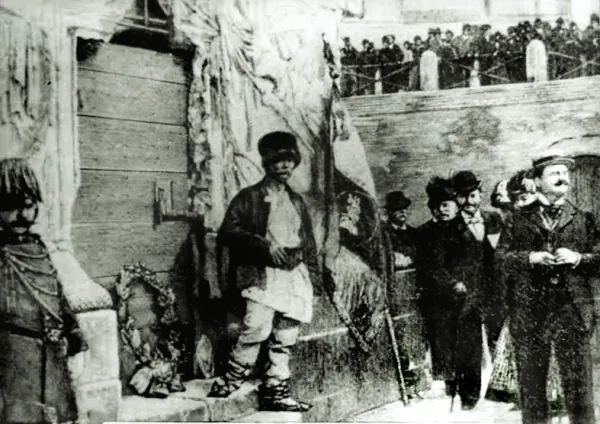
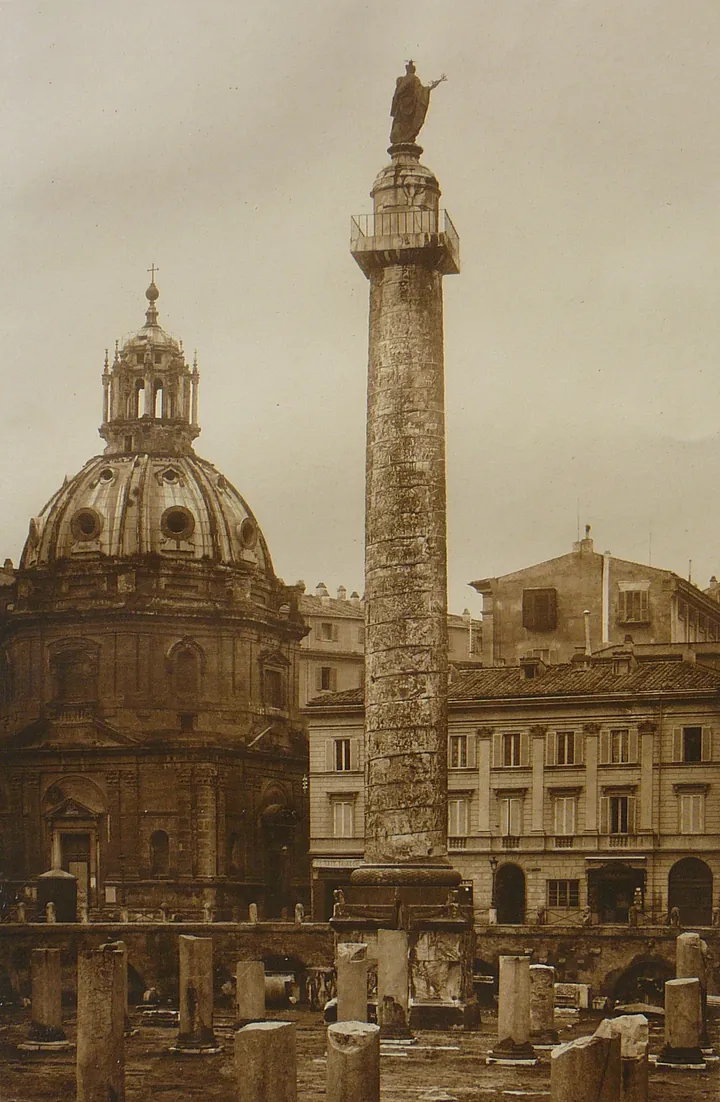
Morning brought a crowd: seeing the folk costume, someone exclaimed that a Dacian had come down off the Column, the Roman press wrote him up, and Duiliu Zamfirescu – Romania's minister in Italy – lodged him and introduced him to professors, journalists, artists, deputies and senators. After a month in Rome he travelled homeward; on 18 March 1896 he was in Bucharest again, professor Urechia's guest.
A Dacian came down off the Column: long hair, shirt and cap, leggings and peasant sandals.
The Rome press, February 1896
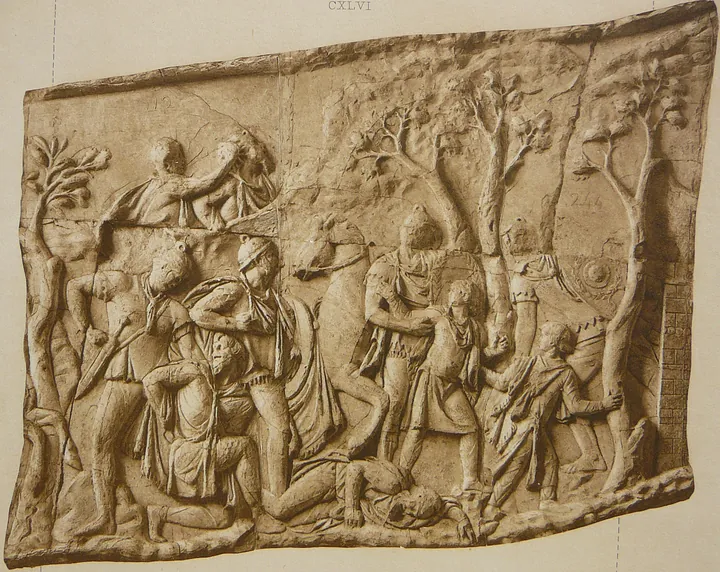
Meanwhile At Leipzig, Cichorius began publishing the Column's photographic corpus in 1896 – the plates shown here.
Chapter IV
1896 – 1911 · 1896–1911, the envoy
Rome had made him famous, and the road kept him: in August 1896, in a Paris lecture hall, professor Emil Picot of the School of Oriental Languages presented the Romanian shepherd, arrived via Vienna, to French students; Belgium, Jerusalem and Rome again followed.
In October 1899 Rome hosted the 12th congress of the Orientalists, over 700 delegates from 40 countries, with a Romanian party led by professor Urechia; senator Angelo Gubernatis proposed that Cârțan himself, in his shepherd's folk costume, lay the congress's laurel wreath at Trajan's Column.
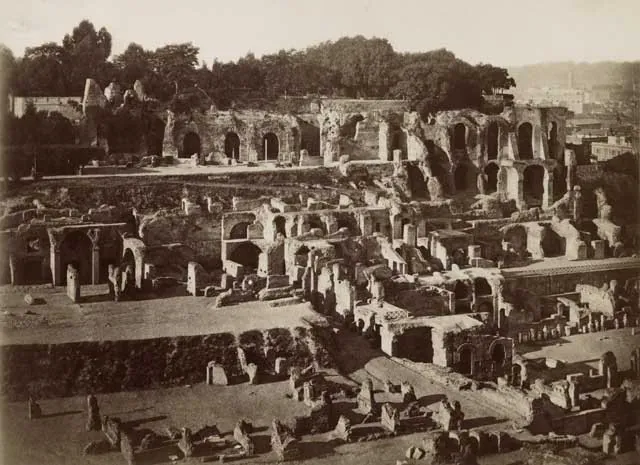
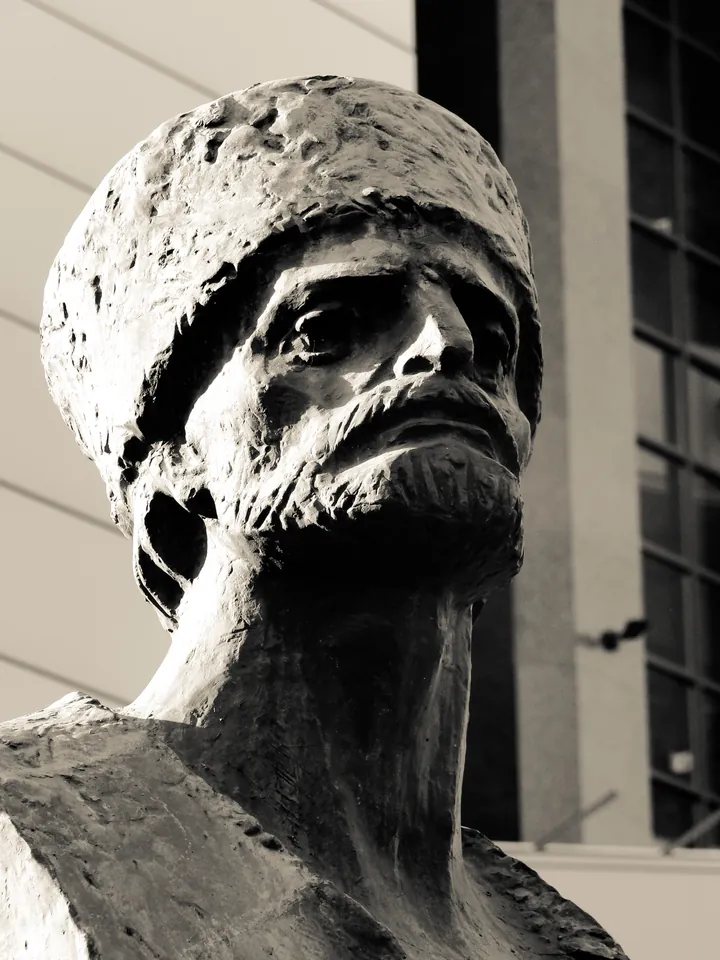
He spent his last years between Ardeal and Romania, still hounded: the Putna gathering of 2 July 1904, a winter-1910 avalanche that buried him for three days, and in July 1911 the house of Mrs. Lahovari at Poiana Țapului, where a doctor saw his days were numbered. He died on 7 August 1911 and sleeps at Sinaia in shepherd's dress, under a stone cross: here lies Badea Cârțan, dreaming of the unity of his people.
Here lies Badea Cârțan dreaming of the unity of his people.
The stone cross at Sinaia
Meanwhile Transylvania was still seven years from its 1918 union with Romania when he died at Sinaia.
The days and the books, seen from above.
43
days on foot, from Cârțișoara to Rome
1,916 km between schematic waypoints
about 45 km per day if the schematic route is divided by 43 days; his actual pace is unknown
70,000
volumes seized by the gendarmes
over 6 a day, day after day, 30 years running
burned after a trial of their own that lasted a year
15 February 1896 · at the Column's base
It is the evening of 15 February 1896, at the Column's base. The sack, the road, the night, the price – four decisions, then the verdict.
1
January 1896: what goes in the traista for the Rome road?
Soil and wheat: an offering for the Roman forefathers, scattered at the Column's base.
2
Cârțișoara to Rome, on foot, in the winter of 1896:
20 to Vienna and 23 to Rome: 43 days in all – the English histories say 45.
3
The evening of 15 February 1896, at Trajan's Column:
The offering and the sleep; the wreath came only in October 1899, from the Orientalists' congress.
4
What did the book roads cost him?
4,000 volumes seized on 15 December 1905, 70,000 in all – burned after a year-long trial of their own.
Answer a card to begin.
A face, a mountain wall, a newspaper caricature, a photograph from Rome, the Column, the Forum, a bust – the shepherd in seven guises.
Images via Wikimedia Commons (public domain, CC0 or CC BY-SA with attribution). Dates are the plates' own.
Every figure comes from the cited sources; the years are the road's own column, 1849–1911.
No: illiterate into his teens, then self-taught – he learned to read pasturing sheep, studied history with Ion Cotigă, and was received by Urechia, Tocilescu, Iorga, Zamfirescu and Gubernatis; in Paris, Emil Picot presented him to French students. He even wrote verse.
No: in February 1896 he scattered home soil and wheat at the Column and slept at its base. The laurel wreath came in October 1899, laid by him on behalf of the Orientalists' congress – Gubernatis's proposal.
No source counts them exactly: tradition says over 250,000 copies and 20 tonnes, the English histories say 200,000, and the Romanian history says hundreds. What is documented is the floor – 70,000 volumes confiscated, then burned.
The story follows the Radio România Cultural portrait against the English and Romanian histories; the walk's dates are the 20 days to Vienna and 23 to Rome, the wreath is October 1899. All eight images are public domain, CC0 or CC BY-SA with attribution, via Wikimedia Commons.
Book totals are quoted with attribution everywhere they appear: tradition's 250,000 copies and 20 tonnes, the English 200,000, the documented 70,000 confiscated. The birth day is 24 January with the 19 January variant noted; the walk is 43 days with the English 45 noted.
Day dates follow the sources; city names follow the era. The 1,916 km is the sum of great-circle distances between successive waypoints in the schematic route shown on the map. It is neither the direct Cârțișoara–Rome distance nor the length Cârțan actually walked. The drawn curve smooths those segments; it does not measure paths, roads or changes in elevation. Dividing by the reported 43 days gives about 45 km per day for this schematic route only, without establishing his actual pace.