BARTHOLOMEW FAIR · SMITHFIELD · 1133–1855
Bill the fair. Bury the fair.
Seven centuries of fair on one field: cloth first, then players, then wonders, then gingerbread — and no single order ever killed it. Bill each century’s fair from the sources, then judge what closed Smithfield after the last proclamation in 1855.
A cloth fair chartered in 1133, three days at Bartholomew-tide, became London’s biggest party — and the City put it quietly away. Bill four fairs from four centuries of sources, walk the fifteen years that ended it, and give the verdict the rails support.
Cloth, then players
Two bills to start: 1400 sells cloth, cattle, and justice by the day — the shows come later, and the game refuses them with dates. 1600 brings Jonson’s fair on stage and Pepys’s fair in the diary: gingerbread, pigs, ropes, and Punch.
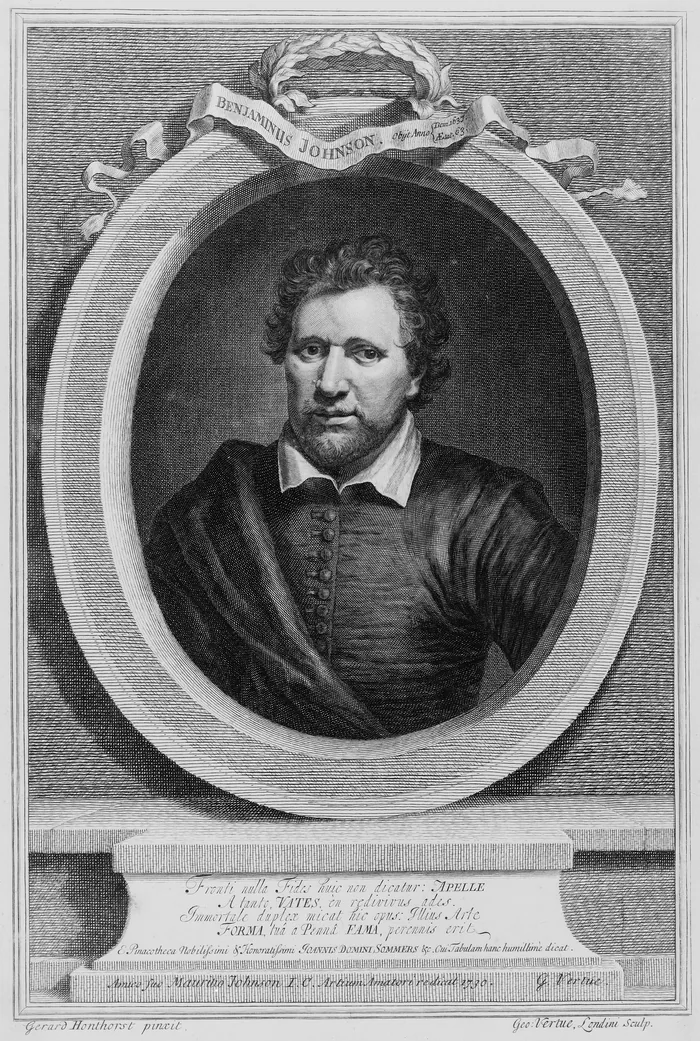
Figure receipt
1730 · Commons PD · Public domain
Bill all four fairs
Pick what belongs on each bill — cloth or conjuror? The sources judge every pick, and each finished bill unlocks the next century.
Wonders, then last orders
1700 fills Smithfield with drolls, wax-work, rope queens, and conjurors — Ward walks in, the papers advertise, and the 1721 fan remembers Fawkes. 1850 is Hone’s fair, priced by the penny: Richardson’s theatre, Toby the learned pig, and a two-headed child at the Globe Coffee House.
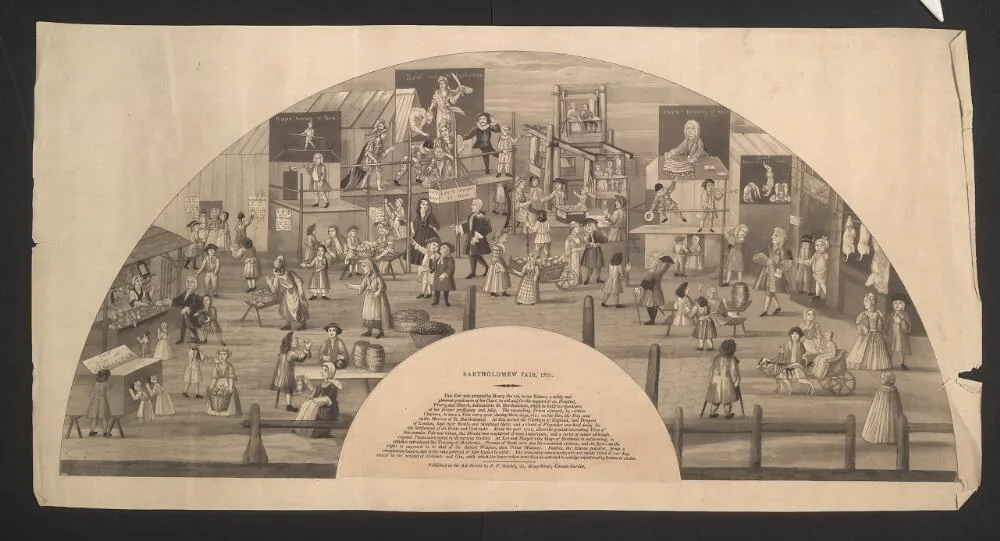
Figure receipt
1721 · Bodleian via Commons · Public domain
Two rails, one field
The charter rail runs from Henry I’s three days to the last court entry; the bill rail from Jonson’s gingerbread to Hone’s twenty-two bills. Every row dated, every row sourced.
The performed set
Every billed act, in bill order.
1400 — Clothiers’ booths → Stow lists the booths, 1598.
1400
1400 — Cattle fair → City ground rights, settled 1453.
1400
1400 — Pie-powder court → Daily court, Stow 1598.
1400
1400 — Mayor’s opening sports → Pepys calls it ‘old custome’, 1663.
1400
1600 — Gilt gingerbread → Joan Trash’s cry, Jonson 1614.
1600
1600 — Bartholomew pig → Jonson 1614; Pye Corner 1641.
1600
1600 — Hobby-horses → Leatherhead’s cry, Jonson 1614.
1600
1600 — Rope-dancers → Pepys and the Italians, 5 Sept 1661.
1600
1600 — Punch → Pepys sees Polichinelli, 1667.
1600
1700 — Drolls → Ward walks in, 1699.
1700
1700 — Wax-work → Hospital Gate, Ward 1699.
1700
1700 — Lady Mary on the rope → As advertised, 1701.
1700
1700 — Turkish wire-walker → Daily Advertiser, August 1744.
1700
1700 — Fawkes the conjuror → On the 1721 fan.
1700
1850 — Richardson’s theatre → Hone counts 1,500 lamps, 1825.
1850
1850 — Toby the learned pig → Hone’s Show XVI, 1825.
1850
1850 — Atkins’s menagerie → Sixpence, Hone 1825.
1850
1850 — Seven-legged mare → Shod on six feet, Hone 1825.
1850
1850 — Two-headed child → Frost transcribes the bill, 1842.
1850
The charter rail
Five dated rows carry what the charter gave and what the City took back.
Three days — eve, feast, morrow — peace to comers and returners
1133 · Henry I’s charter, Barnard translation source
Pickage outside the walls to the City, inside to the prior
1453 · City–prior agreement, Letter-Book K source
Booths in the churchyard, gates locked nightly, Pie-powder daily
1598 · Stow’s Survey source
Licences fall: eighty-seven booths in 1790, three in 1850
1790–1850 · Smithfield Court Book via Webb source
The Lord Mayor not having proclaimed the fair, the court was not held
2 September 1854 · The last Pie-powder entry source
The bill rail
Six dated rows carry what the fair showed, from Jonson’s gingerbread to the last penny bill.
Jonson’s fair-types — gingerbread, pigs, hobby-horses — acted at the Hope
1614 · Jonson, Bartholomew Fayre source
Pigges piping hot at Pye-Corner
1641 · Bartholomew Faire tract via Hone source
The Italians dancing the ropes; the mare that tells money, 12d
1661–1668 · Pepys’s Diary source
Drolls, wax-work at the Hospital Gate, and the mousetrap cry
1699 · Ward, London Spy source
Twenty-two bills, priced by the penny, Richardson’s at sixpence
1825 · Hone’s visit source
Female child with two perfect heads — admission 1d
1842 · The last bill via Frost source
Your fair, your verdict
One question, three answers: what killed the fair? Pick the verdict the rails support — then ask what your own street’s fair would bill.
Give your verdict
Three answers. The rails support exactly one.
Correct. 1840: the Pearson report is adopted. 1843: all shows banned. 1850: nothing left worth a Mayor’s proclaiming. 1854: the last Pie-powder court. 1855: proclaimed for the last time. No single order — a squeeze, then silence.
Refused. No such order exists in the City records Webb calendared — the mechanism was decline plus non-proclamation. Read the 1854 court entry again.
Refused. The trade left centuries before the fair’s biggest years — 1825 still ran to Show XXII. Commerce paid for the spectacle until the spectacle embarrassed the City.
Seven centuries, in brief
The same four bills, stated plainly. 1400: cloth booths, the cattle fair, the Pie-powder court, the Mayor’s sports (Pepys’s ‘old custom’, 1663). 1600: gingerbread, pigs, hobby-horses, rope-dancers, Punch. 1700: drolls, wax-work, Lady Mary, the Turkish wire-walker, Fawkes. 1850: Richardson’s, Toby, Atkins, the seven-legged mare, the two-headed child. The end: squeezed 1840–43, nothing left 1850, last court 1854, last proclamation 1855. The verdict the rails support: squeezed, then unproclaimed.
The end
Squeeze, silence, street
Three beats, fifteen years. The ground first, then the court book, then what remains.
The squeeze
On 2 July 1840 the City adopts the Pearson report: the fair granted for trade has become gambling-houses and open vice, so abridge it to two clear days, refuse the show-booths — and then omit to proclaim it altogether. By 1843 all shows are prohibited; Wombwell’s menagerie rent climbs from £35 to £80 and more.
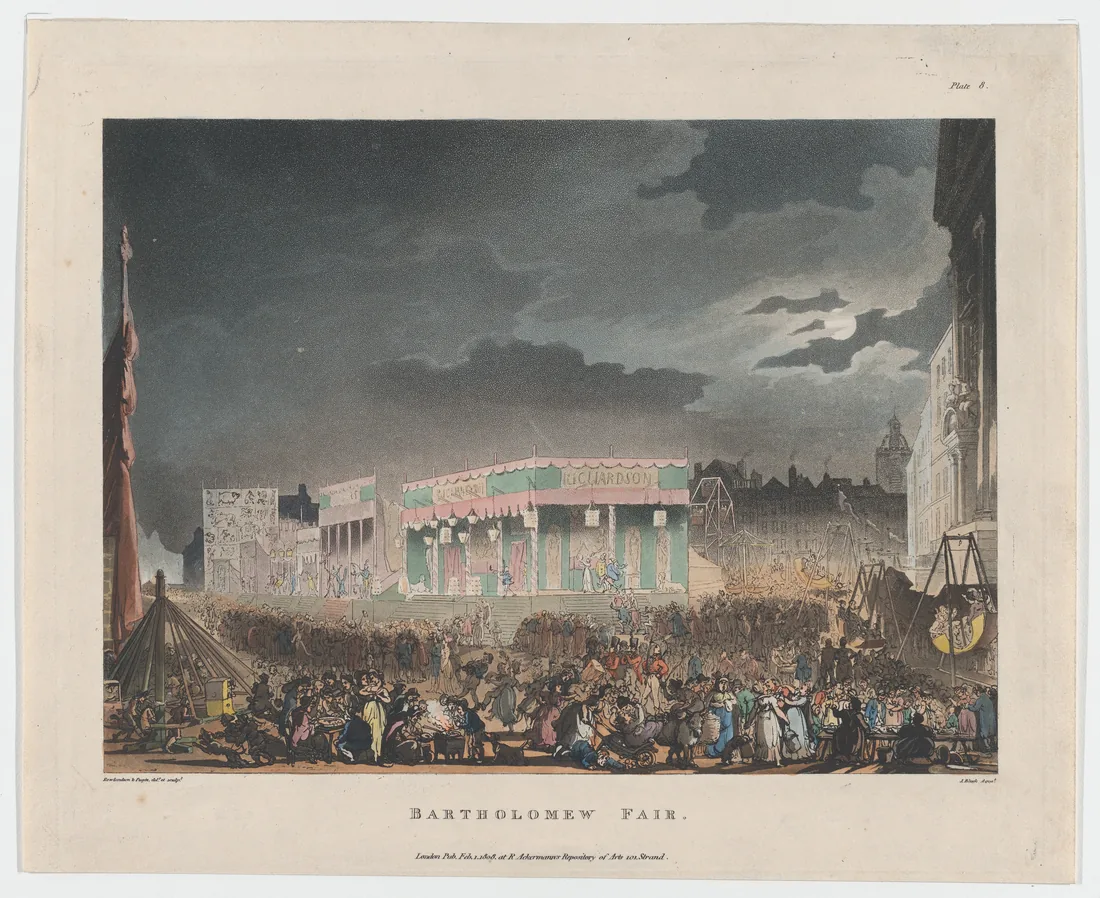
What was squeezed: Bartholomew Fair by night, 1 February 1808 — Richardson’s booth, swings, and the crowd Hone would walk through. Imprint read off this impression. Figure receipt
1808 · Met CC0 · Public domain
Nothing left
In 1850 the Mayor finds nothing left worth proclaiming, and no mayor attends after. The Court Book tells the same story in licences: eighty-seven booths in 1790, three in 1850. Malcolm’s Smithfield, drawn in 1807, shows the ground the fair is leaving: old gables, the priory spires, no booths.
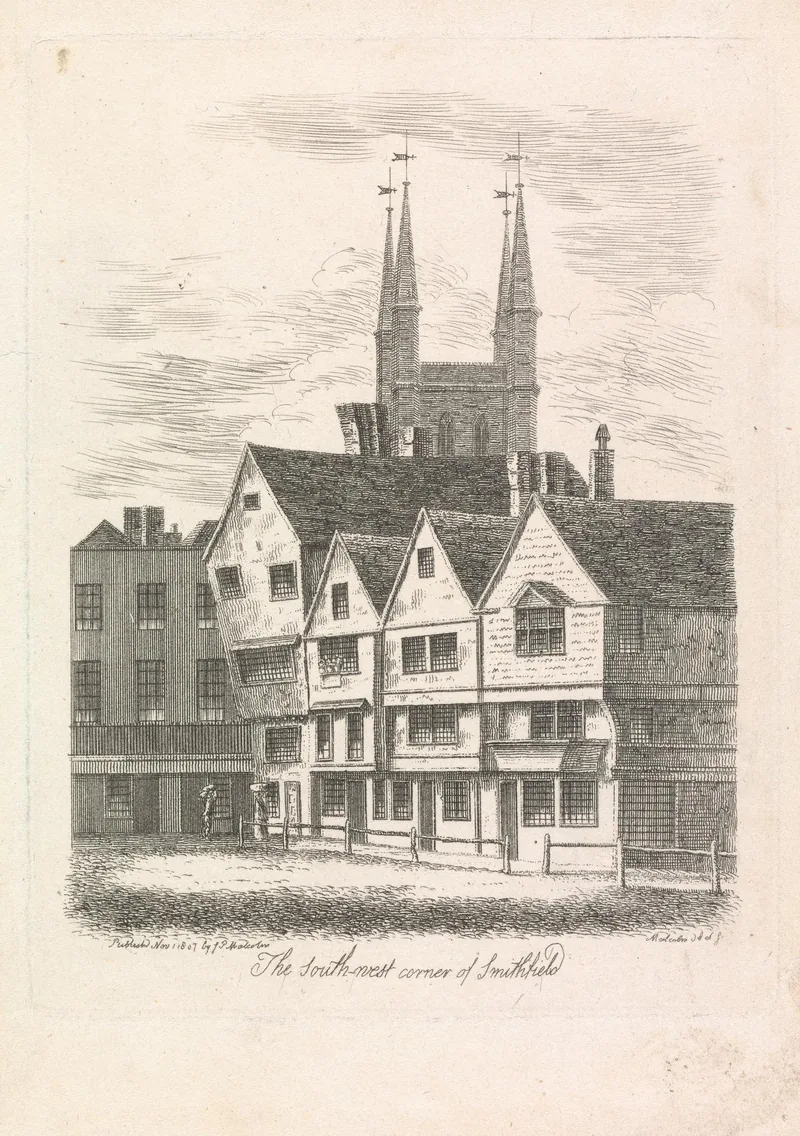
The ground without the fair: Smithfield’s south-west corner, Malcolm 1807. Figure receipt
1807 · YCBA via Commons CC0 · Public domain
Silence
On 2 September 1854 the steward writes the last entry: the Lord Mayor not having proclaimed the fair, the Pie-powder court was not held. In 1855 the fair is proclaimed for the last time — and Morley’s epitaph closes the book: when the nation had outgrown it, a Municipal Court with a few policemen put it quietly away.
The paper
Three days, in the king’s peace
Two passages carry the whole fair: the grant that opened it and the epitaph that closed it.
The charter first, in Barnard’s translation — then Morley, seven centuries later.
- “I grant also my assured peace to persons coming to the fair which is wont at the feast of St. Bartholomew to be held in that place, and to persons thence returning… in that space of three days, to wit on the eve of the feast, on the day itself, and on the following day.”
- “When the nation had outgrown it, a Municipal Court with the help of but a few policemen put it quietly away.”
1133: Henry I’s charter, clause the second. 1859: Morley’s Memoirs, chapter the last.
Cloth Fair keeps the name; the 3s. 6d. fee keeps the receipt.
Sources
Sources and receipts
Every claim here traces to a free text below. Charter translations, fair histories, the play, the diary, the showmen’s press — read them yourself.
Charter and histories
Play, diary, press


Set in open-licensed fonts, served locally.
Go further
Across the river, a different fair:
Answers, dated
Why bill before judging?
Because the fair changed its skin four times — a 1400 answer fails the 1850 question. Bill each century from its own sources, and the verdict means something.
Did one order kill the fair?
No — and that is the trap in the verdict below. The City squeezed the fair through 1840–43, then stopped proclaiming it in 1854–55. No dated banning order exists in the calendared records.
What about Southwark Fair?
A different fair across the river — Hogarth drew it in 1733, and the gin-craze page owns that print. Nothing Southwark is billed here; Yates’s exile seasons there in 1743–44 stay labelled, never billed.
Where did the fair go?
Into a street name and a fee. Cloth Fair still runs where the booths stood, and the Rector of St Bartholomew the Great kept a 3s. 6d. proclamation fee after the last fair of 1855.