GIN CRAZE · LONDON · 1729–1751
Read the pair. Judge the law.
Hogarth drew two streets at once: beer builds, gin ruins. Parliament spent twenty-two years legislating the difference. The numbers move with the duties; no number here moves with a sermon. Attribute the evidence, then judge each Act against what the gallons did next.
One pair of prints, published 1 February 1751 at one shilling each: beer builds its street up, gin lets its lane rot. Place eight fragments — verses and details — on the street they belong to, with Hogarth’s own words correcting you; then call five Gin Acts, 1729 to 1751, and watch duty-paid gallons answer back. Two rails carry the paper: what the law claimed, what answered.
Two streets, one argument
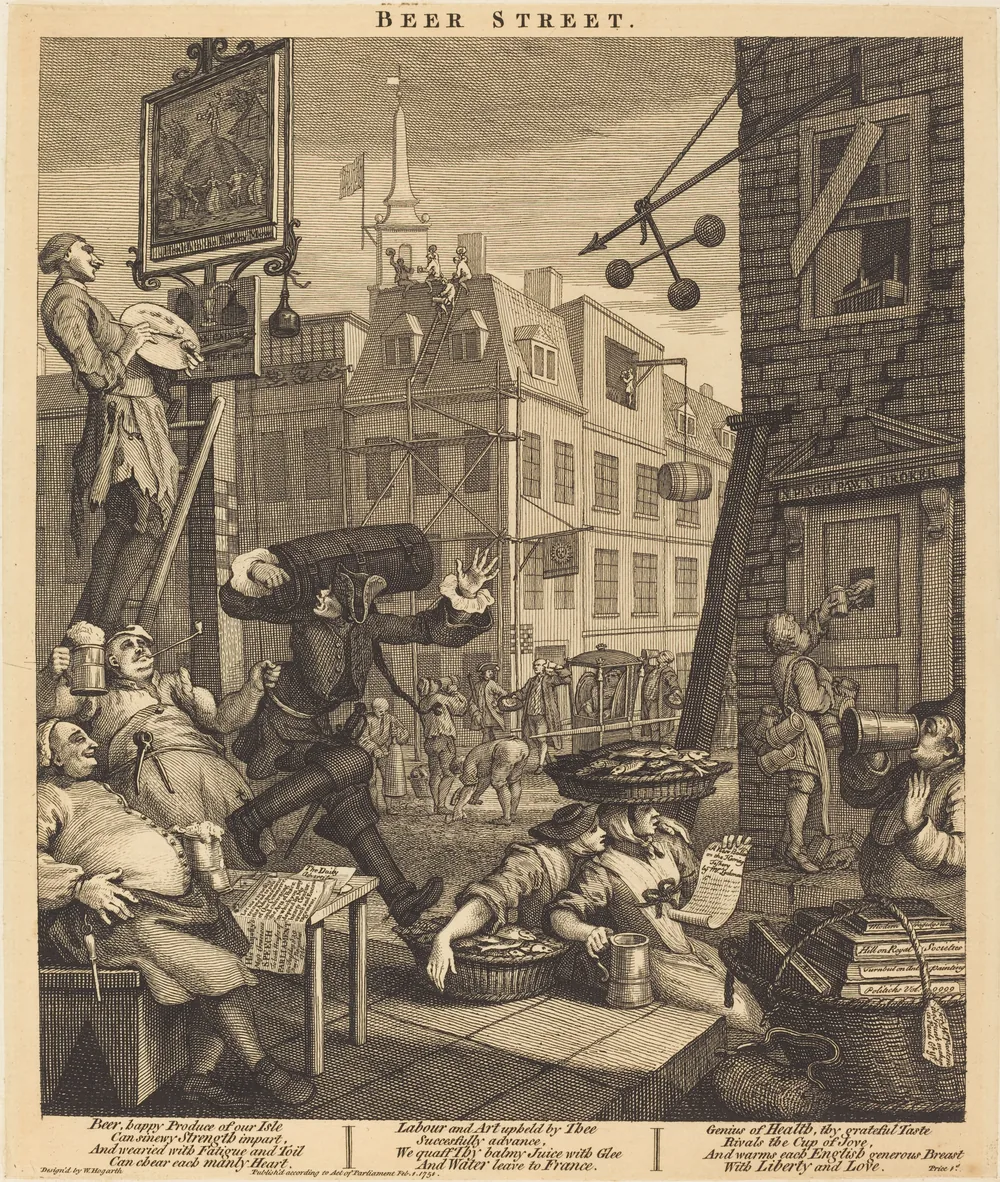
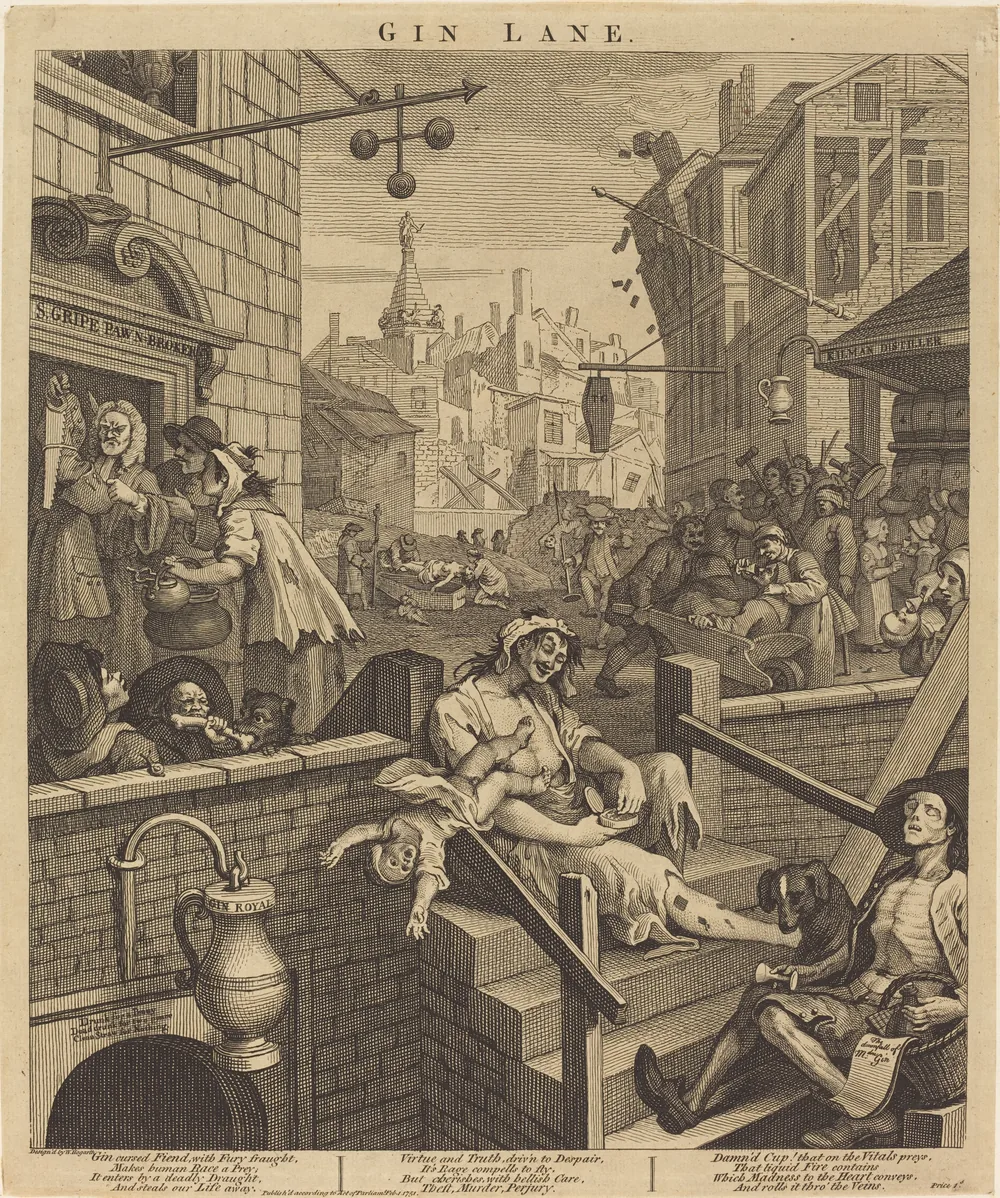
Four verses, four details, two streets. Beer Street and Gin Lane went on sale together on 1 February 1751, one shilling each — Hogarth’s print for terror and his print for contrast, etched for men of the lowest rank. Place each fragment where it belongs; the slider follows your attributions. Four placed unlocks the Acts below.
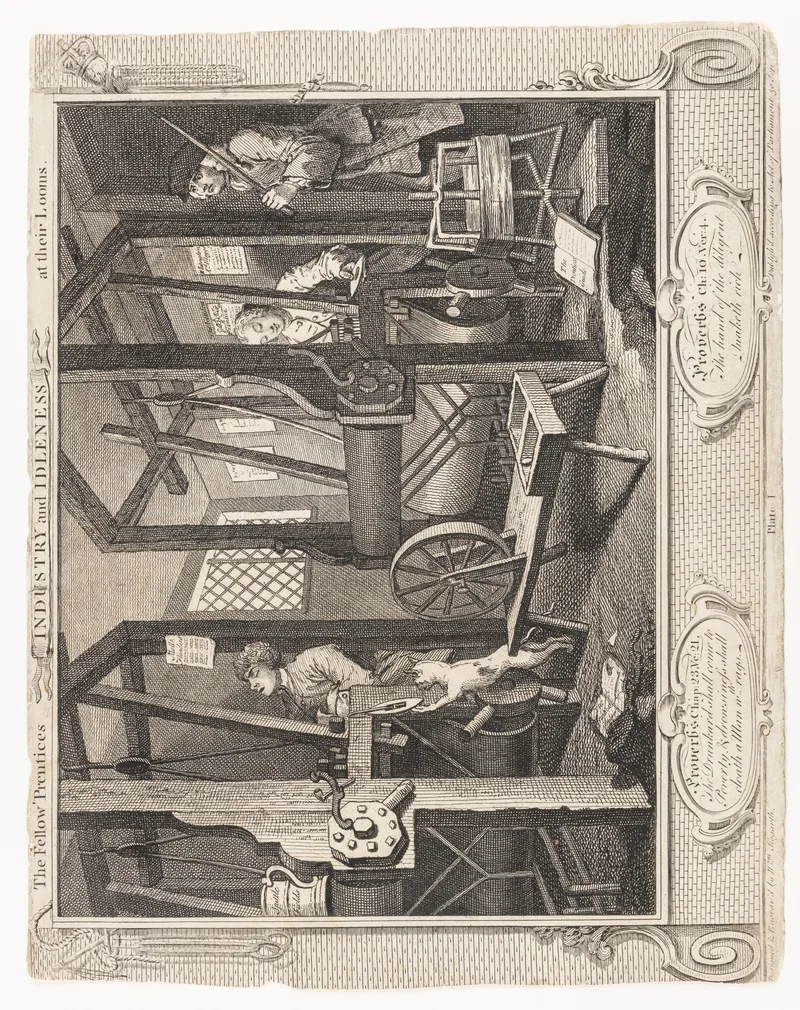
Figure receipt
1747 · Public domain
Place the eight fragments
Verse or detail — Beer or Gin? Hogarth’s own words decide; the slider follows the score.
Five Acts, twenty-two years
From the 5s. gallon duty of 1729 to the settlement of 1751: call each Act — did the gallons fall? The bars are duty-paid spirits charged in England, Webb’s anchors 1684–1758, and Webb’s warning travels with them: trustworthy statistics cannot be given, the illicit stills saw to that. On 29 September 1736 the £50-licence Act bit — and Madam Geneva got a funeral.
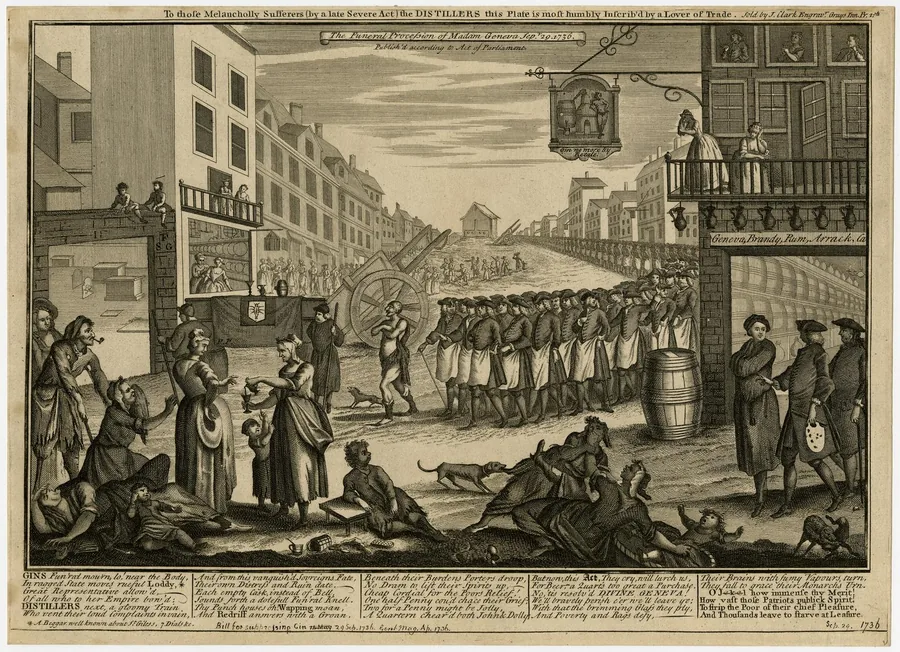
Figure receipt
1736 · BM via Commons · Public domain
Call the five Acts
Predict each Act — gallons fall or rise? — then reveal. Webb’s warning stands: illicit stills hide the true total.
The panic in print
Magistrate, pamphleteer, preacher, satirist: Fielding reckoned more than a hundred thousand poor living on gin, Wilson counted the shops, Maddox adjured the judges, and a mock funeral marched for Madam Geneva. The Old Bailey wrote the footnotes — three trials, two measures and a price. Read them as claims; the next rails carry the answers.
The proof rails, 1729–1758
Two rails. Five dated rows carry what the law claimed, Act by Act. Five dated rows carry what answered back: preambles confessing failure, licences counted, gallons charged. The attributions first, then the paper.
The performed set
The eight attributions and five calls the board gives you to place: fragment, street, and Hogarth’s line; Act, call, and the gallons. The game buttons carry the same lines.
Beer, happy Produce of our Isle → Beer Street — Beer Street — the contrast, “to drive the other out of vogue”.
1 February 1751
And Water leave to France → Beer Street — Beer Street — the happy produce; water is left to France.
1 February 1751
Gin cursed Fiend, with Fury fraught → Gin Lane — Gin Lane — drawn in terrorem: Hogarth’s word for what this street is for.
1 February 1751
Damn’d Cup! that on the Vitals preys → Gin Lane — Gin Lane — the terror print; Beer Street exists to drive it out of vogue.
1 February 1751
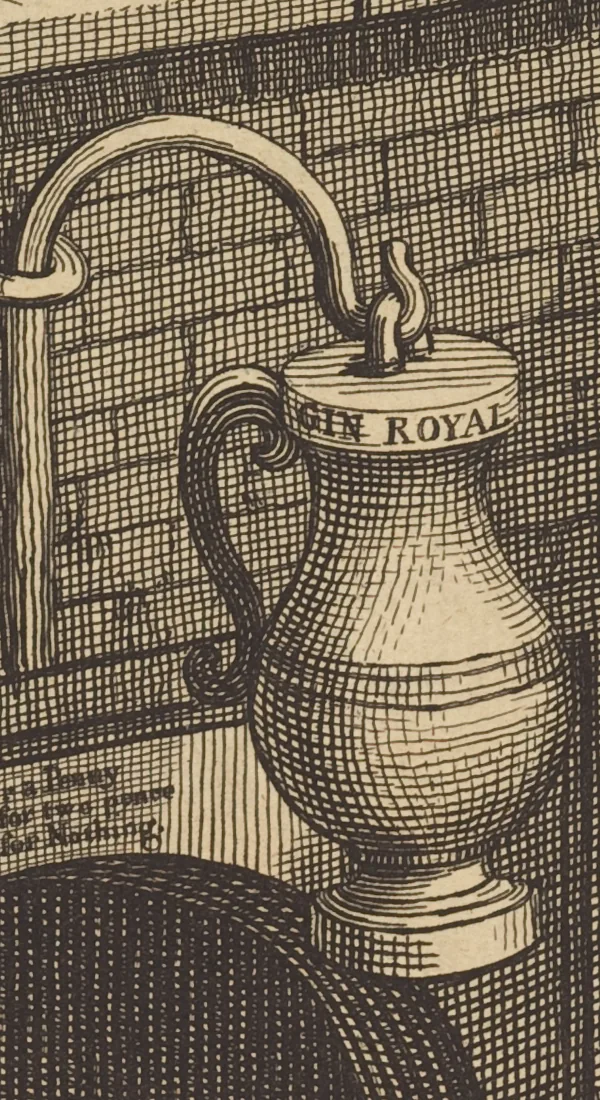
A pump labelled GIN ROYAL → Gin Lane — Gin Lane — the dead-dog pump in the cellar wall, gin on tap.
1 February 1751
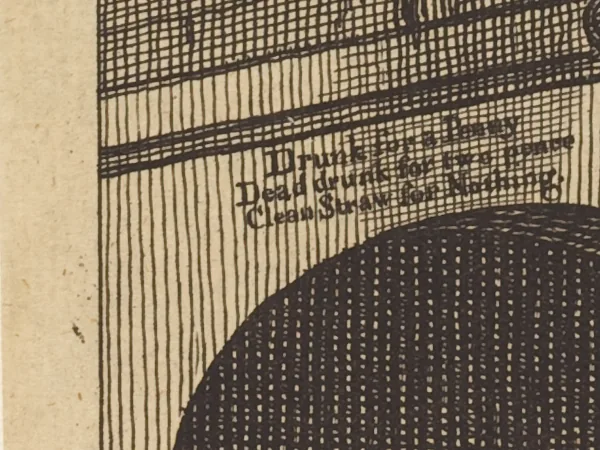
Drunk for a Penny — Dead drunk for Twopence → Gin Lane — Gin Lane — the sign is on the plate, and only the plate is claimed here.
1 February 1751
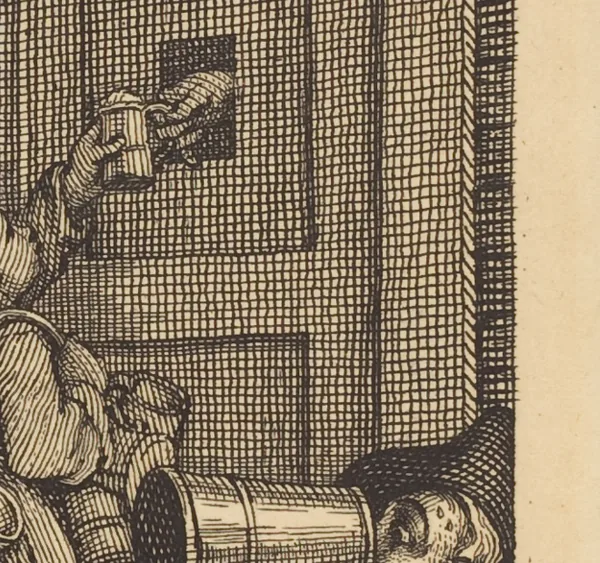
A drinker served through a pawnbroker’s wicket → Beer Street — Beer Street — Pinch the pawnbroker’s wicket, trade thriving through the hatch.
1 February 1751
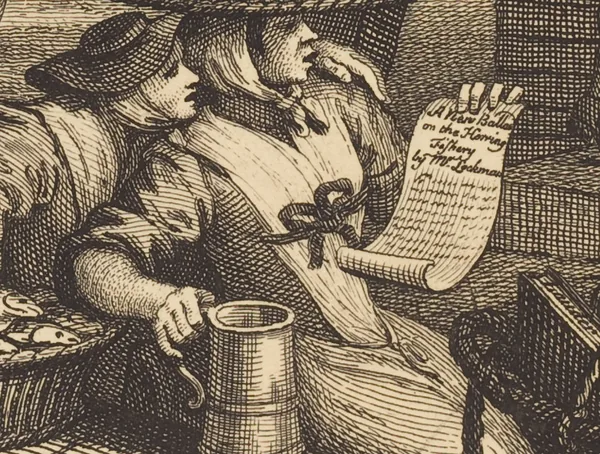
A New Ballad on the Herring Fishery, by Mr. Lockman → Beer Street — Beer Street — the fish-sellers’ ballad sheet, Marian wit for sale.
1 February 1751
1729 — Five shillings a gallon and £20 licences strangle the trade. → No reduction at all: duty-paid gallons rise from 4,612,275 (1727) to 6,074,562 (1734).
2 Geo. 2 c. 17 · in force 25 Dec 1729
1733 — Repeal ends the experiment. → Repealed in 1733 on the barley plea — whilst doing no good, it checked the sale of barley. Duty-paid gallons stood at 6,074,562 by 1734, and rising.
6 Geo. 2 c. 17 · Spirit duties
1736 — £50 licences and 20s. a gallon end retail gin. → Fell three years, then rose faster than before. Only two £50 licences were taken out in seven years.
9 Geo. 2 c. 23 · in force 29 Sept 1736
1743 — Lower duties and £1 licences tame it. → The preamble confesses 1736 ineffectual; gallons keep rising to 7,049,822 by 1751.
16 Geo. 2 c. 8 · in force 25 Mar 1743
1751 — Higher duties and magistrates’ muscle settle it. → Checked by the Acts of 1751 and 1753: 7,049,822 (1751) to 4,483,341 (1752) to 1,849,370 (1758). Duty-paid only — the stills hide the rest.
24 Geo. 2 c. 40 · in force 1 July 1751
The law rail
Five dated rows, 1729–1751: the duties, the repeal, the prohibition, the retreat, the settlement.
5s. a gallon … every retailer … £20 a year … hawking about the streets … expressly prohibited
2 Geo. 2 c. 17, in force 25 December 1729 — Ruffhead abstract source
6 Geo. 2 c. 17, Spirit duties — repeals the 1729 Act outright
Act of 1733 — Chronological Table of the Statutes source
£50 a year licence … 20s. a gallon … no spirits in quantities less than two gallons
9 Geo. 2 c. 23, in force 29 September 1736 — Ruffhead source
the said … Act … hath … been found by Experience … ineffectual to answer the good Purposes thereby intended
16 Geo. 2 c. 8, in force 25 March 1743 — the preamble confesses source
the immoderate Drinking of distilled Spirituous Liquors by Persons of the meanest and lowest Sort … to the great Detriment of the Health and Morals of the common People
24 Geo. 2 c. 40, in force 1 July 1751 — Ruffhead, long-s modernized source
The answer rail
Five dated rows, 1727–1758: no reduction, the barley plea, the three-year fall, the rising retreat, the check.
“no reduction at all” — duty-paid gallons 4,612,275 (1727) to 6,074,562 (1734)
1729 · Sidney Webb — verdict with anchors source
repealed in 1733, “whilst doing no good, it checked the sale of barley to the distillers”
1733 · Sidney Webb on the repeal source
“fall off for the first three years only”, then “at a greater rate than before” — only two £50 licences taken out in seven years
1736 · Sidney Webb — fell, then rose source
duty-paid gallons rose through the retreat: 6,074,562 (1734) to 7,049,822 (1751)
1743 · Sidney Webb’s anchors source
7,049,822 (1751) to 4,483,341 (1752) to 1,849,370 (1758) — “checked by the Acts of 1751 and 1753”
1751 · Sidney Webb on the settlement — duty-paid only source
The duty-paid gallons, Webb’s anchors
| Year | Gallons |
|---|---|
| 1684 | 527,492 |
| 1696 | ≈1,000,000 |
| 1710 | 2,200,721 |
| 1722 | 3,879,695 |
| 1727 | 4,612,275 |
| 1734 | 6,074,562 |
| 1751 | 7,049,822 |
| 1752 | 4,483,341 |
| 1758 | 1,849,370 |
“Trustworthy statistics of the amount of spirits distilled ... cannot be given, owing to ... illicit distilling.” — All figures duty-paid; Webb’s warning travels with them.
Your street, your verdict
One question, three answers: did the law sober London? Pick the verdict the rails support — then ask what your own street’s panic prints would show.
Give your verdict
Three answers. The rails support exactly one.
Correct. Duty-paid gallons fell from 7,049,822 in 1751 to 4,483,341 in 1752 to 1,849,370 in 1758 — the Acts of 1751 and 1753 checked the trade, with Webb’s warning attached: the stills hide the true total.
Refused. They rose through 1729, 1733 and 1743 — then fell by three quarters after 1751. Read the 1751 reveal again.
Refused. No rail row measures fear; every number here moves with duties. Hogarth drew in terrorem — Parliament collected in shillings.
The whole panic, in brief
The same two streets, stated plainly. Beer Street takes “Beer, happy Produce of our Isle”, “And Water leave to France”, the pawnbroker’s wicket, and Lockman’s herring ballad. Gin Lane takes “Gin cursed Fiend, with Fury fraught”, “Damn’d Cup! that on the Vitals preys”, the GIN ROYAL pump, and the penny sign. The five calls: 1729 — no reduction at all; 1733 — repealed on the barley plea; 1736 — fell three years, then rose faster than before; 1743 — the preamble confesses, the gallons rise; 1751 — checked, 7,049,822 to 4,483,341 to 1,849,370, with Webb’s warning. The verdict the rails support: the duties worked. The law rail runs from the 1729 duties to the 1751 settlement; the answer rail from Webb’s first verdict to his last.
The panic
Magistrate, funeral, streets
Each beat dated, each figure captioned for what it shows and when. Prints fix the panic; the rails carry the proof.
The magistrate
Henry Fielding’s Enquiry came out in January 1751, weeks before the prints: more than a hundred thousand of the poor, by his estimate, “eating and drinking, either in the Shops or the Cellars of the same, or in the Streets, Lanes and Alleys”, “conceived in Gin, either in the proper meaning, or in the figurative sense”; on page 140, the beadle Welch reports gin at a penny a quartern. This face is not contemporary — a nineteenth-century impression after Hogarth — so it testifies to fame, not to the man.
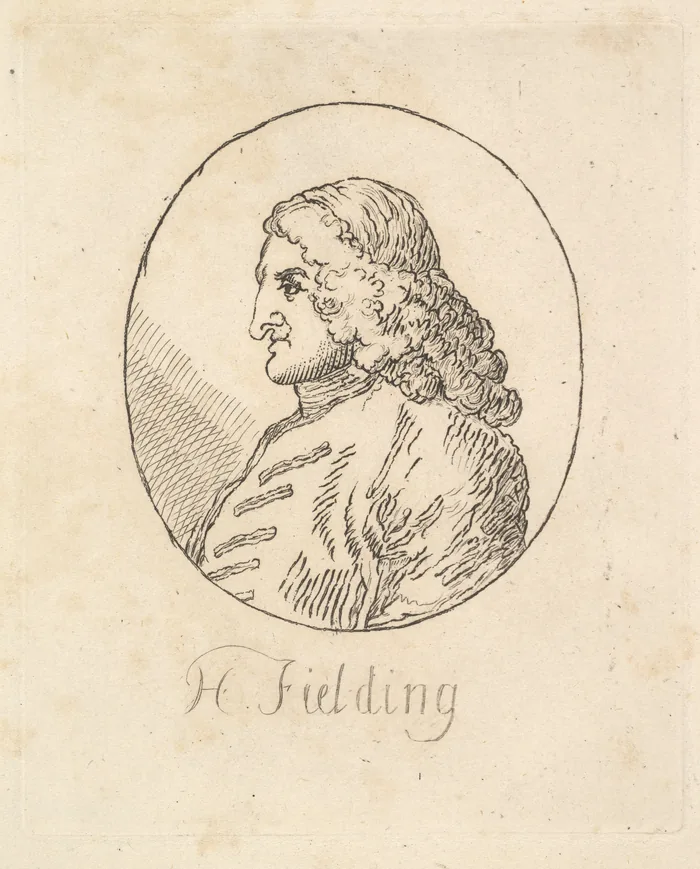
The magistrate after the fact: Fielding, c.1835 impression after Hogarth — fame, not likeness. Figure receipt
1835 after Hogarth · Met CC0 · Public domain
The day the Act bit
On 29 September 1736 the £50 licences and the 20s. gallon duty bit — and the trade buried Madam Geneva in a mock funeral, dedicated “to those Melancholly Sufferers (by a late Severe Act) the DISTILLERS”, sold by J. Clark for 12d. The verses price the grief: “Two for a Penny”, “One half Penny”. The foot dates the bill’s passing to “29 Sep. 1736” and cites “Gent. Mag.” — the day the Act bit.
The day the Act bit: Madam Geneva’s mock funeral, 29 September 1736 — the distillers’ satire on their own ruin. Figure receipt
1736 · BM via Commons · Public domain
The streets
Hogarth’s Noon, 1738: the same St Giles streets Gin Lane is set in, thirteen years before the pair — the crowd, the church spire traditionally identified as St Giles-in-the-Fields, the hunger underneath the comedy. Gin Lane did not invent its setting; it indicted it.
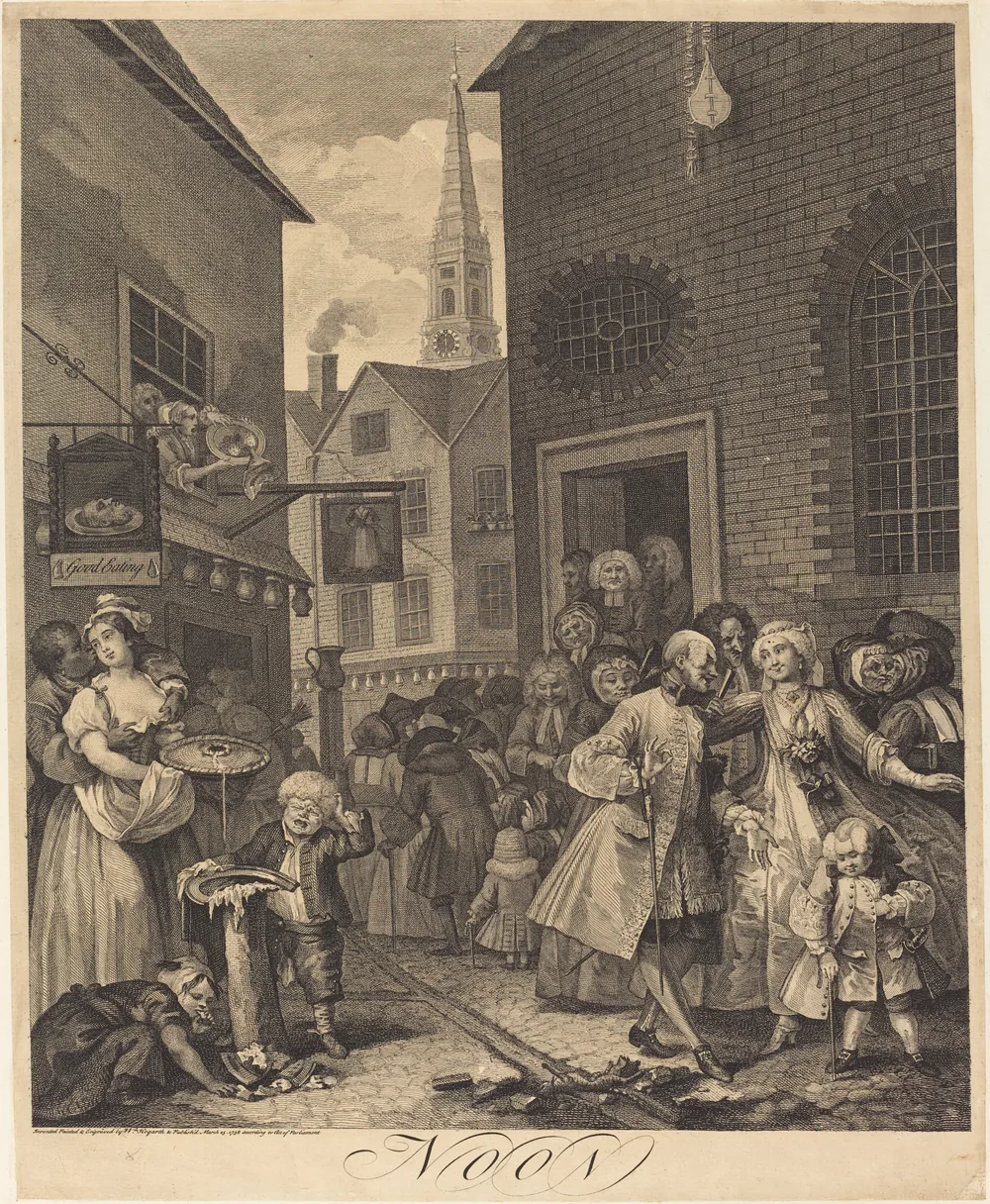
The setting before the indictment: Noon, 1738, in the St Giles streets. Figure receipt
1738 · NGA open access · Public domain
The crowd before
Southwark Fair, 1733 — three years before the £50 licences: the crowd as Hogarth drew it when gin was just another drink. Labelled Southwark, never Bartholomew: the fair across the river, the same appetite. Compare these faces with Gin Lane’s, eighteen years on.
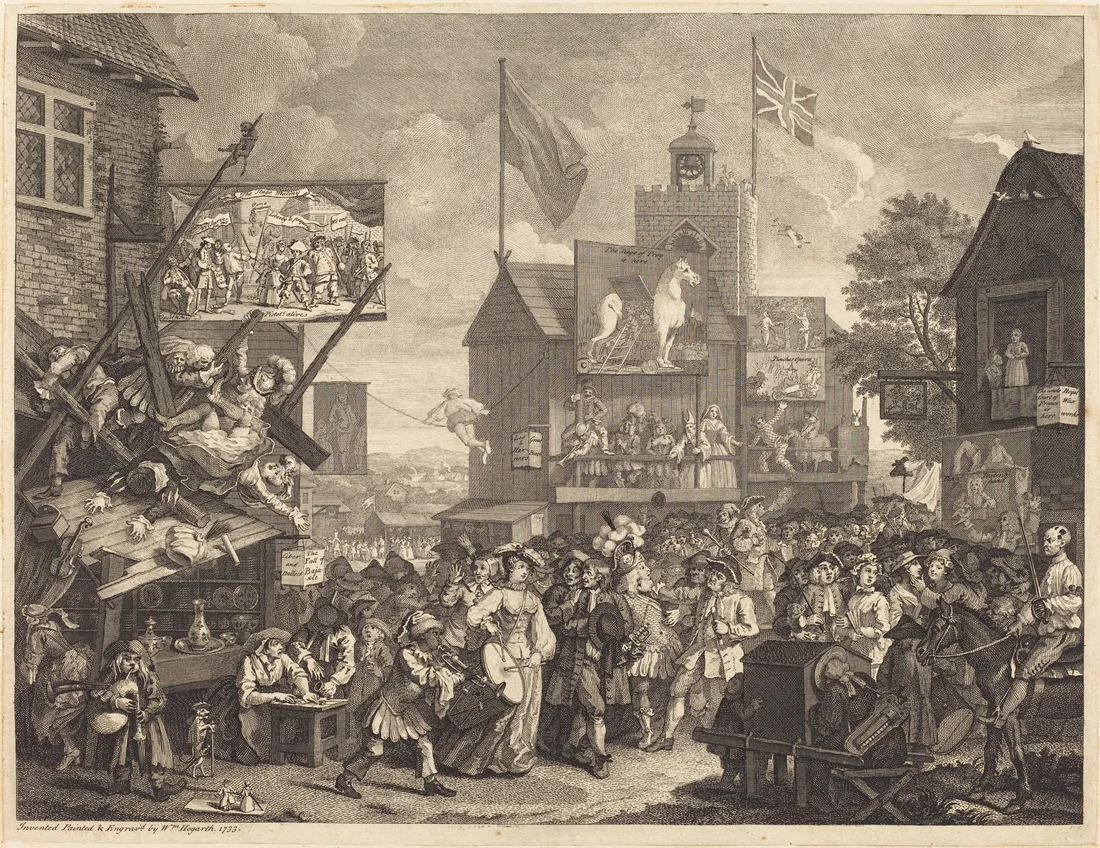
The crowd before the panic: Southwark Fair, 1733 — across the river, the same appetite. Figure receipt
1733 · NGA open access · Public domain
The tavern before
A Midnight Modern Conversation, 1732: the drinking culture before the craze had a name — punch and politics, nobody counting. The date on the file reads 1732/33; the piece treats it as 1732 and says so. Gin’s decade starts here, in good humour.
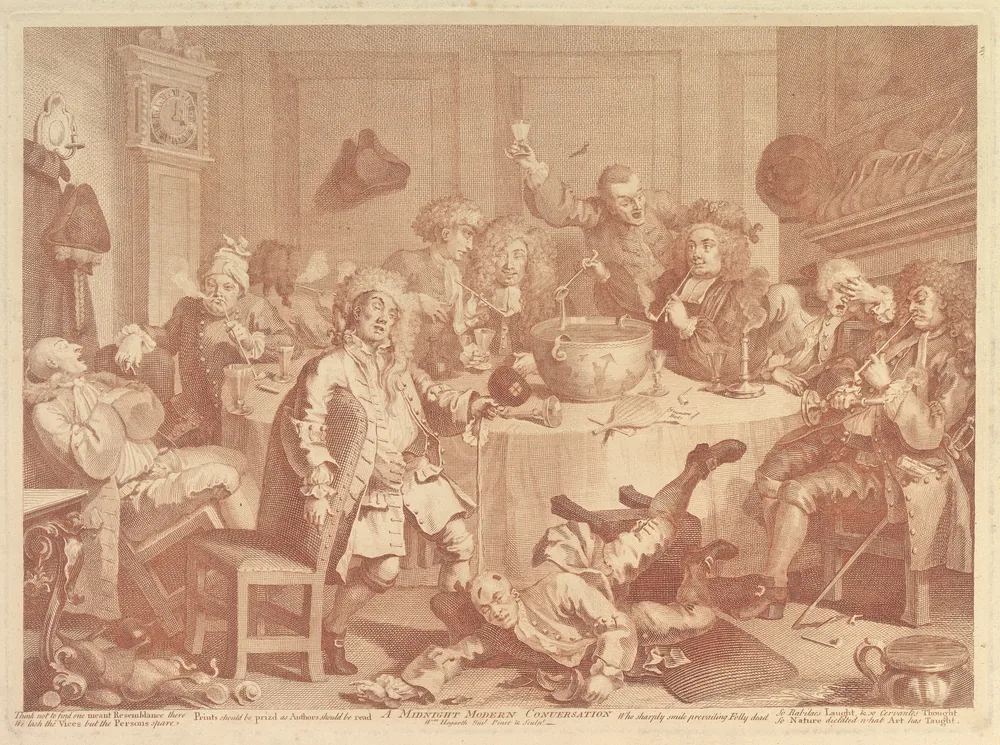
The tavern before the craze: a midnight conversation, 1732 — punch and politics, nobody counting. Figure receipt
1732 · Met CC0 · Public domain
The paper war
Sermons, pamphlets, sentences
Five voices, 1736 to 1757: the pamphleteer, the magistrate, the preacher, the artist, the historian looking back.
The law rail quotes statutes; the answer rail quotes consequences. Statutes prove what Parliament wanted. Consequences prove what it got.
- “conceived in Gin, either in the proper meaning, or in the figurative sense” — Fielding, Enquiry, January 1751
- “Gin-lane … done in terrorem” — Hogarth, in Nichols’s Anecdotes, 1833
- “Shops of Arrack, Brandy, Rum and Strong Waters … like so many Marks, … like so many Poison-Shops” — Wilson, Distiller’s Case, 1736
- “the Flood of Gin … the wide-wasting Torrent of Geneva” — Maddox, sermon, Easter Monday 1750
- “boards … inviting [the poor] to be drunk for the small expence of one penny” — Smollett, History, 1757, looking back
Townley’s authorship of the verses is good authority, not certainty. The 1751 counter-pamphlet is Tucker-attributed. Fielding’s pagination is the printed first edition. The full dated chains stand on the proof rails.
Who wrote: Wilson, the Fall of Bob satirist, Fielding, Tucker, Maddox, the Old Bailey clerks, Smollett. Read the rails in order: one chain of claims, one chain of answers.
Sources
Receipts and method
Every attribution traces to the 1 February 1751 plates; every rail row to the free text it quotes. The law: Ruffhead’s Statutes at Large on Wikisource, the Chronological Table, Webb’s history. The paper war: Fielding, Wilson, Maddox, Tucker, Smollett, the Old Bailey. The pictures: Commons and the Met, all public domain.
The law
- 1729 Act abstract, 2 Geo. 2 c. 17 — Ruffhead vol. 5, p. 720
- 6 Geo. 2 c. 17, Spirit duties — Chronological Table
- 1736 Act, 9 Geo. 2 c. 23 — Ruffhead vol. 6, pp. 279–294
- 1743 Act, 16 Geo. 2 c. 8 — Ruffhead vol. 6, pp. 546–554
- 1751 Act, 24 Geo. 2 c. 40 — Ruffhead vol. 7, pp. 387–396
- Webb, History of the Liquor Laws — verdicts and anchors
- Laxton Bills of Mortality dataset — context, all-cause
The paper war
- Fielding, Enquiry into the Increase of Robbers, 1751 (scan)
- Fielding, Enquiry §II (Wikisource text)
- Nichols, Anecdotes of Hogarth — artist’s intent
- Smollett, History vol. 4 — 1757 retrospective
- Old Bailey: Judith Defour, 27 February 1734
- Old Bailey: informers acquitted, 8 December 1736
- Old Bailey: Thomas Bridge, 18 July 1739
The pictures
- Beer Street, NGA open access (Commons, PD)
- Gin Lane, NGA open access (Commons, PD)
- Southwark Fair 1733, NGA (Commons, PD)
- Midnight Conversation 1732, Met CC0 (Commons, PD)
- Noon 1738, NGA (Commons, PD)
- Apprentices at Looms 1747 (Commons, PD)
- Fielding after Hogarth, c.1835, Met CC0 (Commons, PD)
- Madam Geneva 1736, BM (Commons, PD-old)


.jpg)
Limits in the record
- Pre-1751 penny/twopence shop boards are unverified — the sign lives on the plate and in Smollett, nowhere else here.
- The 1729 Act survives here as Ruffhead’s abstract; the full session printing was not free.
- Assent dates come from statute lists; the stops anchor on in-force dates.
- All gallons are duty-paid — the illicit stills hide the true total. Read every chart with Webb’s warning.
- The Bills of Mortality are all-cause: burials outran christenings every bill-year, whatever the drink.
- No state is claimed for the NGA impressions; the Frenchman-or-mutton variant is described nowhere.
- The Fielding portrait is nineteenth-century; the Noon spire is traditionally, not certainly, St Giles.
- The Madam Geneva file’s BM-terms text describes BM’s site copy; the Commons licence resolves Public domain.
Set in open-licensed fonts, served locally.
Keep walking
Across town, a market hid in a word:
Short answers
Why attribute before judging?
The board state is the thesis: eight fragments placed where the plates put them, each correction quoting Hogarth’s intent. The scrubber then lets you call each Act against its date and witness.
Did the law sober London?
In the end, yes — with the warning attached. 1729: no reduction at all. 1733: repealed. 1736: fell three years, then rose faster than before. 1743: retreated. 1751 with 1753: checked — duty-paid gallons from 7,049,822 to 4,483,341 to 1,849,370. All duty-paid; the stills hide the rest.
Was the penny sign real?
The sign is on the plate — “Drunk for a Penny, Dead drunk for Twopence, Clean Straw for Nothing” — and Smollett remembered such boards in 1757. Pre-1751 shop boards are unverified, and this piece asserts none.
What about the dead babies?
Judith Defour was tried at the Old Bailey on 27 February 1734 for murdering her child for a quartern of gin — guilty, death. Hogarth’s falling child may allude to her; Morgan says so, hedged, and so does this piece. The Bills count all deaths — gin gets no separate column.