CHEAPSIDE · LONDON · OE *CEAP*
Put the market back on the map.
Cheap never meant low-price first: it meant bargain, price, trade. The street still shelves the trades — bread, milk, poultry, fish, iron, gold — in the names of its side turnings.
One staged market day on the wide street Stow called “a market place so called”. Seat six stalls where the names say they stood — every seating refused or confirmed in Stow’s own words — then read the two rails: the street’s paper trail and the word’s thousand-year slide from bargain to bargain-basement.
West Cheap, c.1561
“beginneth the large street of West Cheaping, a market place so called”: Stow’s definition, and the map attributed to Agas shows why — Stow’s own “large street”, linking St Paul’s churchyard with the Poultry. MoEML’s Cheap Ward entry names ward and street alike after West Cheap, the market. The stalls are gone; the side turnings are the labelled shelves they stood on.
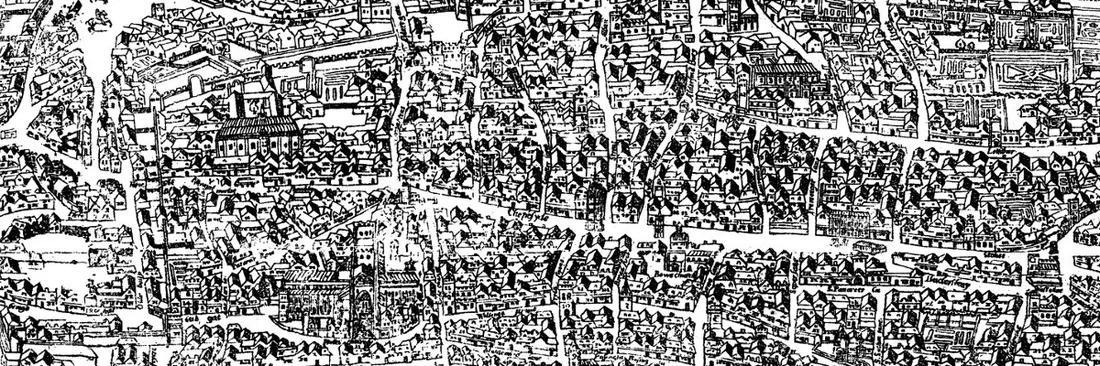
Figure receipt
c.1561, reduced reproduction · attr. Ralph Agas · Public domain
Market day: set the Cheap
Feast-day Evechepynges between the bells, Prime rung for opening, forestalling and regrating punished by forfeit. Pick a trade, then the street whose name still means it; Stow confirms or refuses in his own words. Two more streets — Honey Lane, Wood Street — Stow will not give you at all: their disputes stand in the last beat below.
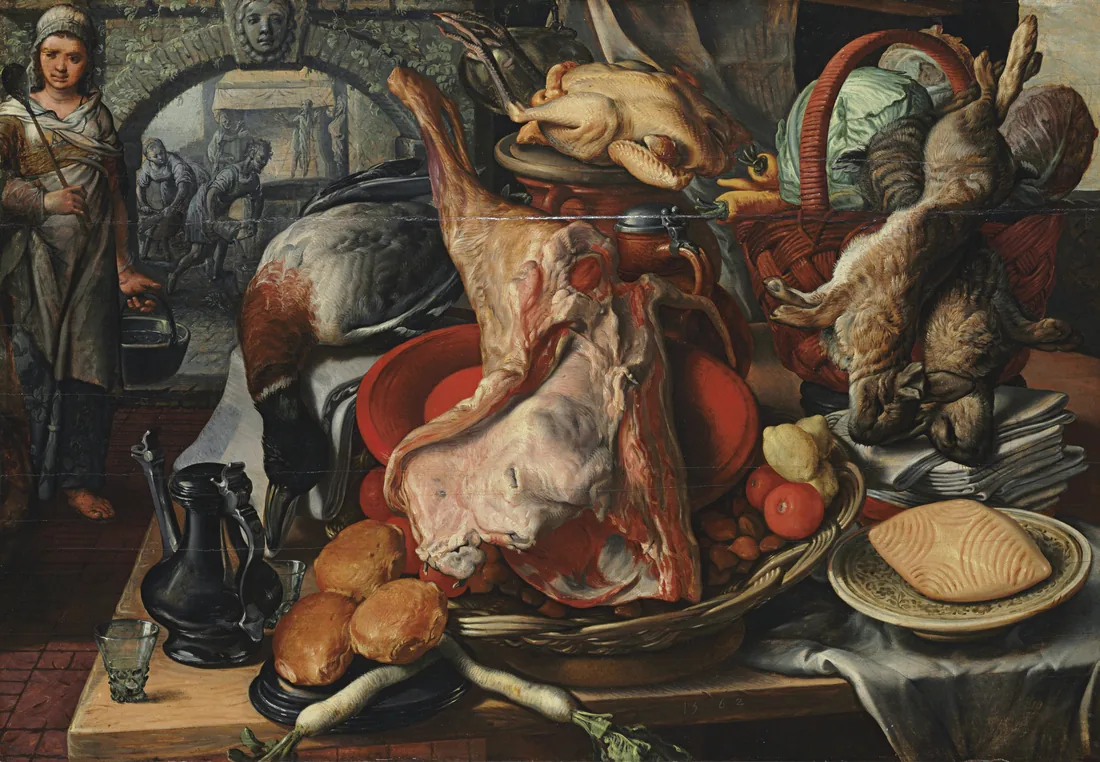
Figure receipt
16th century · Joachim Beuckelaer · Antwerp · Public domain
Seat the six stalls
Pick a trade, then the street. Stow’s lines decide; the board keeps the score.
The cross in the middle, 1290–1643
Commissioned 1290, paid 1291–93, rebuilt 1484–86, gilt 1522, defaced by night in 1581, raised anew in 1606, pulled down on 2 May 1643 by order of Parliament, under guard of horse and foot. Between stood the Great Conduit of 1285, the Standard, and the Little Conduit of 1442 — with punishments at the Standard. Royal entries passed this way: Mary de Medici in 1638, the Midsummer watch two thousand strong.
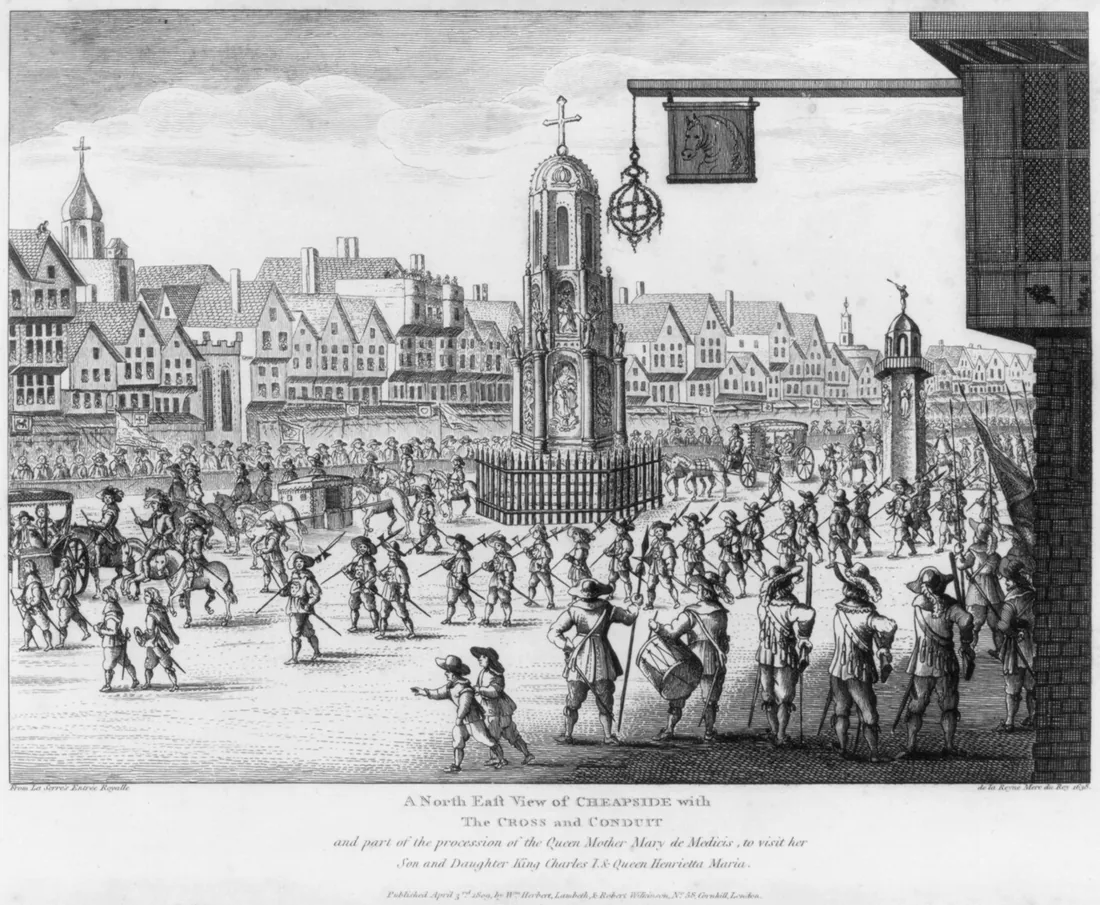
Figure receipt
1809 after La Serre 1638 · Public domain
The proof rails, 1392–1828
Two rails. Four dated records carry the street from feast-day markets to the cross’s fall. Four dated witnesses carry the word from Chaucer’s chapman to Webster’s mechanism. The seatings first, then the paper.
The performed set
The six seatings the board gives you to place: trade, street, and Stow’s line. The game buttons carry the same lines.
bread → Bread Street — so called of bread in old time there sold
Stow 1598 · Bread Street Ward
milk → Milk Street — so called of milk sold there
Stow 1598 · Cripplesgate Ward
poultry → Poultry — the street doth yet bear the name of the Poultry
Stow 1598 · Broad Street Ward
fish → Friday Street — so called of fishmongers dwelling there, and serving Friday’s market
Stow 1598 · Bread Street Ward
ironware → Ironmonger Lane — the ironmongers, of Ironmongers’ lane
Stow 1598 · Of Orders and Customs
goldwork → Goldsmiths’ Row — which is called Goldsmiths’ row
Stow 1598 · Cripplesgate Ward
The street rail
Four dated records, 1392/3–1643: feast-day markets, the market defined, the adjective born beside it, the cross pulled down.
from of old it has been the custom to hold in the City of London on every Feast-day two markets, called “Evechepynges”, one in Westchepe… and that too, by daylight only, between the first bell rung and the second.
Letter-Book H, 1392/3 — Riley, Memorials pp. 532–533 source
beginneth the large street of West Cheaping, a market place so called, which street stretcheth west till ye come to the little conduit by Paul’s gate
John Stow, Survey of London, 1598 — Everyman p. 237 source
in Candlewright street Drapers profered him cheap cloth
John Stow, Survey of London, 1598 — paraphrasing Lickpenny; the adjective beside the market source
On the 2nd of May, 1643, the cross in Cheapside was pulled down… drums beat, trumpets blew, and multitudes of caps were thrown into the air, and a great shout of people with joy.
Contemporary Parliamentarian account, as quoted in Thornbury — officer name unresolved source
The word rail
Four dated witnesses, c.1390–1828: the chapman, the Cheap, the bridge phrase, the mechanism stated.
whyl that the chapman sleep
Geoffrey Chaucer, Canterbury Tales, Shipman, c.1390 — Skeat text via Gutenberg source
Then into Chepe I gan me drawne
London Lickpenny, anonymous, c.1400 — Stow-ascribed to Lydgate; Hammond parallel text source
would have bought me lights as good cheap at the dearest chandler’s in Europe
William Shakespeare, Henry IV, c.1597 — the bridge phrase, still live (Folger) source
good cheap better cheap; the original phrases from which we have cheap
Noah Webster, American Dictionary, 1828 — the mechanism stated outright source
Tomorrow at noon
Walk Cheapside and read the side turnings like shelf labels — Bread, Milk, Poultry, Ironmonger, Friday, Goldsmiths’ Row. Then ask what your own street keeps of its first trade.
Six stalls, six names — every seating dated on the proof rails.
The whole market, in brief
The same Cheap, stated plainly. Bread goes to Bread Street — “so called of bread in old time there sold”, and the 1302 rule bound bakers to sell no bread but in the market. Milk goes to Milk Street — “so called of milk sold there”. Poultry goes to the Poultry — “the street doth yet bear the name of the Poultry”, though the poulters are lately departed to Grasse street. Fish goes to Friday Street — “so called of fishmongers dwelling there, and serving Friday’s market”, the week’s great fish day. Ironware goes to Ironmonger Lane — “the ironmongers, of Ironmongers’ lane”, documented occupancy rather than a derivation sentence. Goldwork goes to Goldsmiths’ Row — “which is called Goldsmiths’ row”, the Cheapside south frontage built in 1491. Honey Lane Stow denies outright — “not of sweetness thereof”, but of washing and sweeping — while Thornbury and Kingsford answer “more probably from honey being sold here”. Wood Street Stow gives to timber houses or the Wood surname; as for any trade in timber, none of the sources consulted puts one there. The street rail runs from the 1392/3 Evechepynges to the 1643 fall; the word rail from Chaucer’s chapman to Webster’s 1828 mechanism.
The street
Cross, conduit, and two disputes
Each beat dated, each figure captioned for what it shows and when. Prints fix the street; the rails carry the proof.
The cross
An Eleanor cross for the Cheap: commissioned 1290, paid for 1291–93, rebuilt 1484–86, gilt 1522, defaced by night in 1581 — then raised anew, the third cross. This is that third cross “alone (as it appeared on its erection in 1606)”: an 1809 engraving after a drawing in the Pepys Library, Cambridge.
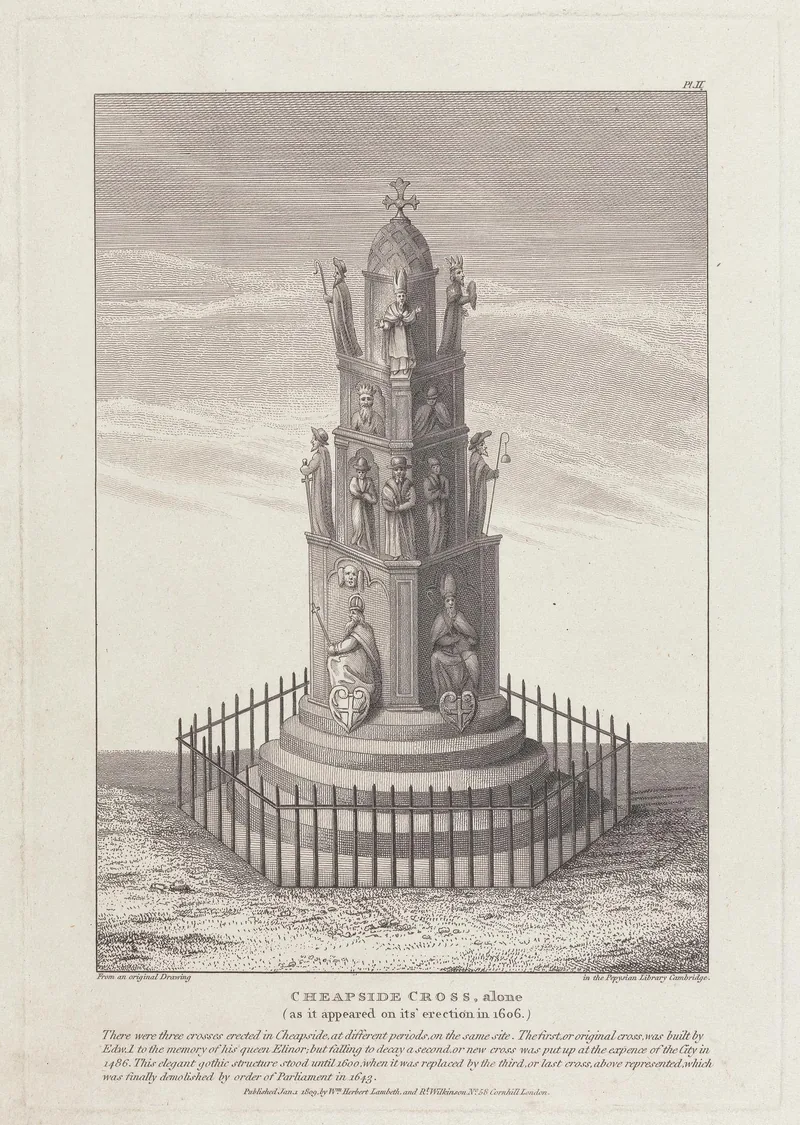
The third cross alone, “as it appeared on its erection in 1606”: an 1809 engraving after a Pepys Library drawing. Figure receipt
1809 after a Pepys Library drawing · Public domain
The fall
On 2 May 1643 the cross in Cheapside was pulled down: drums beat, trumpets blew, caps filled the air, and a great shout of people with joy. On the sixth, by night, the leaden popes burnt where it had stood, with ringing of bells — and the account closes: “no hurt done in all these actions.” The officer’s name is lost to a Harlow-versus-Harley muddle this piece will not resolve by guessing.
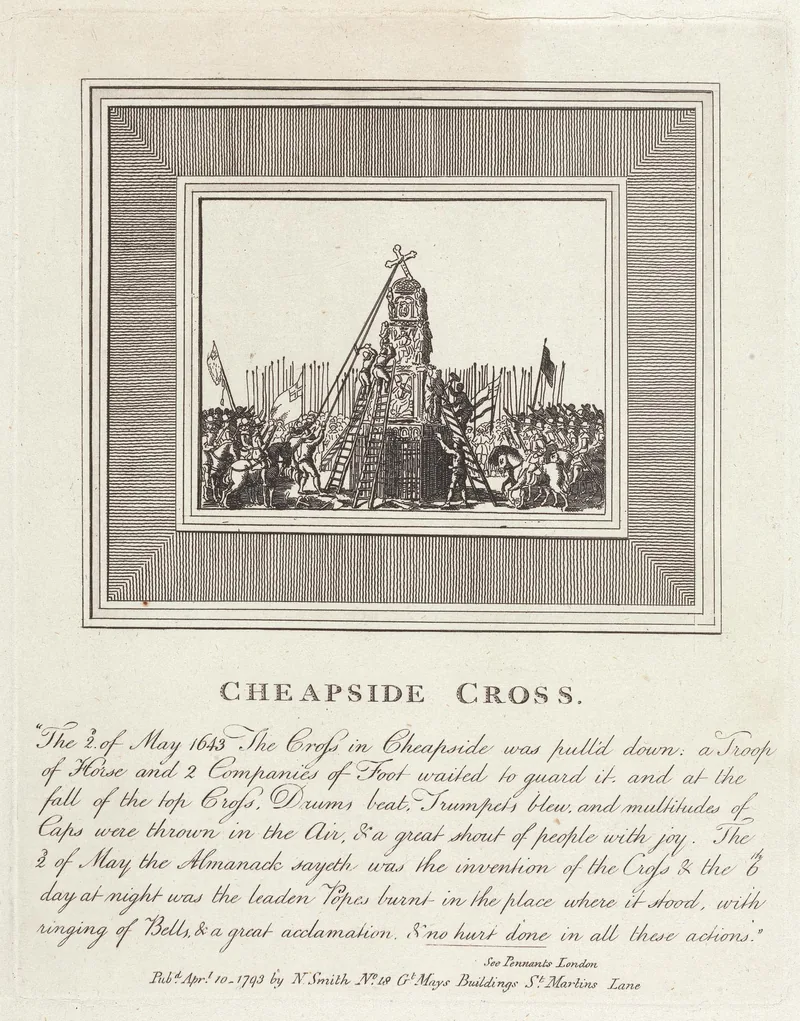
The demolition account: 2 May 1643, horse and foot on guard, hats in the air — printed 1793 from the contemporary relation — “no hurt done in all these actions.” Figure receipt
1793 after 1643 · N. Smith · Public domain
The imagining
Two and a half centuries later, an 1887 engraving after an old print stages the fall: ladders against the tower, ropes on the top cross, horse and foot all round. It matches the account’s choreography — order of Parliament, guard of horse and foot — better than its costumes match 1643.
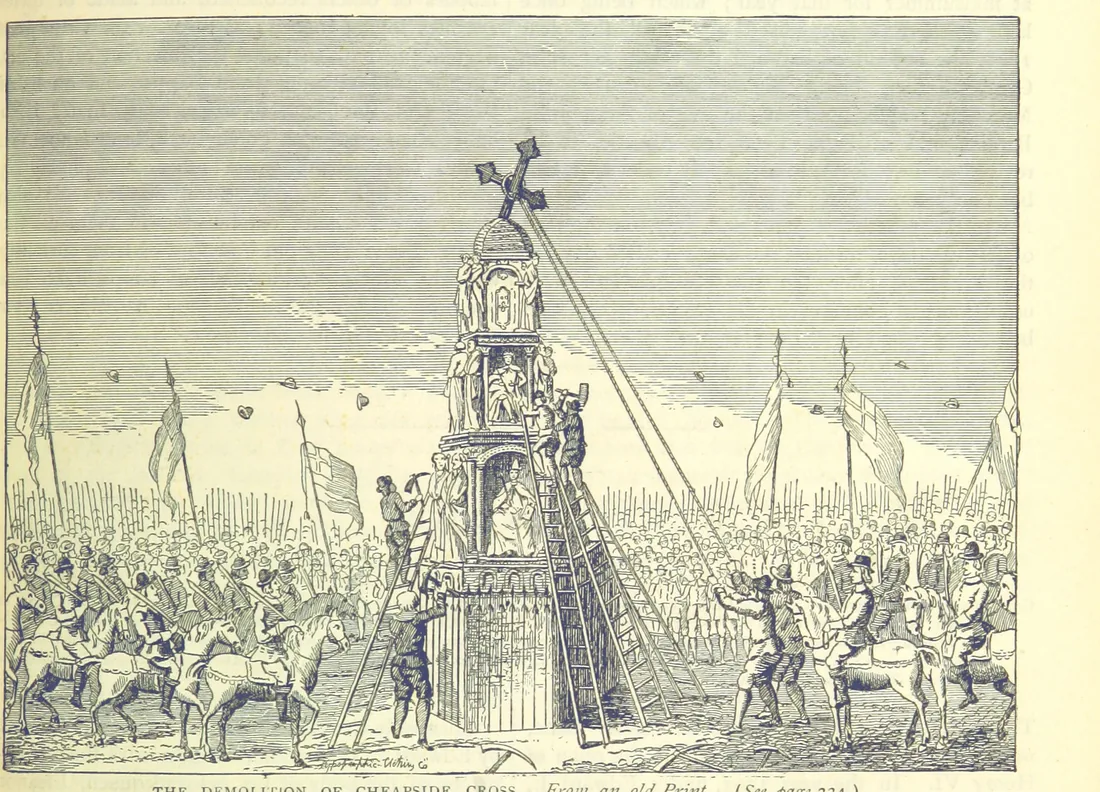
The fall imagined: an 1887 engraving after an old print — ladders, ropes, horse and foot, as the account describes. Figure receipt
1887 after an old print · Public domain
The ancient view
The same firm reprinted the street’s great day: the 1638 entry of Mary de Medici, cross and conduit standing, crowds lining the way — an 1887 “Ancient View” after La Serre’s 1638 Entrée Royalle. Entries and watches were the Cheap’s second trade: the Midsummer watch ran two thousand strong, lit by seven hundred cressets — and near two thousand cresset-men besides, every man with straw hat, painted badge, and breakfast.
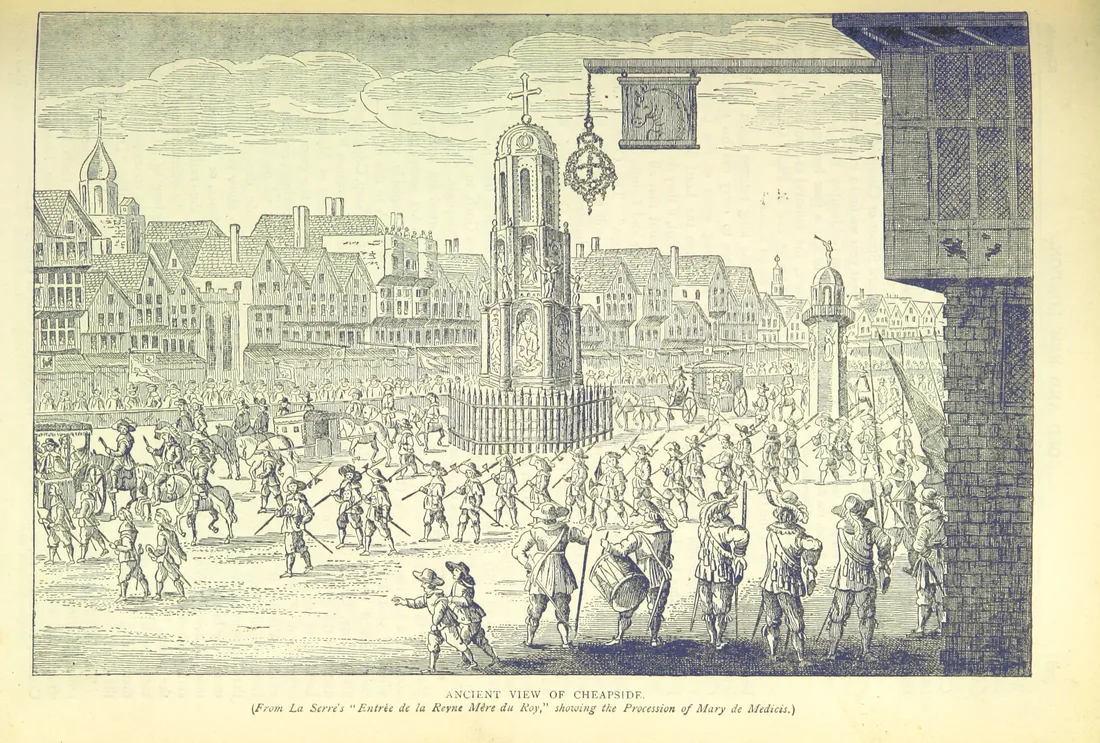
The ancient view: 1887, after the 1638 entry — the same cross and conduit, the same royal procession, a third telling. Figure receipt
1887 after 1638 · Public domain
Two streets Stow won’t give you
Honey Lane: Stow says “not of sweetness thereof, being very narrow, and somewhat dark, but rather of often washing and sweeping” — while Thornbury answers “more probably from honey being sold here” and Kingsford concurs via Harben. Wood Street: “all of timber… and therefore called Wood street” — the houses’ material — “otherwise it might take the name of some builder or owner thereof”, the Wood surname. None of the sources consulted puts such a trade there. The view is Ackermann’s 1833 Cheapside before the Fire, after Pether’s painting — shown small — the scan is low-resolution.
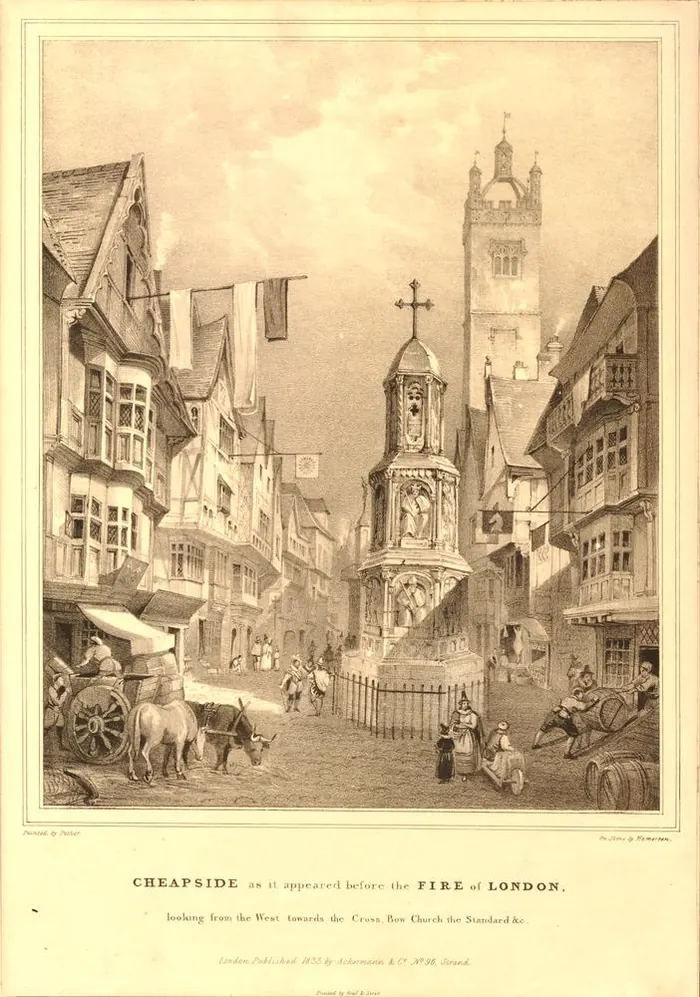
The street looking east to cross, Bow Church and Standard: Ackermann 1833, after Pether’s painting — the period backdrop for the two disputes. Figure receipt
1833 after Pether · Ackermann · Public domain
The words
From bargain to bargain-basement
Three lines, a thousand years apart: the Old English noun, the merchant, the mechanism stated.
The street rail quotes records; the word rail quotes users. Records prove a market stood. Users prove a word moved.
- “trading, bargaining, bargain, sale, purchase” — Bosworth-Toller, s.v. ceap
- “whyl that the chapman sleep” — Chaucer, Shipman, c.1387–1400
- “good cheap better cheap; the original phrases from which we have cheap” — Webster, 1828
Bosworth-Toller is nineteenth-century scholarship (online 2014), verified entry by entry. Chaucer’s dates are composition ranges in Skeat’s text. Webster states the ellipsis outright. The full dated chains stand on the proof rails.
Who used them: Ine’s laws, Chaucer’s Shipman, Langland’s Coveitise, the Lickpenny poet, Stow, Shakespeare, Webster, Chambers. Read the rails in order: one chain of records, one chain of users.
Sources
Receipts and method
Every seating traces to Stow’s Survey in two witnesses; every rail row to the free text it quotes. The street: Stow, the Letter-Books via Riley, Thornbury and Harben on BHO. The word: Bosworth-Toller, Chaucer, Langland, Lickpenny, Shakespeare, Webster, Chambers. The pictures: Commons, all public domain.
The street
- Stow, Survey of London (Gutenberg Everyman full text)
- Stow, 1603 text scan — cross-check witness (archive.org)
- Thornbury, Old and New London I, southern tributaries (BHO)
- Thornbury, Old and New London I, Cheapside central (BHO)
- Thornbury, Old and New London I, northern tributaries (BHO)
- Harben, Dictionary of London, Honey Lane entry (BHO)
- Riley, Memorials + Liber Albus via Munimenta Gildhallae (archive.org)
- MoEML, Cheap Ward gazetteer entry
The word
- Bosworth-Toller, s.v. ceap — bargain, price, goods, cattle
- Bosworth-Toller, market compounds: ceapstow, ceapstret, ceaping
- Chaucer, Canterbury Tales, Skeat text (Gutenberg)
- Langland, Piers Plowman, Passus 13, Wright text (Wikisource)
- Hammond, London Lickpenny parallel text (Zenodo, CC0)
- Shakespeare, Henry IV 3.2–3.3 (Folger)
- Onions, Shakespeare Glossary, cheap (Perseus)
- Webster 1828, cheap — the mechanism stated
- Chambers 1908, chapman to cheap-jack (Wikisource)
The pictures
- Agas map c.1561, reduced reproduction (Commons, PD)
- 1809 view after La Serre’s 1638 entry (Commons, PD)
- Beuckelaer, market scene — Antwerp (Commons, PD)
- Cheapside Cross alone, 1809 (Commons, PD)
- Demolition plate with account, 1793 (Commons, PD)
- Demolition of Cheapside Cross, ONL 1887 (Commons, PD)
- Ancient View of Cheapside, ONL 1887 (Commons, PD)
- Cheapside before the Fire, Ackermann (Commons, PD)


_1.331_-_Demolition_of_Cheapside_Cross.jpg)
_1.307_-_Ancient_View_of_Cheapside.jpg)
.jpg)
Limits in the record
- Conduit wine in 1312 is unverified — the Letter-Book E passage could not be traced.
- Kingsford’s Honey Lane note (vol. II, p. 333) is cited via Harben; the notes volume was not directly sighted.
- The archive.org URL billed “Kingsford 1908” serves the 1603 Stow text, not Kingsford’s notes — cited as the 1603 witness.
- The 1379/1388 Letter-Book H headwords and Evelyn’s demolition line are unverified — printed nowhere here.
- The period dictionary could not be consulted, nor Harben entries beyond Honey; BHO search was unavailable.
- No Goldsmiths’ Row image could be found — Stow’s text carries that beat alone.
- Beuckelaer paints Antwerp, not London; the pre-Fire lithograph is low-resolution; the Agas is a reduced reproduction.
Type: Fraunces and Source Serif 4, under the SIL Open Font Licence.
Keep walking
Across town, two earls became things:
Short answers
Why seat stalls instead of reading?
The board state is the thesis: six names that still mean their trades, placed where the sources put them. Each refusal teaches a pairing; each confirmation quotes Stow. The rails then let you check every seating against its date and witness.
Did cheap mean low-price?
Not first. Bosworth-Toller gives bargain, price, goods, cattle — no low-price sense. The adjective is alive by the 1590s: Stow’s “cheap cloth”, Shakespeare’s uses. Webster in 1828 states the mechanism: ellipsis of “(good) cheap”, a good bargain.
Why can’t I seat Honey Lane and Wood Street?
Because Stow will not give them to any trade. Honey Lane is “not of sweetness thereof”, but of washing and sweeping — though Thornbury and Kingsford answer “more probably from honey being sold here”. Wood Street is timber houses or the Wood surname, and none of the sources consulted puts a trade in timber there. The board seats only the six pairings Stow documents.
What stood in the middle?
The Eleanor cross from 1290 to 1643, the conduits and the Standard — with royal entries, Midsummer watches, and punishments for company. The street was market, monument, and theatre at once — the Standard saw putrid geese in 1375, rotten conger in 1382.