Chapter 4 · Membrane, osmosis, divisionLesson 4.3
Mitosis: how organisms grow and how tissues are repaired
You started as a single cell. Where do the roughly 30,000 billion cells you have now come from, and what replaces the ones that die?
- Size
- from 10 nm to 100 µm
- Level
- membrane and cell
- Time
- minutes and hours
Before you read: what do you think?
How many rounds of doubling would it take for a single cell to become 30,000 billion cells, if every cell divided in every round and none died?
See the answer
About 45. Each round doubles the number: after 10 rounds there are 1,024 cells, after 20 more than a million, after 45 around 35,000 billion. Real development is less regular, because not all cells divide and some die; even so, the calculation shows how fast a doubling number grows.
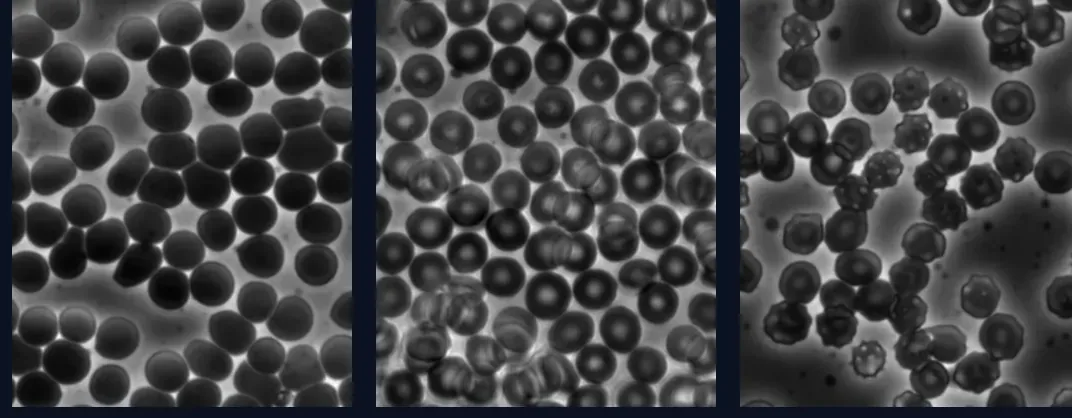
Every second, your bone marrow makes more than 2 million red blood cells. Each of them comes from a cell that divided. The same kind of division took you from one cell to a whole body, and it closes a scratch: it is called mitosis.
One parent cell, two identical daughter cells
The nucleus of a cell holds the chromosomes, the structures that contain DNA, the hereditary information. The cells of your body, called somatic cells, normally have 46 chromosomes each; mature red blood cells are an exception, because they lost their nucleus as they formed.
Mitosis is the division in which a eukaryotic parent cell produces two daughter cells with the same number of chromosomes and the same hereditary information as the parent cell. Before dividing, the cell copies all its DNA. The copies are then shared out equally: each daughter cell gets a complete set. Strictly speaking, mitosis divides the nucleus, and the division of the cytoplasm that usually follows is called cytokinesis. A cell with 46 chromosomes forms two cells with 46 chromosomes each; in shorthand, 2n → 2n.
Bacteria do not divide by mitosis. They have no nucleus, and their splitting in two works by a different mechanism.
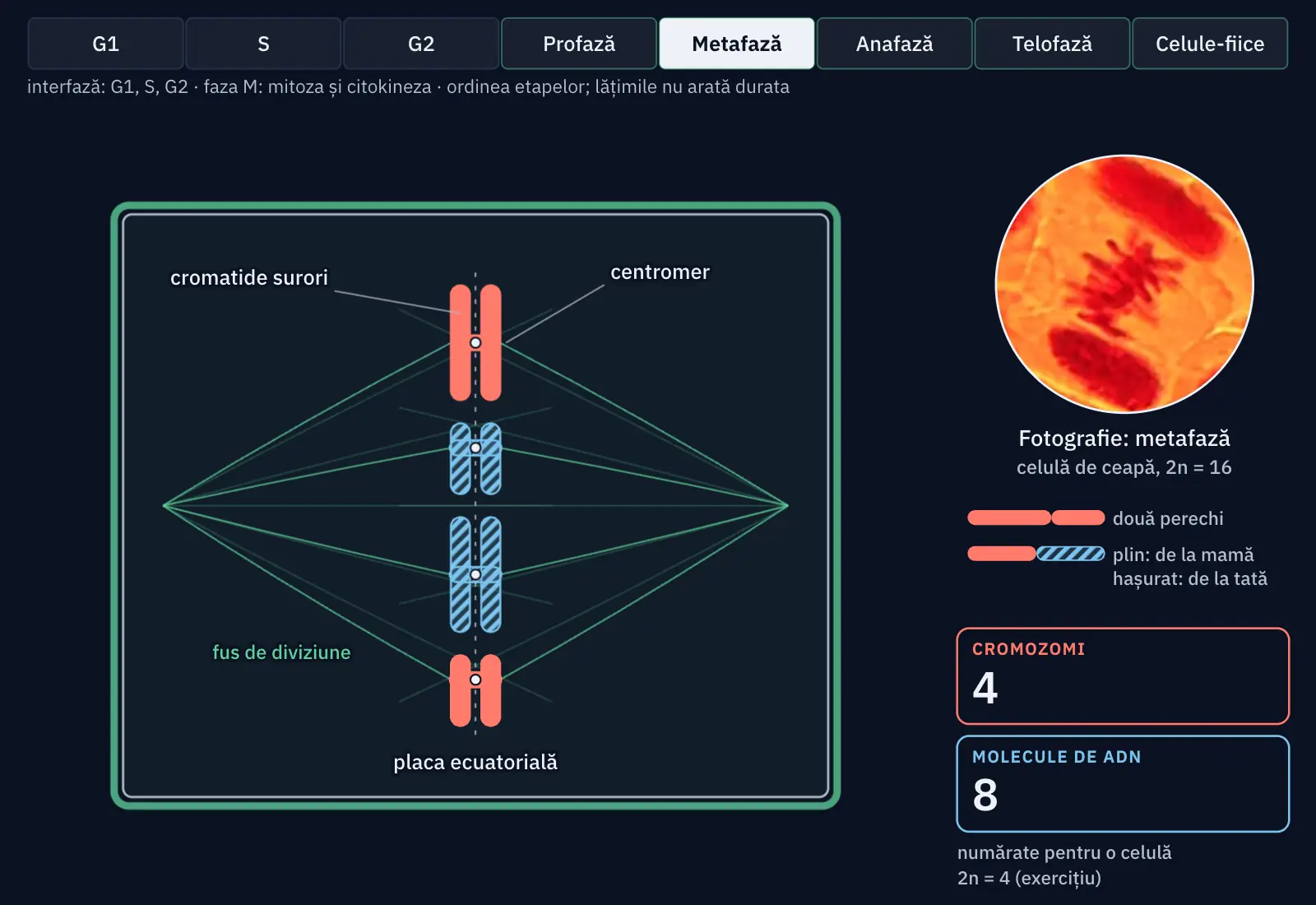
| Stage | What is seen | 2n = 4: chromosomes / DNA molecules | Human, 2n = 46: chromosomes / DNA molecules | Counted for |
|---|---|---|---|---|
| G1 | chromatin in the nucleus; one chromosome, one DNA molecule | 4 / 4 | 46 / 46 | one cell |
| S | DNA replication, at many places at once | 4 / 4→8, no fixed number | 46 / 46→92, no fixed number | one cell |
| G2 | each chromosome has two sister chromatids joined at the centromere | 4 / 8 | 46 / 92 | one cell |
| Prophase | chromosomes condense; the nuclear envelope breaks down; the spindle forms | 4 / 8 | 46 / 92 | one cell |
| Metaphase | chromosomes on the equatorial plate, attached to the spindle at the centromere | 4 / 8 | 46 / 92 | one cell |
| Anaphase | sister chromatids separate and move towards the poles | 8 / 8 | 92 / 92 | the whole cell, still undivided |
| Telophase | new nuclear envelopes; furrow (animal cell) or cell plate (plant cell) | 8 / 8 | 92 / 92 | the whole cell, still undivided |
| Daughter cells | two daughter cells, each with a complete set | 4 / 4 | 46 / 46 | each daughter cell |
In telophase the cell has not yet divided; each new nucleus has 4 chromosomes and 4 DNA molecules (human: 46 and 46). Typical durations, human cells in culture: G1 9 hours, S 10 hours, G2 4.5 hours, M phase 0.5 hours.
Diagram and photograph. The cell is a drawing with 2n = 4: two pairs of homologous chromosomes, one long and one short, with the copy from the mother solid and the one from the father hatched. The counters come from the same calculation as the table; for humans (2n = 46) only the numbers change. The band at the top shows the order of the stages, not their duration; the “Show typical durations” button displays the durations for rapidly dividing human cells in culture, with a cycle of 24 hours (OpenStax Biology 2e). The photographs are real: onion cells (2n = 16), with the phases identified by the author of the photographs; the images are cropped from “Mitosis in yellow onion cells”, Pixelmaniac pictures, Wikimedia Commons, CC BY-SA 3.0; no scale bar.
Growth: more cells, then specialised cells
A child becomes an adult mainly by having more cells, not by its cells becoming huge. Through repeated mitoses, the fertilised egg gives rise to billions of cells. The daughter cells grow and then specialise: some become muscle cells, others skin cells or neurons. This specialisation is called differentiation.
In plants, growth comes from divisions in meristems, zones of unspecialised cells that divide all the time: the root tip, the shoot tip and the buds. This is where the cells that lengthen the plant are made.
Try it at home: stand an onion with its base in a glass of water, without submerging it. Within a few days white roots appear. The tip of each root is a meristem, and under the microscope it shows cells caught in the middle of dividing.
Replacement: cells that die are replaced
An adult body replaces about 330 billion cells every day, almost 4 million a second. Nearly 90% of them are blood cells. By mass, most of the replaced cells are blood cells and the cells lining the gut. Red blood cells live up to 120 days, and the bone marrow replaces them continuously, through the division of the cells they form from.
Skin renews itself in the same way. In its deepest layer, cells divide and push the ones formed earlier towards the surface. The surface layer, made of dead cells, gradually flakes away and is completely replaced in about four weeks.
Not all cells keep dividing. Mature neurons no longer divide, and heart muscle cells divide very rarely, which is why nerve tissue and the heart recover very poorly after an injury.
Repair, regeneration and reproduction without sex
When you cut yourself, the cells at the edge of the wound divide and fill the gap, and the skin closes. Some animals can rebuild whole parts of their bodies. Regrowing a lost part is called regeneration. Newts, for example, can regenerate limbs, the tail and parts of the eye: cells near the wound return to a less specialised state, divide by mitosis and form the new organ.
Mitosis is also a way of reproducing. In asexual reproduction, a single parent produces offspring with the same hereditary information as itself. A sprouting potato tuber grows into a new plant, the strawberry plant forms young plants at the ends of its runners, and many trees and shrubs reproduce from cuttings. In single-celled eukaryotes such as amoebas, cell division is how the organism reproduces.
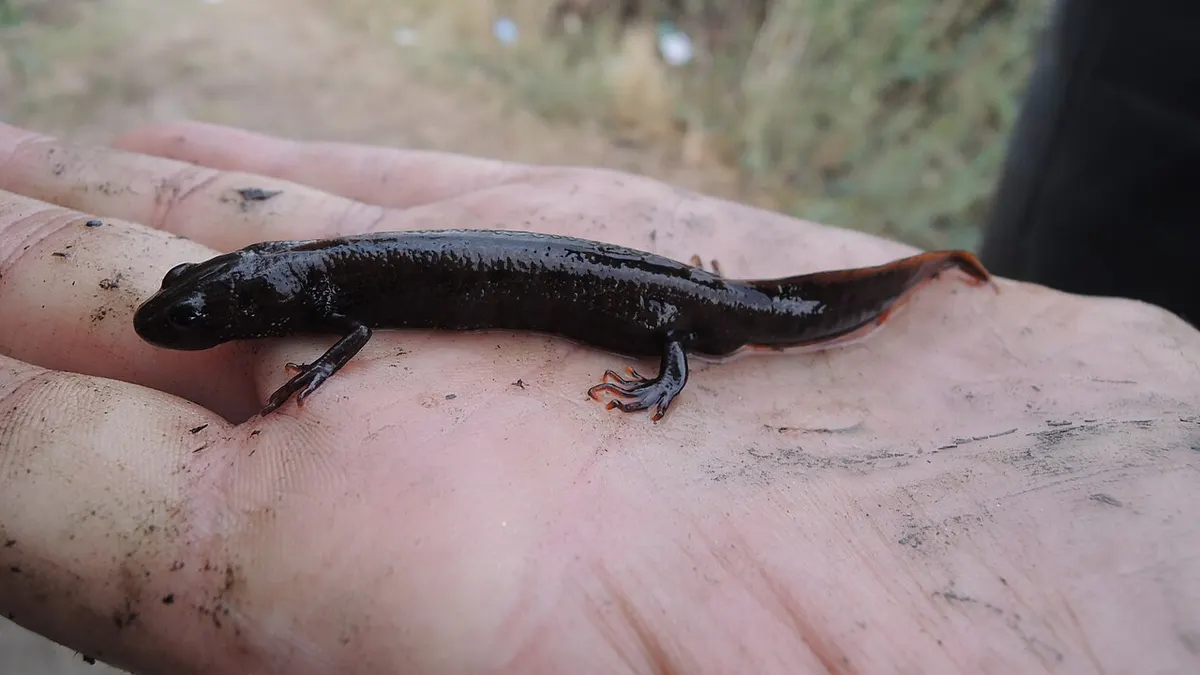
Photo: Llyn Godionduon, CC BY-SA 4.0, source. Cropped and resized.

Worked example
How many cells after several divisions
One cell divides and gives two. If each of those divides again, there are four, then eight: 1 → 2 → 4 → 8. After n complete rounds, the number of cells is 2 to the power n.
After 3 rounds: 2³ = 8 cells. After 10 rounds: 2¹⁰ = 1,024 cells. After 20 rounds: 2²⁰ = 1,048,576, more than a million. Every ten rounds multiply the number by about a thousand.
The calculation assumes that every cell divides in every round and that none dies. It is a worked example: in a real organism cells divide at different rates, many stop dividing and others die. The calculation says neither how long growth takes nor how large the organism becomes.
In Romania
The Danube crested newt
The Danube crested newt (Triturus dobrogicus) lives in the ponds and backwaters of the Danube floodplain, the Danube Delta and the Siret and Prut rivers. The species was described in 1903 by the Romanian zoologist Kirițescu, and its name comes from Dobrogea (Dobruja), a region of Romania. The largest female of the species known in 2009, 175.5 mm long, was found in the Danube Delta. The species is protected under the European Union’s Habitats Directive.
Like other newts, it can rebuild a lost part of its body. An experiment in Japan on another species, the Japanese newt, showed how long this ability lasts: researchers removed the lens of the eye from the same animals 18 times in 16 years. Each time the lens grew back, and the last lenses, formed when the animals were around 30 years old, looked like those of young newts.
All of this rests on mitosis: the cells around the wound divide and give rise to the cells of the new organ.
In short
- Mitosis is the division in which a eukaryotic parent cell produces two daughter cells with the same number of chromosomes and the same hereditary information (2n → 2n).
- Before mitosis the cell copies its DNA, and the copies are shared out equally between the two daughter cells.
- Organisms grow by mitosis; in plants, growth comes from divisions in meristems, for example at the root tip and the shoot tip.
- Mitosis replaces cells that die: blood cells, skin cells, the cells lining the gut.
- Mitosis makes it possible to repair wounds and regenerate parts of the body, as newts do.
- Asexual reproduction happens by mitosis, and it produces offspring with the same hereditary information as the parent.
Common mistakes
WrongAn organism grows because its cells keep swelling.
RightGrowth comes mainly from cells multiplying by mitosis. The daughter cells grow only to their usual size, then specialise.
WrongAfter mitosis, each daughter cell has half the chromosomes of the parent cell.
RightThe DNA is copied before division, so each daughter cell gets a complete set: 46 chromosomes in humans, like the parent cell.
WrongAll the cells of the body divide all the time.
RightThe rate varies greatly. Blood and skin cells are replaced continuously, mature neurons no longer divide, and heart muscle cells divide very rarely.
Check yourself
Seven questions. For the first six you see the explanation at once, with the paragraph of the lesson that supports it; for the written ones you compare with a good answer.
A skin cell with 46 chromosomes divides by mitosis. How many chromosomes does each daughter cell have?
Answer
b) 46. The DNA is copied before division, and the copies are shared out equally. Each daughter cell still has 46 chromosomes.
Where do the cells that make a plant grow longer divide?
Answer
c) In the meristems at the root tip and the shoot tip. In plants, divisions are concentrated in the meristems. The cells of mature leaves and of the vessels are already specialised.
Which of the following is NOT a role of mitosis?
Answer
d) The division of a bacterium. Bacteria have no nucleus and do not divide by mitosis. The other three are repair, asexual reproduction and cell replacement, all by mitosis.
A cell goes through 6 complete rounds of division; every cell divides in every round and none dies. How many cells result?
cellsAnswer
64 cells. The number doubles in every round: 1 → 2 → 4 → 8 → 16 → 32 → 64, that is 2⁶ = 64.
Choose the role of mitosis in each situation.
Answer
Growth: A bean seedling grows taller and taller; A baby grows into a schoolchild.
Replacement or repair: The skin on a grazed knee heals; Bone marrow makes red blood cells.
Asexual reproduction: A strawberry runner produces a new plant; An amoeba divides into two amoebas.
The same division plays different roles: it increases the number of cells in a growing organism, replaces lost cells or forms a new organism.
Why do the heart and brain recover poorly after an injury, while skin recovers easily?
Answer
a) Because mature neurons no longer divide, and heart muscle cells divide very rarely. Rebuilding a tissue needs cells that can divide. Skin has a layer of cells that divide all the time; mature neurons have stopped dividing, and heart muscle cells are replaced very slowly.
A gardener cuts a shoot off a geranium, plants it in soil and a month later has a new plant with flowers the same colour as the parent plant. Explain the role of mitosis here and why the flowers are the same colour.
A good answer
The cutting formed roots and leaves through repeated mitoses, so the new plant grew from the cells of the parent plant. This is asexual reproduction. In mitosis, each daughter cell receives the same hereditary information as the parent cell, so the new plant has the same hereditary information as the parent plant and the same flower colour.
A complete answer names asexual reproduction, links the growth of the cutting to mitosis and explains that mitosis keeps the hereditary information the same.
Terms
- mitosis
- The division in which a eukaryotic parent cell produces two daughter cells with the same number of chromosomes and the same hereditary information.
- cytokinesis
- The division of the cytoplasm at the end of cell division, which produces two cells.
- somatic cells
- The cells of the body that are not reproductive cells; in humans, those with a nucleus have 46 chromosomes each.
- differentiation
- The specialisation of newly formed cells for a particular function.
- meristem
- A zone of a plant made of unspecialised cells that divide all the time, for example the root tip and the shoot tip.
- regeneration
- The regrowth of a lost part of the body through the division of the cells around the wound.
- asexual reproduction
- The production of offspring from a single parent, with the same hereditary information as that parent.
Sources and link to the programme
- OpenStax – Anatomy and Physiology 2e, 18.3 Erythrocytes – the bone marrow makes more than 2 million red blood cells a second; red blood cells live up to 120 days
- OpenStax – Biology 2e, 10.1 Cell Division – human somatic cells have 46 chromosomes, gametes 23; mitosis (karyokinesis)
- OpenStax – Biology 2e, 10.2 The Cell Cycle – DNA replication before mitosis; heart muscle cells and mature neurons stay permanently out of division
- OpenStax – Biology 2e, 30.1 The Plant Body – meristems, regions of continuous division and growth, with undifferentiated cells
- OpenStax – Biology 2e, 32.3 Asexual Reproduction – the potato tuber, the strawberry runner and cuttings as asexual reproduction in plants
- OpenStax – Anatomy and Physiology 2e, 5.1 Layers of the Skin – the basal layer of the epidermis; the horny layer is completely replaced in about four weeks
- Sender R., Milo R. (2021) – The distribution of cellular turnover in the human body, Nature Medicine 27: 45–48 – about 0.33 × 10¹² cells replaced a day, nearly 90% of them blood cells; 80 ± 20 g a day
- Sender R., Fuchs S., Milo R. (2016) – Revised estimates for the number of human and bacteria cells in the body, PLoS Biology – the body of a reference adult has about 3.0 × 10¹³ human cells
- Eguchi G. et al. (2011) – Regenerative capacity in newts is not altered by repeated regeneration and ageing, Nature Communications – newts regenerate limbs, the tail and eyes; the lens of the Japanese newt removed 18 times in 16 years, animals about 30 years old; cells that return to a less specialised state and divide
- Gherghel I., Iftime A. (2009) – On a record of largest specimen of Triturus dobrogicus (Kiritzescu 1903) from the Danube Delta, Biharean Biologist 3(1) – the species described by Kiritzescu in 1903; its range along the Danube floodplain below the Iron Gates, the Danube Delta, the Siret and the Prut; a record female of 175.5 mm from the Danube Delta
- Wikipedia – Danube crested newt – the species is listed under the Bern Convention and in Annexes II and IV of the Habitats Directive
- Bergmann O. et al. (2009) – Evidence for cardiomyocyte renewal in humans, Science 324 (PMC) – heart muscle cells are renewed in humans, from about 1% a year at age 20 to 0.3% a year at age 75; fewer than half are replaced in a lifetime
- OpenStax – Biology 2e, 40.2 Components of the Blood – mature mammalian red blood cells have no nucleus
From the programme: “The role of mitosis in growth and development” (common core). Specific competences addressed: 2.2, 4.1.