Târgu Mureș: do the angles of a triangle always add up to 180 degrees?
In Bolyai's town, the triangle run from Târgu Mureș to the North Pole and Quito sums to 226.385 degrees — reckoned from real coordinates, three ways. Pick your town and grow the triangle: the sum climbs before your eyes.
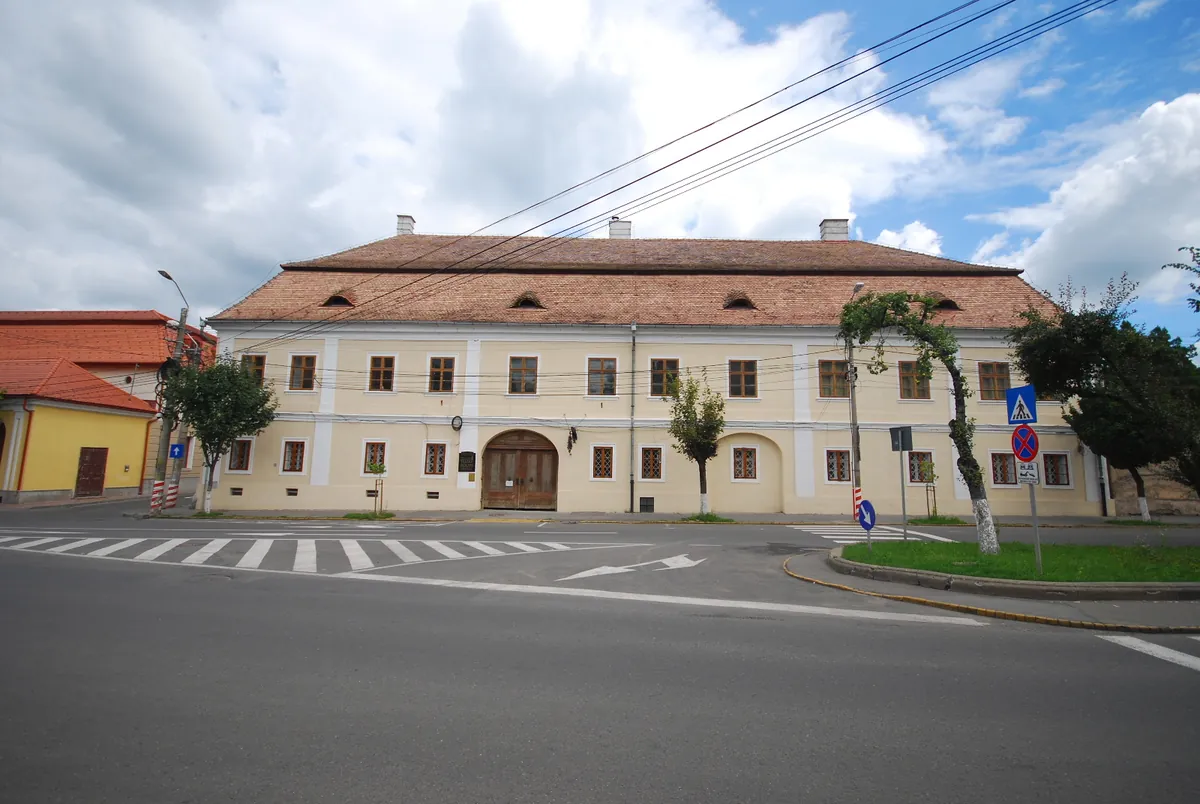
Târgu Mureș stands in Mureș County, in Transylvania; the library is at 17 Bolyai Street.
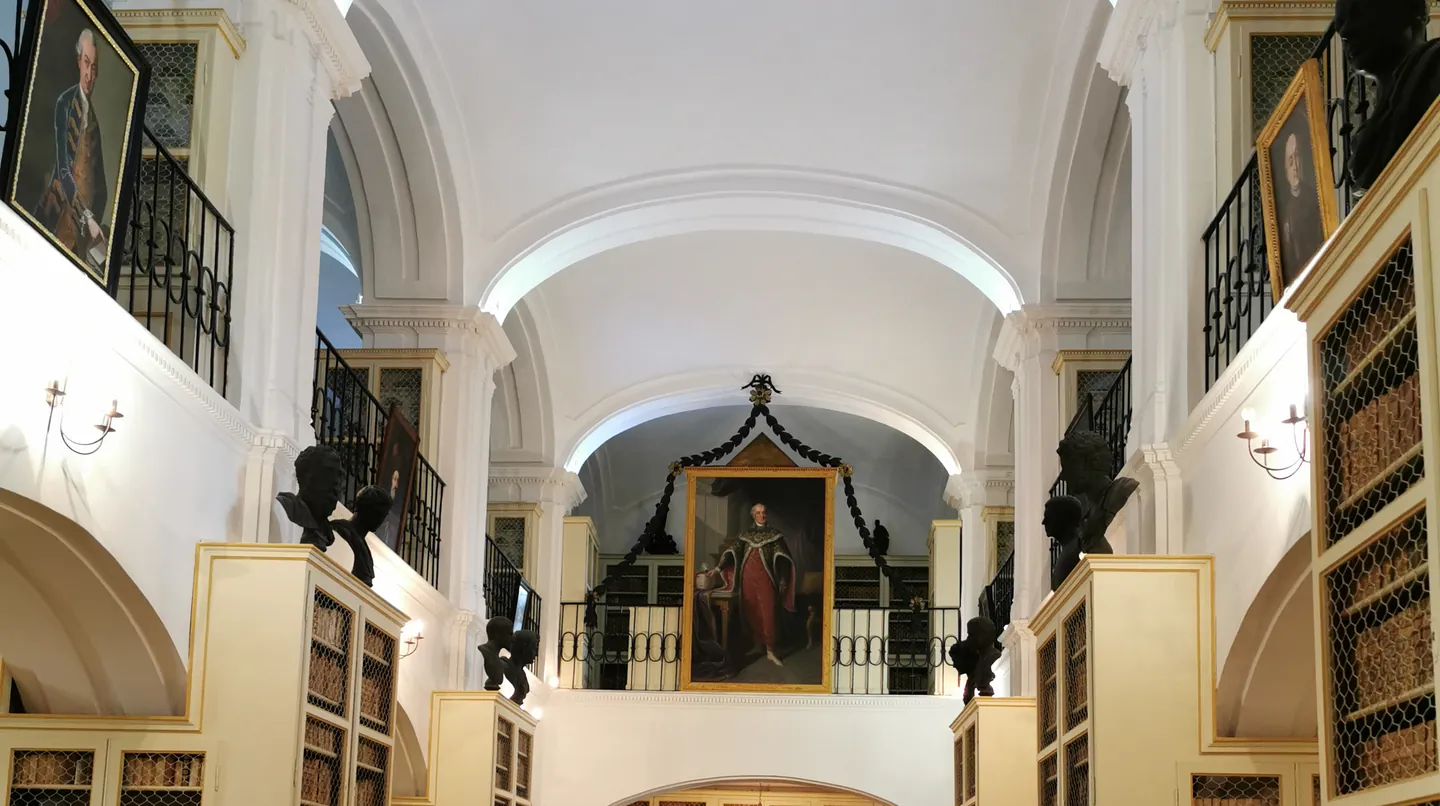
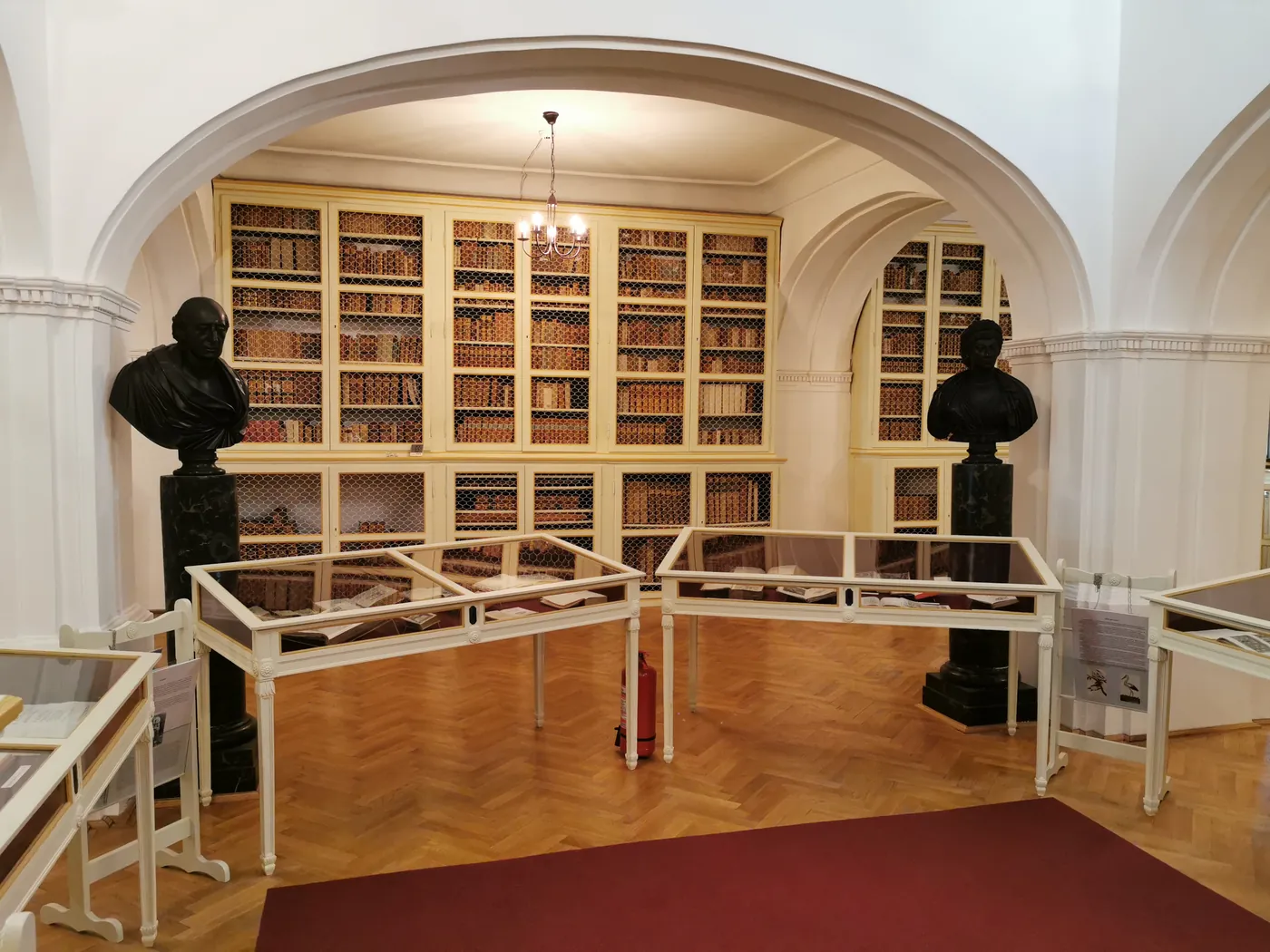
The great hall of the Teleki–Bolyai Library in Târgu Mureș. Photo: Elekes Andor, 5 September 2019. (Photo: Wikimedia Commons, CC BY-SA 4.0)
Târgu Mureș – Reghin – Sighișoara: sum 180.000599° (excess 2.16″)
The ladder
Five steps, one globe. The first four take the chosen town as their first corner and show the sum reckoned from real coordinates, three ways; the fifth shows a triangle where the excess reads plainly. The first step reads 180 degrees; the last passes 267. Every sum is reckoned by three separate routes, and the worst disagreement between them is 1.27 millionths of an arcsecond. Whoever jumped straight to the break can climb the steps here: the ladder is the proof.
Step one: the neighbours
The triangle next door sums to 180 degrees
Târgu Mureș, Reghin, Sighișoara: legs of 28.2, 62.6 and 40.2 km over 424 km². The sum is 180.000599° — the excess is 2.16″, about 1,700 times smaller than one degree: on the globe, such a triangle is no different from a dot.
Step two: the country
The country triangle moves into minutes
Târgu Mureș, Bucharest and Iași: legs of 263.4, 324.1 and 239.8 km. The sum climbs to 180.043930°, an excess of 2.636′ — arcminutes, still invisible to the naked eye.
Step three: the continent
The continent triangle passes 181 degrees
Târgu Mureș, London and Cairo: legs of 1,872.5, 3,511.3 and 1,923.2 km over 1,291,225 km². The sum reaches 181.822676°: the 1.823° excess already reads in figures, even if the triangle still looks all but flat on the globe.
Step four: the break
The triangle with the Pole leaps past 225 degrees
Târgu Mureș, North Pole and Quito: legs of 4,832.0, 10,032.0 and 11,020.8 km. The sum leaps to 226.384794° — an excess of 46.385° over 32,860,049 km²: here the break is visible to the naked eye.
Step five: how far it reads
Three legs of about 10,000 km each: the sum is 267.772335 degrees
North Pole, Quito and Libreville: three legs of 10,032.0, 9,780.2 and 9,962.1 km. The sum is 267.772335°, almost three quarters of a circle, with an excess of 87.772°. This large triangle makes the excess plainly visible. And the scale of the break, computed numerically from the exact spherical formula: an excess of one arcminute takes an equilateral triangle with sides of 165.1 km; one degree, 1,275.9 km; one and a half degrees, 1,560.7 km.
The man behind the question §
János Bolyai was born on 15 December 1802 in Cluj and grew up in Târgu Mureș, where his father, Farkas Bolyai, taught mathematics at the Reformed College. At the Military Engineering Academy in Vienna, between 1818 and 1822, he finished a seven-year course in four. His father, Farkas, would publish, a decade later, his son’s fame-making work — as an appendix to his own treatise.
The library on the street now named for him opened as a public library in 1802, from the books of Sámuel Teleki (1739–1822), a native of Gornești in Mureș County. The street it stands on is now called Bolyai, and the number is 17.
The question that obsessed him was two thousand years old: Euclid's fifth postulate, which says that through a point outside a line passes a single parallel. His father had tried to prove it, without success. In MacTutor’s history of non-Euclidean geometry, Gauss had reached the conviction as early as 1817 that the postulate is independent of the other four, but published nothing.
On 8 November 1824, Gauss wrote to Taurinus — in the letter quoted by the MacTutor biography — that assuming a sum below 180 degrees leads to a geometry “curious” and “quite different from ours”, but “thoroughly consistent”.
The notebooks, as summarised by the MacTutor biography, show János building the basic ideas of hyperbolic geometry as early as 1820. On 3 November 1823, a freshly made engineering officer at Timișoara, he wrote his father the famous sentence: “created a new, another world out of nothing.” The idea was ready; the unified system followed.
In MacTutor’s biography, early in 1831, on his way to a new posting at Lviv, his father urged him to put the work on paper, as an appendix to the Tentamen, his mathematics treatise. On 20 June 1831 Farkas sent an offprint to Gauss; the book appeared in 1832, at Târgu Mureș. In the appendix's few pages, Bolyai denotes by Σ the geometry in which the fifth postulate is true and by S the one in which it is denied — and the theorems valid in both he calls absolute (Appendix §15, in Halsted’s translation). From this division absolute geometry was born: the theorems that need no postulate of parallels.
To a friend, Gauss wrote that he regarded the young geometer “as a genius of the first order”; to the father he answered that to praise it would amount to praising himself — nearly the whole content of the work coincided with his own meditations of thirty or thirty-five years, in the letters quoted by the MacTutor biography.
Meanwhile, at Kazan, Nikolai Lobachevsky had published in 1829 a similar geometry, in Russian, in a local university journal. Bolyai learned of it only in 1848. In the SEP’s account, Lobachevsky had even tried to test his geometry by calculating a triangle — one formed by stars in the sky; the calculation gave no conclusive result. In the words of the historian V. F. Kagan, quoted by MacTutor, Bolyai studied it line by line, not to say word by word — and the news stirred “a real storm” in his soul.
The distinction everything hangs on: Bolyai's geometry does not describe the Earth. Its triangles fall short of 180 degrees, and the shortfall — the “defect” — grows with the area. The ladder's triangles above are spherical: their sums pass 180 degrees because they lie on a sphere. Bolyai's discovery can be said in one sentence: the fifth postulate is optional.
Legendre had proved that the sum cannot pass 180 degrees — but his proof used continuity: without the Archimedean axiom, Hilbert shows in The Foundations of Geometry, the theorem cannot be proved. The sphere falls outside the theorem: its great circles close, and triangles climb past 180 degrees instead of falling short.
Bolyai left the army in 1833, lived on the family estate at Domáld, then, from 1846 (in MacTutor’s biography), back in Târgu Mureș. He died of pneumonia in 1860, aged 57, and was buried in the Reformed cemetery; in 1911 he was exhumed and laid beside his father. In the library on the street now named for him are kept 14,000 manuscript leaves of his.
Three geometries, three sums
The plane gives 180 degrees; the sphere gives more, like the ladder's triangles; Bolyai gives less. Source: SEP and MacTutor.
The method §
Every figure on the ladder comes from one reckoning, and the reckoning is done three times, three ways. Briefly:
What the globe shows
The globe draws one spherical triangle per step, with great circles between corners, and prints the sum in the box on top. The story figures are the Târgu Mureș ones; the method tables carry the same figures, for every step. The globe’s steps follow the story’s steps: when the step changes, the triangle jumps to the next.
The ladder ledger
The ledger reads like this: each row gives one starting step’s triangle, with legs, sum, excess and area. Sums carry six decimals; excesses show in degrees, arcminutes or arcseconds, by size.
| Triangle | Legs (km) | Sum | Excess | Area (km²) |
|---|---|---|---|---|
| Târgu Mureș – Reghin – Sighișoara | 28.2, 62.6 and 40.2 km | 180.000599° | 2.16″ | 424 |
| Târgu Mureș – Bucharest – Iași | 263.4, 324.1 and 239.8 km | 180.043930° | 2.636′ | 31,121 |
| Târgu Mureș – London – Cairo | 1,872.5, 3,511.3 and 1,923.2 km | 181.822676° | 1.823° | 1,291,225 |
| Târgu Mureș – North Pole – Quito | 4,832.0, 10,032.0 and 11,020.8 km | 226.384794° | 46.385° | 32,860,049 |
| North Pole – Quito – Libreville | 10,032.0, 9,780.2 and 9,962.1 km | 267.772335° | 87.772° | 62,179,930 |
How big before it reads
The thresholds read like this: each row gives the side and area of the equilateral triangle whose excess is the row’s — computed numerically, by repeated bisection, from the exact spherical formula.
| Excess | Side (km) | Area (km²) |
|---|---|---|
| 1 arcsecond | 21.3 km | 197 |
| 1 arcminute | 165.1 km | 11,807 |
| 0.1 degrees | 404.4 km | 70,842 |
| 0.5 degrees | 903.3 km | 354,211 |
| 1 degree | 1,275.9 km | 708,423 |
| 1.5 degrees | 1,560.7 km | 1,062,634 |
A British yardstick
The same country step, measured the British way: Edinburgh, London and Târgu Mureș give 180.627508°, an excess of 0.628°. At 0.628°, the British step stands between the starting ladder's country and continent steps.
Your triangle §
Pick any three corners — 13 verified towns plus the North Pole — and the page reckons the sum on the spot, by the same three routes as the ladder. If the chosen triangle is one of the five starting steps, it also gets its own sending page; otherwise the sending goes to the page itself. If you pick the same corner twice, the page stops you and says so.
Târgu Mureș – London – Cairo: legs of 1,872.5, 3,511.3 and 1,923.2 km; sum 181.822676°, excess 1.823°, area 1,291,225 km².
The reckoning runs in the browser, from verified coordinates; the agreement of the three routes is checked at every choice. If the routes ever disagreed, the page would say so.
The town you pick goes nowhere.
Sources and method §
- The excess: Σα − π = F/r² — the spherical-excess formula (α in radians; F the area, r the sphere’s radius), with the proof through the three great circles (Hopf, “Selected Chapters of Geometry”, ETH Zürich lectures, 1940). The radius is the Earth's volumetric mean, 6,371 kilometres (the NASA sheet); the flattening of 0.003353 is a reminder that the Earth is not a sphere — the page’s figures belong to the spherical model, not the ellipsoid.
- Every sum is reckoned three ways: the angles one by one, from the spherical law of cosines; the excess directly, from l'Huilier's formula; and the angles from 3D vectors, with no side lengths. The worst disagreement between routes is 1.27 millionths of an arcsecond — far below the differences between the spherical model and the ellipsoid.
- The coordinates of the 13 towns come from Nominatim (© OpenStreetMap contributors, ODbL), gathered on 11 October 2026; the raw replies sit in the research file. The North Pole is a defined point — 90° north latitude —, not a lookup.
- The first four steps re-anchor on seven Romanian towns — Târgu Mureș, Reghin, Sighișoara, Cluj-Napoca, Sibiu, Bucharest, Iași —, and the first step always takes the two verified towns nearest the chosen one. The fifth step is fixed: the North Pole, Quito, Libreville.
- The model is a sphere, not the ellipsoid: the towns' altitudes do not enter the reckoning, and the triangles are drawn on the mean-radius sphere. Sums print with six decimals on the ladder, in the tables and in the reckoner; the decimals show that the three routes agree, not that the Earth is a perfect sphere.
- The manuscript leaves: 14,000 leaves, by the library’s Romanian page (its English page gives about 13,000 pages); MacTutor speaks of more than 20,000 pages of mathematical work. How these numbers relate has not been established here; each is shown with its source’s unit.
- What is not on the page: the page count of the appendix itself (no opened primary source gives it).
The people and the appendix
- MacTutor, János Bolyai biography (University of St Andrews). mathshistory.st-andrews.ac.uk
- MacTutor, Farkas Bolyai biography. mathshistory.st-andrews.ac.uk
- MacTutor, “Non-Euclidean geometry”. mathshistory.st-andrews.ac.uk
- Stanford Encyclopedia of Philosophy, “Geometry in the 19th Century”. plato.stanford.edu
- D. Hilbert, The Foundations of Geometry (Townsend transl., Gutenberg #17384), concluding discussion. users.fmf.uni-lj.si
- J. Bolyai, the Appendix, §15, in Halsted’s English translation (Neomon, Austin, 1896). archive.org
- Teleki–Bolyai Library, “Biblioteca Teleki-Bolyai” (history) and “János Bolyai”. telekiteka.ro
The reckoning
- H. Hopf, “Selected Chapters of Geometry”, ETH Zürich lectures, 1940 (PDF). pi.math.cornell.edu
- E. W. Weisstein, “Spherical Excess” and “Girard's Spherical Excess Formula”, MathWorld. mathworld.wolfram.com
- MacTutor, Albert Girard biography. mathshistory.st-andrews.ac.uk
- NASA, “Earth Fact Sheet”. nssdc.gsfc.nasa.gov
Data and pictures
- Coordinates: Nominatim (© OpenStreetMap contributors, ODbL), 11 October 2026. Photos: Wikimedia Commons — Elekes Andor (CC BY-SA 4.0) and Losy (CC BY-SA 3.0 ro), licences with each picture.
See also: The most-read people from Romania on Wikipedia — where Bolyai stands among the Romanians the world reads.
Saturday at 10:00
The Teleki–Bolyai Library stands at 17 Bolyai Street, in Târgu Mureș, Romania. The exhibitions are open Tuesday to Friday from 10:00 to 18:00 and on Saturdays from 10:00 to 16:00, with last entry half an hour before closing. Ask about the 1832 Appendix and the Bolyai memorial room — and take the question home: how big must the triangle drawn from your town be for the sum to pass 226 degrees? The answer is on the ladder above.