For 26 years he built Hurezi, Mogoșoaia and printing presses — then the Porte took his fortune and, on 15 August 1714, his 60th birthday, his head: his, his four sons' and his counsellor Ianache Văcărescu's.
By Marius Comper · 18 September 2026 · English edition
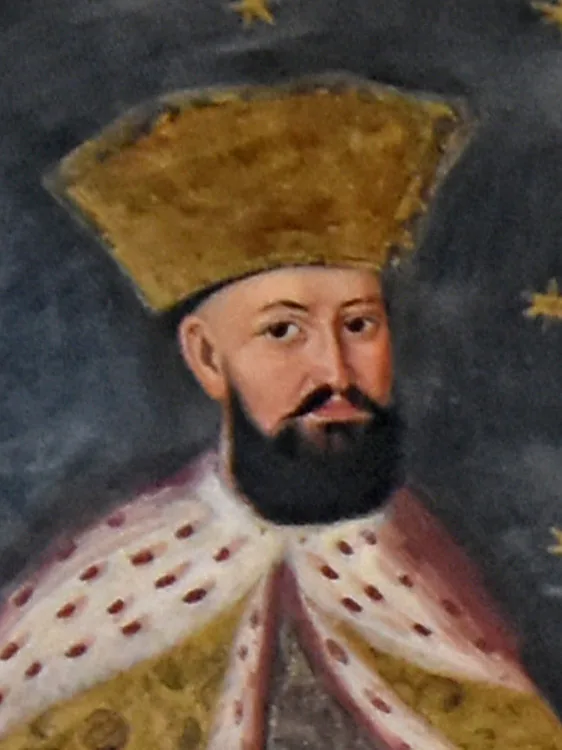
Constantin Brâncoveanu — a 1709 portrait, five years before 15 August 1714. Constantin Brâncoveanu, a 1709 portrait · CC BY-SA 4.0, Dan Mihai Pitea · Wikimedia Commons
The short answer
Constantin Brâncoveanu reigned 26 years, from October 1688 to 15 August 1714: Hurezi, Mogoșoaia, presses and schools, a balance held against three empires. Then the Porte deposed him by firman, took him to Yedikule, tortured him to declare his fortune and, after seizing everything, beheaded him on his 60th birthday, with four sons and his counsellor Ianache Văcărescu.
The fortune is the documented engine of the fall: from the Brâncoveni estate to the walls of the Porte, the map below ties each place to its step in 1714. And the game separates, story by story, what the archives say from what the legends say.
The wealth map
10 documented places and 5 steps of the fall, from March to August 1714. Start the run or touch a place.
A schematic map, drawn from zero; positions are representative, and the Bucharest–Constantinople road is a straight line, not the real route.
24 March 1714 – after 15 August 171410 documented places and 5 steps of the fall, from March to August 1714. Start the run or touch a place.
The documented hoardSchematic10 documented places · 5 steps of the fallThe map is drawn from zero, not to scale: the places are documented, the positions indicative. This page shows no sum of money — because no source gives one.
All 5 steps
24 March 1714The firman of deposition reaches Bucharest, through Mustafa-Aga.
spring 1714The road to Constantinople: the prince and his own, locked in Yedikule.
summer 1714Torture for the fortune: the Porte wants the treasure's hiding place.
15 August 1714Before the seraglio: the four sons and Ianache Văcărescu, then the prince.
after 15 August 1714The bodies, thrown into the Bosporus; Christian fishermen bury them at Halchi.
From Brâncoveni to the seraglio
Four chapters, the same anatomy: the dates, a scene in the sources' own words, an archival image and a wide-world anchor.
I
The rise
1654–1688
Brâncoveni 1654, the Cantacuzino household, the logothete's office and the 1688 Bible: a sister's son takes the throne in a single day.
Constantin Brâncoveanu is born on 15 August 1654, on the Brâncoveni estate, son of Papa Brâncoveanu and Stanca Cantacuzino. Left an orphan, he grows up in the house of his uncle, stolnic Constantin Cantacuzino, and inherits through his grandfather Preda a substantial part of Matei Basarab's fortune.
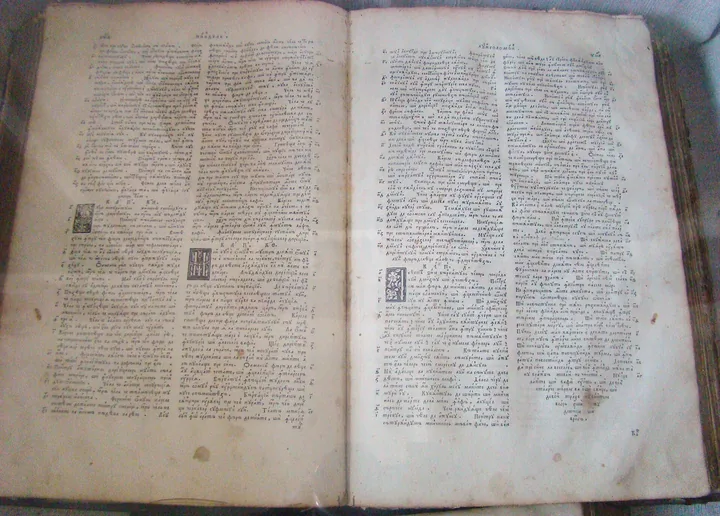
As grand logothete, he oversees the printing of the Bucharest Bible, ordered by Șerban Cantacuzino: printing starts in November 1687 and ends in September 1688, and the title page, of 10 November 1688, already names the new prince Constantin.
After Șerban's death the boyars raise him to the throne on the very same day, and the stolnic uncle — proclaimed prince, says Del Chiaro — refuses the throne and clears his nephew's road to the Porte's confirmation. 26 years of reign were beginning.
The Bucharest Bible, 1688: the first whole Bible in Romanian, ordered by Șerban Cantacuzino and overseen by logothete Brâncoveanu. The Cantacuzino Bible, 1688 · CC BY-SA 3.0, Țetcu Mircea Rareș · Wikimedia Commons
II
The foundations
1690–1702
Hurezi 1690–1697, Mogoșoaia 1698–1702, the press and the Academy: 26 years show nowhere better than in stone and in books.
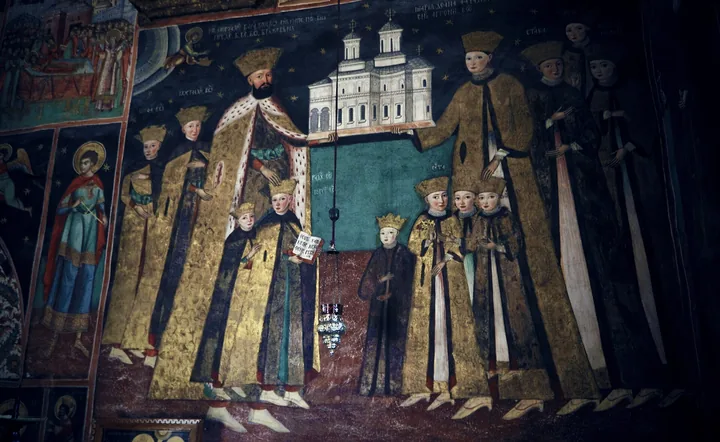
Hurezi begins in 1690 and is finished in 1697: the great church, dedicated to Saints Constantine and Helen, is the masterpiece of the style that bears his name — local tradition, Byzantium and the Italian Renaissance in the same wall. The first pisanie dates from June 1692, the consecration from 8 September 1693, the family's votive fresco from 1709.
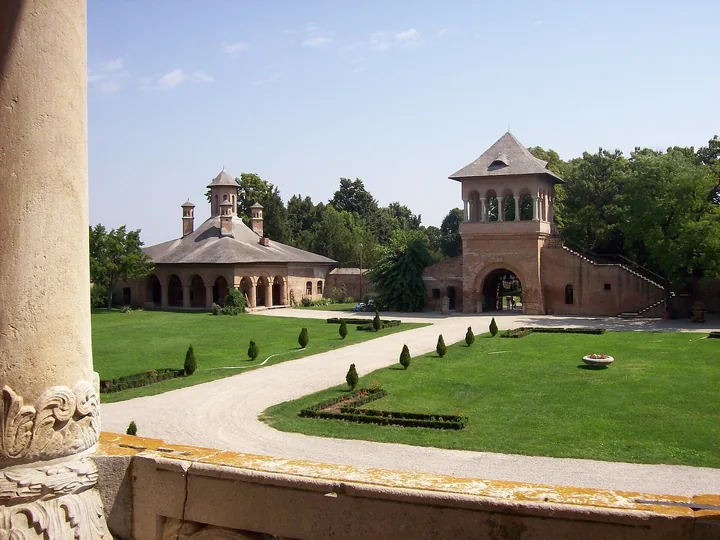
Mogoșoaia rises between 1698 and 1702, 10 kilometres from Bucharest; Potlogi, Doicești, Râmnicu Sărat, Sâmbăta de Sus and the Old Court of Bucharest complete the row of foundations. All stand on the wealth map, each at its step.
Under the same reign works the Bucharest press, under Antim Ivireanul: books in Romanian, Greek, Bulgarian, Arabic, Turkish and Georgian. In 1694 the Princely Academy of Bucharest is founded. The four sons — Constantin, Ștefan, Radu, Matei — are born in 1683, 1685, 1690 and 1702; beside them, seven daughters.
Mogoșoaia Palace, built between 1698 and 1702: the loggia, the belvedere and the balcony stair — Brâncovenesc style in secular form. Mogoșoaia Palace · Public domain · Wikimedia Commons
III
The fall
1710–1714
Urlați, the returned gifts, the March firman: a 26-year balance breaks in a few weeks.
The Russo-Turkish war of 1710–1711 caught him in the middle: he contacted Peter the Great and accepted his gifts, but never crossed to his side. The army waited at Urlați, by the Moldavian border, then the gifts went back to the Russians and the prince remained, formally, the Porte's man.
It was not enough. Denounced to the Porte and worked from inside by the Cantacuzinos — the Brâncovenesc Anonymus shows them plotting his ruin — Brâncoveanu received the firman of deposition in Holy Week itself, through Mustafa-Aga. Cousin Ștefan Cantacuzino triumphantly took the throne.
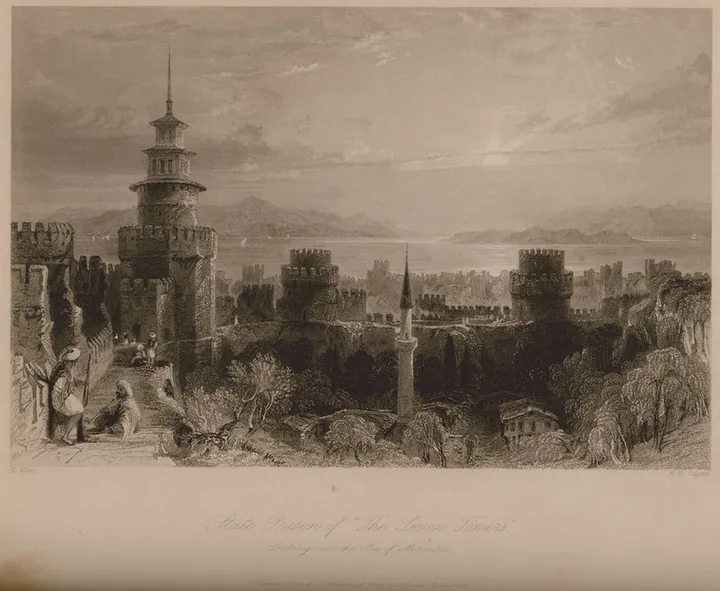
The deposed prince's road led to Constantinople, to the prison of the Seven Towers, Yedikule. There, under torture, he declared his entire fortune, estates and all. The Porte was hunting the hidden treasure; what it found, it seized.
Yedikule, the Seven Towers: the Constantinople prison where the deposed prince was held and tortured in 1714 — an 1836 engraving. Yedikule, an 1836 engraving by Walsh and Allom · Public domain · Wikimedia Commons
IV
15 August 1714
1714
The Dormition, 60 years, before the seraglio: six heads fall for an unrenounced faith.
On 15 August 1714, the Dormition of the Mother of God — an imperial feast, his 60th birthday and Lady Marica's name day — the deposed prince, the four sons and Ianache Văcărescu are brought before Sultan Ahmed III. The envoys of Austria, Russia, France and England watch too.
The fortune had already been seized; the family's lives could still be ransomed only by renouncing the faith. They refused. Constantin, Ștefan, Radu and Matei, then counsellor Ianache, were beheaded before the father's eyes.
Del Chiaro, the prince's Italian secretary, writes what followed: the heads carried on poles through the streets of Constantinople, the city's unrest, the bodies thrown into the Bosporus for fear of revolt and fished out by Christians, buried at Halchi Monastery. In June 1992 the Romanian Orthodox Church canonised all six; the feast is on 16 August, and the relics rest at New St. George in Bucharest.
The family's votive portrait, Hurezi, 1709: the prince, the lady and the sons painted five years before 15 August 1714. The family's votive portrait, Hurezi, 1709 · CC BY-SA 3.0, Fusionofhorizons · Wikimedia Commons
The figures
Six figures hold the whole story. Each is verified in the sources.
1654
born at Brâncoveni, on 15 August
1688
takes the throne as the Bible is printed
1697
Hurezi finished, the style's masterpiece
1702
Mogoșoaia finished, between 1698 and this year
1714
the fall: the firman on 24 March, the scaffold on 15 August
26
years of reign, from October 1688
Treasure or archive?
Six stories of money and death. For each, choose: does it stand in the archives or in legend?
The rules
You get six stories in turn: three rest on documents, three on legends.
You press Document or Legend; the card turns over the verdict with the proof.
The score adds up at the end; you may restart any time.
The game needs JavaScript; with it off, the verdicts below stand open, as a list.
He reigned 26 years, from October 1688 to 15 August 1714.
Score
Documented: the reign's endpoints are October 1688 and 15 August 1714. “26 years” is the rounding historians use too.
At Yedikule he was tortured to declare his fortune.
Score
Documented: the Ottomans tortured him to find the immense fortune he was believed to have amassed — so writes Del Chiaro.
The Porte seized his entire fortune.
Score
Documented: after “all of his fortune had been seized”, the family's lives could only be ransomed by renouncing the faith.
The famous scaffold words are the exact transcript of the execution.
Score
The schoolbook wording comes via Șincai, 1811, almost 100 years later, and circulates in variants. No contemporary transcript exists.
He hid a treasure that was never found.
Score
No archive and no chronicle names a hiding place. The Porte tortured to learn it and seized what it found; the rest is story.
He was the richest prince in Europe.
Score
No consulted source measures fortunes across a continent. Rich — yes, with estates, palaces and foundations; “richest” — a legend's word.
Myths to burst
Three things everybody knows — which survive the sources only by half.
“We have the transcript of the last words”
Apocryphal in detail
The famous wording — “of our kind none have lost their faith” and the long speech — comes via Șincai, 1811, almost 100 years after the scaffold, and circulates in variants. The contemporary witness Del Chiaro describes the scene — the heads on poles, the city's unrest — not a transcript.
“Brâncoveanu's hidden treasure”
Undocumented
The Sultan believed it existed, which is why he ordered torture; the Porte seized all it found. But no archive and no chronicle names a hiding place — not at Hurezi, not at Mogoșoaia, not in the lake. The treasure with an address is legend.
“Brâncoveanu's Bible”
A nuance to correct
Half true: the Bucharest Bible, the first whole one in Romanian, was ordered by Șerban Cantacuzino, overseen by logothete Brâncoveanu, printed from November 1687 to September 1688, with the title page of 10 November 1688 — already under the new prince Constantin.
Sources
Every fact on the page points to an entry here. The full document is SOURCES.md.
.jpg)


