A life between Istanbul, Iași and Moscow · 1673–1723
The prince who wrote down the Turks' music
Held over two decades at Tsargrad, prince a single year at Iași, beaten on the Prut and exiled in Russia, Dimitrie Cantemir wrote the books from which Europe learned the Turks' music, the history of the Ottoman Empire, and the geography of Moldavia.
his roadthe road of the books and the bones
From Silișteni to Dmitrovka, from Iași to London
The map below draws its own roads as you read: first his life (Silișteni, Constantinople, Iași, Stănilești, Moscow), then, in dashed line, the roads of the books and of the bones.
Distances are great-circle arcs between approximate waypoints, rounded to the hundred: the order of magnitude of a life that crossed three empires.
Chapter I
The hostage who learned
1687 – 1710 · the making
- Years
- 1687 – 1710
- Road on the map
- 600 kmgreat-circle, rounded
- Signature work
- The Divan (Iași, 1698)
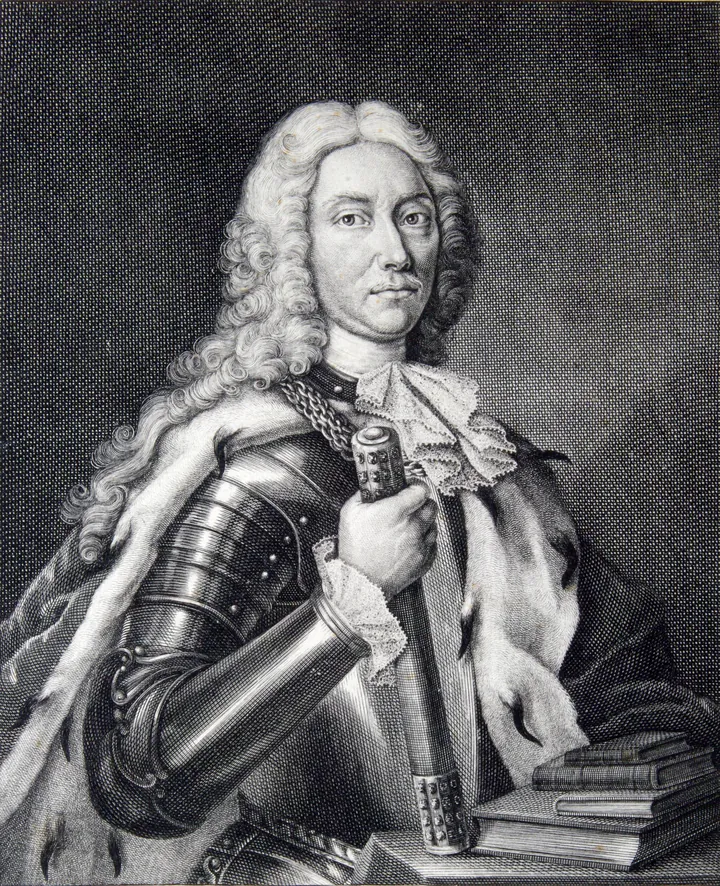
Dimitrie Cantemir was born on 26 October 1673 at Silișteni, in Moldavia's Lower Country, son of Constantin Cantemir, enthroned in 1685, and Ana Bantăș. The father could not read, but schooled his sons thoroughly: Dimitrie learned Greek and Latin from childhood.
Between 1687 and 1710 he spent most of his time at Constantinople, as hostage and envoy of his father, then of his brother Antioch. He lived in the family palace in the Phanar, learned Turkish and Ottoman history at the Greek Academy of the Patriarchate. Meanwhile, he composed music.
.jpg)
At Tsargrad too he wrote his first books: the Divan (Iași, 1698), in Romanian and Greek, and the Istoria ieroglifică (1705), a coded political satire counted as the first novel in Romanian. He had already reigned once in between: on his father's death, in March 1693, he took the throne for three weeks, until the Porte deposed him for Constantin Duca.
Meanwhile: In 1697, as he learned Turkish in the Phanar, Eugene of Savoy destroyed the Ottoman army at Senta.
Chapter II
A year on the throne
1710 – 1711 · the reign
- Years
- 1710 – 1711
- Road on the map
- 800 kmgreat-circle, rounded
- Signature work
- Treaty of Lutsk (13 Apr 1711)
In 1710 the Porte named him prince of Moldavia. Cantemir believed the Ottoman Empire was collapsing, and gambled everything on Peter the Great: on 13 April 1711, at Lutsk, the treaty putting Moldavia under Russia's protection was signed in secret. He had written the 17-article text himself, from end to end; for Moldavia, Metropolitan Ghedeon signed.
In early summer Peter entered Moldavia and joined his army with Cantemir's near Iași; together they marched down toward the Prut. That same spring, at Satu Mare, the peace of 29 April ending Rákóczi's uprising had been sealed. Eastern Europe was reshuffling every alliance at once.
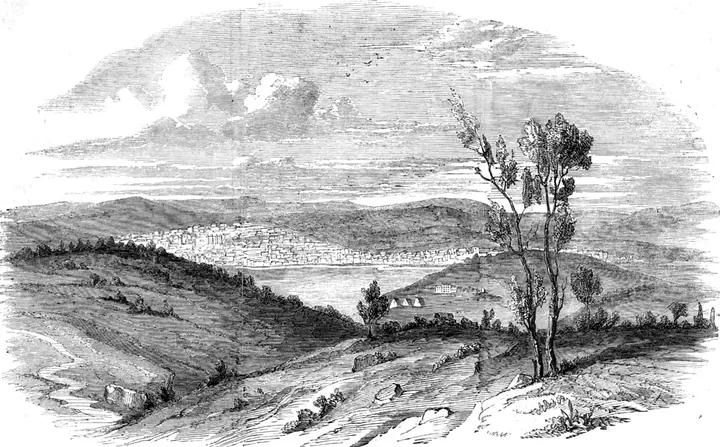

At Stănilești, on 18–22 July 1711, the Christian army was encircled. The Peace of the Prut humiliated Peter (Russia abandoned Azov), and Cantemir lost his throne for good, fleeing into exile with his boyars and troops, the chronicler Ion Neculce among them.
Meanwhile: Two years earlier, Peter had crushed Charles XII at Poltava (1709), the victory that convinced Cantemir he was betting on the winning horse.
Chapter III
The exile who wrote
1711 – 1723 · exile
- Years
- 1711 – 1723
- Road on the map
- 2,700 kmgreat-circle, rounded
- Signature work
- Descriptio Moldaviae (1714)
In 1712 Peter gave him the Bogorodskoye estate (“Black Mud”) and the title of knyaz; Emperor Charles VI made him a prince of the Empire. Peter had refused to hand his ally to the victorious Turks. He settled at Dmitrovka, near Oryol, with a train of boyars, and wrote for twelve years almost without pause.
In 1714 he was admitted to the Berlin Academy, which asked him for a description of Moldavia: thus were born the Descriptio Moldaviae and the country's first true map. In exile too he wrote the History of the Growth and Decay of the Othman Empire and, between 1719 and 1722, the Hronicul, the first critical history of the Romanians as a whole.
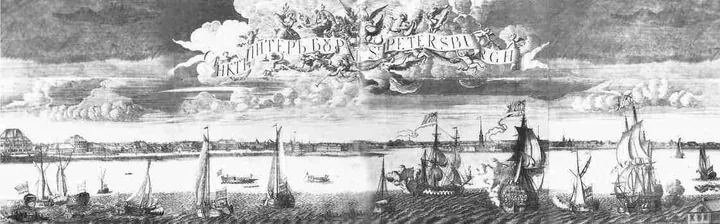

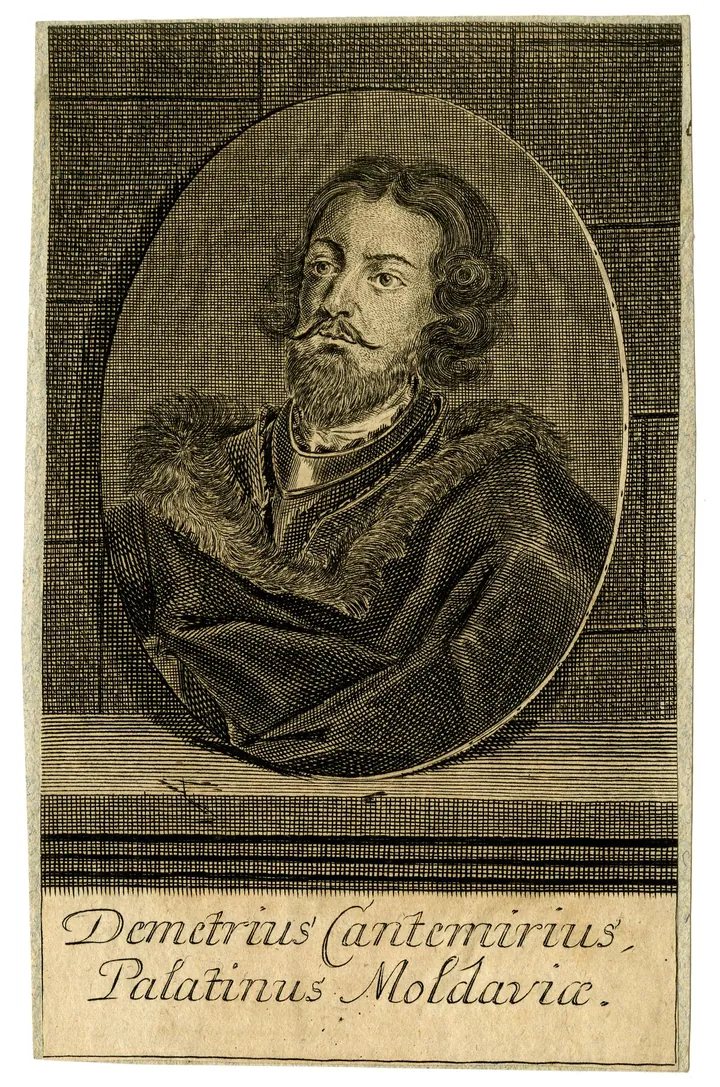

He was no forgotten exile: in 1722 his Systema of the Turkish religion came off the press at St Petersburg, in Russian, and the manifesto with which Peter opened the Persian war, on 15 July 1722, was drafted by him. He died at Dmitrovka on 21 August 1723.
Meanwhile: In the year of his death, in Scotland, Adam Smith was born.
Chapter IV
The book of music
c.1700 – 1705 · the notation
- Years
- c.1700 – 1705
- Road on the map
- no road on the map
- Signature work
- The Edvar (c.1700)
The Edvar, the Book of the Science of Music in Letters, is Ottoman music theory written by a practitioner: an alphabet in which every letter is a note and every numeral a duration. It reads right to left: notes on the first line, rhythm on the second. Written at Tsargrad around 1700, the copy was presented to Sultan Ahmed III.
The collection keeps over 350 instrumental pieces (318 peshrevs and 36 saz semais), gathered and notated by him, not composed; his own compositions, a few dozen, are still played in the Turkish classical repertoire. The autograph original is kept at the Turcology Institute in Istanbul.
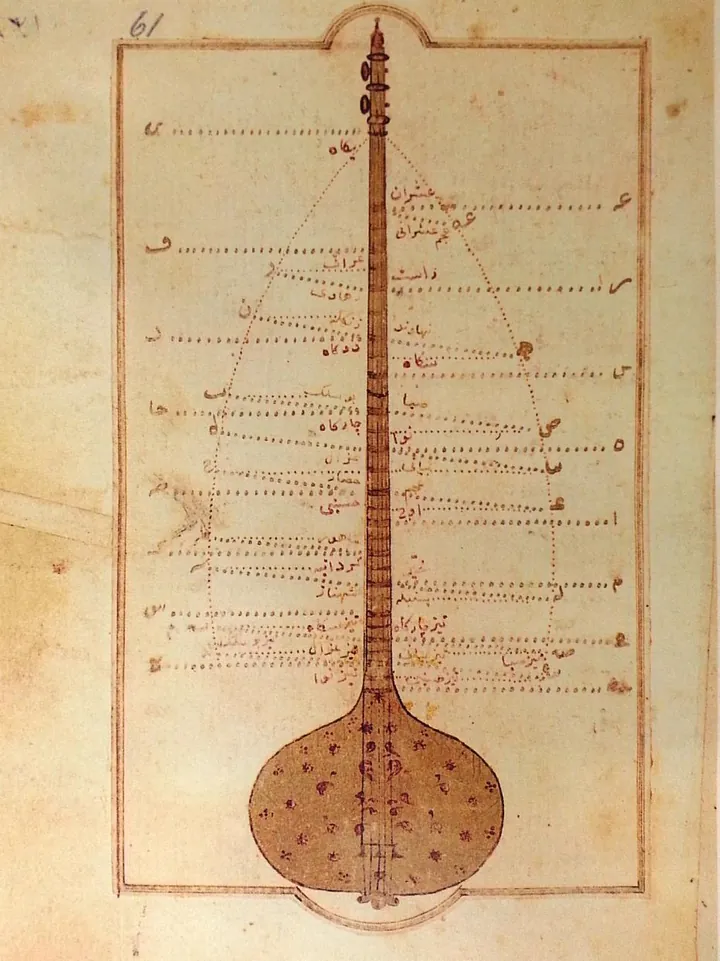

Below you can try the system yourself: the eight principal frets of the tanbur neck, from bottom to top, under the names he gave them, plus the rhythm numerals. The sounds are illustrative, after the standard modern correspondences.
The tanbur neck
The eight principal frets, from the bottom of the neck up, under the names from his drawing. Below them, the whole scale played through.
- Yegâh
- Irâk
- Dügâh
- Çargâh
- Hüseynî
- Gerdâniye
- Tiz Segâh
- Tiz Nevâ
Tap each fret to hear it.
Pitches are illustrative, after the standard modern correspondences (the Arel-Ezgi system).
The rhythm numerals
Under each letter, the duration is written in the signs 1–4: 1 is the time unit, 2 its double, 3 its triple, 4 its quadruple. Three tempo marks (slow, moderate, fast) match Andante, Moderato and Allegro. The treatise's example peshrev is in makam Zengûle, on usul Devr-i kebir, at 28 beats to the cycle.
1 = ♪
Tap the numerals 1–4: each is a multiple of the unit.
Meanwhile: In 1703, the year Ahmed III came to the throne and Peter laid the first stone of St Petersburg.
Chapter V
The books Europe read
1714 – 1935 · posterity
- Years
- 1714 – 1935
- Road on the map
- 2,900 kmgreat-circle, rounded
- Signature work
- History of the Othman Empire (London, 1734)
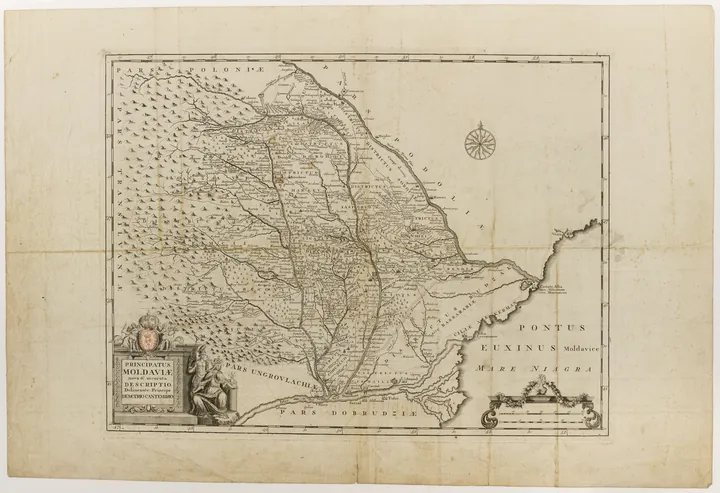
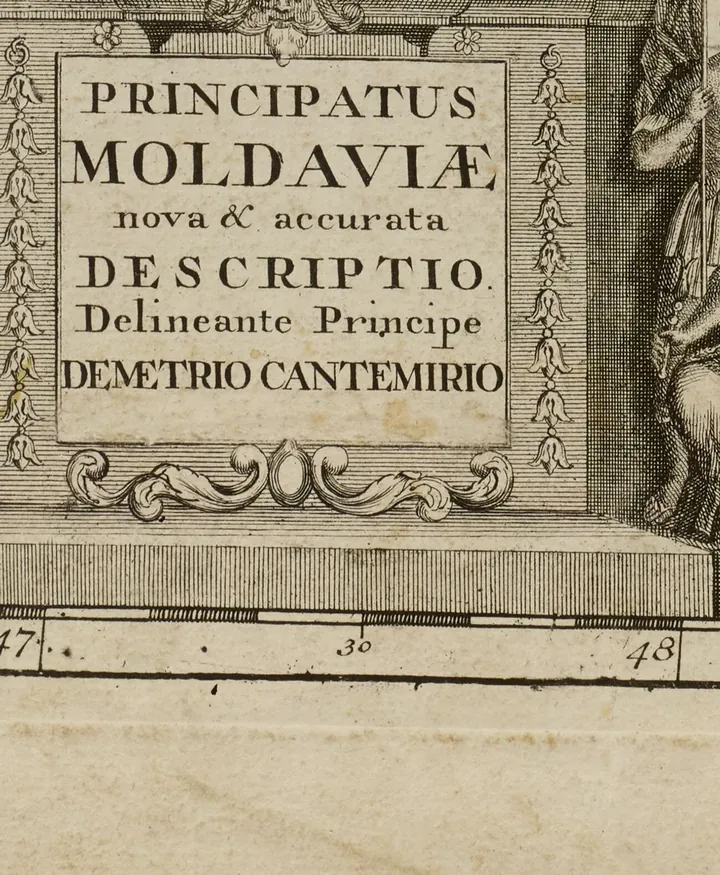
The Descriptio Moldaviae was written in Latin in 1714, at the request of the Berlin Academy. It circulated in manuscript for decades: first in German, in a geography magazine (1769) and in book form (1771). The manuscript map of c.1714, the first true map of Moldavia, was printed in the Netherlands in 1737, with the cartouche “Principatus Moldaviae nova & accurata descriptio, delineante Principe Demetrio Cantemirio”.
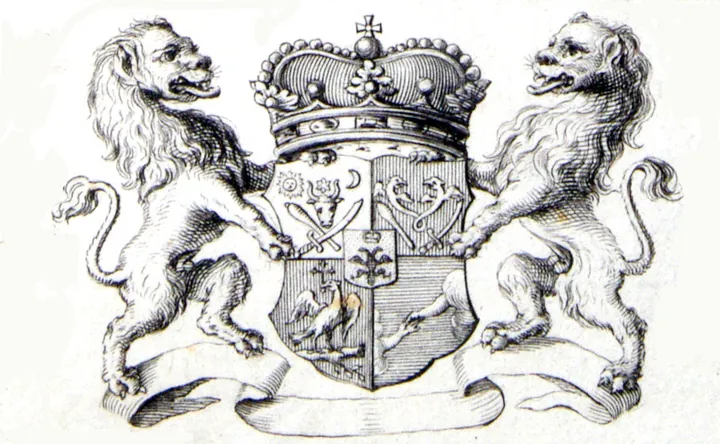
The History of the Growth and Decay of the Othman Empire, taken to London by his son Antioch, the ambassador, was printed first in English (1734–1735), then in French and German, and remained into the mid-nineteenth century the book of record on the Ottoman Empire.
.jpg)
The Hronicul (1719–1722) argued the Latin origin of the language and the Roman origin of the people. His son Antioch (1708–1744), ambassador in London and Paris, friend of Voltaire and Montesquieu, would be called the father of Russian poetry. And in the autumn of 1935, the prince's bones returned to Iași, to the Three Hierarchs church.
The noblest wine grows at Cotnari, on a great hill[...] we dare affirm it finer and nobler than all the other wines of Europe, Tokay itself not excepted[...] if it be kept shut three years[...] it catches fire like spirits[...] it is green, and the older it grows, the greener.
Descriptio Moldaviae, our translation from the Latin
The history of the Growth and Decay of the Othman empire was translated into English from the Latin MS. of Demetrius Cantemir, prince of Moldavia (London, 1734, in folio). The author is guilty of strange blunders in Oriental history; but he was conversant with the language, the annals, and institutions of the Turks.
Edward Gibbon, Decline and Fall of the Roman Empire, ch. 64, n. 41
Meanwhile: As Gibbon wrote The Decline and Fall of the Roman Empire, he cited Cantemir in the notes.
1711: what would you have done?
Four crossroads from the year that decided his life. Choose, then learn what he chose.
-
1
April 1711: do you sign?
April 1711. Peter's envoys lay Russia's protection on the table: a hereditary throne for your house, no meddling in the country, the old borders. The price: war with the Porte, now.
What happened
He signed: at Lutsk, on 13 April 1711, in secret and under oath. He had written the 17-article text himself; for Moldavia, Metropolitan Ghedeon signed.
-
2
Summer: the tsar at the gates
In early summer 1711 Peter enters Moldavia and camps near Iași. The treaty is secret; the Porte still thinks you loyal. What do you do?
What happened
He received him: Peter joined his army with Cantemir's near Iași, in early summer 1711, and together they marched down toward the Prut.
-
3
July: encircled on the Prut
18–22 July, Stănilești: encircled on the Prut, no supplies, the vizier ahead. Peter wants to treat. What do you choose?
What happened
A peace humiliating for Russia: on the Prut, Peter abandoned Azov to get his army out of the encirclement. Cantemir lost his throne for good.
-
4
After peace: pardon or exile?
Peace is signed without you. The Porte has set another prince in Iași. Do you take your boyars and remaining troops and ride north, or kneel at Tsargrad?
What happened
He left. Peter had given him the Bogorodskoye estate and the title of knyaz, Charles VI had made him a prince of the Empire. Twelve years of writing followed, with Ion Neculce among his companions.
No choices yet.
The life in numbers
Six numbers that sum it all up: each checked against the sources below.
- 49
- years of life, 1673–1723
- 3
- weeks of the first reign, 1693
- 17
- articles at Lutsk, written by him
- 354
- pieces notated: 318 peshrevs + 36 saz semais
- 11
- languages spoken and written
- 1935
- the bones return to Iași

What didn't happen
He composed 350 pieces.
He gathered and notated over 350 (318 peshrevs and 36 saz semais), but composed a few dozen himself. The gathering is the feat: over 350 pieces saved in his letters.
Istoria ieroglifică is the first Romanian novel.
Written at Tsargrad in 1705, it is a coded political satire: Călinescu called it “a Romanian Roman de Renard with polemical aims” (our translation), fed by the Cantemir–Brâncoveanu rivalry. The first novel, yes; a story for the story's sake, no.
He was a failed prince.
His reign lasted, all told, a year and three weeks. But the Stănilești defeat took his throne and gave him posterity: without exile there would have been no Descriptio, no London History, no Gibbon footnote. He matters not for what he reigned but for what he wrote after losing.
Sources and method
Every date and figure on this page is checked against at least one open source, cited below; Latin passages are the editors' translations, with the original in view.
Distances measure great-circle arcs between approximate waypoints and round to the hundred: the order of magnitude, not the topography. The sounds in the music section are illustrative.
Quotations in old Romanian keep the spelling of the cited edition; the editors' omissions are marked with square brackets.
The hostage who learned
- Wikipedia, Dimitrie Cantemir: birth (26 Oct 1673, Silișteni), the 1687–1710 Constantinople years, first reign (Mar–Apr 1693, three weeks)
- Encyclopaedia Britannica, 11th ed. (1911), Cantemir: the eleven languages, “ruled only one year” (Wikisource, public domain)
- Monoskop, Dimitrie Cantemir (after Brezianu–Spânu, Historical Dictionary of Moldova): the Divan (Iași, 1698, bilingual), Istoria ieroglifică (1703–1705)
- Wikipedia, Battle of Senta (11 Sept 1697): the “meanwhile” anchor
A year on the throne
- Wikipedia, Treaty of Lutsk: 13 April 1711, the terms (hereditary throne, “all power with the lord”, the old borders), after Panaitescu 1958
- Wikipedia, Pruth River Campaign: 18–22 July 1711, the encirclement, the abandonment of Azov
- Monoskop, Dimitrie Cantemir: the meeting with Peter at Iași (June 1711)
- Wikipedia, Battle of Poltava (1709): the “meanwhile” anchor
The exile who wrote
- Wikipedia, Dimitrie Cantemir: Bogorodskoye 1712, knyaz and Reichsfürst, Berlin Academy 1714, death (21 Aug 1723, Dmitrovka), reburial (Iași, 1935)
- Wikipedia, Russo-Persian War 1722–1723: Peter's 15 July 1722 manifesto, drawn up by Cantemir
- Descrierea Moldovei, “Prescurtare din viață”: the Systema, printed in Russian at St Petersburg, 1722 (Wikisource)
- Wikipedia, Adam Smith (baptised June 1723): the “meanwhile” anchor
The book of music
- Anca-Cristina Grigoraș, “Le Prince roumain Dimitrie Cantemir et son ouvrage”, Revista MUZICA 2/2021: the treatise (parts, 318 peshrevs + 36 saz semais), the notation (33 letters, rhythm numerals), the dedication to Ahmed III
- Wikipedia, Dimitrie Cantemir: “roughly forty” own compositions still performed; the Bezmara (1999), Lux Musica (2000) and Hespèrion XXI (2009) recordings
- Wikipedia, Turkish makam: the perde table in cents (modern correspondences, used illustratively) and Usul (music): Devr-i Kebir, 28 beats
- Wikipedia, Ahmed III (acceded 1703) and Saint Petersburg (founded 27 May 1703): the “meanwhile” anchors
The books Europe read
- D. Cantemir, Descriptio Moldaviae, Latin (Wikisource, after Opere I, 1872): the Cotnari and Red Groves passages, in our translation
- D. Cantemir, Descrierea Moldovei, tr. Vasile Vârnav 1806 (Wikisource, public domain): the Romanian quotations
- D. Cantemir, The History of the Growth and Decay of the Othman Empire, tr. N. Tindal, London, 1734–1735 (1756 ed. at Internet Archive)
- Edward Gibbon, Decline and Fall of the Roman Empire, ch. 64 n. 41 and ch. 61 n. 57 (CCEL, public domain)
- Wikipedia, Dimitrie Cantemir: the Descriptio (1714, at the Academy's request), the Hronicul (1719–1722), the son Antioch (1708–1744)
The game
- Wikipedia, Treaty of Lutsk and Pruth River Campaign: the dates and outcomes in the game cards
- Encyclopaedia Britannica, 9th ed. (1878), Demetrius Cantemir: “the campaign... so humiliating to Russia”; Peter “refused to give up his ally” (Wikisource, public domain)
- Wikipedia, Treaty of Szatmár (29 April 1711): the “meanwhile” anchor
Images
- Engraving from the Descriptio Moldaviae, 1716 · Wikimedia Commons
- Drawing from the music treatise, c.1700 · Wikimedia Commons
- Period view, unknown artist · Wikimedia Commons
- Alexei Zubov, panorama · Wikimedia Commons
- Anonymous engraving (CC BY-SA 4.0) · Wikimedia Commons
- After Dimitrie Cantemir, manuscript c.1714, printed 1737 · BnF Gallica · Wikimedia Commons
- Detail from the map above · BnF Gallica · Wikimedia Commons
- Dimitrie Cantemir's arms, 1734 · Wikimedia Commons