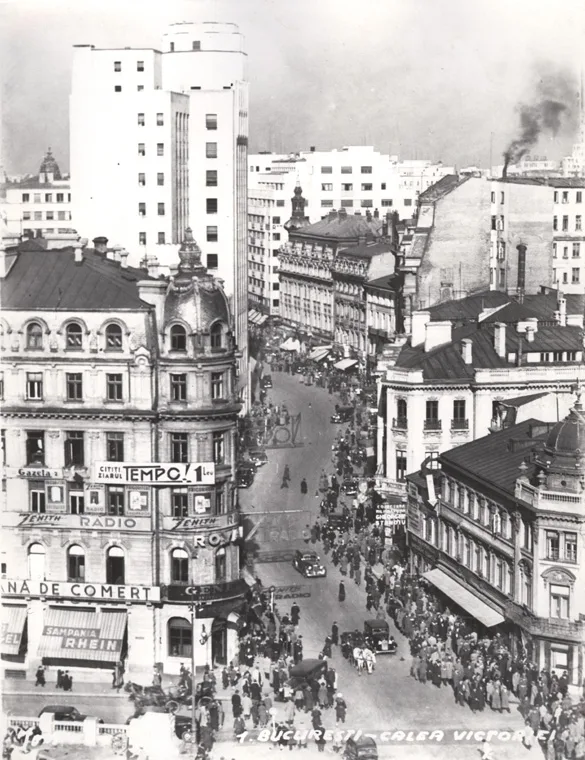
Bucharest, Romania · Calea Victoriei · November 1933
The automatic exchange in Bucharest's Telephone Palace, 1933: how it found a five-digit number
At midnight between 4 and 5 November 1933, the daily Curentul reported, Bucharest completed its switch to automatic telephone exchanges. Below is the 12,000-line Rotary 7-A2 exchange in the Telephone Palace (Palatul Telefoanelor), reconstructed from the description its engineers published. Dial a number and follow the call to the subscriber at the speeds of the day.
The exchange, step by step
The simplified 1933 diagram, with every selector at its published speed. Follow the pulses from the dial to the register and the steps by which the line finder and the selectors set up the call; the call timeline below marks every pulse and every step.
Turn the dial from the hole of the digit you want until it reaches the finger stop, or press the digit buttons.
Lifting the receiver
What happened when you lifted the receiver?
Your line belonged to a group of 200. A common shaft turned all the time; when you lifted the receiver, a clutch coupled to it the rotor of a free line finder, whose brushes passed over 45 terminals a second and stopped on the contacts of your line.1
The finder's bank was a semicircle of 100 positions on each row. The rotor carried two sets of brushes facing each other, one on the even rows and one on the odd, so a full turn passed all 200 lines.1 On average the finder had half a turn to go, 2.2 seconds; at worst a full turn, 4.4 seconds.
A link circuit then looked for a free register (it could reach a hundred), the device that recorded the digits you dialled, and connected it to your line; then you heard dialling tone.23 The paper does not say how long connecting the register took. The history of the building published by Orange, the company that now runs the network, says the equipment was designed so that the wait would not exceed three seconds, without saying which wait.8
The register
Why didn't the dial move the selectors?
In direct-control Strowger exchanges, the step-by-step system, every pulse from the dial moved a selector one step. In the Rotary exchange the register received the pulses and controlled the selectors itself. For ordinary telephones the dial sent ten pulses a second, and the register accepted between seven and fourteen.3
A receiving relay and a chain of counting relays counted each digit's pulses, and the count was then passed to four storing relays marked 1, 2, 4 and 6. A technician could read the stored digit by adding up the numbers on the relays that were energised.3
The register then started the selectors, driven from a shaft that a motor kept turning. When a selector chose a level or, on the final selector, a line, every step sent an impulse back to the register, which counted them and stopped the movement at the right number. The engineers called this "revertive impulse control" and had kept it from earlier Rotary systems.3 The selectors could start setting up the call before the caller had finished dialling.3
The selectors
How did the selectors choose the route to a number?
A selector had ten levels, each with 20 or 30 outlets.12 A spindle with ten trip fingers, marked black and red in turn so that its position could be checked from a distance, turned at 14 steps a second and picked the level. Then the brush carriage turned at 28 steps a second, and the brushes released on that level searched for the first free trunk, a connecting line to the next selector; they stopped when the test found one free.13
A 1st group selector reached 20,000 lines, 2,000 on each level; the penultimate selector, called the 4th group selector in the 1933 diagram, reached 2,000; the final selector, 200.23 With 2,000 lines to a level, the register needed the first two digits before it could choose the level of the 1st group selector; the third digit, together with whether the second was odd or even, chose the group of 200 lines, and the last two found the line.
In November 1933 numbers beginning with 2 stayed with the automatic exchange on Dacia Boulevard, opened in 1927, and numbers beginning with 3 or 4 moved to the new exchange on Calea Victoriei, at the corner of Strada Oteteleșanu, then called the Oteteleșanu exchange.47 A call between two 10,000-line units passed through one more selector, the incoming 3rd group selector.2
The final selector
How did the final selector find the right line?
The final selector chose the level from the tens digit, then waited for the units digit. Its brushes moved along that level at 14 steps a second while the register counted the steps. Each level held 20 lines, so when the hundreds digit was odd the register ordered ten steps more.13
Then the final selector tested the line and signalled to the 4th group selector whether it was free, busy or dead. If it was free, the called telephone rang and you heard ringing tone; if busy, busy tone; for a number given to no one, what the engineers called "dead line tone".3 After the last digit, usually only the travel of the final selector's brushes was left: from one step to 20, from a fourteenth of a second to 1.43 seconds.
Numbers that did not exist
What did you hear on a number that did not exist?
Calls to numbers given to no one were routed to a dead line set aside for them, and you heard dead line tone. If you started dialling and stopped, the register released the connection after about 30 seconds; if you kept the receiver off the hook, you heard dialling tone again.3
When the new exchange opened, 65% of telephone numbers changed. The telephone company told subscribers: "Dial all five digits that make up a telephone number." Some were leaving out the first.5
The palace and the dates
When did the Telephone Palace exchange go into service?
The palace on Calea Victoriei was built between 5 September 1931 and its inauguration on 24 April 1933. At 52.50 m it was the tallest building in Bucharest until 1956 (the city's height records). The architects were Louis S. Weeks and Edmond van Saanen Algi, and the steel frame was designed in New York by the engineer Walter Froy.7 The exchange on the first floor had 12,000 numbers and room for 40,000.78
In April 1933 the engineers' journal said the exchange would go into service in September.1 On 5 November the Bucharest daily Curentul wrote that it would start "on the night of 4 to 5 November, at 12 sharp" and that the manual exchange in the Post Office Palace would close; the next day it reported that the new installation had been "put into the subscribers' use from midnight last night".410 The history published by Orange gives 3 November 1933 at 24:00.8
The system was developed by the laboratories of Le Matériel Téléphonique in Paris; the Bucharest equipment was made and installed by the Bell Telephone Manufacturing Company of Antwerp, both associated with the American ITT group.1 Electrical Communication also printed a photograph of the switchracks of "Victoria Exchange, Bucharest".2
What the sources leave open
- How long connecting the register and each relay took: the papers give no times. The reconstruction counts them as zero, so the times on the page are the selectors' travel times.
- Where the line finder started from: wherever the previous call had left it. The reconstruction picks a random place on every call.
- How many trunks were busy: the reconstruction assumes the first one is free, and the line called is free.
- Which level each digit was given: in 1933 this was set by cross-connections on a jumpering field. The reconstruction uses the grouping in the paper (2,000 lines a level, 200 on a final selector) in the order of the digits.
- Which combination of the relays 1, 2, 4 and 6 stood for each digit: the text says the digit is their sum, and the wiring appears only in the circuit diagram; the reconstruction uses the simplest combination.
- How the 12,000 numbers were split between the prefixes 3 and 4: the reconstruction puts the caller in a complete unit 3 and equips numbers 40000 to 41999 in unit 4, reached through a 3rd group selector.
- Where a call to a prefix with no equipment stopped, and what happened next at the Dacia exchange, whose 7-A1 equipment the paper does not describe: the reconstruction stops the call after the 1st group selector.
Sources
The exchange's speeds and working come from the papers of the engineers who designed it; the numbering and the date, from the Bucharest press of November 1933.
- L. Schreiber, W. Hatton, "7-A2 Rotary Automatic Telephone System", Part I, Electrical Communication 11(4), April 1933, pp. 179–190. www.worldradiohistory.com
- Idem, Part II, Electrical Communication 12(1), July 1933, pp. 43–50. www.worldradiohistory.com
- Idem, Part III, Electrical Communication 12(2), October 1933, pp. 128–136. www.worldradiohistory.com
- "Când intră în funcțiune noua centrală automată?" [When will the new automatic exchange go into service?], Curentul, 5 November 1933, p. 5 (Cluj Central University Library). dspace.bcucluj.ro
- Notice of the Romanian Telephone Company (Societatea Anonimă Română de Telefoane), Universul, 9 November 1933, p. 3. www.bibliotecadeva.ro
- Universul, 8 November 1933, p. 1 (masthead: the paper's switchboard, 3-3010 to 3-3015). www.bibliotecadeva.ro
- George M. Croitoru, Cireșica Micu-Croitoru, "90 de ani de la construcția Palatului Telefoanelor, important reper urbanistic al imaginii Bucureștiului interbelic" [90 years of the Telephone Palace], Historia Urbana 32 (2024), pp. 229–243. doi.org
- Orange Romania, Palatul Telefoanelor. Peste nouă decenii de poveste și de inovație [The Telephone Palace: over nine decades of history and innovation] (2024). storage.ghost.io
- Nicolae Ionescu, Calea Victoriei between Casa Capșa and the Telephone Palace, 1935; Library of the Romanian Academy, via Wikimedia Commons (public domain). commons.wikimedia.org
- "Automatizarea rețelei telefonice din Capitală" [The automation of the capital's telephone network], Curentul, 6 November 1933, p. 7. dspace.bcucluj.ro
