Measured: asteroid orbits (JPL) and the meteoroid’s orbit
It came from the asteroid belt
Its orbit, worked out afterwards from videos of the fireball, reached out to 2.7 times the Earth’s distance from the Sun, into the asteroid belt, and back in to 0.74 times, inside the Earth’s orbit. It circled the Sun about once every two and a quarter years.
The dots are 30,000 real asteroids, each on its own measured orbit and moving along it as the clock runs. The meteoroid was far smaller than any of them, about 19 metres across. No telescope ever saw it.
Measured: orbits (JPL Horizons; Borovička et al. 2013)
Out of the sunrise
It passed closest to the Sun around New Year’s Eve 2012, six weeks before it met the Earth, then approached from inside the Earth’s orbit. NASA found that its approach stayed within 15 degrees of the Sun’s direction: in the daytime sky, where telescopes cannot look.
In Chelyabinsk the Sun rose at 9:17 that Friday, on a mostly clear morning, 13 degrees below freezing. Three minutes later the fireball came out of the east-south-east, about 20 degrees above it.
Measured: the trajectory, from videos (Popova et al. 2013)
Nineteen kilometres a second
At 9:20:21 local time, cameras first caught it 97 kilometres up, about 220 kilometres east-south-east of the city. It was moving at about 19 kilometres a second, on a shallow path only 18 degrees above the horizon.
At that angle it crossed more than 200 kilometres of sky in the next 11 seconds. Dashcams, security cameras and phones filmed it from as far as 700 kilometres away: more than 400 cameras in all.
Measured: heights along the path (Popova et al. 2013)
Coming apart on the way down
The air in front of it was squeezed and heated until it glowed. From about 83 kilometres down it began to shed dust and fragments, faster after 54 kilometres.
It was a weak rock, cracked right through. Jiří Borovička and colleagues found that the body as a whole could withstand only about one megapascal, ten times the air pressure at sea level, and that it broke apart most violently between 45 and 30 kilometres.
Scene: computed from the trajectory and ETOPO 2022 relief; city drawn
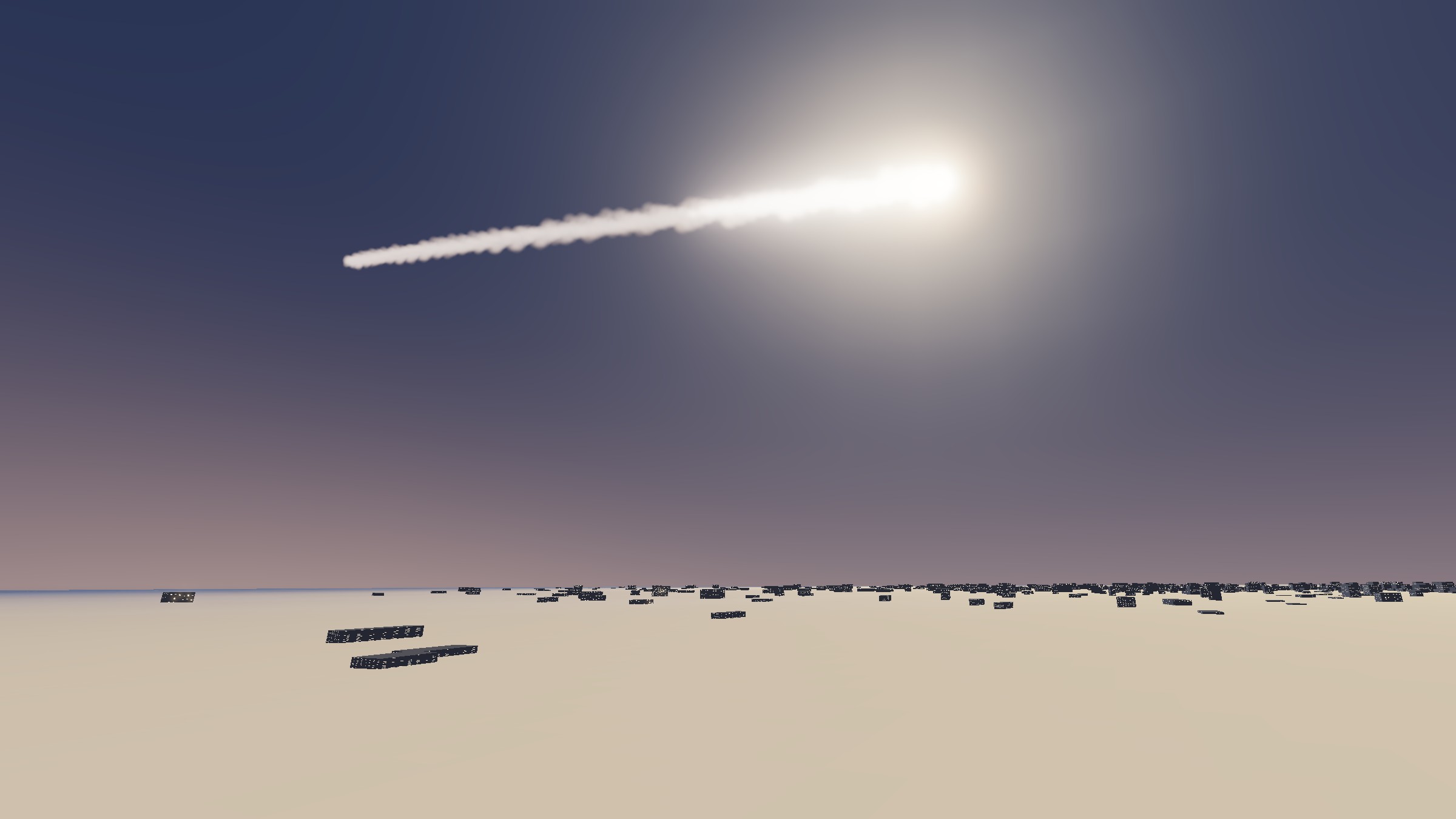
Brighter than the Sun
At 9:20:32 it reached its peak, 29.7 kilometres up and about 35 kilometres south of the city centre. For someone directly beneath it, Peter Brown and colleagues calculated, it was about 30 times brighter than the Sun.
Shadows swung across the snow as it passed. In a survey of people who had been outdoors, 25 of 1,113 reported sunburn and 315 said they felt heat on their skin.
Measured: heights (Popova et al. 2013); fragments drawn
The burst
At 27 kilometres the main body burst. Two large fragments flared again near 24 kilometres; one broke up at 18.5 kilometres, the other glowed down to 13.6 kilometres and went dark. What was left fell on without light.
How much reached the ground is disputed. Olga Popova’s team estimated that three-quarters of the rock vaporised and most of the rest turned to dust, leaving 4 to 6 tonnes of meteorites. Borovička’s team thought 95% became dust and small fragments, and that probably no more than 2 tonnes has been recovered.
The energy is disputed too. Every central estimate lands between about 430 and 600 kilotonnes of TNT, around 30 times the Hiroshima bomb, but no two methods agree exactly.
Computed: the Sun’s position for 03:20 UT
A trail in the sunlight
On the ground the Sun was only just above the horizon. Thirty kilometres up, the trail of dust and smoke was already in full sunlight, bright on one side and dark on the other, and the winds at different heights began to bend it.
There was no sound yet. The fireball had travelled about 60 times faster than sound, and the noise of its passage was still on its way to the ground.
Computed: distance from the energetic part of the path at the speed of sound
Then the sound arrived
The air pushed aside along the path spread outwards as a shock wave. It reached the ground first beneath the brightest part of the track, then swept out across the towns.
Chelyabinsk is about 45 kilometres from the point of peak brightness through the air. At the speed of sound up there, about 300 metres a second, the shock needed about two and a half minutes to cover it; across the city the blast arrived between one and a half and two and a half minutes after the flash. It shattered thousands of windows, and the flying glass injured many people.
Reported: field survey (Popova et al. 2013) and official counts
Glass
Windows broke in a wide strip under the track, out to about 120 kilometres from it. In Chelyabinsk, glass shattered in 3,613 apartment buildings, 44% of the city’s total. Officials counted 7,320 damaged buildings across the region.
In all, 1,613 people asked for medical help, 1,210 of them in Chelyabinsk itself, many of them hurt by flying glass. On the first day alone, 112 were taken to hospital.
Reported: detections (Brown et al. 2013; Le Pichon et al. 2013); ring drawn at 300 m/s
Heard around the world
The same pressure wave travelled on through the atmosphere as infrasound, too low for human ears. In 2013 the International Monitoring System, built to listen for nuclear tests, had 42 working infrasound stations. Twenty of them recorded the blast, the farthest in Antarctica, about 15,000 kilometres away. It was the largest blast the network had detected up to then, beaten since only by the Tonga eruption of 2022: the waves went twice around the globe and were picked up for almost three days.
Seismometers felt it too: the shock hitting the ground sent surface waves through the rock that were recorded thousands of kilometres away.
Measured: JPL Horizons ephemeris
The other asteroid, sixteen hours later
At 19:24 universal time (01:24 the next morning in Chelyabinsk), asteroid 2012 DA14, about twice as long, some 40 metres, passed 27,700 kilometres above the Earth’s surface, inside the ring of geostationary satellites. Astronomers had known it was coming for a year.
It was a coincidence, nothing more. DA14 came up from the south on a quite different orbit; the Chelyabinsk rock had come from the east-south-east, out of the Sun. NASA said the two were unrelated.
Measured: the path; find area (Borovička et al.); stones drawn
Stones in the snow
Over the following days people found more than a thousand meteorites in the snow, in a strip along the track south-west of Chelyabinsk, most of them small. Most had a thin black crust, melted on the way down.
The rock is an LL5 ordinary chondrite, a common kind of stony meteorite, crossed by dark veins left by an old impact. Cosmic rays had been striking it for only about 1.2 million years: roughly since it broke off a larger body.
Drawn after measurements: Suomi NPP OMPS (Gorkavyi et al. 2013)
Dust around the world
Hundreds of tonnes of dust were left high in the stratosphere. Three and a half hours later NASA’s Suomi NPP satellite found the plume above 40 kilometres near Novosibirsk, 1,100 kilometres to the east.
Within four days the faster, upper part had gone all the way round the planet and was back over Chelyabinsk. It settled into a belt between 50 and 70 degrees north that could still be measured three months later.
Reported: Popova et al. 2013
The hole in the ice
The largest piece came down on frozen Lake Chebarkul, 70 kilometres west of the city, and punched a hole about 7 metres across through 70 centimetres of ice. Divers searched the mud on the lake bed for months.
On 16 October 2013, eight months later, it was lifted from the bottom. It broke apart as it came up, and the scales gave out at 570 kilograms: the largest Chelyabinsk meteorite yet found.
Measured: published orbits; 86039 from JPL
Where did it come from?
Borovička’s team noticed that the meteoroid’s orbit was close to that of asteroid 86039 (1999 NC43), about 2 kilometres across, and suggested the two were once part of the same object. Two years later the team itself called the link unlikely: the meteorites’ spectra do not match the asteroid’s.
Others doubted it too. Vacheslav Emel’yanenko and colleagues asked how a 20-metre piece could have been thrown off with the speed that would have required; Carlos and Raúl de la Fuente Marcos proposed another asteroid, 2011 EO40. Even the orbit itself differs from team to team. The question is still open.
Measured: NASA CNEOS fireball catalogue
One fireball in 1,074
NASA’s public catalogue lists 1,074 fireballs recorded by US government sensors since April 1988. The dots are the 888 with a known position, sized by the light they gave off.
Together the 1,074 radiated about 7.3 × 10¹⁴ joules as light. Chelyabinsk alone accounted for 52% of it: more than all the other 1,073 combined. The next brightest, over the Bering Sea in December 2018, gave off about a twelfth as much.
Computed: from published rate estimates (Brown et al. 2013)
How often?
From the record of fireballs, Brown and colleagues found signs that bursts of this size may be far more common than surveys of asteroids had suggested, though the record holds only a handful of them. Their fit gives roughly one every 20 years somewhere on Earth; the asteroid surveys implied about one in 140 years.
Most go unnoticed, over the oceans or empty land. And most rocks of Chelyabinsk’s size are still unknown: of an estimated 20 million near-Earth asteroids 10 to 20 metres across, only about 500 had been found by 2013.