Trajan's Column, Rome, 113 AD
The war carved in stone
In 113 Trajan raised a 155-scene war report in stone: two Dacian Wars, some 190 metres of spiral frieze, 2,662 carved figures. Read the campaigns, then the frieze itself, scene by scene.
The wars in four chapters
Representative route
From Drobeta to Sarmizegetusa
Dedicated on 12 May 113, Trajan's Column winds 155 scenes of the Dacian Wars up its shaft in a spiral some 190 metres long. Below, the two campaigns it narrates: the First War of 101–102 and the Second of 105–106, from the Danube crossing to the fall of Sarmizegetusa.
The routes on the map are representative, drawn through the verified places of the wars. Read the frieze itself in the scene reader further down.
Chapter I
The stone
113 · the monument
- Chapter
- 113
- Height of the shaft
- 29.78 m
- Scenes
- 155
- Carved figures
- 2,662
The Column was dedicated on 12 May 113: 155 scenes counted by Conrad Cichorius, winding 23 turns up the shaft in a band some 190 metres long, with 2,662 carved figures – Trajan himself appears 58 times.
The shaft alone stands 29.78 m – 100 Roman feet – 35.07 m with its pedestal, 38.4 m to the statue base; its 19–20 marble drums weigh some 32 tonnes each, in about 29 blocks for the whole monument. The inscription declares the work removed a hill as high as the Column.
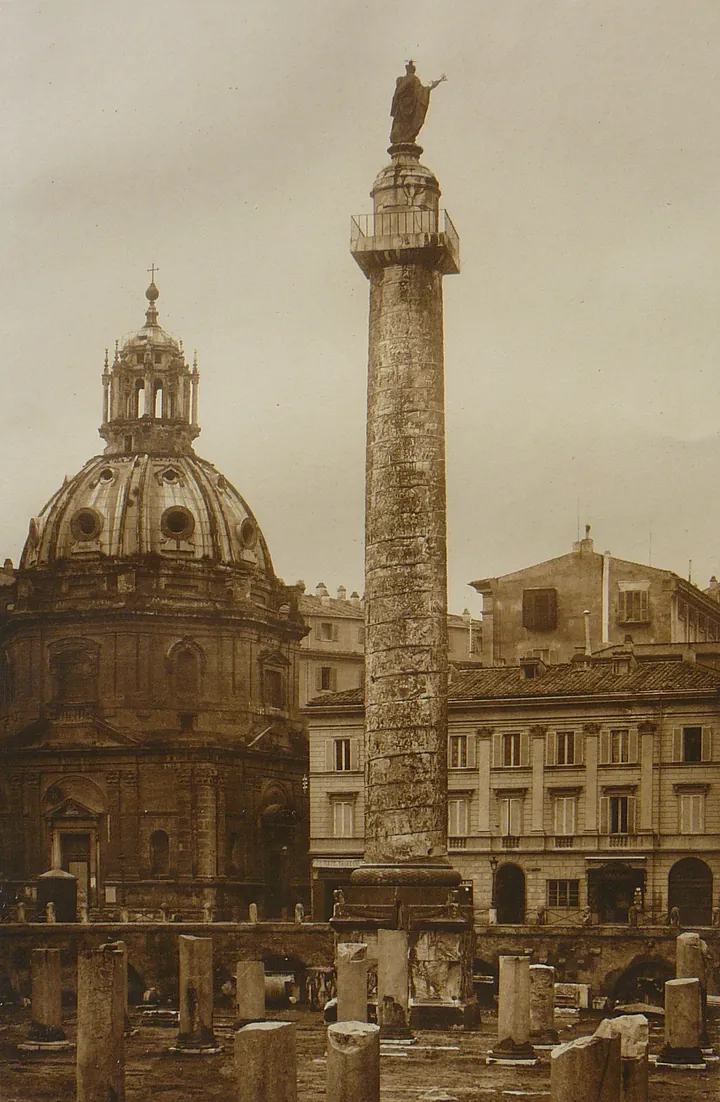

Trajan's ashes were buried in the base after his death – Dio 68.16 – an exceptional honour inside the city walls. A gilt-bronze Trajan crowned the top until the Middle Ages; since 4 December 1587 the statue is St Peter.
SENATVS POPVLVSQVE ROMANVS / IMP CAESARI DIVI NERVAE F NERVAE / TRAIANO AVG GERM DACICO PONTIF / MAXIMO TRIB POT XVII IMP VI COS VI P P / AD DECLARANDVM QVANTAE ALTITVDINIS / MONS ET LOCVS TANTIS OPERIBVS SIT EGESTVS
The dedication inscription (LacusCurtius)
Meanwhile The frieze's 155 scenes were still the standard count when Lepper and Frere re-edited Cichorius.
Chapter II
The First War
101 – 102 · 101–102, crossing and peace
- Chapter
- 101 – 102
- The Danube crossing
- 101, pontoon bridge
- Tapae
- 101
- The peace
- 102
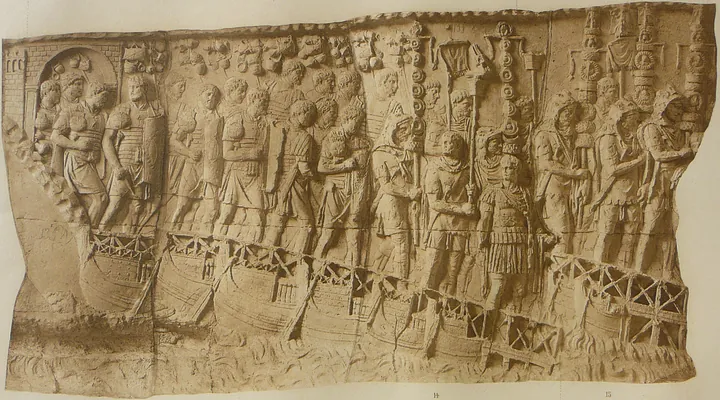
Dio's trigger is money and pride: Rome paid Dacia annual subsidies, and Trajan “was grieved at the amount of money they were receiving annually”. In 101 the legions crossed the Danube on a pontoon bridge – the stone bridge came later.
At Tapae the Romans won hard: the Buri sent a mushroom-letter urging peace, Trajan tore his own clothes for bandages, and the fallen got an altar with yearly rites. Decebalus sued for peace, granted in 102.

Between the wars Apollodorus of Damascus bridged the Danube in stone at Drobeta, in 103–105: 20 piers by Dio's count, 68.13. Hadrian later removed the superstructure, fearing barbarian crossings.
After spending some time in Rome he made a campaign against the Dacians; for he took into account their past deeds and was grieved at the amount of money they were receiving annually.
Cassius Dio 68.6.1 (Cary transl., 1925)
Meanwhile The mushroom-letter of the Buri is the war's strangest dispatch: peace advice written on a giant fungus.
Chapter III
The Second War
105 – 106 · 105–106, the end of Dacia
- Chapter
- 105 – 106
- Apollodorus's bridge
- 103–105
- Sarmizegetusa falls
- summer 106
- Decebalus dies
- autumn 106
In 105 Decebalus broke the peace of 102 – rearming, sheltering deserters, rebuilding forts – and the Senate declared him an enemy again. Dio's account includes the Longinus episode: the captured general who took poison rather than be ransomed.
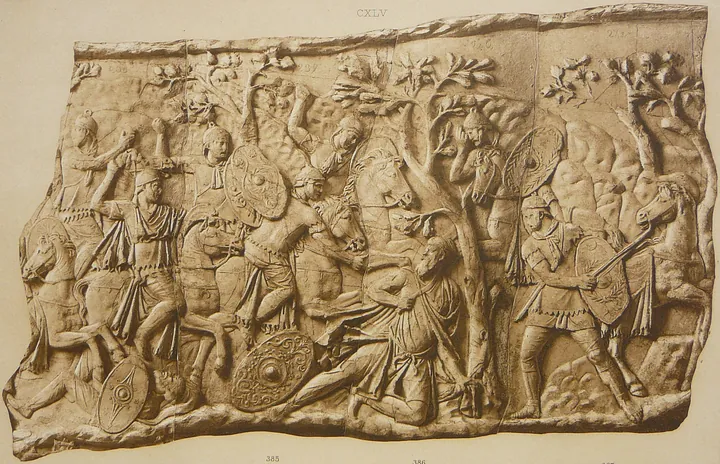
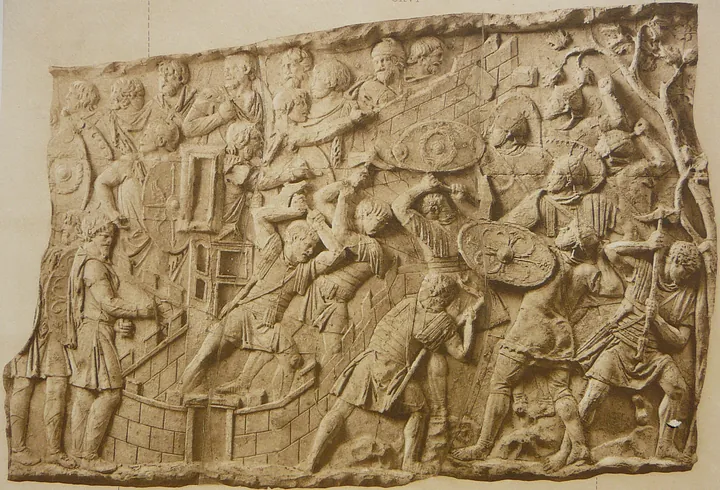
Trajan crossed on the stone bridge and took Sarmizegetusa in the summer of 106 after a hard struggle; the Dacian nobles burned their palace and drank poison. Decebalus fled, was cornered by the cavalry of Tiberius Claudius Maximus, and cut his own throat – scene CXLV, in the autumn of 106.


Dio adds the treasure: gold and silver hidden in the bed of the river Sargetia, its course diverted and restored, revealed by a captive named Bicilis. Dacia became a province in 106, with its capital – Colonia Dacica Sarmizegetusa, founded 106–110 – some 40 km from the Dacian capital.
Decebalus, when his capital and all his territory had been occupied and he was himself in danger of being captured, committed suicide; and his head was brought to Rome. In this way Dacia became subject to the Romans.
Cassius Dio 68.14.3 (Cary transl., 1925)
Meanwhile Decebalus died in the autumn of 106; the Column telling his death was dedicated seven years later.
Chapter IV
The echo
109 – 1972 · copies and readings
- Chapter
- 109 – 1972
- Adamclisi
- 108–109
- The V&A cast
- 1864
- The MNIR copy
- 1972
The wars' other monument stands in Dobruja: the Tropaeum Traiani at Adamclisi, raised about 108–109 to Mars Ultor for the victory – including the winter battle of 101–102 – with an altar naming some 3,800 fallen.
The Column itself was copied early and often: Napoleon III had it moulded in the early 1860s, and the V&A bought its full plaster cast in 1864; Bucharest's National History Museum has shown a full-scale copy since 1972.
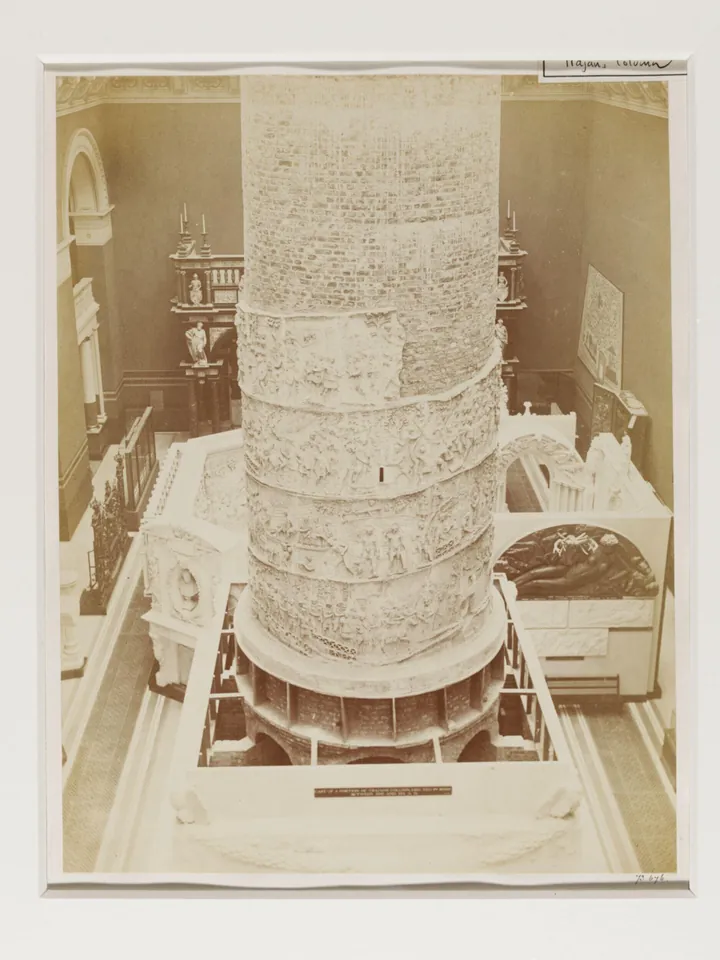

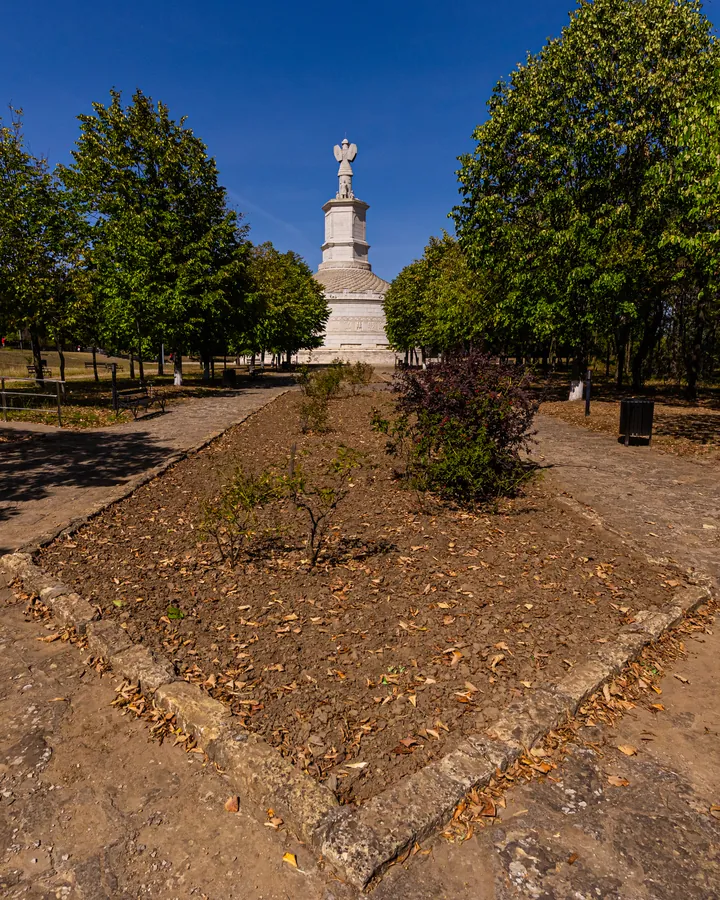

Scholars read the frieze both ways. For J. R. Clarke it stands between documentary history and allegory; for Penelope Davies (AJA, 1997) it foregrounds marching, building, speeches and sacrifice – Trajan proving to Rome that the costly wars were competently run.
Meanwhile The V&A bought its cast in 1864; the Cast Courts housing it were built in 1873.
The Column quiz
Four questions about the monument, the wars, and their telling. Choose, then check against the sources.
-
1
The spiral
Unrolled, how long is the spiral frieze?
What happened
About 190 metres, winding 23 turns up the shaft – a band widening from a metre at the base to 1.2 at the top.
-
2
The king's end
Surrounded in the autumn of 106, Decebalus:
What happened
He killed himself. Cornered by Claudius Maximus's cavalry in the autumn of 106, Decebalus cut his own throat; his head was brought to Rome.
-
3
The bridge
Who built the stone bridge over the Danube?
What happened
Apollodorus of Damascus: the stone bridge at Drobeta, 103–105, with 20 piers by Dio's count (68.13).
-
4
The ashes
Trajan died in 117. What happened to his ashes?
What happened
In the base. After his death in 117 the Senate voted Trajan burial in the Column's square chamber – an exceptional intramural honour.
Answer a card to begin.
Seven scenes from the spiral
Seven plates from Cichorius (1896–1900): the frieze's famous moments in the order of the wars. Tap a scene to study it – or read the whole spiral straight through.
Scene III–IVThe Danube crossing
The Danube crossing Conrad Cichorius, plate VII, 1896 · Wikimedia Commons - The pontoon bridge of 101 – the stone bridge came later
- Danube personified as a river god watching the crossing
- Trajan leads the landing; the war's first scenes, III–IV
Scene XThe address
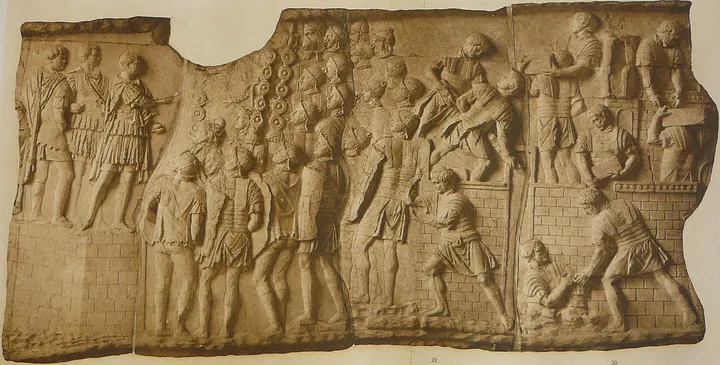
The address Conrad Cichorius, plate XI, 1896 · Wikimedia Commons - Trajan on a podium addresses the troops – the adlocutio
- One of his 58 appearances on the frieze
- Speeches, sacrifices, construction: the war as Rome told it
Scene XCVIII–CThe bridge
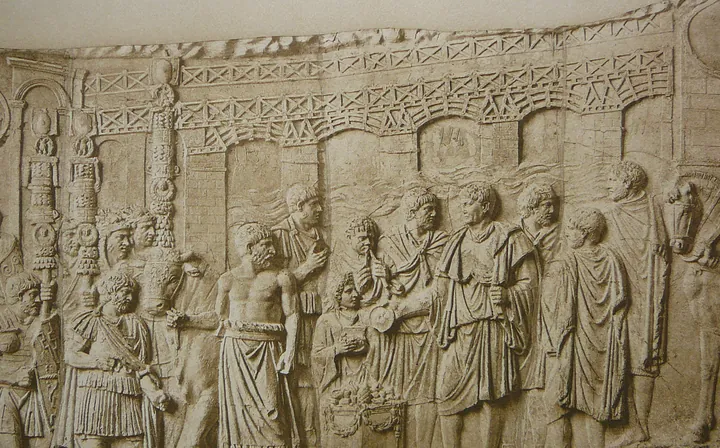
The bridge Conrad Cichorius, plate LXXII, 1900 · Wikimedia Commons - Apollodorus's stone bridge at Drobeta, 103–105
- 20 piers by Dio's count; scenes XCVIII–C open the Second War
- Hadrian later removed the superstructure
Scene CXIII–CXXIThe siege
The siege Conrad Cichorius, plate LXXXVII, 1900 · Wikimedia Commons - The assault on the fortress guarding Sarmizegetusa
- The Dacians torch their own city, CXIX–CXXI
- Mass suicide of the nobles: the capital falls, summer 106
Scene CXLVThe king's death
The king's death Conrad Cichorius, plate CVI, 1900 · Wikimedia Commons - Cornered by Roman cavalry in the autumn of 106
- Decebalus cuts his own throat – scene CXLV
- His head was brought to Rome (Dio 68.14.3)
Scene CXLVIThe prisoners
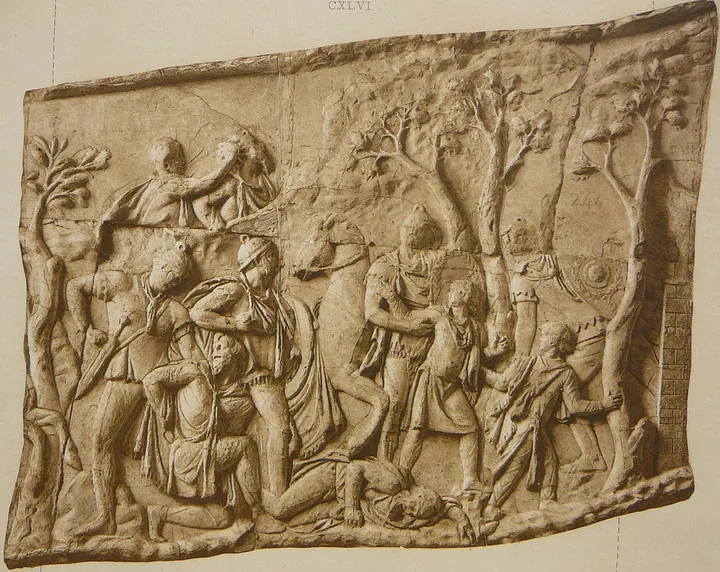
The prisoners Conrad Cichorius, plate CVII, 1900 · Wikimedia Commons - Dacian men and boys taken prisoner, scene CXLVI
- The spiral's human cost, carved by the victors
- The war ends in deportation, not battle
Scene CXLVII–CXLVIIIThe head
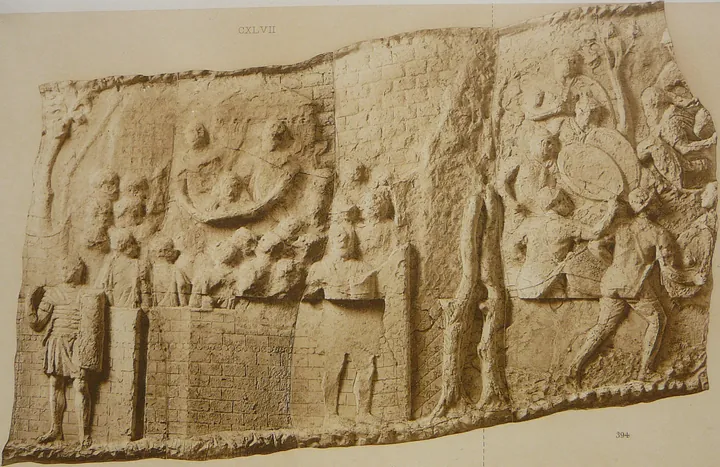
The head Conrad Cichorius, plate CVIII, 1900 · Wikimedia Commons - Decebalus's head displayed to the troops
- The pileati captured: scenes CXLVII–CXLVIII
- Dacia becomes a province, 106

.jpg)


Plates: Conrad Cichorius, Die Reliefs der Traianssäule (Berlin, 1896–1900), via Wikimedia Commons. Scene numbers are his.
The Column in six numbers
Every figure below comes from the cited histories and the standard counts. Disputed figures stay out.
- 113
- the year of the dedication
- 155
- scenes counted by Cichorius
- ≈190
- metres of spiral frieze, about
- 2,662
- carved figures on the frieze
- 58
- appearances of Trajan himself
- 106
- Dacia becomes a Roman province
Three things people get wrong
The Column has 150 scenes.
Close, but the count is 155 scenes, numbered by Conrad Cichorius in 1896–1900 – with 2,662 figures, Trajan appearing 58 times.
It was carved from 20 blocks.
Roughly right for the shaft, which is 19–20 massive drums at some 32 tonnes each – but the whole monument runs to about 29 blocks, and the reliefs were carved after stacking.
The Dacians on the Column are our ancestors.
One strand among several: Romanians descend from Daco-Romans and later admixtures – and the frieze shows the Dacians through Roman eyes, as defeated enemies.
Sources and methods
Scene numbers are Cichorius's (1896–1900), still the standard via Lepper and Frere; the plates shown are his. Dio is quoted from the Cary Loeb translation of 1925 (public domain); the Romanian renderings are our own.
Dimensions follow the standard conventions: 29.78 m for the shaft, 35.07 m with the pedestal, 38.4 m to the statue base. Figures the sources dispute – 19 or 20 drums, the treasure's tons – stay out of the arithmetic.
Map routes are representative paths through verified places, drawn dashed throughout. No distances are given because the paths are illustrative.
The stone
The First War
The Second War
The echo
The seven scenes
Images
- Conrad Cichorius, plate I, 1896 · Wikimedia Commons
- Conrad Cichorius, plate VII, 1896 · Wikimedia Commons
- Conrad Cichorius, plate XI, 1896 · Wikimedia Commons
- Conrad Cichorius, plate LXXII, 1900 · Wikimedia Commons
- Conrad Cichorius, plate LXXXVII, 1900 · Wikimedia Commons
- Conrad Cichorius, plate CVI, 1900 · Wikimedia Commons
- Conrad Cichorius, plate CVII, 1900 · Wikimedia Commons
- Conrad Cichorius, plate CVIII, 1900 · Wikimedia Commons
- Isabel Agnes Cowper, 1873 · Wikimedia Commons
- Laurențiu Angheluță (Luthonium), CC BY-SA 4.0 · Wikimedia Commons