Brașov · 1557–1583
The deacon who printed a language
Deacon Coresi's press put Romanian into print: about 35 titles in 26 years, ten of them in Romanian, set letter by letter on Brașov paper. This is the shop, the books, and the shelves where the surviving copies sit today.
Twenty-five of thirty-five
2535
About 35 titles left his press between 1557 and 1583; 25 prints survive. Every leaf was set letter by letter: the first book alone took from 12 June 1557 to 14 January 1558.
his roadcities where copies sit today
From Târgoviște to Brașov, from Brașov to Sebeș
Târgoviște to Brașov and back, then Brașov to Sebeș and home: twenty-six years of printing drawn as one road, with the book towns lighting up as the chapters pass.
The solid line is his road; the rings mark the ten cities where copies sit today. Distances are great-circle arcs, rounded to the hundred.
Chapter I
The press
1557 – 1558 · ink, paper, ten apprentices
- Years
- 1557 – 1558
- Road on the map
- 100 kmgreat-circle, rounded
- Signature book
- The Little Octoechos (1557)
On 12 June 1557, in a Brașov workshop, the first sheet of an Orthodox book goes under a Transylvanian press: the Little Octoechos, the eight tones of the Resurrection chants, set in the worn type Dimitrie Ljubavić had cast at Târgoviște. Coresi prints it beside Oprea the logothete, on the order of the town judge, Johannes Benkner.
The run takes seven months: begun on 12 June, finished on 14 January, in the year 7065 from the Creation. The great initials go down in red, the body in black, on paper made in Brașov town, watermarked crown and root. Four arabesque frontispieces, each crowned with a cross, open the tones.
The epilogue names three thrones, Isabella and her young son in Transylvania, Pătrașcu in Wallachia, Alexandru in Moldavia, because the book is meant for Romanians in all three lands. Then the prince calls, and Coresi goes back to Târgoviște, where with ten apprentices he prints a Triodion-Pentecostarion rich in woodcuts, finished in 1558.
Why Brașov at all? The town has the better presses, Honterus has run the first Transylvanian press since 1533, a paper mill that makes enough paper for print, and Saxon money willing to pay for books. Benkner himself will order from Coresi, in Slavonic and in Romanian, until his death in 1565.
“S-au început aceste cărţi în luna lui iunie în 12 zile; s-au sfârşit în luna lui ianuarie 14 zile, în oraşul Braşov.”
Epilogue of the 1557 Octoechos, via Oltean 2013
Meanwhile: Meanwhile: in 1556 the Transylvanian Diet dissolves the Catholic bishopric of Alba, and a Romanian bishopric rises at Geoagiu.
Chapter II
The books
1559 – 1570 · ten books in Romanian
- Years
- 1559 – 1570
- Road on the map
- set in one town
- Signature book
- The Four Gospels (1561)
Two years later the press pulls a wet sheet no one has seen before: the Four Gospels in Romanian, Brașov, 1561. The colophon says at whose word it was written, “cu zisa jupânului Haneşă Bégneru”, and by whose hands: “eu diaconu Coresi ot Trăgovişte şi Tudor diiacu”. Bibliographers number it BRV I, 10: 246 leaves, 24 lines to the page.
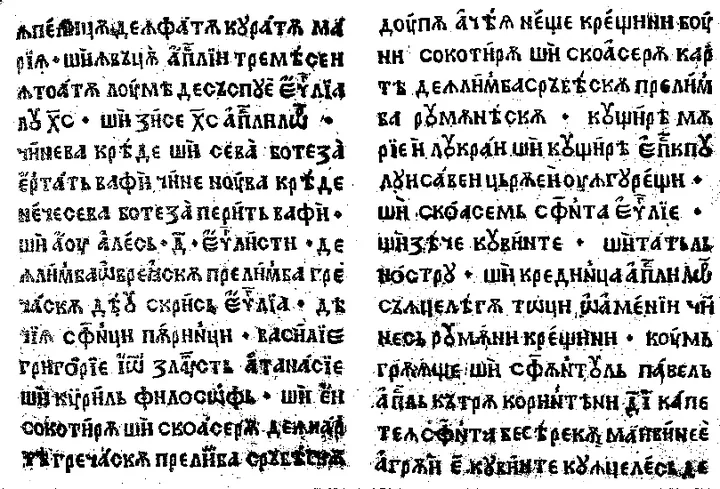
It is not the first Romanian book. That honour belongs to a lost book: the Sibiu Catechism of 1544, entered in the town protocols under Magister Philippus Pictor and never seen since. Coresi's own Question, the Întrebare creștinească of 11 thin leaves, 1559 by the old bibliography and 1560 by the new, is the oldest Romanian printing you can still open.

.png)
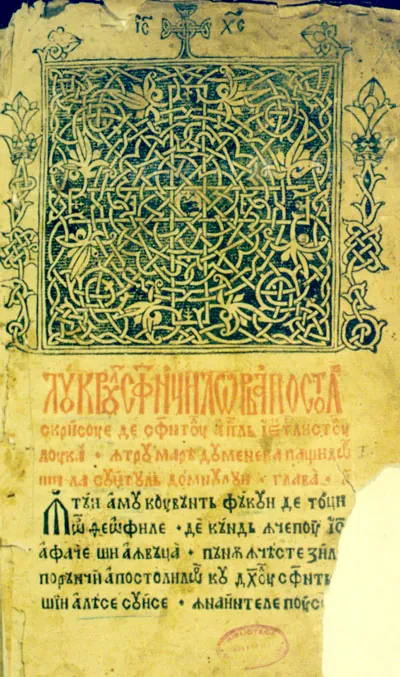
The shelf fills through the 1560s: the Apostol of 1563, 308 leaves; the Gloss on the Gospels with its prayer book, 1564, ordered in Romanian by the Hungarian nobleman Forró Miklós; each signed, dated, and argued over ever since. Benkner dies in 1565; after 1569 Coresi prints at his own choice, a printer turned publisher.
Then 1570, the pair: the Psalter and the Missal, both in Romanian, both done by 1 September, the Missal set between 1 June and 15 July. The prince himself takes “un livret”; the priests are summoned to Cluj for 18 January 1571 to buy it at 32 deniers, against the Psalter's florin. One copy of the Missal survives, found in the Șchei church, kept at Sibiu since 1953.
The Psalter's preface states the whole program in a single breath: seeing that nearly every tongue has God's word in its own language, and the Romanians have it not, “numai noi Rumânii n'avămu”, he wrote them these Psalters. Print it side by side with the Slavonic, as the 1577 Psalter does, and no priest can call the Romanian book heretical.
“Cu mila lu Dumnezeu eu diaconu Coresi, déca văzuiu că mai toate limbile au cuvântulu lu Dumnezeu în limba lor, numai noi Rumânii n'avămu...”
Preface of the 1570 Psalter, BRV I, 16, via CIMEC
Meanwhile: Meanwhile: at Zabludov, in 1569, the homiliary comes off the press that will model his own of 1581.
Chapter III
The shelves
1577 – 1583 · what survives, and where
- Years
- 1577 – 1583
- Road on the map
- 300 kmgreat-circle, rounded
- Signature book
- The Sebeș Sbornic (1580)
In 1580 the press travels: at Sebeș, by order of Metropolitan Ghenadie of Transylvania, Coresi the deacon sets the bulkiest book of his life, the Sbornic, 467 leaves in folio, woodcuts and all. No thicker Coresi book exists; four copies are recorded, two at the Academy, one at the National Library, one at the Brukenthal.
Home at Brașov, the judge Lucas Hirscher pays for the last great Romanian book: the Teaching Gospel of 1581, 317 leaves in folio, translated with the priests Iane and Mihai of St Nicholas in Șchei from the Slavonic copy Hirscher had begged from Metropolitan Serafim. Nine copies are recorded, the best kept of all his books.
The last dated book is a Slavonic Gospel Book of 1583, set with Mănăilă; no copy is recorded at home, only a defective one at Hilandar, on Mount Athos. The deacon dies at Brașov the same year.
What remains can be counted, and the count is honest only if it says what it counts: the figures below are copies described in the collective catalogue around 2000, 60 in the catalogue of the books, not every survival, and never the print runs, which no source records. Open the shelves:
“Din porunca prea sfinţitului mitropolit al Ardealului Kir Ghenadie, m'am ostenit cu acéstă scriere eu păcătosul şi ticălosul ce me numesc între omeni Coresi diaconul.”
Colophon of the 1580 Sbornic, BRV I, 28, via CIMEC
The shelves today: libraries and shelfmarks
In short: most copies sit in Bucharest, at the Academy; the rest spans Sibiu, Iași, Arad, Brașov and Cluj, with outliers in London, Sofia, Athos, Petersburg and Krušedol.
- Bucharest, Library of the Romanian Academy, the Gospels and the Acts: 1561 (inv. 40–43), 1562 (inv. 46), 1563 (inv. 49–52), 1579 (inv. 89).
- Bucharest, Library of the Academy, the exposition and the chant: Tâlc 1564 (inv. 53–56), Octoechos II 1575 (inv. 72–74), Psalters 1577–78 (inv. 77–78, 83–84), Triodion 1578 (inv. 85–87).
- Bucharest, Library of the Academy, the first and the last Romanian leaves: Octoechos 1557 (inv. 38), Întrebare 1559 (inv. 44), Pravila (inv. 65), Psalter 1570 (inv. 67), Sbornic 1580 (inv. 96–97), Homiliary 1581 (inv. 99–103).
- Bucharest, National Library: Gospel Book 1579 (inv. 642795), Sbornic 1580 (inv. 164580), Triodion 1578 (inv. 763512), Homiliary 1581 (inv. 178010).
- Sibiu: Metropolitan Library, Gospels 1561 (IV/1) and Missal 1570 (II/9); Brukenthal Museum, Sbornic 1580 (inv. 199975).
- Iași: University Library, Homiliary 1581 (RV717); Museum of Romanian Literature, Psalter 1577 (inv. 4862) and Triodion 1578 (inv. 5858).
- Arad, Diocesan Library: Tâlc 1564 (A1, 01). Cluj-Napoca, University Library: the 1561 Gospels, no shelfmark published.
- Brașov-Șchei, St Nicholas church museum: Sbornic 1568 (inv. 82), Octoechos I–II 1574–75 (inv. 83–84), Homiliary 1581 (inv. 86), Psalter 1577 (inv. 126).
- Abroad: London (SSEES, the 1562 Gospel Book); Sofia (Sbornic I, the unique copy); Mount Athos, Hilandar (Octoechos II 1575, Psalter 1577, the defective 1583); Petersburg (a fragment of the 1580 book); Krušedol (Psalter 1577).
Meanwhile: Meanwhile: at Orăștie, in 1582, the Palia appears, five recorded copies of another Romanian Old Testament, from another press.
The compositor's bench
Four lines from his own prefaces and colophons, each with one word missing. Set them right, as the apprentices did.
The bench, Brașov, ink still wet
-
1
Brașov, 1561
The colophon of the Four Gospels names who wrote it, and at whose word. Fill the name: “...scris-amu eu ___ ot Trăgovişte şi Tudor diiacu.”
The documented line
“Și cu zisa jupânului Haneşă Bégneru, scris-amu eu diaconu Coresi ot Trăgovişte şi Tudor diiacu.” Oprea had stood beside him for the 1557 Octoechos; the Gospels he signs with Tudor.
-
2
Brașov, 1570
The preface of the Psalter states the whole program in one line. Fill the word: “...numai noi ___ n'avămu.”
The documented line
“...mai toate limbile au cuvântulu lu Dumnezeu în limba lor, numai noi Rumânii n'avămu.” Not the Christians: the Romanians. The lack is a people's, and the book answers it.
-
3
Brașov?, 1578
The Triodion's colophon counts the hands that set it. Fill the number: “...am scris aceste cărţi cu ___ ucenici...”
The documented line
Five: “cu 5 ucenici”. Ten had worked the Târgoviște press twenty years earlier; by 1578 the shop runs leaner, and says so.
-
4
Brașov, 1557
The Octoechos epilogue dates the run precisely. The books were begun in June, on which day? “S-au început ... în luna lui iunie în ___ zile.”
The documented line
The 12th, and finished “în luna lui ianuarie 14 zile”. Seven months under the press for the first book: begun 12 June 1557, done 14 January 1558.
The verdict
No lines set yet.
The books, title by title
Twenty-two prints described in the collective catalogue, each with its BRV number, its leaves and its recorded copies. Start with three: the Gospels of 1561, the Psalter of 1570, the Homiliary of 1581.
The Four Gospels
The first Romanian Gospels in print: 246 leaves, signed with Tudor, at Benkner's word.
The Psalter
The book whose preface states the program: “numai noi Rumânii n'avămu”.
The Teaching Gospel (Homiliary II)
The last and greatest Romanian book: 317 leaves, paid for by Hirscher, translated with the Șchei priests.
| Book | Year | BRV | Leaves | Recorded |
|---|---|---|---|---|
| The Little Octoechos | 1557 | BRV IV, 3 | 164 | 1 |
| The Christian Question | 1559* | BRV IV, 4 | 11 | 1 |
| The Four Gospels | 1561 | BRV I, 10 | 246 | 5 |
| The Slavonic Gospel Book | 1562 | BRV I, 11 | 240 | 2 |
| The Apostol | 1563 | BRV I, 12 | 308 | 4 |
| Gloss on the Gospels + Euchologion | 1564 | BRV I, 13 | – | 3 |
| The Psalter (1568) | 1568 | BRV I, 14 | – | 0 |
| The Sbornic, part II | 1568 | BRV I, 15 | 222 | 3 |
| The Psalter | 1570 | BRV I, 16 | 204 | 1 |
| The Missal | 1570 | BRV IV, 9 | 42 | 1 |
| Nomocanon of the Holy Fathers | 1570–1580 | BRV IV, 10 | 12 | 1 |
| The Octoechos, part I | 1574 | BRV I, 17 | 216 | 1 |
| The Octoechos, part II | 1575 | BRV I, 18 | 198 | 6 |
| The Slavonic Psalter | 1577 | BRV I, 20 | 170 | 5 |
| The Slavonic-Romanian Psalter | 1577 | BRV I, 19 | 316 | 2 |
| The Triodion | 1578 | BRV I, 21 | 291 | 5 |
| The Little Octoechos (1578) | 1578 | BRV I, 22 | 204 | 2 |
| Psalter in Slavonic and Romanian | 1578 | BRV IV, 14 | 323 | 2 |
| The Slavonic Gospel Book (1579) | 1579 | BRV I, 23 | 208 | 2 |
| The Sebeș Sbornic | 1580 | BRV I, 28 | 467 | 4 |
| The Teaching Gospel (Homiliary II) | 1581 | BRV I, 29 | 317 | 9 |
| The Slavonic Gospel Book (1583) | 1583 | BRV I, 31 | 205 | 0 |
The Târgoviște Triodion-Pentecostarion of 1558 and the Slavonic Missal of 1568–70 are not described in the collective catalogue and stand outside this table.
The press in numbers
Six numbers hold the shop together.
467
leaves in the Sebeș Sbornic, the thickest
The thickest and the thinnest of his books, both counted leaf by leaf in the collective catalogue: 934 pages against 22.
- 26
- years of printing, 1557–1583
- ≈35
- titles issued, about
- 25
- prints survive to this day
- 60
- copies recorded in the collective catalogue
- 467
- leaves in the Sebeș Sbornic, the thickest
- 32
- deniers for the 1570 Missal, the Psalter cost one florin
What didn't happen
He printed the first Romanian book.
The first Romanian book was the 1544 Sibiu Catechism of Filip Moldoveanul, attested in the town protocols but lost. Coresi's are the oldest fuller Romanian writings to survive: that is the precise first.
The print runs are known.
No run figure survives for any Coresi title. What survives is counted copy by copy: 9 for the 1581 Homiliary, 5 for the 1561 Gospels, down to none for the 1568 Psalter, known only from an 1875 glossary.
He worked alone, for one church.
His colophons name Oprea, Tudor and Mănăilă beside five to ten apprentices; his patrons run from Saxon Lutherans to a Calvinist nobleman to Wallachian voivodes and Orthodox metropolitans. The shop served whoever paid for books.
Sources and method
Every date and figure on this page is checked against at least one open source, cited below; counts say “recorded” where the catalogue, not the world, was counted.
Distances measure great-circle arcs between the documented towns and round to the hundred: the order of magnitude, not the road. Catalogue years with a star are disputed between authorities.
Quotations in old Romanian keep the spelling of the cited catalogue entry; translations are the editors'.
The press
- CIMEC, Collective catalogue of old Romanian books: the Little Octoechos (Brașov, 1557), BRV IV, 3, [164] leaves, with Oprea the logothete
- Fr. Vasile Oltean, “456 ani de la editarea primei cărți coresiene la Brașov”, Ziarul Lumina, 9 Feb 2013: the epilogue (12 June – 14 January, year 7065), Benkner's order, the Brașov paper, the 3 copies
- Eva Mârza, “Preliminarii la un repertoriu al tipografilor români 1508–1830”, Annales Universitatis Apulensis 8 (2004): Liubavić's type, the Târgoviște Triodion-Pentecostarion (1557–1558, 10 apprentices), Benkner and Hirscher, the paper mill
- Fr. Bogdan Dedu, “Primul mare tipograf în slujba limbii române”, Ziarul Lumina, 28 June 2008: the Macarie – Liubavić – Filip Moldoveanul – Coresi line; why Brașov
The books
- CIMEC: the Romanian Gospel Book (Brașov, 1561), BRV I, 10, [246] leaves: the colophon “cu zisa jupânului Haneşă Bégneru, scris-amu eu diaconu Coresi ot Trăgovişte şi Tudor diiacu”
- CIMEC: the Romanian Psalter (Brașov, 1570), BRV I, 16, [204] leaves: the preface “numai noi Rumânii n'avămu”
- Fr. Lucian Petroaia, “440 années de l'impression du missel de Coresi – Brașov, 1570”, Danubius XXVIII (2010): the 1570 pair (1 June – 15 July, 1 September), 32 deniers against 1 florin, the Cluj summons (18 Jan 1571), the 25 surviving prints
- Eva Mârza (2004): the Forró Miklós commission (1564), Benkner's death (1565), the printer-publisher after 1569
The shelves
- CIMEC: the Slavonic Sbornic (Sas-Sebeș, 1580), BRV I, 28, [467] leaves: “din porunca ... mitropolitului Ardealului Kir Ghenadie”
- CIMEC: the Teaching Gospel (Brașov, 1581), BRV I, 29, [317] leaves, 9 recorded copies
- Fr. Bogdan Dedu (2008): the Homiliary at Lucas Hirscher's expense, with the priests Iane and Mihai of Șchei; the Slavonic original from Metropolitan Serafim; the 1569 Zabludov model
- CIMEC: the Slavonic Gospel Book (1583), BRV I, 31: “un exemplar defectuos ... la mănăstirea Hilandar”; holders with shelfmarks under every title
- Wikipedia, Central University Library of Cluj-Napoca: “the set of Gospels printed by Deacon Coresi at Brașov in 1561” (after the library's site)
The game
- CIMEC, the 1561 Gospel Book colophon (BRV I, 10): “scris-amu eu diaconu Coresi ot Trăgovişte şi Tudor diiacu”
- CIMEC, the 1570 Psalter preface (BRV I, 16): “numai noi Rumânii n'avămu”
- CIMEC, the 1578 Triodion (BRV I, 21): “am scris aceste cărţi cu 5 ucenici”: against the 10 at Târgoviște (Mârza 2004)
- Fr. Vasile Oltean (2013), the 1557 Octoechos epilogue: “S-au început ... în luna lui iunie în 12 zile; s-au sfârşit în luna lui ianuarie 14 zile”
The catalogue
- CIMEC, Collective catalogue of old Romanian books, 16th century: the descriptions with BRV, leaves and holders
- Ioan Bianu, Nerva Hodoș, Dan Simonescu, Bibliografia românească veche 1508–1830, I–IV, Bucharest, 1903–1944 (the BRV number under every title)
- Eva Mârza (2004): the print list with parallel datings (the Question 1559, the Apostol 1563/1565); BRV I, 25 “indicat greşit drept tipăritura lui Coresi de la 1580”
Images
- A page of the Romanian Apostol, 1563 · Wikimedia Commons
- First pages of the 1559 Catechism, after Crăciun 1945–46 · Wikimedia Commons