Alba Iulia · 15 October 1922
The crown cast from a cannon
An Ottoman gun captured at Plevna becomes the Steel Crown of Romania: blessed in 1881, crowned at Alba Iulia in 1922, guarded in the treasury today. One metal, two lives.
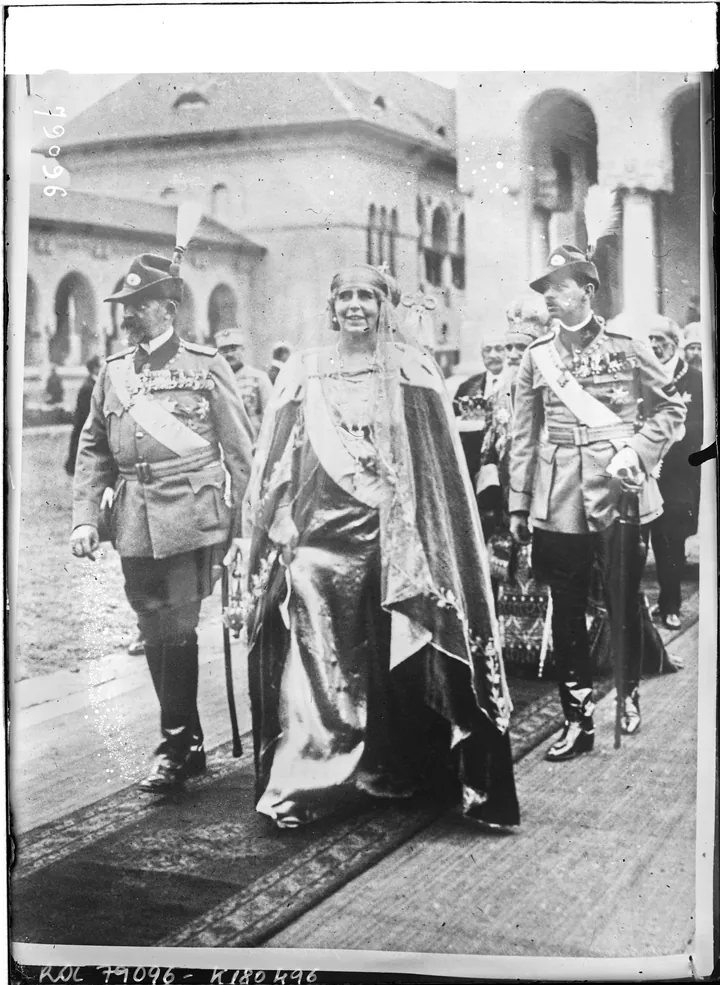
One metal, two lives
One metal, two lives
Six stations, one metal, two lives: from an Ottoman gun line at Plevna to the crown on the national arms. Step through them in order, or read them all below.
-
1 / 6
Plevna: the gun
Romanian troops capture an Ottoman 90 mm gun at Plevna. The gun will keep its inscription and its place in the museum; its muzzle is destined for the crown.
-
2 / 6
Bucharest: the forging
The Arsenal cuts the gun down to its muzzle and forges a 1,115-gram crown after Aman's sketch. Carol I chooses steel over gold and is crowned on 10 May 1881.
-
3 / 6
Alba Iulia: the coronation
Ferdinand crowns himself with the 1881 crown in the cathedral courtyard, then crowns the kneeling Marie. The steel of Plevna becomes the crown of Greater Romania.
-
4 / 6
Bucharest: the anointing
Michael I is crowned and anointed with the same steel crown in the Patriarchal Cathedral in Bucharest.
-
5 / 6
Bucharest: the treasury
The crown enters the Historical Treasury of the National Museum of Romanian History, inaugurated in 1972, where it can be seen today.
-
6 / 6
Everywhere: the arms
Law 146/2016 puts the Steel Crown back on the eagle's head in the national arms, where it had stood from 1881 to 1947.
Every station below is sourced in the chapters that follow it.
Chapter I
The cannon
1877–1878 · a gun is taken at Plevna
- Chapter
- 1877–1878
- Captured
- 28 November 1877
- Calibre
- 90 mm
- Forged into
- the crown's muzzle-steel
In the autumn of 1877 the Romanian Army stood before Plevna, besieging Osman Pasha's fortress alongside the Russians. When the fortress fell, its guns became trophies, and one Ottoman 90 mm gun was set aside for a fate no gun had ever had.
The gun itself was never melted down whole. The Arsenal kept it, inscribed, as a relic: taken by the Romanian host at Plevna on 28 November 1877 (Old Style), it records that from it was worked the steel crown of King Carol I, 10 May 1881. Only its muzzle, the zburătura, the front part of the barrel, went into the crown.
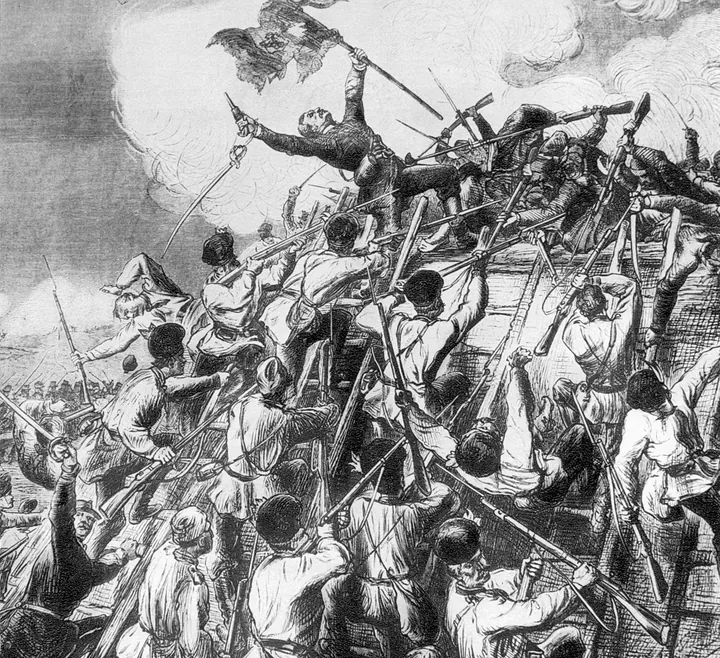
That is the whole trick of this object: a weapon of a defeated empire, cut down and reforged into the symbol of the sovereignty won against it. Carol I would later say he chose steel, not gold, to honour the bravery of the soldiers who had taken it.
The siege itself belongs to our Plevna page; here the gun's second life begins. What the Arsenal's craftsmen did with one gun-muzzle in the spring of 1881 is the next chapter.
From this gun, taken by the Romanian host at Plevna on 28 November 1877, was worked in the Arsenal the steel crown of the King of Romania Carol I, 10 May 1881.
Inscription on the Plevna gun (Romanian original quoted in the method note)
Meanwhile, at Plevna, Osman Pasha surrenders on 28 November 1877 Old Style, 10 December by the modern calendar.
Chapter II
The crown
1881 · the Arsenal forges the steel
- Chapter
- 1881
- Blessed
- 10 May 1881
- Weight
- 1,115 grams
- Fleurons
- 8, all steel
The commission moved fast. On 11 April 1881 the prime minister, Dimitrie Brătianu, tasked the minister of culture, V. A. Urechia, with settling the form of the crown; two days later the scholars Alexandru Odobescu, Bogdan Petriceicu Hașdeu and Grigore Tocilescu agreed it should follow the medieval crowns of Mircea the Elder and Alexander the Good.
The painter Theodor Aman drew the design in ink, crown and sceptre on one plate, 45 by 27.5 centimetres, kept today at the Theodor Aman Museum. Then the pupils and soldier-craftsmen of the Army Arsenal cut the Plevna gun down to its muzzle, the so-called zburătura, and forged the crown. They made three near-identical models; the king's is the finished one.
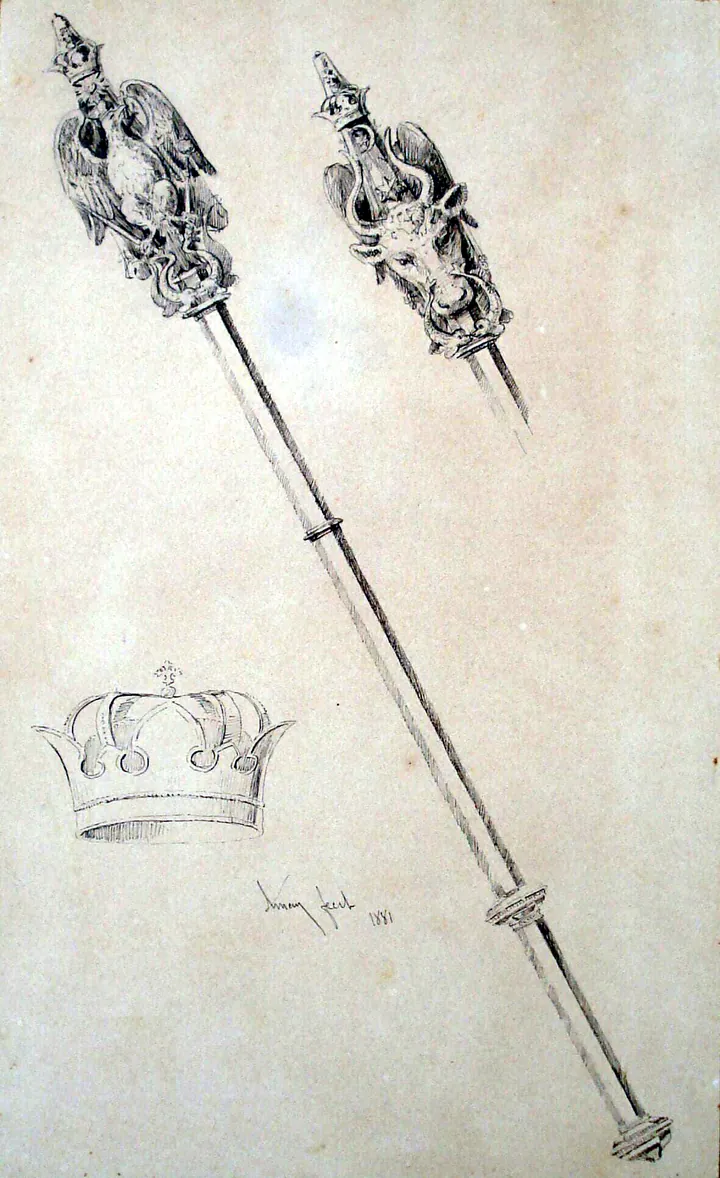
Carol I came back from Sinaia on 3/15 May and found the crown on his desk at Cotroceni Palace. A week later, on 10 May 1881, it was blessed at the Metropolitan Church in Bucharest and placed on his head as Romania was proclaimed a kingdom.
The finished piece weighs 1,115 grams: a frontal circle with 8 fleurons and 8 pearls, every gem-model stylised in steel, the fleurons joined at the top by the “Danube Crossing” cross, the inside lined with red velvet.
It consists of a circle from which rise eight hemispheres holding the royal globe with the “Danube Crossing” cross. Inside it is lined with red velvet, against which the shining steel stands out beautifully.
Carol I, memoirs, on finding the crown at Cotroceni
Meanwhile, in Bucharest, the gold crown above the royal mantle is replaced by the Steel Crown on 14/26 March 1881, months before the coronation.
Chapter III
The coronation
1922 · Alba Iulia crowns Greater Romania
- Chapter
- 1922
- Coronation
- 15 October 1922
- Ceremonies
- 15–17 October
- Salutes
- 101 cannon shots
The ceremonies ran 15–17 October 1922: the coronation itself at Alba Iulia on the 15th, the festivities in Bucharest after. The decision had gone out to the authorities on 20 September 1922, and the Coronation Cathedral, raised in 1921–1922 for exactly this purpose, was consecrated that September.
The crowns travelled first. On 14 October 1922 Ion I. C. Brătianu brought them to Alba Iulia: the king's simple crown of 1877 Plevna-cannon metal on a yellow velvet cushion, and the queen's gold Byzantine-style diadem, made in Paris by the jeweller Falize.
The service was sung by Metropolitan Nicolae Bălan of Transylvania, with the Te Deum of Metropolitan-Primate Miron Cristea. But the crowning happened in the cathedral courtyard, not inside: Ferdinand, a Catholic, would not be crowned by an Orthodox hierarch, so he placed the steel crown on his own head and then crowned Marie, who knelt before him.
Across the country every church sang a Te Deum, and 101 cannon shots announced the coronation in each county capital. Then the sovereigns rode at the head of their regiments in the military parade, the steel gun of Plevna, saluting in gunfire, saluted back in steel.
The service was beautiful, solemn, not too long, the choir excellent. The inside of the church, though not large, is imposing, and the frescoes are good.
Queen Marie, diary note on the coronation service
Meanwhile, in Bucharest, the capital is decked with flags for the 16–17 October festivities and the royal entry.
Chapter IV
The vault
1940–2016 · from the throne to the treasury
- Chapter
- 1940–2016
- Anointing
- 6 September 1940
- Museum since
- 1972
- Arms restored
- 2016
The crown's third wearing came on 6 September 1940, the very day of his second accession, when Michael I was crowned and anointed with it by Patriarch Nicodim Munteanu in the Patriarchal Cathedral in Bucharest.
After the monarchy fell, the crown passed into state custody. Since the inauguration of the National Museum of Romanian History in 1972 it has stood in the Historical Treasury in Bucharest, among more than 3,000 pieces of precious metal and stone; a faithful copy is kept at Peleș.
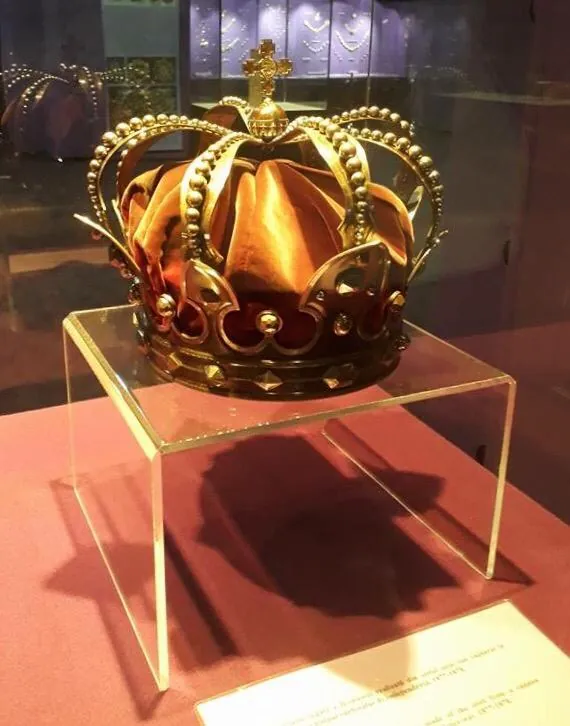
In heraldry the crown never really left. It replaced the gold crown in the arms on 14/26 March 1881 and stayed through the 1921 great arms of Greater Romania, voted that July. The communist arms dropped it; Law 146/2016, published in the Official Gazette on 19 July 2016, put it back on the eagle's head.
And the steel travelled further still: when Carol I instituted the Order of the Crown at the proclamation of the Kingdom, its founding regulation required the order's small central crown to be made from the steel of the same Plevna gun.
Law amending Law no. 102/1992 on the country's coat of arms and the state seal, the crown returns to the eagle's head.
Law 146/2016, Official Gazette no. 542, 19 July 2016
Meanwhile, in Bucharest, the order's jewellers keep striking the small steel crown for every new Order of the Crown.
Cast the crown
Four decisions stand between the gun and the throne. Choose as the 1881 commission chose, then defend the choice as the court demanded.
-
1
The metal
April 1881. Romania is about to become a kingdom and needs a crown. The commission asks you: which metal?
The court's verdict
Carol I chose steel, the bravery of the Romanian soldiers cast into the crown of 10 May 1881.
-
2
The model
The metal is settled. Now the form: what should the first crown of the kingdom look like?
The court's verdict
The commission fixed the Assanid form, Mircea's and Alexander's crowns as the model for Aman's sketch.
-
3
The grey crown
The court objects: a steel crown looks grey next to the gold crowns of Europe. How do you defend the choice?
The court's verdict
The crown stayed all steel, even its “gems” are steel. The glitter argument lost to the Plevna argument.
-
4
The gesture
15 October 1922, Alba Iulia. The cathedral is consecrated, the crown is blessed, but who places it on the king's head?
The court's verdict
Ferdinand placed the crown on his own head, then crowned the kneeling Marie. The courtyard, not the altar.
No decision yet, the steel waits.
The crown in numbers
Six figures, each transcribed from the sources and each re-checked against this page.
- 1,877
- an Ottoman 90 mm gun is captured at Plevna
- 1,881
- Carol I is crowned with the new steel crown at Bucharest
- 1,115
- grams of Plevna gun-steel on the king's head
- 8
- steel fleurons ring the crown, joined by the Danube-crossing cross
- 1,922
- Alba Iulia crowns Ferdinand and Marie with the 1881 steel crown
- 101
- cannon shots announce the 1922 coronation in each county capital
Four things the crown is not
It is made of gold
It is not. The crown weighs 1,115 grams of steel; even the gem-models and the pearls are stylised steel, and the only soft thing about it is the red velvet lining. Gold belongs to the queen's diadem, made in Paris.
The whole cannon was melted down
It was not. Only the muzzle, the zburătura, the front part of the barrel, went into the crown. The gun itself survives, inscribed, and passed from the Arsenal Museum to the National Military Museum.
Three gemstones were added in 1922 for the provinces
Undocumented. One secondary account claims three precious stones for Bessarabia, Bukovina and Transylvania, but every documented description of the crown is all steel, and no verified source confirms the addition. The page does not state it.
The Metropolitan crowned Ferdinand
He did not. Ferdinand was Catholic, so the crowning happened in the cathedral courtyard: the king placed the steel crown on his own head, then crowned Queen Marie, who knelt before him. The hierarchs sang the service; the gesture was the king's.
Sources and method
Every date and number on this page is transcribed from the sources below and re-checked by scripts/check.py against the built HTML. Quotations are given in English with the source named; the cannon's inscription is translated from the Romanian original recorded in the method note of the Romanian edition.
Two claims stay open on purpose: the gun's maker, given as F. Wöhlert of Berlin in one secondary source and Krupp in another, and the story of three gemstones added in 1922, which contradicts the documented all-steel construction. Both are examined in the myths section, not smoothed over.
The cannon
The crown
- The 11–13 April 1881 commission (Brătianu, Urechia, Odobescu, Hașdeu, Tocilescu); the form after Mircea the Elder and Alexander the Good; Theodor Aman's ink sketch
- The blessing at the Metropolitan Church in Bucharest, 10 May 1881; 8 fleurons and 8 pearls, jewels stylised in steel, the 'Danube Crossing' cross; 1,115 grams; red velvet lining
- Carol I chose steel, not gold, as a symbol of the bravery of the Romanian soldiers; the crown and sceptre designs by Theodor Aman, made at the Army Arsenal
The coronation
- The 15–17 October 1922 festivities, on the 15th at Alba Iulia and the rest at Bucharest; the decision communicated on 20 September 1922
- The crowns brought to Alba Iulia on 14 October 1922 by Ion I. C. Brătianu; the king's simple crown, of Plevna-cannon metal, on a yellow velvet cushion
- Metropolitan Nicolae Bălan's service, Metropolitan-Primate Miron Cristea's Te Deum; Queen Marie's diary note; the mounted military parade
- 101 cannon shots announced the coronation in the county capitals; Te Deums in every church in the country
The vault
- Michael I, crowned and anointed with the same crown by Patriarch Nicodim Munteanu in the Patriarchal Cathedral in Bucharest, 6 September 1940
- The gold crown in the arms, replaced by the Steel Crown on 14/26 March 1881; kept in the 1921 great arms; restored by Law 146/2016
- Today in the Historical Treasury of the National Museum of Romanian History; a faithful copy at Peleș; the Order of the Crown's small crown, of the same cannon's steel
The four plates
- Carol Szathmari, 1877 · Public domain · Wikimedia Commons
- Theodor Aman, d. 1891 · Public domain · Wikimedia Commons
- BnF, Agence Rol press photo, 1922 · Public domain · Wikimedia Commons
- Photo: CommonsRomaniaRa, 2016 · CC BY-SA 4.0 · Wikimedia Commons


_-_btv1b530960093.jpg)
